Uncategorized Archive
There’s when things end and then there’s when we physically leave, and the two rarely coincide. Sometimes it takes six months, a year, or even longer for our body to catch up with our brain.
Knowing when to leave a job, a relationship, and even a party is a skill. If you’re unhappy at work, have asked for what you want, and know you can’t it where you are, develop an exit strategy and act on it quickly.
When you’re checked out, people know. Unhappiness shows up in our performance, attitude, and body language. And quitting and staying is bad for your career, reputation, and business relationships.
If you’re unhappy at work and are ready to make a change, there are a few actions you should take to keep your reputation intact while you make a transition:
- Make sure you’ve fully investigated your options at your current place of work before deciding to move on. Share your desires in a positive way, with people who can help you get what you want. Saying, “I’d really like to do _________, or I’d really like to work in the ______ department” will get you much further than saying, “I’m underutilized, undercompensated, and unappreciated.”
- Do your job and do it well. Don’t go missing in action.
- Only commit to things you know you can and will do, and keep your commitments.
- Confide in people about your unhappiness and future plans who are outside your current place of work. People talk. Assume anything you tell someone at work will be told to someone else.
- Take at least one action every day towards getting what you want. It can be easy to get into a rut when job hunting. Stay in action.
If you’re unhappy at work, it’s probably time for a change – either within or outside your company. Ask for what you want in a positive way. Do a great job on a daily basis, regardless of how you feel. Confide in people outside of your workplace. And take one action every day towards getting what you want.
Know when to go.

At the end of presentations, attendees often approach me and say something like, “People tell me my communication style is really direct and that it can be off putting. I don’t know what to do about this.” Or they say, “People say I’m really quiet and hard to read. They have a difficult time getting to know me.” 
If you’ve been given the same feedback repeatedly, or know you create a first impression that may be challenging to others, set expectations and tell people about your communication style when you begin working with them. Don’t wait until they feel offended, confused, or frustrated. Simply tell people when you meet them, “I’ve been told that I’m too direct and how I provide feedback can be off putting. Anything I say is to be helpful. If I ever offend you or provide too much information, I hope you’ll tell me.” Or you could say something like, “I’m told that I’m quiet and it’s hard to get to know me. I’m more open than I may appear. If you want to know anything about me, feel free to ask.”
People will make decisions about and judge you. There is nothing you can do about this. But you can practice what I call, ‘get there first.’ Set people’s expectations about your communication style and what you’re like to work with, and then ask people to speak freely when they aren’t getting something they need.
The root of frustration and upset is violated expectations. People may not be aware of their expectations of you or be able to articulate them, but if they didn’t have certain expectations, they wouldn’t be upset when you acted differently than how they (possibly unconsciously) expected.
I’m a proponent of anticipating challenges and talking about them before problems arise. If you know something about your behavior is off putting to others, why not be upfront about it.
When people interview to work for me, I set clear expectations about my communication style and what I’m like to work with. I tell them all the things I think they’ll like about working for me and all the things I suspect they won’t. I tell them the feedback I’ve received from past employees and things I’m working alter. People often nod their heads and say, “no problem,” which, of course, may not be true. They won’t know how my style will impact them until they begin working with me. But when I do the things I warned them would likely be annoying, we can more easily talk about those behaviors, than if I had said nothing.
Talk about your communication style when projects and relationships begin. Replace judgment and damaged relationships with dialogue.

People are too afraid to tell the truth at work. We’re afraid that if we give honest performance feedback, people will get upset. They will. We’re afraid that if we say what we think, we’ll get marginalized, put in a corner, never to be given cool work again. That’s unlikely.
We tiptoe around the people we work with, afraid to hurt people’s feelings and rock the boat. This doesn’t work. Without honesty in the workplace, performance won’t improve and problems won’t get solved.
Here are five ways to increase honesty in the workplace:
Increase honesty in the workplace tip #1: Overtly tell employees that it’s acceptable, safe, and expected that they will make mistakes. If people are afraid to make mistakes, they’ll never risk trying anything new.
Create an award for the person who failed while trying to do something new. And present the award very publicly, sending the message that it’s ok to fail.
Increase honesty in the workplace tip #2: Set the expectation when you hire and onboard new employees that they will receive regular and balanced (positive and negative) performance feedback. Tell candidates and new employees that giving and receiving honest feedback is part of your organization’s values and culture, and if employees don’t want to give and receive this type of feedback, they shouldn’t work for your company.
When you interview employees, ask about a time they received negative feedback and what they did with that information. People who can’t answer this question aren’t self-aware or open to feedback. Don’t hire them.
Increase honesty in the workplace tip #3: Create safe places and occasions to give regular feedback. Ensure managers and employees meet one-on-one at least monthly to discuss performance. Give teams a chance to openly talk about how projects are going. Debrief significant projects and pieces of work by asking what did and didn’t work. And ensure managers are asking for employees’ feedback on what the manager can do differently to make work an easier place to be. Feedback goes both ways – up and down. Managers earn the right to give feedback when they’re open to receiving it.
While you’re going to ask for feedback, it doesn’t mean that you’re a dumping ground. It’s perfectly ok to tell employees what you want feedback about and what you don’t. If you made a decision and aren’t looking for input, don’t ask for input on that subject. If you receive unsolicited and unwelcomed feedback, say “no thank you.” A feedback-rich culture doesn’t mean you accept feedback on every topic all the time. It’s ok to set boundaries.
Increase honesty in the workplace tip #4: Don’t be daunted by people’s negative reaction to feedback. No one likes to be told s/he is wrong and no one wants his/her competence called into question, as a result, becoming defensive when receiving negative feedback is normal and natural. Not becoming defensive is not the norm. People might tell you you’re wrong, turn red, cry, yell, or go silent and pretend you don’t exist for a period of weeks. But everyone will survive. Try not to hire people who won’t talk to you for weeks after receiving feedback. Those folks need to grow up.
Increase honesty in the workplace tip #5: Remind people over and over and over that honest feedback is what allows employees and organizations to grow, evolve, and thrive. Not telling the truth creates stagnation and will ultimately lead to individual and organizational failure. The more you give and receive feedback, the more comfortable employees will be with the process.
Periodically give yourself a pep talk about being honest with your employees. Letting someone linger in a job in which s/he cannot be successful is not kind, it’s cruel. To talk about people when they’re not present, versus giving candid feedback directly, is also unkind.
We all need to man or woman up. Tell employees that everyone in the organization is expected to tell the truth and to do so directly, kindly, and tactfully. Likewise, everyone is expected to be open to receiving feedback graciously. Over time people will become more comfortable speaking up and receiving all types of input. And if you want a feedback-rich culture, the people who can’t or won’t speak candidly, aren’t the right fit for your organization.


I read a quote a few months ago that struck me – “It’s so hard to change yourself, what makes you think you can change someone else?” This seems so true. And yet, how much energy do we invest trying or at least hoping other people will change? We want our not-so-forthcoming managers to give regular and helpful feedback, our homebody selves to enjoy crowds and large parties, our not-so-affectionate partner to become a cuddler.
People are who and (largely) how they are. Even with lots of effort, coaching, and even counseling, it’s hard to change.
As someone who leads a training and development company, it feels risky to write this. I’m concerned that my words will be misunderstood. So I want to be sure I’m clear. People can learn new skills. Managers can learn to coach and give feedback. People at all levels and in all roles can learn to communicate differently. Everyone can learn to use new technology. But we don’t fundamentally change who and how we are. People who hate to public speak aren’t likely to wake up tomorrow clambering to give presentations to a thousand people. People who don’t like crowds aren’t likely to want to spend every weekend at large sporting events.
What I’m really trying to say is, stop trying to get something from someone who can’t give it to you. If you work for someone who never provides feedback, no matter how often you ask, get input from someone else. Lots of people can provide you with helpful information if you ask for it and make it safe to tell you the truth. If you partner or best friend isn’t social, ask someone else to go to events with you. If you’re chastising yourself for not being more athletic, accept that you like to read, and buy yourself a new book.
Instead of trying to get something from someone who can’t give it to you, get what you can from that relationship and get the rest of your needs met elsewhere. And tell others to do the same. I had someone working for me a few years ago who was extremely sensitive and didn’t do well receiving feedback. I tried to accommodate her needs and preferences, softening my messages, picking my battles, and in the end, giving less and less feedback. And it was exhausting. Eventually I said to her, “I’m not the right manager for you and this is the not right company for you. It’s not a good fit. You won’t be happy here, and I want you to be happy. Let’s help you find another home.”
I’m not telling you to get a new job. I’m telling you to be realistic in your expectations of yourself and others. The most powerful thing you can do is to be yourself and let others be themselves. And if you don’t like how or who someone is, hang out with someone else.

Most of us wait to give negative feedback until it’s the right time, aka the recipient won’t get upset. Or we wait, hoping the situation will resolve itself. If something is really an issue, the likelihood of either happening is pretty slim. The right time to give feedback is shortly after something happens. I’ll offer up the 24-guideline and the one-week rule. Wait 24-hours to give feedback, if you’re upset. But don’t wait longer than a week.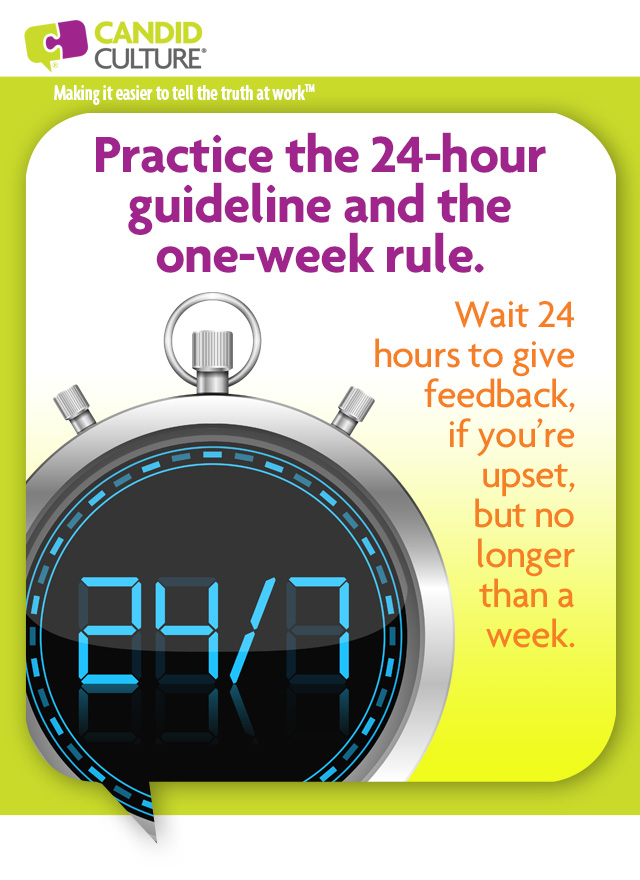
The purpose of giving positive or negative feedback (I like the words upgrade feedback) is to motivate someone to replicate or change a behavior. That’s it. Feedback is supposed to be helpful. If you wait longer than a week to give either positive or upgrade feedback, the person isn’t likely to remember the situation you’re referencing and the purpose of giving feedback – to change or replicate a behavior – will be lost.
Here are four practices to make negative (upgrade) feedback conversations shorter, less painful, and more useful:
Giving feedback practice one: Agree to give and receive feedback at the onset of relationships. Do this with everyone you work with – direct supervisors, direct reports, peers, internal and external customers, and vendors. If we’ve done How to Say Anything to Anyone training for your organization or you’ve read the book, you got the specific language to have this conversation.
Giving feedback practice two: Prepare for feedback conversations by writing down what you plan to say and then delivering the feedback to a neutral person. Ask that person to tell you what she heard and what her expectations would be, based on what you said. Confide in someone either at your level or above at work or someone outside of work, to keep the gossip to a minimum. Ask for confidentiality.
Giving feedback practice three: Tell a neutral person about your situation, and ask what she would say to address the situation. Everyone but you will do a better job at giving feedback. Feedback conversations become hard when we’re emotionally involved. The guy working at the 7-11 will do a better job than you. Seriously. It’s our emotions and concern about the other person’s reaction that makes feedback conversations challenging.
Giving feedback practice four: Agree to do a weekly debrief with the people you work closely with, and follow through. Answer the questions – what went well this week from a work perspective and what would we do differently if we could. Answer the same questions about your working relationship. Giving feedback about your relationship will be hard at first. It will be easier the more you do it. Be sure to say “thank you” for the feedback, regardless of what you really want to say. One of the reasons giving negative feedback is so hard, is we wait too long. Shorter, more frequent conversations are better than long, infrequent discussions.
Giving negative feedback doesn’t have to be so hard. Follow the suggestions above and remind yourself that the purpose of giving feedback is to be helpful. If you were doing the wrong work, you’d want to know. And others do too.

There is way too much guessing at work. You may find yourself thinking, “I’m going to miss this deadline. I wonder what the consequences will be?” Or perhaps, “She said she wanted input on this project. I wonder if she really meant that, and how much feedback is ok to provide?” Or maybe, “He asked for a proposal. Is he expecting something elaborate, or will a one-pager do?”
We often don’t know what others are expecting from us, so we guess. The problem with guessing is that we may do more work than we actually need to, and not in the way the other person wants it. Even worse, when we don’t work according to others’ expectations, they aren’t likely to tell us. Instead, they tell others and make decisions about us that aren’t positive.
I’m a fan of asking lots and lots of questions, preferably at the beginning of anything new. Anticipate all that can happen, get in front of breakdowns, and set clear expectations by asking questions. The people who participate in training with me get an entire box of questions to ask. And the homework is to go ask more questions of the people they work most closely with. Asking questions will always be easier than recovering from violated and often unstated expectations.
If you want fewer breakdowns and frustrations at work, ask the following questions of the people you work with:
Managing up question one: What do you want to do, on this project, and what do you want me to do?
Managing up question two: What does a good job look like?
Managing up question three: What will be different in the organization when this project is finished?
Managing up question four: How would I frustrate you and not even know it?
Managing up question five: How often do you want to receive updates from me?
Managing up question six: Do you want to receive all the details or just big picture information?
Managing up question seven: Do you want to receive the information in bullet form or paragraphs?
It’s never too late to ask questions like these. It’s ideal to ask the question at the beginning of a piece of work. But asking in the middle or even towards the end is fine too. People will appreciate that you asked, whenever you ask.
Ask more. Assume less. Suffering is optional at work.

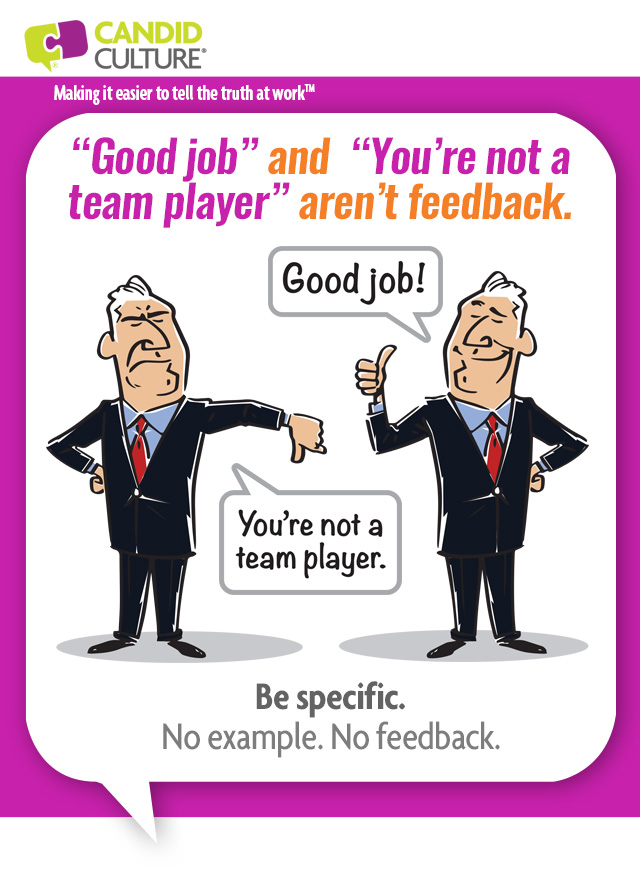
Want to know why people get defensive when you give feedback and why they often don’t change their behavior? Because what you’re giving them isn’t actually feedback.
“You’re awesome to work with” isn’t feedback. Neither is “You did a great job.” “Your work isn’t thorough” isn’t either. Neither is, “You were inappropriate.”
Most of what we consider feedback isn’t feedback at all. It’s vague, unhelpful language that leaves people wondering what they need to do more, better, or differently.
There are only two reasons to give feedback – to encourage someone to either change or replicate a behavior. Unfortunately, most of the ‘information’ we give is too vague to help people do either.
When you give coach or give feedback, you serve as someone’s GPS. Like the GPS on your phone, you need to be so specific the person knows precisely what to change or replicate. If you were driving and your GPS said, “Good job” or “I think you’re off track,” you’d throw the GPS out the window and get a map.
If you give someone what you consider feedback and he says, “I don’t know what you mean, can I have an example?” you’ll know you weren’t helpful.
Here are six tips for giving helpful feedback:
Giving feedback tip one: Write down what you plan to say, then strip out half the words. Shorter feedback with fewer words is better.
Giving feedback tip two: Practice what you plan to say out loud. Have you noticed that what you ‘practice’ in your head is typically not what comes out of your mouth?
Giving feedback tip three: Before having the ‘real’ conversations, give the feedback to an independent, third party and ask her to tell you what she heard. Ensure who you talk with will maintain confidentiality. Your organization doesn’t need more gossip.
Giving feedback tip four: Tell someone else about the conversation you need to have, and ask him what he would say. Anyone not emotionally involved in the situation will do a better job than you will. Again, ensure confidentiality.
Giving feedback tip five: Ask the feedback recipient what he heard you say. Asking, “Does that make sense?” is an ineffective question. “Do you have any questions?” isn’t any better.
Giving feedback tip six: Give one to three examples of what the person did or didn’t do, during the conversation. If you don’t have an example, you’re not ready to provide feedback, and anything you say will evoke defensiveness rather than behavior change.
Giving feedback doesn’t have to be so hard. Be so specific that your feedback could be used as driving directions. The purpose of feedback is to be helpful.


Last week had some really, really terrible moments. Our office WIFI went out during a webinar. Not even the phone worked. I took on a commitment I knew I shouldn’t have, and it required too many long nights, flights, and time away from my family. And I self-medicated with chocolate, and possibly coffee cake, and maybe pizza. There’s more, but I don’t want to bore you.
Some days are going to be terrible. It’s so easy to feel like we’re screwing things up and that we are indeed a screw up. Give yourself a break. The thing to know and remember, in the moment, is that you’re not terrible. You’re a human being, doing the best you can.
Here is a list of ways to give yourself a break and as a result, do your best work. I’ll admit, I’m working on doing these things too. Every day, I’m annoyed that I’m not perfect. I want to be a combination of Sheryl Sandberg, Mary Poppins, and Kate Middleton. I’m not. I’m a business owner, working mom, who hasn’t seen the inside of a gym in over a year, and dreams of nights at the Ritz Carlton, by myself.
Nine Way to Give Yourself a Break:
- Set realistic deadlines. Set yourself up to win and look good.
- Ask yourself, “Do I really want to do this,” before agreeing to any new commitment.
- Turn off the alerts on your phone and laptop. You’ll be more focused and get more work done.
- Ask for help. If there is someone who can help with a project (and it won’t make you look bad), let them.
- Go to bed earlier than you think you need to.
- Take a day off. Your company offers vacation time for a reason. People do better work when they take time to relax and rejuvenate.
- Take time for yourself, even if it’s 30 minutes.
- Drink more water and make sure you eat breakfast and lunch. I’m starting to sound like your mom.
- Say “thank you” more and “I’m sorry” less.
Some of these things are business focused, some are personal. You bring yourself – your whole self – to work. It’s why you’re good at what you do. People want to work with real people. And real people over commit, make mistakes, and spend too much time on Facebook. Give yourself a break.

The inspiration for this week’s blog came from the most unlikely source, time with my son. I want each of his days to be exciting and fun. On the days we do nothing but hang out and play at home, I feel like I’ve failed just a little bit. It’s a lot of pressure. Not unlike work and creating an office culture.
I want each of my employees to be happy and to enjoy their jobs and enjoy working for me, every day. That can’t and won’t happen. Some days are hard. Some are dull. Sometimes I’m fun and easy to work for. Lots of days I’m not.
I had a manager years ago who told me that my need to be liked by my employees would take me down. He was right. Unfortunately, I’m not the only manager with this challenge.
Lots of managers tell me they’re hesitant to give feedback because they’re afraid employees will quit. Other managers do work they know they shouldn’t be doing, because they don’t want to burden their employees.
Not every day will be great. And that’s ok. Work is a roller coaster. Some days are awesome. Others are the pits. Your job isn’t to make people happy at every moment, it’s to create a supportive environment and ensure people have the tools to be successful.
My son has a clean and safe home full of fun toys. I’ve created a positive environment for him. My employees have all the tools they need to be successful. I work hard to set clear expectations and give timely positive and upgrade feedback. The rest is up to them. Some days I’m sure they’re happy. Most days, hopefully. And then I’m sure there are days that a job at Taco Bell sounds appealing.
Here are five actions to create a positive culture at work:
Office culture tip #1: Set clear expectations at the beginning of every new project and task. The root of frustration and unhappiness is thwarted expectations.
Office culture tip #2: Ask for and be open to feedback from your employees and coworkers. Ask for feedback regularly and work to respond with, “Thank you for telling me that.”
Office culture tip #3: Respond to feedback by changing what it makes sense to change. Giving feedback that is never acted upon creates cynicism and distrust.
Office culture tip #4: Provide rationale for your decisions. It’s fine to do things the way you want to do them, even if others disagree. Explain your rationale. You’ll get more buy in.
Office culture tip #5: Don’t be afraid to make decisions that are unpopular. There is a reason that you want to do what you want to do, the way you want to do it. Vet your plans, when appropriate. Be open to others’ input. And then do what you think is right (within the scope of your role).
Your job isn’t to please everyone and trying to do so will likely produce lesser results and be exhausting.





It’s not easy to admit when we’re overwhelmed and need help. In fact, it’s such a hard thing to say that instead of asking for help, most of us either work harder or longer or job hunt.
Admitting work overload isn’t a weakness and it isn’t bad. It’s all in how you handle it.
If you find yourself with work overload and you aren’t sure what to do, consider taking these four steps.
Eliminate work overload step one: Every time you find yourself doing something that someone else could and should do, write it down, including how much time the task took. Doing this will create awareness of how much time you spend doing things that may not be the best use of your skills and experience. Then work with whomever you need to in your organization to align that work where it belongs. This practice isn’t to make you sound like an entitled prima donna. It’s an entrepreneurial way to approach your work.
The business owner’s mantra is, “If I can pay someone less than I get paid to do something, I should do that.” Consider how you can apply that practice to your workplace, without appearing to be someone who won’t ‘wash windows.’ Meaning, you don’t want to be or appear to be someone who isn’t willing to do grunt work. Every job has it. But those tasks shouldn’t be where you spend most of your time, unless your job description and annual goals say so.
Eliminate work overload step two: Watch out for and eliminate time suckers. This includes people, problems, and processes. If you find yourself in meetings all day long, consider which meetings you can skip or send someone else on your team. If someone in your office swings by daily to have personal conversations, tell the person, “I’d love to talk with you and I’m working under a deadline. Can we catch up later?”
Lots of people are at work longer than they need to be because of time spent talking with coworkers they don’t know how to ask to go away. You’re doing everyone a favor when you end conversations that are distracting. If you really want to talk about what’s happening with your coworkers’ kids, mother-in-law, and home renovation, go to lunch or happy hour.
Eliminate work overload step three: Sometimes doing 110% percent isn’t important. Notice when you’re doing more than you need to and when that additional work doesn’t add significant value. I.e., you put together an elaborate PowerPoint presentation and then spent five more hours printing and stuffing folders to put the presentation in. Next time, focus on the content and worry less about the aesthetics.
Eliminate work overload step four: Lastly, know when and how to ask for help. The last organization where I worked, before starting Candid Culture, was very fast paced and lean. I worked all the time and consistently felt overwhelmed. I eventually went to my boss to ask for help. I made a list of everything I was working on and asked him to rate each item based on how important he saw the project/task. He put an “A” next to the things that needed to get done first, a “B” next to the things that came next, and a “C” next to the things that were the least important. He told me to do the A’s first, then the B’s, and if I got to the C’s, great, if not, no problem.
The meeting was eye opening for me. I assumed he thought everything on my list was an “A” and that left me stressed with an inability to prioritize. Hearing how he perceived my workload reduced my anxiety and gave me permission to ease up on projects I’d previously considered timely.
Don’t suffer in silence. But do approach reducing work overload in a positive way. Rather than whining to your boss and coworkers, end conversations that you know are a time drain, limit work that doesn’t add significant value, and ask for help prioritizing when you can’t do it for yourself.