Business Communication Archive
How many times do you walk by something in your house or office and think, “I have to clean that up?” Or get in your car and think, “I really need to wash this thing.” Every day we put up with things that drain our energy and attention, but we often do nothing.
What you’re tolerating may be small –a disorganized drawer or desk. But it may also be bigger –an unsatisfying relationship, a job you’ve outgrown, or a policy with which you disagree.
I took a time management class years ago and the trainer helped us organize our Word files so things were easier to find. She asked the question, “What are you tolerating?” I thought it was a funny question in relation to my laptop’s hard drive. But after my files were organized and I could access things without searching for 20 minutes, I realized how much time I’d been wasting and what I was indeed tolerating.
What frustrates you, but you’re so used to it, you no longer even notice? Perhaps you’re tired of responding to emails late at night or on the weekends? Or frustrated by people who don’t keep their word? We train people to treat us as they treat us.
Here a few suggestions for how to say no at work:
Start cleaning up the small things that make you cringe each time you look at them. Perhaps start with your desk or a drawer you’re afraid to open. Then consider when you’ve said yes, when you meant no. These situations are harder than cleaning out a drawer because they involve other people.
If you’ve agreed to something you don’t want to do, you can often renegotiate. Saying no at work could sound something like this, “I said I really wanted to lead X project and realized that I don’t have the time to do the project justice. I think I need to replace myself. I’m sorry to suggest a change so late in the game. I shouldn’t have offered to take it on in the first place. It was too ambitious. Who do you think would be a good fit?” Retracting yourself is better than doing a poor job.
Or, “I realized I said I’d plan our next family reunion. I’d love to do it and don’t feel I have the time to do the event justice. Who do you think would take it on?”
If you’ve committed to something you really don’t want to do, it will likely show. You’ll resent it and might not do the best job. Both of which are bad for your relationships and reputation. So start speaking up and saying no at work. And if that feels too big, go wash your car. You’ve got to start somewhere.
Seven years ago today I left my corporate job and started what’s now Candid Culture. Thank you for your support and for working towards having a more candid workplace. Please enjoy 20% off all of our resources through Friday May 16th. Use code: 7YEARSOFCANDOR.
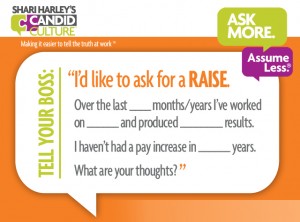 The time to ask for a raise isn’t at the end of the year. In fact, the end of the year, when compensation decisions have likely already been made and you’re competing with everyone else in your organization for a finite pool of money, is the worst time to ask for a raise. The time to ask for a raise is at the beginning of the year, and it could sound like this:
How to ask for a raise:
“Next year I’d like to take on more responsibility and be earning _____. What would it take to get me there? I’ve written a few goals. Can we review the goals together and talk about if this is the right course of action to help me get to the next level?”
Set yourself and your boss up for success in giving you a raise. Significant pay increases need to be justified and approved by others in the organization. And results justify raises.
A few steps to take to get the pay increase you want:
- At the beginning of the year, you and your boss should agree upon goals that are important to the organization.
- Agree that at the end of the year, goal achievement will position you for more responsibility and more money.
No manager will promise a raise a year out, but ensure your career path is a conversation that will be had.
Given that you may want to ask for a raise now, here are some techniques for asking for more money in the middle of the year:
- Schedule time to talk with your boss, so you’re sure to have her undivided attention.
- Bring a list of accomplishments from the past months or years. Be sure to document those accomplishments in whatever format and level of detail your organization’s decision makers’ like to get information. You’ll know that by watching how the leaders communicate.
- Give your boss a copy of the list.
- Be bold. Use words like, “I’d like to talk with you about my career. It’s been _____ months/years since I’ve had a raise. I’ve generated __________ results. Can we discuss what it would take to get me to the next level?”
- Don’t say, “This is awkward and I’m uncomfortable asking, but I’d like to talk about my compensation.” That’s not a powerful way to ask for anything.
The worst you will get is a no. You won’t get fired or ‘in trouble’ for asking. And if you get a no, ask, “What do I need to do to position myself for a significant pay increase in the next year?”
When asking for money, time, or resources, it’s easier to say no than it is to say yes. So give your manager something that’s easy to say yes to.
When asking for a raise, say:
- “I’d like to position myself for more responsibility and more money.
- What do I need to do to do that?
- What’s a reasonable time frame to make that happen?
- Whose support do I need in addition to yours?
- What can I do to ensure the leaders who will also impact the decision are knowledgeable about my contributions?”
You will not get what you don’t ask for. So be bold, but also be deliberate, planful, and smart about how you ask.

 Companies want people who make things happen. And to make things happen, you have to speak up. No, anticipating the train wreck and commenting after the train goes off the tracks doesn’t count.
What if you said what you thought, in a way other people could hear you, when you had the right to do so? Meaning, you have the relationship with the other person to tell the truth and you’ve asked permission to be candid?
6 Courageous Steps to Advance Your Career:
- Look for opportunities to make things better.
- Ask for permission to take the ball and run with it.
- Build relationships with other people who are making things happen.
- Don’t say yes, when they mean no.
- Find a way to say no, while engaging the other person in a conversation so a new approach is generated.
- Are willing to go out on a limb, work hard, and fail.
Here’s how to speak up for change without being labeled as the problem person who finds flaws in everything:
- Look for and present solutions, not merely problems.
- Offer to do the work to move towards a better way of doing things. Don’t drop problems at your other people’s doors.
- Ask questions versus overtly say why something is wrong. That could sound something like, “I’d love to help. Tell me more about the process. Perhaps we can insert a step to make this better. What do you think of trying…?” No one likes to be told he’s wrong. Asking questions elicits participation more than overtly saying, “This is broken. We need to fix it.”
Many people are afraid to speak up at work and believe that people who speak up get fired. I haven’t found this to be the case. People who work hard and produce results are typically the last people to be let go.
Say what you think in a way that is not critical; offer solutions not just problems; be a force for good and take an active role in making things better, and my hunch is your career will accelerate faster than you ever thought possible.

 I’ll never forget a coaching meeting I had about two years ago. I gave the manager I was coaching some tough feedback and he replied by saying, “I know I do that.” So I asked him, “If you know this is an issue, why are we having the discussion? He told me, “I just figured this is the way I am.” And I realized that knowing a behavior is ineffective doesn’t mean we know what to do to make things better.
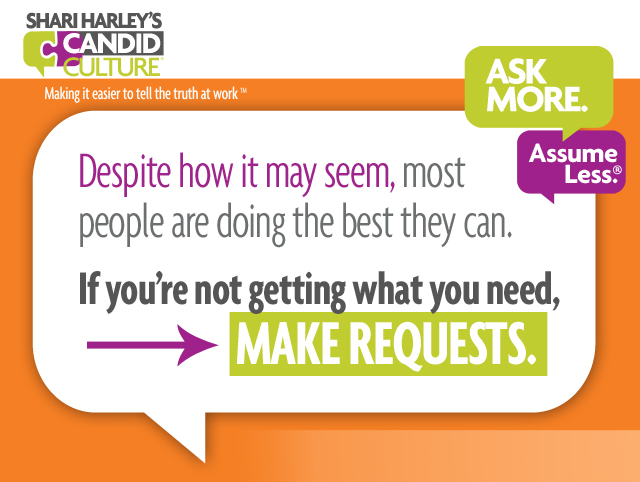
The people you work with want to do a good job. They want you to think well of them. Yes, even the people you think do little work and/or are out to get you. Give people the benefit of the doubt. Assume people are doing the best they know how to do. And when you don’t get what you want, make requests.
There are two ways to give feedback. One way is very direct.
Version one: “You did this thing and here’s why it’s a problem.”
The other way is less direct. Rather than telling the person what went wrong, simply make a request.
Version two: “Would you be willing to…” Or, “It would be really great to get this report on Monday’s instead of Wednesday. Would you be willing to do that?”
It’s very difficult to give feedback directly without the other person feeling judged. Making a request is much more neutral than giving direct feedback, doesn’t evoke as much defensiveness, and achieves the same result. You still get what you want.
When I teach giving feedback, I often give the example of asking a waitstaff in a restaurant for ketchup. Let’s say your waiter comes to your table to ask how your food is and your table doesn’t have any ketchup.
Option one: Give direct feedback. “Our table doesn’t have any ketchup.”
Option two: Make a request. “Can we get some ketchup?”
Both methods achieve the desired result. Option one overtly tells the waiter, “You’re not doing your job.” Option two still tells the waiter he isn’t doing his job, but the method is more subtle and thus is less likely to put him on the defensive.
You are always dealing with people’s egos. And when egos get bruised, defenses rise. When defenses rise, it’s hard to have a good conversation. People stop listening and start defending themselves. Defending oneself is a normal and natural reaction to negative feedback. It’s a survival instinct.
You’re more likely to get what you want from others when they don’t feel attacked and don’t feel the need to defend themselves. Consider simply asking for what you want rather than telling people what they’re doing wrong, and see what happens.
I will admit, asking for what you want in a neutral and non-judgmental way when you’re frustrated is very hard to do. The antidote is to anticipate your needs and ask for what you want at the onset of anything new. And when things go awry, wait until you’re not upset to make a request. If you are critical, apologize and promise to do better next time. It’s all trial and error. And luckily, because most of us aren’t great at setting expectations and human beings are human and make mistakes, you’ll have lots and lots of chances to practice giving feedback and making requests.

 Surveys are a great way to gather data. They’re not a great way to build relationships. In addition to sending out employee engagement surveys, ask questions live. Employees want to talk about their experience working with your organization. And employees will give you real, honest, and salient data, if you ask them and make it safe to tell the truth.
Here are a few methods of gathering data, in addition to sending employee engagement surveys:
Managers, ask questions during every one-on-one and team meeting with employees.
Managers, consider asking:
- What’s being talked about in the rumor mill?
- What do I need to know about that you suspect I don’t?
- What makes your job harder than it has to be? What would make your job easier?
- What meetings are not a good use of time?
Listen and be careful not to defend. Employees want to be heard. Respond if you’re able, but don’t deflect the feedback you’ve received.
Leaders, conduct roundtable discussions with small groups of employees throughout the year. I’d suggest discussions with groups of six employees. Have lunch or coffee. Keep the meetings informal.
Leaders, consider asking:
- What’s a good decision we made in the last six months. What’s a decision we made that you question?
- What would need to happen for you to be comfortable referring your friends to work here?
- What’s something happening in the organization that you’re concerned about?
How to Get the Truth:
- Share as much information as you can. Trust your employees.
- Ensure there are no negative consequences for people who tell you the truth.
- Give positive attention to the people who risk and give you negative information.
- Tell employees what you learn during these discussions and what you will and won’t be doing with the information.
- You don’t need to act on every piece of data you receive. Just acknowledge what you heard and explain why you will or won’t be taking action.
Employees are loyal to managers and organizations they feel connected to. And connections are formed through conversations. So in addition to sending employee engagement surveys, ask questions during every conversation and make it clear that you’re listening to the answers.
The fear of saying what we think and asking for what we want at work is prevalent across organizations. We want more money, but don’t know how to ask for it. We want to advance our careers but are concerned about the impression we’ll make if we ask for more. Instead of making requests, many employees assume they won’t get their needs met and choose to leave their jobs, either physically or emotionally.
How to Retain Good Employees:
The key to keeping the best employees engaged and doing their best work is to ask more questions and make it safe to tell the truth.
Managers: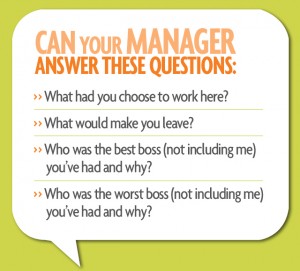
- Do you know why your employees chose your organization and what would make them leave?
- Do you know your employees’ best and worst boss?
The answers to these questions tells managers what employees need from the organization, job, and from the manager/employee working relationship.
Can your manager answer these questions – that I call Candor Questions – about you? For most people, the answer is no. Most managers don’t ask these questions. And most employees are not comfortable giving this information, especially if the manager hasn’t asked for it.
It’s easy to mistake my book, How to Say Anything to Anyone, as a book about giving feedback. It’s not. It takes me nine chapters to get to feedback. The first eight chapters of the book are about how to create relationships in which you can tell the truth without fear. You can read all the feedback books you want and take numerous training classes on coaching, managing people, giving feedback, and managing conflict, and you’ll still be hesitant to speak up, because a formula for giving feedback is not what you’re missing. What’s missing is being given permission and knowing it’s safe to tell the truth.
Managers, here’s how to retain good employees:
“I appreciate you choosing to work here. I want this to be the best career move you’ve made, and I want to be the best boss you’ve had. I don’t want to have to guess what’s important to you. I’d like to ask you some questions to get to know you and your career goals better. Please tell me anything you’re comfortable saying. And if you’re not comfortable answering a question, just know that I’m interested and I care. And if, at any point, you’re comfortable telling me, I’d like to know.”
 Then ask the Candor Questions during job interviews, one-on-one, and team meetings. We’re always learning how to work with people. So continue asking questions throughout your relationships. These conversations are not one-time events.
If you work for someone who isn’t asking you these questions, offer the information. You could say:
“I wanted to tell you why I chose this organization and job, and what keeps me here. I also want to tell you the things I really need to be happy and do my best work. Is it ok if I share?”
Your manager will be caught off guard, but it is likely that she will also be grateful. It’s much easier to manage people when you know what they need and why. Most managers want this information, it just may not occur to them to ask.
If the language above makes you uncomfortable, you can always blame me. You could say:
“I read this blog and the author suggested I tell you what brought me to this organization and what I really need to be happy here and do my best work. She said I’d be easier to manage if you had that information. Is it ok if I share?”
Yes, this might feel a little awkward at first, but the conversation will flow, and both you and your manager will learn a great deal about each other.
The ability to tell the truth starts with asking questions, giving people permission to speak candidly, and listening to the answers.

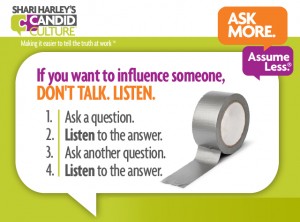 When selling a product, service, or idea, people often think that providing more information is better. The more data points, the more likely the other person is to be persuaded. This is not necessarily the case. Excluding data hounds, most people don’t like to be overloaded with information. But people do appreciate the opportunity to talk about what they want and need. So if you want to sell something, give people a chance to talk.
I’ll never forget one of my first sales calls, many years ago. I was selling Dale Carnegie Training. After calling a prospect for six months, he agreed to spend ten minutes with me. Feeling rushed, I laid out all of our training brochures and quickly told him about every program we offered. Then I asked if he wanted to buy anything. He didn’t.
If I had asked a few questions and listened to his answers, I could have provided information on just the training programs he needed, instead of giving him a list of likely irrelevant options.
Selling a product or service is no different from selling an idea. You are trying to persuade someone to your way of thinking. Resist the temptation to persuade solely by educating. Instead, ask questions, listen to the answers, and then tell the person what you heard her say. If you’ve taken a listening class, you learned the practice of paraphrasing what someone said. Paraphrasing is a very old technique, but still very effective.
People need to feel heard and understood. From my experience, asking relevant questions, demonstrating that you listened to the answers by paraphrasing what the person said, and providing pertinent and succinct information is what people need to make a decision.
Click here to download five free questions from our box of Candor Questions for Sales and Customer Service.

You know when someone gives you ‘the tone’. Similar to when people roll their eyes at you, when you get ‘the tone’ you’re being told that the other person is exasperated.
 Tone of voice communication is one of the hardest things to coach because we don’t hear ourselves. People who give people ‘the tone’ rarely know they’re doing it. One of the best ways I know to effectively coach tone of voice is to ask tone givers to tape themselves during phone calls. Then listen to the recording together and ask the tone giver, “If your grandmother called and someone spoke to her that way, would you be happy?” You can also read written correspondence out loud, adding the tone you ‘heard’, and ask the sender how she would have interpreted the message.
When given the tone, most people feel judged. And when people feel judged, conversations are constrained.
The way to avoid giving ‘the tone’ is to come from a place of curiosity. When you ask the question, “What were you thinking when you approached the customer that way,” you can sound curious or judgmental. Being judgmental evokes defensiveness, which shuts conversations down. Being curious creates discussion.
Consider asking questions like these to invite discussion:
• Tell me more about…
• Help me understand what happened here…
• What are your thoughts about…
• What’s the history behind….
• Why do we do it this way?
Any of these questions will lead to good discussion, if you manage your tone.
If you want to get information or influence someone, ask questions and engage the person in a dialogue. We often try to persuade people by giving them information. This rarely works. Instead of over loading people with data, ask questions which evoke discussion. Through discussion you might get to a different place. And if not, you’ll at least have learned why the other person thinks as he does and you will have shared your point of view in a way that is inviting versus off putting.
It’s easy to give people ‘the tone’ when we’re tired and frustrated. Try to avoid difficult conversations when you’re tired or stressed. Wait to have important conversations until you know you can manage yourself and your tone.

Conference calls taken on speaker phone, listening to music without headphones, and a posse of visitors, make the people working in a cubicle nearby want to permanently work from home.
The key to being able to ask your coworkers to move the conversation to a conference room is the same as giving any type of feedback –set expectations and ask for permission to speak candidly.
 Working in a cubicle is challenging. Here is some language to make it easier to ask your coworkers to pipe down:
Get the people who sit in your work area together to talk about your working environment.
That conversation could sound like this, “It’s often pretty loud in our work area. I was wondering if we could set some guidelines of how we’ll manage our workspace, so it works for everyone? What do you think of establishing some practices we all agree to follow? For example, when making or taking phone calls, everyone will either use the handset or a headset. We won’t take or make phone calls on speaker phone. We’ll always use earphones if listening to music or watching videos. If a conversation in a cubicle lasts longer than five minutes, people will take the conversation to a conference room. And when these guidelines are broken, and they will because we’re human, it’s ok to say something.
We could even have a system to let people know it’s getting loud and that a guideline is being broken. With everybody’s agreement, we could throw a nerf ball into the loud cube, put a note in front of the person, or simply walk over and ask the person to take the conversation elsewhere. I want our work environment to work for everyone and make it easy for us to speak up without being concerned that we’re going to hurt someone’s feelings or damage relationships. What do you think?”
You DON’T need to be a manager to do this. Take control of your working environment by asking for what you want. Initiating this conversation may feel odd and uncomfortable, but I assure you most of the people you sit with will be grateful you had the courage to start the conversation.
 You can say anything to anyone at work when you have permission to do so. Suffering is optional. Make requests today and follow up when things get loud. You can do it!
Read How to Say Anything to Anyone and get the words to make even the hardest conversations easy!
I could give you a list of fifty employee retention strategies you could follow to improve employee performance, engagement and retention. But the truth is, there are really just four things you must do. Employees may appreciate the other 46 things but don’t necessarily need them to stay with your organization and do their best work.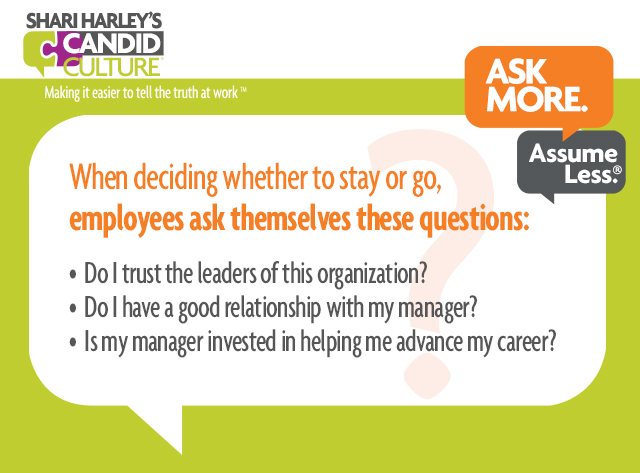
The Colorado Society of Human Resource Management hosts an annual Best Companies competition, and organizations of all sizes compete. Last year I led a workshop before the awards ceremony. The purpose of the workshop was to share the things that make an organization a great place to work. While researching the program, the things that separate the great companies from the less desirable places to work became very clear. I’ll share those employee retention strategies here.
Employees ask themselves these questions at work:
- Do I trust the leaders of this organization?
- Does my opinion/voice matter in this organization?
- Do I have a good relationship with my manager?
- Is my manager invested in helping me advance my career?
Employees enjoy yoga, concierge service, espresso, and social events at work, but these perks don’t necessarily improve retention or performance. The only perk known to improve employee loyalty and commitment is a flexible schedule. Everything else is nice to have, but not essential.
This is what’s really important to your employees:
- I trust the leaders who run this organization.
- My opinion means something. I am listened to.
- I feel respected (by my manager) and have good relationships in the organization.
- My work is challenging and interesting.
So what should you do if you want to be a best place to work?
Four Employee Retention Strategies Leaders Can Use to Create Relationships with Employees at All Levels:
1. Know employees’ names, talents & career goals.
2. Be visible. Talk to employees.
3. Give more information than you think you need to. Employees want to know how your organization is performing.
- Hold town hall meetings. Give financial updates.
- Use ‘Ask the CEO’ boxes to encourage questions and feedback.
- Encourage senior leaders to conduct small, roundtable discussions with employees at all levels.
4. Align leaders’ words and actions.
- Organizational guidelines are applied consistently among all employees.
- Don’t gossip or chuck other leaders under the bus.
- Be consistent. Don’t say, “The CEO says this, but we’re going to do this instead.”
Four Employee Retention Strategies Managers Can Take:
1. Meet one-on-one with employees and have meaningful discussions about employees’ performance and career goals.
2. Ask employees for their opinion and demonstrate that you’ve heard them.
3. Provide opportunities for employees to do work they enjoy.
4. Ensure employees who want to advance in your organization are learning and growing.
Read about our Be a Great Place to Work leadership training program designed for Senior Leaders and HR Professionals.