Business Communication Archive
When I led leadership development training for a large mutual fund company we offered a lot of training focused on helping people have hard conversations. Over time I realized that despite that I’d bought and offered the best training programs I could find, the training wasn’t helping. Managers didn’t give enough feedback and when they did give feedback, employees were often left confused, wondering what they needed to do differently.
I decided that what was missing was the conversation before the crucial conversation. It wasn’t that managers didn’t know what they wanted to say, many managers felt they couldn’t say what they wanted to say. There wasn’t sufficient safety or permission for giving feedback, so managers said little or delivered messages that were so vague, employees were left wondering if there was a problem. This is when the idea for Candid Culture was born.
 If you’re struggling with giving feedback, I doubt it’s the message that’s the challenge. The distinction between being able to tell the truth (as you see it) and saying nothing, is the quality of your relationship.
Think about the people – personal and professional – who can say anything to you. These are the people who can tell you that the person you’re dating is wrong for you, that a piece of clothing is not flattering, that you disappointed them, or dropped the ball. You may not enjoy getting the feedback, but you’re able to hear what they have to say and take it in, because you know they care about you and have your best interests at heart. You trust their motives. When you trust people’s motives, they can say anything to you. When you don’t trust people’s motives, there is little they can say.
If you’re struggling to give feedback, evaluate your relationship by asking these three questions:
- Does this person know that I have her back under any circumstances?
- Does this person trust me?
- Does this person know that I accept her just as she is?
If the answer to any of the questions above is no, it’s not giving feedback you’re struggling with, it’s the quality of your relationship. Work on building trust with this person and you’ll be able to say whatever you feel you need to say.
Here are five steps to building trusting relationships:
- Get to know people better than you know them now. Download free conversation-starting Candor Questions to have these conversations.
- Tell people you want them to succeed and demonstrate that by being supportive of their efforts.
- Don’t be judgy. No one likes to be told that she is wrong.
- Set the expectation that you will give both positive and negative feedback when appropriate, because you want the person to win. And if you remain silent, you are of no help to the other person.
- When you deliver feedback, be extremely specific. Feedback that is specific will be received much better than vague feedback, which is typically judgmental.
When people know that you respect and want good things for them, you have a great deal of freedom to speak up. When people don’t trust your motives, giving feedback is almost impossible. The recipient will become defensive and dismiss whatever you say, rationalizing that you don’t like her and never have.
Worry less about giving feedback –for now. Instead, build trust. Get to know people better, then work on giving feedback.
 If a friend asked you to do something, you did it, and she didn’t say thank you, you’d probably think twice the next time she asked you for something. The people you work with are not different.
If you don’t say thank you to employees, they too will stop doing things you think are important. Human beings thrive on recognition and relationships. We need both to survive. And when we don’t feel connected or appreciated, we find appreciation elsewhere.
If you think saying “thank you” to the people you work with is unnecessary, consider this example. An overwhelmed employee feels strapped for time. She produces a 30-page report every month that takes hours of her time. No one has ever talked with her about how the report is used and why it’s important. So when she is overwhelmed and decides that something needs to go, she stops doing work that appears not to add value—the 30-page report. It turns out the report reflects her department’s results and is reviewed by the CEO, CIO, CFO, and COO. Oops.
There are managers who think that a paycheck is enough of a thank you to employees (old school) and that any other thank you to employees is unnecessary (this doesn’t work). Human beings want to make a difference.We don’t like doing tasks we perceive as not being impactful. So tell the people you work with that their work matters by saying thank you, and how you say thank you matters. Saying, “Thanks for doing such a great job on that project” doesn’t go nearly as far as saying, “Thank you for taking over the Briggs proposal. You shepherded the proposal from beginning to end and made sure no detail was overlooked. You made all of us look good and we would not have won the business without you.” Like all feedback, specific feedback is meaningful and drives future behavior. Vague feedback feels inauthentic and doesn’t tell the recipient what to replicate in the future.
Onto why it’s important to say “I’m sorry.” Some people think that saying you’re sorry puts you in a weak position and that you will lose employees’ respect. This couldn’t be further from the truth. Strong people admit when they’re wrong. Weak people can’t admit mistakes.Admitting fault ingratiates you to other people. Refusing to take responsibility alienates you.
It’s very frustrating to work hard and never be told “thank you.” Likewise, it’s upsetting when people don’t apologize for dropping the ball and making mistakes. It’s so easy to say “thank you” and “I’m sorry,” and it costs nothing. The more you demonstrate appreciation for the people you work with and take responsibility for your mistakes, the harder people will work on your behalf.

I’m taking golf lessons, which should frighten anyone within 100 feet. Every time the instructor explains something new, he asks me, “Does that make sense?” “Does that make sense” is a common clarifying question, that many managers, trainers, and instructors ask, but it’s not a good question for two reasons.
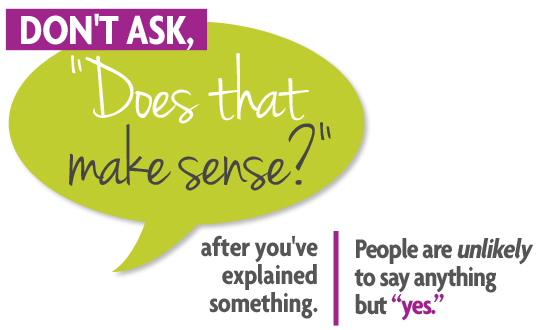
Reason number one: If an explanation doesn’t make sense to me, I’m the idiot for not ‘getting it.’ It’s not that the instructor hasn’t been clear, I just ‘didn’t get it.’
Reason number two: The question doesn’t force me to speak. “Does that make sense” is like asking a shopper in a store, “Can I help you?” We all know the right answer to that question is, “No, I’m just looking.” This is a similar to when someone asks, “Are there any questions?” The right answer is “no.” And when people say “no,” the person who asked the question often says, “good,” affirming people for not asking questions and making it less likely that questions will be asked in the future.
Here are some clarifying questions that will force people to talk and won’t make them feel stupid for asking questions. Instead of asking, “Does that make sense,” consider asking:
- So I know I’ve been clear, tell me what you heard me say.
** This may sound harsh and like micromanaging in writing, but the questions can be asked in a supportive and non-judgmental manner.
- Just so I know how I landed, what do you think I’m asking/expecting you to do?
- What do you think you need to do?
- What are you planning to do?
I was talking with one of my clients a few months ago. She was very upset because she told one of her employees what to do and he didn’t do it. Frustrated, she said, “He knew what to do, and he didn’t do it.” I asked her, “How do you know that he knew what to do?” She replied, “I told him what to do and when I asked if he had any questions, he said no.”
Her situation is a common one. The right answer to “do you have any questions” is “no.” And we’re surprised when we swing by the person’s desk two weeks later to get a status update on the project, and he hasn’t started working on it yet.
Here are some additional examples of clarifying questions and delegation questions. These questions will force people to speak, providing a clearer sense of what people know and are likely to do.
- What questions do you have?
- What are you planning to do first? If the person answers this question appropriately, ask what he is planning to do next. If he doesn’t answer the question appropriately, step in and give more direction.
Provided you trust that the person knows what to do, give a tight deadline and ask to review the person’s work in a few days. Give people some freedom, but not enough to waste a lot of time and go down a fruitless path. Delegation is something few managers do well and the root of many missed deadlines and frustrations in the workplace.
The golf instructor should be asking me:
- What did you learn today?
- What are you planning to do as a result of what we’ve covered?
- What techniques did I ask you to follow?
- Let me see how that form looks?
- What questions do you have for me?
If he asks me these clarifying questions and forces me to do the things he is asking me to do, he will know what I know and am likely to do on the golf course. All he knows right now is that I’m poking fun of him in a blog post.
 The people you live and work with are hesitant to give you negative feedback. They’re afraid you’ll freak out, and they don’t want to deal your freak out. It’s easier to say nothing.
When I started teaching how to give and receive feedback, I provided elaborate explanations as to the predictable response to feedback and the rationale for that response. Now I’ve boiled the natural response to receiving feedback into three words: The Freak Out.
Every person you know personally and professionally wants to be liked and approved of. Even the people in your office who you think are lazy want you to think they do good work. And when anyone calls another person’s competence into question, that person is likely to freak out (become defensive).
It’s very difficult not to get at least a little bit defensive when receiving feedback. A defensive response often sounds something like, “Thanks for the telling me that. Can I tell you why I did it that way?” The problem with that slightly defensive response is that what the other person hears is, “You’re not listening. I am wasting my time talking to you.” Then the conversation quickly ends. People want to feel heard. And when the feedback recipient becomes defensive, the person giving feedback doesn’t feel heard.
Don’t feel badly about becoming defensive when you receive negative feedback. Becoming defensive when receiving bad news just means you’re a living, breathing human being with feelings. That beats the alternative. But The Freak Out scares people. They don’t want to deal with your mild, moderate, or very defensive reactions.
Because people want to avoid The Freak Out, they keep negative feedback to themselves or worse, tell someone else. If you want more truth, you need to make it clear there won’t be negative repercussions for speaking up.
Here are seven steps to get others comfortable giving you negative feedback:
1. Ask for feedback
2. Be specific about the type of feedback you want.
3. Tell the person from whom you’re asking for feedback when and where she can observe you in action.
- A bad example of asking for feedback: “I really want your feedback. Feel free to give it anytime.” This is too vague and doesn’t demonstrate seriousness on your part.
- A good example of asking for feedback: “I really want your feedback on the pace of the new hire orientation program. Will you sit through the first hour next Wednesday at 9:00 a.m., and tell me what you think of the pace and why?” This request tells the person specifically what you want and demonstrates you’re serious about wanting her feedback.
4. When you receive feedback say, “Thank you for telling me. I’m going to think about what you’ve said and may come back to you in a few days to talk more.”
5. Don’t respond to negative feedback immediately. Walk away instead of responding.
6. If you’d like more information or want to tell the person you disagree with what she said, wait until you’re calm to have that conversation.
7. You can express a counter point of view, you just can’t do it immediately after you receive the feedback.
No matter what a person’s role in your life – your boss, a peer, external customer, or even spouse – it takes courage to give you feedback. When a conversation requires courage, the speaker’s emotions are heightened. If the feedback recipient’s emotions rise in response to the feedback, conversations escalate. This is how arguments start. If you want to put the other person at ease and get more feedback in the future, do the opposite of what she is expecting. Rather than getting even the slightest bit defensive, do the opposite. Say, “Thank you for the feedback. I’m sorry you had that experience. I’m going to think about what you’ve said, and may come back to you to talk more.” Then walk away.
Walking away, when all you want to do is react, is very difficult. Walking away will require a good deal of self control, but the rewards are great. You will build trust, strengthen your relationships, and get more information than you have in the past, information you need to manage your career, reputation and business.

This funny communication skills training video provides the words to tell someone they smell, that there is too much cleavage at work, and that there is no texting in the workplace. Giving feedback doesn’t have to be hard.
About fifteen years ago, I worked with a woman with whom I didn’t get along. We were on the same team and had the same job, but didn’t see eye to eye on how to approach work or solve problems. And when we didn’t agree, things got ugly. I have to admit to being afraid of her. She was nasty when things didn’t go her way.
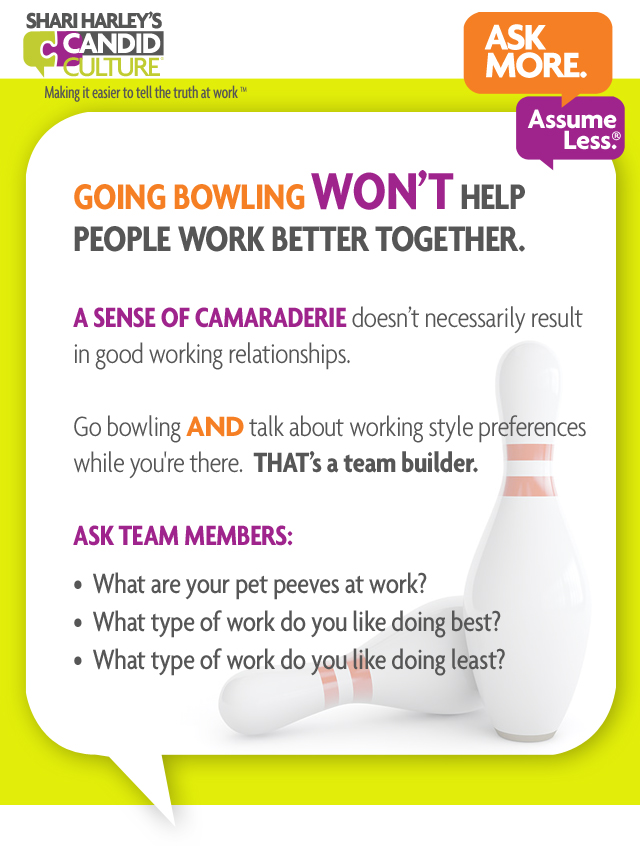 The odd thing is that socially, we did fine. When our team socialized outside of work, we had fun and got along well. That’s when I realized that there was no correlation between getting along outside of work and working well together.
Lots of teams go bowling, to baseball games, and out for happy hour as corporate team building activities. And while team members may enjoy being together at these events and get to know each other better personally, they don’t learn team members’ working style preferences, the work others are really good at, and the things at which team members are not as good.
Go bowling or out for happy hour, just don’t expect people to work better together after doing those activities. If you want to do corporate team building activities, give team members a chance to learn about each other and themselves, and make agreements of how team members will work together in the future. Create occasions for candor.
When I lead corporate team building activities, I put people in small groups, give the group a box of Candor Questions to Say Anything to Anyone, and time to answer the questions. One person in the group asks one question from the box. Everyone in the group answers that person’s question. The person who asked the question then answers his own question. Then another person on the team asks a question and so on. A great conversation always ensues.
People talk about things they should have and wished they’re talked about when they started working together. Team members learn about each others’ work style preferences and what each person needs from both the job and each other. But most importantly, team members have permission to talk about things they normally don’t, and begin to create a climate of candor, which is essential for any group of people working together. For a team to work well together, it must be safe to tell the truth. Teams need to talk about the things that impact them most –each other.
So go bowling and out for happy hour. But also create opportunities for team members to talk about the things that matter most –how they impact each other at work.

 You’ve either seen the video or heard about the group think that happened before NASA’s Challenger exploded in 1986. One engineer felt strongly that there was a defect in the Challenger’s design. He spoke up, others disagreed. He continued to speak up, until it became very uncomfortable to do so.
Most employees don’t even get that far. Many employees are afraid to speak up at all, feeling that it’s not ok to have a counter point of view, and that those who disagree with ‘management’ are eventually fired. I honestly am not sure where this comes from. It hasn’t been my experience, and yet the fear of speaking up is pervasive. I hear it in almost every organization with which I work.
If it’s not ok to express different opinions, your organization will deliver the same-old products and services you always have. If staying the same works in your industry, great. But stagnation is a killer to most organizations.
If you want more innovation in the workplace, you have to make it safe to speak up and offer a different point of view. Saying new, different, and even controversial things must be encourage and rewarded.
Five Ways to Encourage Innovation In the Workplace:
- Ask for new ideas and different points of view.
- Wait until you get both. Don’t allow a meeting or discussion to move on until you get new, opposing, and different points of view.
- Positively acknowledge people who risk and say something new or different from the norm.
- Ensure people with new ideas and different points of view are allowed to finish speaking before they’re interrupted or before someone else tries to negate their ideas.
- Create a few new awards in your organization and announce winners publicly and with great fanfare. You get what you reward.
Create Awards to Encourage Innovation In the Workplace:
- Acknowledge the person who fails massively trying something new.
- Award the person who brings new ideas to the table, regardless of what happens to those ideas.
- Celebrate the person who willingly gives you the worst news.
The fear of speaking up and saying something new or different will kill your innovation efforts. It will also kill your employees’ ambition and ability to be creative. Make it safe to tell the truth, even when the truth is hard to understand or unpopular, and see what happens to innovation, creativity, and employee productivity and morale.
 It’s hard to watch people do things that damage them – personally or professionally. And yet, if they haven’t asked for feedback, people likely won’t listen to unsolicited advice, so don’t bother giving it.
If you really want to give unsolicited advice, ask for permission and make sure you get a true “yes” before speaking up.
The conversation could go something like this:
“I noticed we’re getting behind on the XYZ project. I have a couple of ideas about what we can do. Would you be interested in talking about them?” Or, “That Monday meeting is rough. I feel for you. I used to run meetings like that. Would you be interested in talking about some meeting management strategies? I’d be happy to share what I’ve learned.”
After you offer to talk (aka, give your opinion), listen and watch the response you get. Does the person’s words and body language portray a true “yes, I’d like your opinion” or what seems like an “I’m supposed to say yes” reply? If you get the latter, you’re likely just giving unwanted advice that won’t be heard. If that’s the case, let it go. But if the person appears generally interested and open, proceed.
You could also say something like:
“Last week we were talking about your frustrations about not being promoted. I have a couple of ideas about that. Do you want to talk about them? Either way is fine, but I thought I’d offer.”
Or, “That was a tough conversation during today’s staff meeting. It’s hard to present ideas and not have them be embraced. I have a couple of thoughts about ways you can approach the conversation during the next meeting. Want to talk about them?”
If you make the invitation to talk, the other person has to be able to say no. An invitation is only an invitation if no is an acceptable answer. You can’t ask if the person wants your input and then keep talking even if he verbally or physically said no.
Be brave. If you care about someone personally or professionally and you see him doing something that gets in the way of his success, ask permission to say something. If you get the go ahead, proceed. If you get a “no thank you,” accept that and move on. You’ve done your part.
Read How to Say Anything to Anyone, and get the words to have even the toughest conversations.

Employees leave managers not jobs. We’ve all heard this 100 times.
One of the most prevalent reasons for employee turnover is boredom and lack of growth. We’ve also heard this many times.
We know why employees leave jobs. The question is what must managers do to engage and retain their best people. The answer is actually quite simple, although possibly not easy to execute.
 Employees want to know that their manager:
- Knows them
- Cares about and is invested in their careers
- Gives feedback so they can improve
- Provides opportunities so they can develop
In other words, employees need attention, and attention requires time, time many managers may not feel they have.
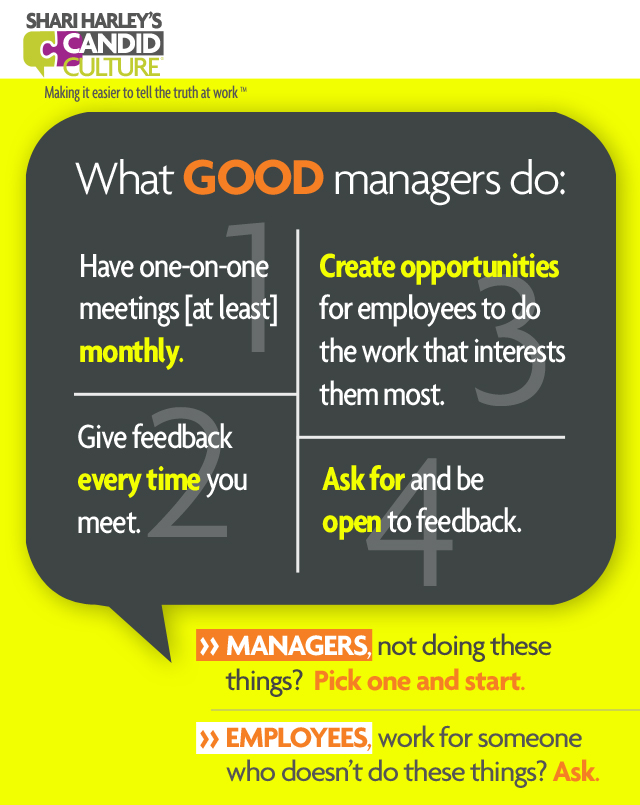
Here is a five-step formula for employee retention and employee engagement:
- Get to know employees better and differently
- Have meaningful, one-on-one meetings [at least] monthly
- Give feedback every time you meet
- Ask for and be open to feedback
- Create opportunities for employees to do the work that interests them most
Managers, how do you make time for these meetings when are busy and have several direct reports?
- Meet for 15-30 minutes
- Meet over the phone while commuting or waiting for flights
- Ask direct reports to create an agenda and run the meetings
- Ask direct reports to send follow-up notes of decisions and plans made during meetings. Give some of the accountability away.
- If meetings get cancelled, reschedule as soon as possible. Direct reports take cancelled meeting personally. Cancelled meetings, that are not rescheduled, send the message that managers don’t care about employees and their careers.
Employees, if your manager doesn’t schedule meetings with you:
- Ask permission to put a monthly meeting on your manager’s calendar
- Provide rationale for why you want to meet–to get your manager’s feedback and ensure you’re focused on the right work
- Ask permission to reschedule meetings when they get cancelled
- Don’t take cancelled meetings personally
- Offer to meet with your manager via the phone when it’s convenient for him/her. Leverage commute and travel time.
Employees need time with their managers. Meaningful discussions and work result in employee engagement and employee retention, so managers, make the time, even when you don’t feel you have it. Ask questions you don’t ask now. Give feedback, even if it’s uncomfortable. Give your employees an opportunity to do the work that interests them most. And watch your employee engagement and employee retention improve. And if your manager doesn’t do these things, politely and persistently ask. You won’t get what you don’t ask for. We are all 100% accountable for our careers.
 People are drowning in data, more specifically in email. If you want people to read your communications, send short emails and fewer of them.
How often do you open an email, see its daunting length, close the email promising you’ll get back to it later, but don’t. Then you bump into the sender a week later and he asks, in an annoyed tone, “Did you get my email?” And you attempt to conjure up the email, distinguishing it from the 1500 you’ve received since.
Some people like receiving lots of information, others don’t. Ask your internal and external customers how much information they want to receive, in what format, how frequently, and with how much detail. And when you can, accommodate their preferences.
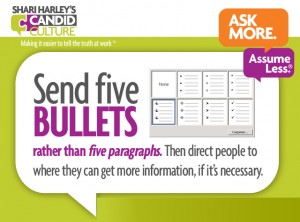
I’m a big picture person. For me, more information is not necessarily better. I’ll read five bullets. I won’t read five paragraphs. I’m frequently guilty of opening a long email, becoming overwhelmed, deciding I don’t have time to read the entire message, promising to read it later, and by the time I go back to the message, I’ve typically missed a deadline.
You can say it’s my problem that I don’t read long emails, not the sender’s problem. And you’d be right. I should read every email I get in full. But when I don’t give the sender something she needs, because I was overwhelmed by the length of her email, it becomes her problem too. If you want people to respond and do what you’re asking, communicate how they like to communicate, whenever possible.
I’d like to say that people are so used to reading short text messages and Facebook and Twitter updates that they’ve been trained not to read anything longer than a few sentences. And there may be something to that. But the truth, is there are detail people who like a lot of data and there are big picture people who don’t. If you provide a high level summary – just what recipients need to know – followed by more details or information on where more details can be found, you accommodate both the detail and the big picture people.
When you write your next email or any other type of communication, consider, could this be said with fewer words? Do the recipients want or need this level of detail? Then, shorten your communications and accommodate both the big picture and the detail people. And you’ll be amazed at how quickly you receive the things you’re asking for.
And if that’s not working, go old school and use our greeting cards to write a note, because no one can resist and handwritten note.