“If you have nothing nice to say, don’t say anything at all.” Most of us grew up hearing these words. Last week I used them with my six-year-old son, and instantly regretted it. He said something hurtful to me and I told him to keep those thoughts to himself.
I want him to keep his thoughts to himself if he doesn’t like a kid at school or doesn’t want to play with someone. Walk away, find another place to play, is often my guidance. But with me? With me I want him to be honest, always, even if it hurts.
Every time we talk with people, we train them how to interact with us. If I tell my son not to tell me the truth, I teach him to protect my emotions and stifle his. I teach him I’m not strong enough to handle the truth and that I’m someone who needs protecting. I teach him that he can’t be honest with me.
If you want your coworkers, boss, family and friends to be honest with you, make it easy to tell you the truth. Take in what others say without visibly reacting. Say “thank you” for whatever feedback and input you get, even when you want to say everything but. Take the time to ‘get over’ hard messages and then discuss further, when you’re not angry.
People learn quickly. If we react to suggestions, input, and feedback negatively, people learn that we can’t take challenging data and they stop giving it to us. I don’t want to be the person the people I care about are afraid to talk with because my reaction is just too hard to deal with.
Should you care about everyone’s feedback? No. Should you ask everyone for feedback? No. Should you be open to everyone’s feedback? No. Be open to feedback from the people who matter most to you. Open your heart and your mind. Close your mouth. Even when you want to do everything but. Strengthen your relationships and train people that you can handle the truth.
How many times have you been sitting at your desk wondering, “Why won’t they ___________ ?” Perplexed, you talk with your buddy at work. The conversation goes something like, “I’ve got this person, and I can’t figure out why they won’t ______________.” Or perhaps you talked directly to the person, but after several conversations, they still haven’t done what you asked them to do.
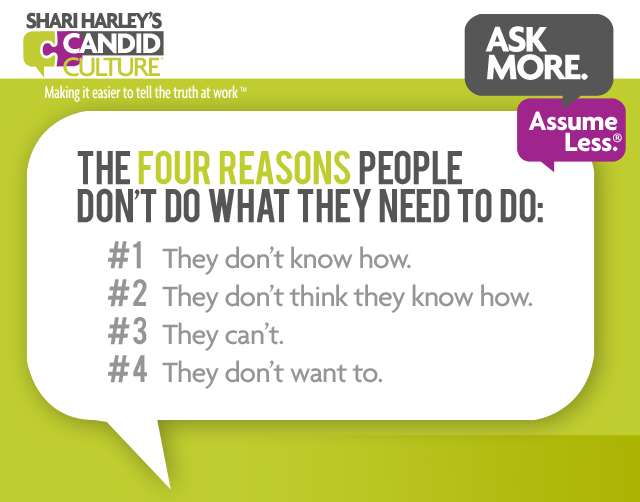
There are four reasons why people don’t do what you ask them to do:
They don’t know how.
They don’t think they know how.
They can’t.
They don’t want to.
Reason number one for a lack of employee performance, they don’t know-how, is the easiest to solve. People who don’t know how to do something need training, coaching, a mentor, a job aid or some other form of instruction. The hope is that with the right training and exposure, they will be able to do what you’re asking.
Reason number two for a lack of employee performance, they don’t think they know how, can be improved over time with patience and consistent coaching. You aren’t working with clean slates. Most people are recovering from or reacting to a past relationship or situation. If a person worked for a controlling manager who never let them make a decision or worked for someone who invoked punitive consequences for making mistakes, the person will likely be hesitant to make decisions. Hence why they continue to ask questions and repeatedly check in, but never make a decision independently.
If you work with someone who doesn’t think they know what to do, but you know they have the answer, encourage them to trust themself. When they come to you for validation or approval, ask questions, don’t give answers. Tell the person you trust their judgment and encourage risk-taking. Tell them you’ll support their decision, even if it proves to be the wrong one. And encourage them to make a decision next time without consulting you. Then keep your word. If they make a wrong call, you have to have their back and can’t invoke negative consequences.
Reason number three for a lack of employee performance, they can’t, is challenging but clear-cut. People who can’t do a task their brains aren’t wired for, will never do that responsibility well, regardless of how much coaching, training, and assistance you provide. If you have repeatedly and effectively, coached, trained, and provided support and the person still can’t do what is being asked, remove that responsibility and give the person something they can do well. If that responsibility is a large part of the job, you have someone in the wrong job. It’s time to make a change.
Reason number four for a lack of employee performance, they don’t want to, is annoying but manageable. There are lots of reasons people don’t do things they don’t want to do. Those reasons include, but aren’t limited to, boredom, lack of buy-in as to why something is important, insufficient time, feeling like a task is beneath them, etc. If you’ve got someone who can but doesn’t want to do something, you can either take the responsibility away, incent them to do it, or give feedback EVERY TIME the task doesn’t get done.
Giving negative feedback isn’t fun for the giver or the receiver. No one wants to hear that they aren’t meeting expectations and most people don’t want to tell you. But the discomfort of receiving negative feedback EVERY TIME the person doesn’t do what they need to do will create behavior change. They will either begin doing what you ask, quit, or ask for a transfer. Either way, your problem is solved.
The first step in getting people to do what you want them to do is to discover why they’re not doing what you ask. It’s impossible to appropriately manage employee performance if you don’t know why someone isn’t doing what needs to do be done. And the person to ask why a responsibility isn’t getting done isn’t you or your buddy, it’s the person not doing the work. So, get out of your head, leave your office or laptop, and go talk to the person not doing the work.
Here’s how to start an employee performance conversation:
“I’ve noticed you’re not doing ___________. Help me understand what’s happening.” Watch your tone, inquire from a place of genuine curiosity, and identify the reason they aren’t doing what they need to do. Then you can intervene appropriately and hopefully get what you want.
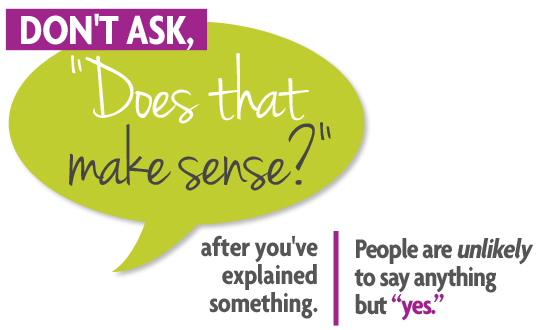
I’m taking golf lessons, which should frighten anyone within 100 feet. Every time the instructor explains something new, he asks me, “Does that make sense?” “Does that make sense” is a common clarifying question that many people ask, but it’s not a good question for two reasons.
Reason number one: If an explanation doesn’t make sense to me, I’m the idiot for not “getting it.” It’s not that the instructor hasn’t been clear, I just “didn’t get it.”
Reason number two: The question doesn’t force me to speak, thus the person asking the question doesn’t get any information. “Does that make sense” is like asking a shopper in a store, “Can I help you?” We all know the right answer to that question is, “No, I’m just looking.” This is a similar to when someone asks, “Are there any questions?” The right answer is “no.” And when people say “no,” the person who asked the question often says, “good,” affirming people for not asking questions and making it less likely that questions will be asked in the future.
The golf instructor should be asking me:
What did you learn today?
What are you planning to do as a result of what we’ve covered?
What techniques did I demonstrate?
Let me see how that form looks.
What questions do you have for me?
If he asks me the clarifying questions above, he will know what I am likely to do on the golf course.
Here are some clarifying questions that will force people to talk and won’t make them feel stupid for asking questions. Instead of asking, “Does that make sense,” consider asking:
“I want to make sure I gave clear instructions. Will you tell me what I’m asking you to do?” You could also phrase the questions like this, “Just so I know how I landed, what do you think I’m asking/expecting you to do?”
** This may sound condescending and like micromanaging in writing, but the question can be asked in a supportive and non-judgmental manner.
I was talking with one of my clients a few months ago. She was very upset because she told one of her employees what to do and he didn’t do it. Frustrated, she said, “He knew what to do, and he didn’t do it.” I asked her, “How do you know that he knew what to do?” She replied, “I told him what to do and when I asked if he had any questions, he said no.”
Her situation is a common one. The right answer to “Do you have any questions” is “no.” And we’re surprised when we swing by the person’s desk two weeks later to get a status update on the project, and he hasn’t started working on it yet.
Here are some additional examples of clarifying and delegation questions. These questions will force people to speak, providing a clearer sense of what people know and are likely to do.
What questions do you have?
What are you planning to do first? If the person answers this question appropriately, ask what they are planning to do next. If they don’t answer the question appropriately, step in and give more direction.
Provided you trust that the person knows what to do, give a tight deadline and ask to review the person’s work in a few days. Give people some freedom, but not enough to waste a lot of time and go down a fruitless path. Delegation is something at which most managers can improve. More effective delegation will lead to fewer missed deadlines and frustrations in the workplace.
You’ve either seen the video or heard about the group think that happened before NASA’s Challenger exploded in 1986. One engineer felt strongly that there was a defect in the Challenger’s design. He spoke up, others disagreed. He continued to speak up, until it became very uncomfortable to do so.
Most employees don’t even get that far. Many employees are afraid to speak up at all, feeling that it’s not ok to have a counter point of view, and that those who disagree with ‘management’ are eventually fired. I honestly am not sure where this comes from. It hasn’t been my experience, and yet the fear of speaking up is pervasive. I hear it in almost every organization with which I work.
If it’s not ok to express different opinions, your organization will deliver the same-old products and services you always have. If staying the same works in your industry, great. But stagnation is detrimental to most organizations.
If you want more innovation in the workplace, you have to make it safe to speak up and offer a different point of view. Saying new, different, and even controversial things must be encourage and rewarded.
Five Ways to Encourage Innovation In the Workplace:
Wait until you get both. Don’t allow a meeting or discussion to move on until you get new, opposing, and different points of view.
Positively acknowledge people who risk and say something new or different from the norm.
Ensure people with new ideas and different points of view are allowed to finish speaking before they’re interrupted or before someone else tries to negate their ideas.
Create a few new awards in your organization and announce winners publicly and with great fanfare. You get what you reward.
Create Awards to Encourage Innovation In the Workplace:
Acknowledge the person who fails massively trying something new.
Award the person who brings new ideas to the table, regardless of what happens to those ideas.
Celebrate the person who willingly gives you the worst news.
The fear of speaking up and saying something new or different will destroy your innovation efforts. It will also squelch your employees’ ambition and ability to be creative. Make it safe to tell the truth, even when the truth is hard to understand or unpopular, and see what happens to innovation, creativity, and employee productivity and morale.
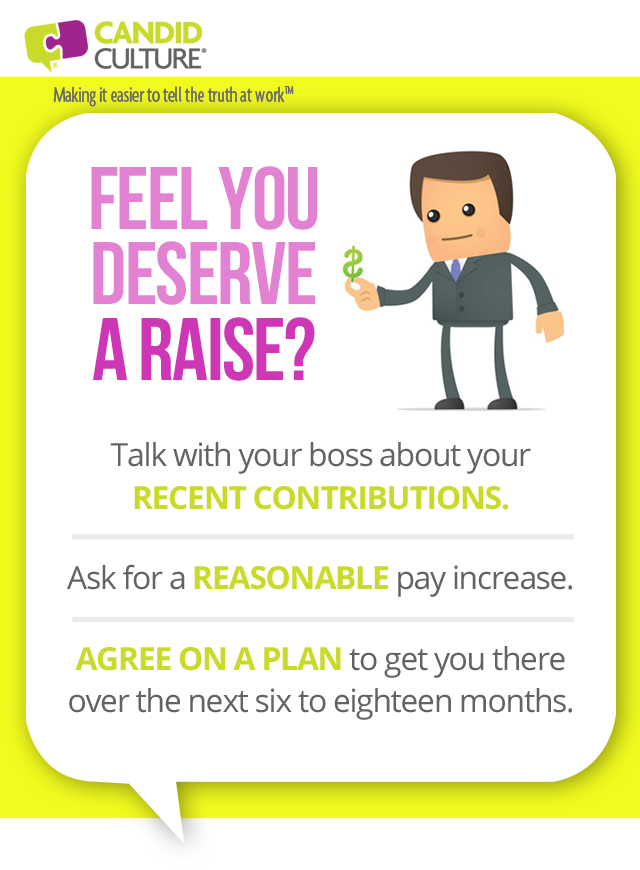
The best way to get your next job is to be great at your current job and ask for more. And the same goes for asking for a raise. Do a great job, make your contributions known, and work with your boss to create a plan to help you get to the salary you want.
Saying or acting as if you’ve been treated unfairly and that your talents aren’t being recognized may be true, but it may also get you the reputation as a negative whiner. People want to work with positive and appreciative people. Demonstrate both when asking for more.
Below are eight steps for asking for a raise:
How to ask for a raise step one: Write down the accomplishments you’re proud of since your last significant pay increase.
How to ask for a raise step two: Find out what your job pays on the open market. Jobs are assigned a value and a pay zone that is often transferable across industries. For example, if an entry level accountant at a big four accounting firm is earning $60,000, the pay zone is likely $50,000 – $70,000. If said employee asks for $64,000, that’s realistic. If they ask for $85,000, they’ll be seen as out to lunch. If an employee wants to earn $85,000, with their current level of education and experience, they’ll have to switch careers.
How to ask for a raise step three: Learn your company’s philosophy on compensation. Companies often deliberately decide to pay in the top, middle, or lower part of pay zones. For example, if an industry like sports or entertainment is glamorous and lots of people want to work in that industry, jobs are likely to pay less. Perhaps a company has great perks and benefits, and in exchange, pays less. Alternatively, some companies want to be known as providing the highest compensation and will pay for it. Knowing where your company falls on the compensation spectrum will help you determine a realistic number to ask for. Your Human Resources representative can answer these questions.
How to ask for a raise step four: Be prepared to present and talk about the impact you’ve made on your organization. Focus on accomplishments and how you’ve changed the business, not on how hard you’ve worked. Results get rewarded.
How to ask for a raise step five: Don’t give an ultimatum, unless you’ve already discussed a pay increase a few times, nothing has changed, and you’re ready to leave. Instead, work with your manager to create a realistic plan to get you to an agreed-upon pay rate. Put the plan, with specific milestones you need to hit, in writing and agree to discuss results quarterly. Managers may be hesitant to promise a future pay increase, but will support written work-related goals, which will help you make the case for a pay increase.
How to ask for a raise step six: Don’t be afraid to ask for a raise. You may not get the raise you want, but nothing bad will happen for asking, providing you do so appropriately. The initial conversation could sound something like, “I love working here and am really enjoying my job. Because of my contributions to our organization, I feel I’m worthy of a pay increase. Can we schedule a time to talk about what might make sense? And with your permission, I’d like to send a list of my most recent accomplishments. Would that be ok?”
How to ask for a raise step seven: Discover who needs to support your pay increase. Your boss may not have the ability or authority to give you an increase. Subtly ask what they can do. That could sound something like, “Who needs to participate in the decision to grant me a pay increase? Is there anything I can do to assist with sharing my accomplishments or making the case for an increase?”
How to ask for a raise step eight: Once you know what your job pays across industries and your company’s philosophy on compensation, ask for a realistic number that will make you happy. If you’re asking for large increase, consider incremental raises over a period of months. Ask for something that’s easy to say yes to.
If you think you deserve a pay increase, don’t be afraid to ask. Ask in a positive way, focusing on the value you’re adding to the business. Be patient and work with your boss to create a plan to get where you want to be. The worse you’ll hear is “no.” And if the answer is no, you’ve planted a seed and opened the door to the next conversation.
The daily monologue in my house sounds like, “I am not your housekeeper. My job in life is not to clean up after you.” I am, of course, talking to my six-year-old son who picks up nothing. Instead, he throws everything on the floor. My expectation is that he will pick up after himself, and when he doesn’t (ever), I am very frustrated.
Violated expectations are at the root of disappointment, frustration, and broken relationships. We think, “I expect you to do or be a certain way and you’re not, so I’m unhappy.” If you want to be more satisfied and less frustrated, change your expectations. I don’t mean lower your expectations. I really do mean change them.
When I had my son, I had no idea how difficult it would be to have someone I barely knew (our first nanny) take care of him. It was tortuous until I got the sage advice, “You’re not going to get everything you want. Pay attention to the big things and be ok with good enough.” That’s hard for me. I want things done a certain way (my way). But I also don’t want to do everything myself. So, I find myself altering my expectations and being ok with good enough. And it is very, very difficult.
You likely want each of your employees, coworkers, boss, clients, and vendors to do things a certain way. Sometimes they’ll meet those expectations and sometimes they won’t. Decide what you must have, communicate those expectations (repeatedly if necessary), and let the rest go.
Here are four steps for setting expectations at work:
Setting expectations step one: Consider everything you need or want from a person. Make a list, even if you’ll be the only person who sees it.
Setting expectations step two: Determine what that person is capable of providing. What’s realistic given who they are and the constraints they’re under (time, skills, experience, etc.)?
Setting expectations step three: Reset your expectations, if necessary.
Setting expectations step four: Ask for what you want and be specific about your requests. Telling someone, “This needs to get better,” will accomplish nothing. Telling someone, “I’d like to be included in each meeting that relates to this project and cc’d on all pertinent emails,” may just get you what you need.
As William Ury said in his book Getting to Yes, be hard on the problem and easy on the person. When you address violated expectations, simply share what you expected to have happen and what actually did happen. That could sound like, “I thought we agreed I would be invited to each meeting pertaining to this client. There was a meeting last week I wasn’t invited to. What happened?” Watch your tone of voice when asking this question. Be neutral and curious.
Changing your expectations will likely be a daily occurrence. People won’t necessarily do things your way or even the way you hoped. Decide what you must have, and let the rest go. Just think of all the time and aggravation you’ll save.
No one likes giving people negative feedback. Giving negative feedback often makes both the feedback deliverer and the recipient feel badly. To make everyone feel better, we dress negative feedback up with pickles and relish, otherwise known as The Empathy Sandwich.
The Empathy Sandwich in action: “You’re doing really great. Now you did almost cost the company $50,000, but in general, things are going great.”
The Empathy Sandwich leaves people unclear, wondering if there is a problem. Instead of softening negative feedback with positive platitudes on both ends, tell people you’ll be providing positive and negative feedback as things happen, and then separate both types of feedback.
Giving feedback to people you manage: “As your manager, my job is to help you be successful. As a result, I’ll tell you what I see, as I see it. I’ll give you both positive and upgrade (negative) feedback in a timely way. Because if I don’t, you won’t grow as a result of working with me.”
Paving the way to give feedback to peers and those at a higher level: “We see each other work and are in a unique position to provide each other with feedback. If you see me do something positive or not so positive, I’d like to know. I promise I’ll be receptive.”
Delivering feedback and avoiding The Empathy Sandwich: When you give feedback, separate the positive from the negative. You could say something like, “I want to talk about a few things today. Here are some things that are going well… Now, I also have something to talk with you about that is not going as well… After you deliver the negative feedback, say something like, “I know there is a tendency to dwell on negative feedback. I want to remind you of the positive things we talked about today.”
People can handle negative feedback. They won’t quit if you’re honest about their performance. They will likely become defensive and get upset for a time. That’s ok! Your job when giving feedback is to be clear, timely, and specific. Prepare and practice your delivery out loud. Ensure you have the relationship to deliver the feedback. Don’t worry so much about the response.
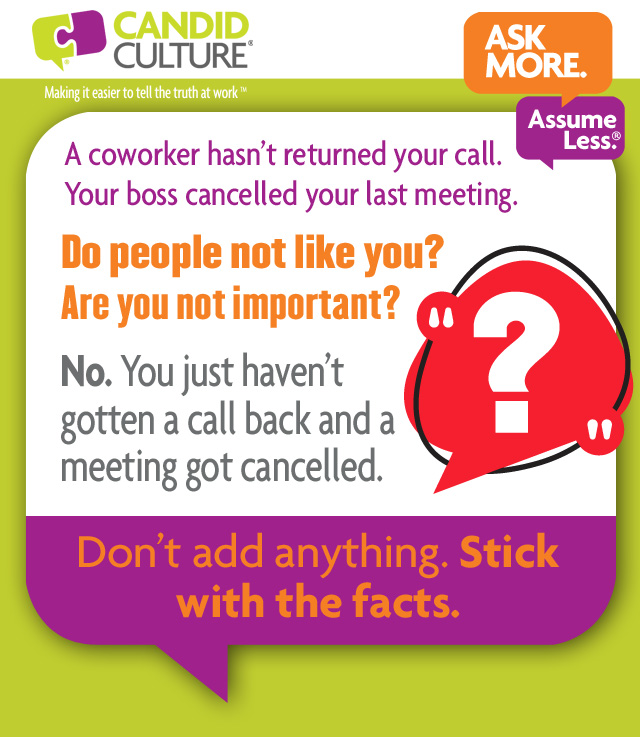
You interviewed for a job four weeks ago but haven’t heard back from the recruiter. You asked a coworker to have lunch, no reply. You asked a team member for a document, but after three emails, two texts messages, and a voicemail, still no reply.
It’s normal and natural to go to a dark place when we don’t get a response we’re expecting. We wonder, “Maybe they don’t like me? Perhaps they don’t want me involved in the project? Did I step on their toes? Maybe I asked in the wrong way?”
Wondering why we haven’t heard from people and inventing reasons for the lack of communication is normal and natural. It’s also exhausting and draining.
I’ll admit, I am on pins and needles after I deliver a training program, until I connect with my client to hear how they felt about the program. Even when I know I did a great job, I need to get the feedback and I’m on edge until I get it.
I’ve had enough training on communication and interpersonal relationships to know that others’ responses are usually not personal. People are busy taking care of themselves, as they should. They’re thinking about their own deadlines, deliverables, and the demands on their own time. Ninety-nine percent of the time they’re not thinking about us.
People are wired for self-preservation, and this very good and important. If you don’t take care of yourself, who will? The question, is how do we get our own needs met when we don’t get the response we’re expecting or the communication we need?
The most powerful approach is to remember that people’s response or lack thereof has nothing to do with us, and to let it go. Don’t be consumed with the lack of communication. Move on. You’ll hear back from the person when you hear back. This would be a powerful position to take, and it’s very difficult, at least for me.
The next approach could be to make up an interpretation that empowers you. You’re going to invent a reason you haven’t heard from the person, you might as well invent a reason that makes you feel good. For example, “The person participated in an escape room this past week and hasn’t made it out yet. They don’t have an Apple watch and have no way to communicate.”
Another approach is to set expectations when you begin working with people. Ask the recruiter, “If I haven’t heard back from you and a few weeks have passed, is it ok if I call to check in?” Ask your boss, “Is it ok if I reschedule meetings that get cancelled?” Ask your coworkers, “If I need information but haven’t heard back after three attempts, what should I do? Who else can I ask rather than wait?” Having a plan in place when you don’t get the communication you need will give you a clear course of action, rather than guessing.
But ultimately the most powerful – even if it’s the most difficult – response is to know deep down that the lack of communication is not about us.
We’ve all heard the expression, “It doesn’t hurt to ask.” But what if it can and does?
A past, full-time nanny told me she was planning to attend a party the night I had an overnight work trip planned. She told me I need to find alternative care for my son while I was out of town. I had made an agreement with the nanny when I hired her. She could take any day off during the year, except when I was traveling for work. And I would provide months of notice when I scheduled a work trip. Her request to attend a mid-week, party when I was traveling was incredibly stressful (for me) and made me question her judgment and her commitment to the job.
While it’s true that you won’t get what you don’t ask for, it’s also true that requests form others’ impressions of us. Some asks may create the impression that we’re difficult to work with. Other requests may create the impression that we’re out of touch or entitled. Be brave in what you ask for but also be judicious and aware of how requests may impact others.
So, what shouldn’t you ask for at work? What’s appropriate in one environment may not be ok in another.
Here are a few do’s and don’ts to follow when making requests:
Don’t ask for anything that requires your boss to break the rules or treat you differently from other employees. This may seem obvious, but I’ve been asked for things that I couldn’t legally provide. A candidate asked me to write them a monthly check towards their personal health insurance plan versus participating in our company-sponsored health insurance plan. It’s an innocent request but put me in a very awkward position and I said no.
Consider how your requests impact other people. Will your request for time off create challenges for your teammates?
Don’t ask for or take time off during the busiest times of the year. Ask your boss what those busy times are and then plan accordingly.
Don’t ask for exceptions unless you’re desperate – being paid in advance to cover unforeseen personal expenses, taking time off you haven’t earned, and using company resources for personal use. All of these may seem acceptable in the moment, but if they make your boss bend or break the rules, they’ll likely make you look bad too.
Be brave. Be bold. And be careful what you ask for. Your reputation is more important than a request that feels important right now but will be insignificant by next year.
“I don’t like my boss and my career is going nowhere in this organization, but we get free lunch and the office has a game room, so I think I’ll stay,” said no employee ever.
Employees enjoy free lunch and ping pong, but these perks don’t improve retention or performance. The only perks known to improve employee loyalty and commitment is time off, a flexible schedule, and the ability to work from home. Everything else is nice to have, but does not impact career decisions.
We’ve all heard about the great workplace exodus. Employees are leaving jobs in droves for a different life. To retain employees, a job has to work for employees’ desired lifestyle – the number of hours employees want to work, the amount of commuting and travel they want to do, and the social aspects that get met at work. Once those basic needs are met, leaders and managers can focus on other things.
Organizational leaders and managers have been led down a path of expensive distractions disguised as employee retention strategies. Eliminate the noise and focus on the four things that really matter to employees. And provided you meet your employees’ lifestyle needs, your best people will stay.
After lifestyle needs, this is what’s important to your employees:
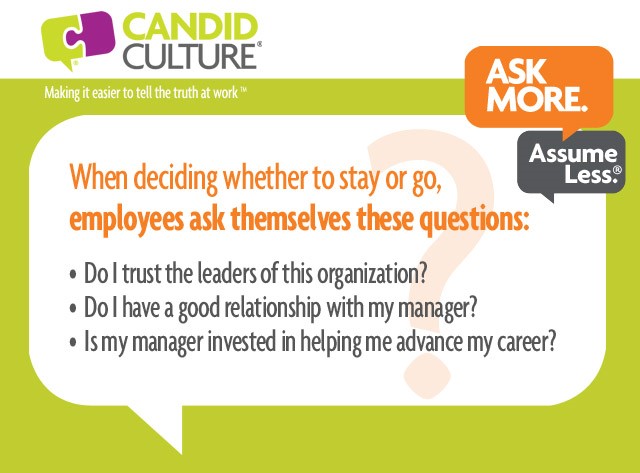
I trust the leaders who run this organization.
My opinion means something. I am listened to.
I feel respected (by my manager) and have good relationships in the organization.
My work is challenging and interesting.
So what should you do if you want to be a best place to work?
Here are Four Employee Retention Strategies Managers Can Take:
1. Meet one-on-one with employees and have meaningful discussions about performance and career goals.
2. Ask employees for their opinion and demonstrate that you’ve heard them.
3. Provide opportunities for employees to do work they enjoy.
4. Ensure employees who want to advance in your organization are learning and growing.
Read about our Be a Great Place to Work leadership training program that eliminates the noise and teaches the things leaders and managers really need to do to retain the best employees.