Last week we had movers in our warehouse moving products in and out of storage. The movers charged by the hour. Shortly after they arrived, I noticed one of the movers on his phone. Then I noticed another on his phone. I didn’t say anything. The phone use continued. So, I politely asked the two movers to only use their phones when they were on a break. And then I felt badly about saying something and spent the rest of the day apologizing. I didn’t want them to think I was ‘mean’.
I know it was ok to hold them accountable. I was paying a lot of money for their time. It was completely reasonable to expect them to be working. But I want to be liked and approved of (yes, even by the movers who I’ll never see again).
Every time I apologized or sought to justify my message, my communication lost power. Why say anything if I’m going to spend the day regretting and retracting my message?
After the experience with the movers, I realized how often I apologize for making requests, even perfectly legitimate and modest requests. And I’m wondering why I do this? Are we taught it’s not ok to ask for things?
Making requests is a subtle form of giving feedback. It’s less direct than what I call the “tell method.”
It’s ok to have expectations. It’s ok to make requests. And it’s ok to hold people accountable. I know this. You know this. And yet, I see how often I and others apologize for making requests and giving feedback. I feel like we need a regular pep talk – a little bird whispering in our ear each time we ask someone to do what we hired them to do. “It’s ok to ask. You aren’t mean. It’s ok to hold people accountable. If people don’t want to do the work they agreed to or can’t accept feedback, they’re not the right people.”
I’ll just keep giving myself that pep talk, because it’s ok to ask and not feel badly about it.
You receive a meeting request for April 5th. Your calendar is open, so you accept the request. You get asked to visit an out-of-state client on April 12th. Your calendar is open, so you say yes. You’re asked to make a presentation in place of a team member who is out of town, on April 14th. You want to be a team player, so you say yes. And soon what was a relatively slow month is booked with meetings, travel, and other commitments. Mid-month you’re tired, over-extended, and resentful. You want to be a good team member and a responsive professional. How do you do both without feeling tired and resentful?
One of the best pieces of advice I heard many years ago was to decide how to handle something before the situation presents itself. For example, if you’re trying to lose weight and you’re going to an event that will have an amazing buffet, decide what you will and won’t eat before you arrive. Choosing not to eat the desserts will be much easier if you’ve made that decision before the event rather than when you’re standing in front of temptation. Managing commitments and schedules can work the same way.
Before having a child, I worked 80 hours a week and traveled up to six days a week. After having my son, I realized that I didn’t want to keep that kind of schedule anymore. I needed to cut back. So, I created clear and specific boundaries for myself. I decided how many days a month I would travel, by what time I needed to arrive home from a trip, and how many speaking engagements I would commit to each month. When I received speaking requests, I honored my pre-established boundaries. If I was already on the road the maximum number of days, I told myself I would travel, I asked if the client could do a different month and if the answer was no, I turned the work down.
I never deviated from my established boundaries. And when speaking requests came in, the decision-making wasn’t a struggle. I didn’t have to decide if accepting a request would be too much. I’d already made the hard decisions about the schedule I would keep. So, each incoming request either fit into my already-decided-schedule or it didn’t.
I work for myself. I have latitude to make decisions about my schedule that I might not if I still had corporate job. So how do you make and share decisions when you’re not your own boss?
Decide what you want your schedule to look like. How many hours do you want to work a week? What time would you like to start and stop working on most days? How much travel are you willing and able to do? How many meetings can you attend a day and still get your work done, so you’re not working each evening or weekend?
Then communicate your desired schedule to the person you work for. Tell your manager how much travel you would like to do and the hours you would like to work. Then negotiate. You may not be able to maintain the schedule you want all the time, but you certainly won’t if you don’t make your desires known.
The time to tell your manager that you want to reduce your travel is before you’re asked to take a trip, not after. But it’s never too late. If you find yourself too busy or on the road too much, you can always have a conversation and renegotiate.
It’s been two years since I’ve traveled for work or done an in-person speaking engagement. I’m just now accepting speaking engagements that will put me back on the road. And I’ve realized that I need to reset my boundaries. Life has changed in the past two years. I need to re-adjust my commitments to myself. And the time to do that is before the next speaking requests comes in, not after.
When I was growing up, my dad rarely said no to anything I wanted to do. He just refused to pay for it. I wanted to do a 10-day, residential program for middle schoolers over the summer. He said, “Ok, but I’m not going to pay for it.” I wanted to study abroad. “Ok,” he said, “how are you going to pay for that?” I wanted to travel around the country. He said, “Ok, how are you going to make that happen?” He wasn’t going to stand in my way, but he wasn’t going to pave the way either. As a result, I became very resourceful.
Summers in college, I went to work for that residential, summer program so I got the experience. I got a job as a teen-tour counselor and got to travel around the country. And I found the least expensive study-abroad program that gave credit for travel. I figured it out.
My dad’s philosophy, “If it’s to be it’s up to you” must have come from my grandfather who I remember saying, “You can have anything you’re willing to work for.”
My takeaway: If there is something I want, there is always a way.
Sometimes people will say you can’t make something happen. Friends, family, and coworkers might say things like, “That will never work.” “Is that a good idea?” “Are you sure about that?” Or a manager at work might say, “That will be too costly. It’s too difficult.”
If you really want to make something happen, there is always a way.
Recently I was talking to someone with an ambitious sales goal. I asked her how she planned to meet the goal. She said she was putting her intention on the phone ringing. She was visualizing people calling her. I told her that was great, and perhaps she might want to make some calls.
Things might just land in your lap, but most likely they won’t.
Here are six steps to pursue goals when the world tells you not to or when what you want seems too big, too hard, and out of reach:
Get very clear on what you want. It’s very difficult to attain a vague goal.
Know the why behind your goal. Why you want something will keep you going when things get hard or feel impossible. For example, you want a job with international travel because you want to see the world. Or you want a job with less travel because you want to take your kids to school.
Don’t listen when people tell you that you “don’t really need that” or “it’s not that important”. Only you know what you really need.
Don’t talk about your goals with people who are unsupportive or questioning. The people in your life care about you and want to protect you. In doing so, they may be discouraging. It’s ok not to share what you’re working on until you’ve made it happen. All of a sudden you have a new house, a new job, or a baby on the way. The people in your life don’t need the play-by-play.
Take small, regular steps towards your goal. Creating what you want will likely take time.
Expect setbacks. Bumps in the road will happen. Setbacks are discouraging. It’s ok to take breaks and feel frustrated. Then pick yourself up and start again.
When there’s a will there’s a way. And there is always a way. Good things come to those who pursue them.
I wrote a repair person, who worked in my house, a two-page, single spaced list of all the things that needed addressing. Then I followed up with seven text messages. I don’t want people to have to guess what they have to do. I want to be thorough. It feels like the right and helpful thing to do.
The problem? The repair person didn’t read my list. It was too long. I would have been better off saving my time and saying nothing if he wasn’t going to read the list anyway.
When people send me an email with five paragraphs, my eyes glaze over. I close the email promising to read it later, but don’t until the sender asks if I received their email. People are busy and have to choose where to invest time. When it comes to communication, often, less is more. The question is, how to be succinct and still be thorough? How do you make sure people know what’s expected without providing so much information that nothing gets read?
I’m going to admit, I struggle with this.
I’ve decided to create some communication rules for myself. I’m hoping they’ll be helpful to you as well.
Draft communications and save them as a draft. Read them again a few minutes later and ask, “Can I say this in half as many words? Is all of this information necessary?”
Think communications through rather than communicating impulsively. I’m someone who operates with a high sense of urgency. I suspect my sense of urgency has helped me to be successful personally and professionally, but it also has me send messages before I’ve thought everything through, which leads to seven text messages, rather than one.
Limit yourself to one or two messages. When you know you can send only one email or text message, you’ll likely be more thoughtful about the communications.
Draft succinct instructions and then ask the person what they’re planning to do. This is a delegation technique. Require the person to whom you’ve delegated to tell you what they know or don’t know. Then you know how to help.
I suspect that providing the right amount of detail will be something I’ll struggle with forever. The key take aways are this:
People often don’t read long communications. If you can say it in fewer words, do so. Shorter is better. Be complete, but don’t go overboard. Make sure things are said only one time. If you’re not sure someone read or understood what you said or wrote, ask them what they heard or read. Don’t ask, “Do you have any questions?” Or “Does that make sense?” Both are waste-of-time, non-questions.
At the end of presentations, attendees often approach me and say something like, “People tell me my communication style is really direct and that it can be off putting. I don’t know what to do about this.” Or they say, “People say I’m really quiet and hard to read. They have a difficult time getting to know me.”
If you’ve been given the same feedback repeatedly, or know you create a first impression that may be challenging to others, set expectations and tell people about your communication style when you begin working with them. Don’t wait until they feel offended, confused, or frustrated. Simply tell people when you meet them, “I’ve been told that I’m too direct and how I provide feedback can be off putting. Anything I say is to be helpful. If I ever offend you or provide too much information, I hope you’ll tell me.” Or you could say something like, “I’m told that I’m quiet and it’s hard to get to know me. I’m more open than I may appear. If you want to know anything about me, feel free to ask.”
People will make decisions about and judge you. There is nothing you can do about this. But you can practice what I call, ‘get there first.’ Set people’s expectations about your communication style and what you’re like to work with, and then ask people to speak freely when they aren’t getting something they need.
The root of frustration and upset is violated expectations. People may not be aware of their expectations of you or be able to articulate those expectations, but if they didn’t have certain expectations, they wouldn’t be upset when you acted differently than how they (possibly unconsciously) expected.
I’m a proponent of anticipating challenges and talking about them before problems arise. If you know something about your behavior is off putting to others, why not be upfront about it.
When people interview to work for me, I set clear expectations about my communication style and what I’m like to work with. I tell them all the things I think they’ll like about working for me and all the things I suspect they won’t. I tell them the feedback I’ve received from past employees and things I’m working to alter. People often nod their heads and say, “no problem,” which, of course, may not be true. They won’t know how my style will impact them until they begin working with me. But when I do the things I warned them would likely be annoying, we can more easily talk about those behaviors, than if I had said nothing.
Talk about your communication style when projects and relationships begin. Replace judgment and damaged relationships with dialogue.
Running effective meetings is hard. It takes courage. Who wants to tell their boss, peers, and customers to put away their phones, stop side talking, and laser their communication? No one. But if you don’t manage ‘bad’ meeting behavior, you look bad and you won’t get the results you want.
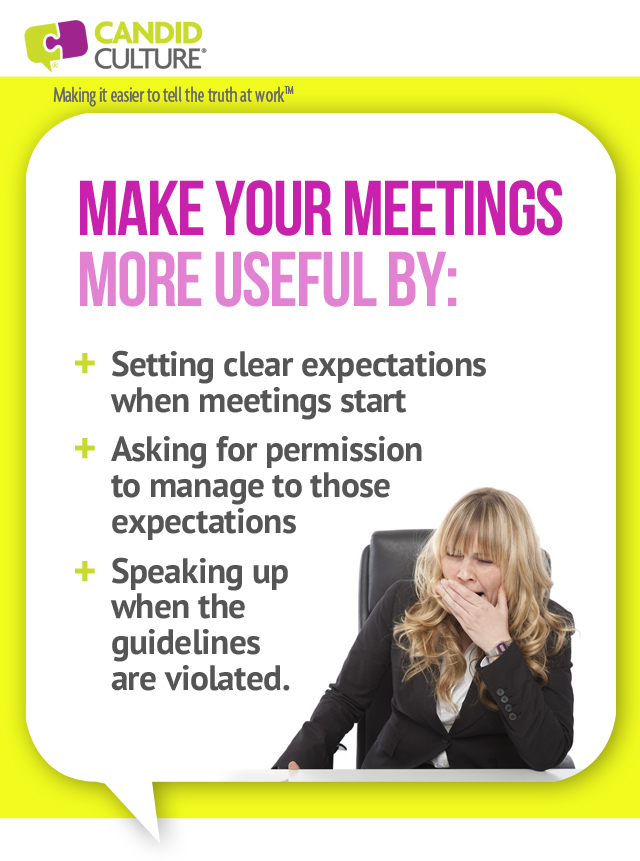
If you run meetings, work with the meeting participants to set expectations everyone agrees to follow. Standard meeting guidelines for running effective meetings include not side talking, putting away or silencing electronics, tabling tangents, not interrupting others, speaking succinctly, etc. You can set any behavior guidelines you like as long as the meeting participants agree to those expectations. Ask meeting participants what behavior guidelines they want to follow. The more control you give people, the more buy in you’ll get.
Possibly even more frustrating than running a meeting in which participants break all the ‘rules’, is participating in inefficient meetings when you aren’t the facilitator. It’s difficult to sit through a poorly run meeting feeling there isn’t anything you can do to make it better.
Luckily, there are things you can do to improve the meetings you don’t run. None of my suggestions will be comfortable. But think of all the time you’ll save.
Conversation one – running effective meetings: If you want to impact the meetings you attend, approach the facilitator(s), empathize about what a challenging meeting it is to run, tell the person you want to be supportive, and ask if they want to discuss some different ways to manage the meeting. That conversation could sound something like, “Wednesday’s staff meeting is tough to run. I empathize with you. Would you be interested in talking through some different ways to manage participant behavior? I have some ideas and would be happy to discuss. I’d like to be supportive.”
Conversation two – running effective meetings: If you want to be more direct, you could say something like, “Can we talk about Wednesday’s staff meeting? It can’t be an easy meeting to run. I empathize with you. Key decision makers are missing meetings, and a few people tend to take over the conversation and take us off track. Can I make a few suggestions that might help? What do you think of working with the group to set some expectations people agree to be managed to and then holding people to those agreements? We can share the facilitation responsibilities by assigning jobs during the meeting – back up facilitator, note taker, timekeeper, etc. – so all of the responsibility doesn’t fall to you. What do you think?”
The person running the meetings knows they’re not going well. They just don’t know what to do about it. Offer support. Don’t judge. Be helpful and possibly they’ll be receptive.
The key to running an effective meeting is to set clear expectations people agree to follow, review those expectations at the beginning of every meeting, and speak up when the expectations are violated. All of these things take courage. But meeting participants will be grateful to you for being strong.
When you feel you’ve been wronged, it’s natural to want to lay into the offending person, give negative feedback, and tell him exactly what you think. The problem with doing this is that as soon as a person feels accused, he becomes defensive. And when people are put on the defensive and feel threatened, they stop listening. And you’ve potentially damaged your workplace relationship.
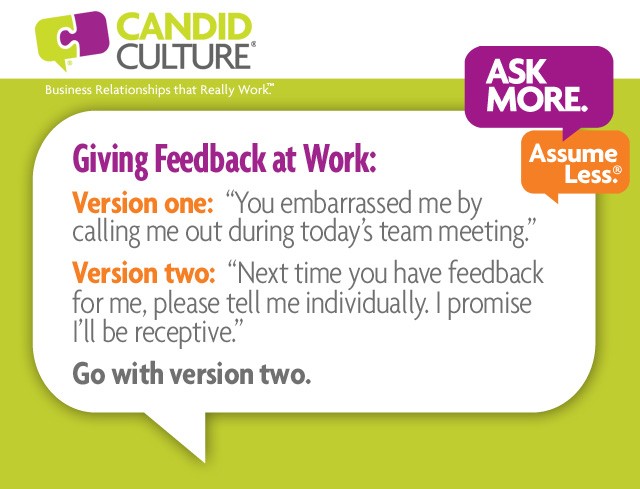
When someone does somethingfor the first time that violates your expectations, use the lowest level of intervention necessary. Allow the person to save face, and ask for what you want, without giving an abundance of negative feedback and pointing out all the things he’s done wrong.
Likewise, when you cut your finger while cooking, you put a Band-Aid on your finger. You don’t cut off the finger. This is true with business communication too.
When you’re facilitating a meeting, you can ask the two people who are side talking to stop, or you can go third grade on them and ask, “Is there something you want to share with the rest of us?” Both methods will stop the behavior. But one embarrasses the side talkers a lot, the other only a little.
Likewise, when one of your coworkers takes credit for your work, you can give feedback and say, “I noticed you told Mike that you worked on that project, when we both know that you didn’t. Why did you do that?” Or you can skip the accusation and ask a question instead, saying, “I noticed you told Mike you worked on that project. Can I ask why you did that?” From there you can have a discussion, give feedback if you need to, and negotiate.
When your boss doesn’t make time to meet with you, rather than saying, “You don’t make time for me. That makes it hard for me to do my job and makes me feel unimportant.” Instead consider saying, “I know how busy you are. Your input is really important in helping me move forward with projects. How can we find 30 minutes a week to connect so I can get your input and stay on track?”
In each of the situations above, you’d be justified in calling the person out and giving negative feedback. And it might feel good in the moment. But being right doesn’t get you closer to what you want, and it can damage your workplace relationships.
Practice good business communication –say as little as you have to, to get what you want. If this method doesn’t work, then escalate, communicate more directly, and give direct feedback. The point is to get what you want, not to make the other person look bad. The better the ‘offender’ feels after the conversation, the more likely you are to get what you want in the future.
Many people worry about giving feedback because they fear they don’t have the ‘right’ words. They’re concerned they’ll say ‘it’ wrong and damage their relationships.
Feedback is hard enough to give without worrying about saying everything perfectly. Worry less about having all the right words and more about whether or not people trust your motives.
When people trust your motives – why you’re giving feedback – you can say almost anything. When they don’t trust your motives, you can say almost nothing.
Getting negative feedback is hard. It’s easier to listen to feedback when we trust the person who’s giving us the feedback – we know their intentions are to help versus to judge or hurt us.
Speak from the heart, be authentic, and worry less. Be yourself. If you’re nervous to say what you want to say, tell the other person you’re nervous. If you’re struggling to find the right words, say so. If you’re worried you’ll damage the relationship or that it isn’t your role to give the feedback, say that. Authenticity goes a long way.
How’s how to give feedback you’re apprehensive about:
How to give feedback example one: Consider saying, “There’s something I need to talk with you about, but I’m concerned that I won’t use the right words and will damage our relationship.”
How to give feedback example two: “There’s something I want to talk with you about, but I’m concerned how it will come across. Is it ok if I say what I need to say?”
How to give feedback example three: “I want to give you my thoughts on something, but I’m concerned that it’s not my place to do so. Is it ok if I share my ideas about _________?”
Other people aren’t expecting you to be perfect. But they do want to know they’re working with a human being. And human beings are fallible. We have fears. We make mistakes. And sometimes we don’t say things perfectly.
You don’t have to be perfect; you just have to be real.
Think about all the people in your life who frustrate you. The employees who turn in work without checking for errors. The person who cancels meetings two minutes before meetings are scheduled to start. And in personal relationships, our friends who come late, cancel, or just aren’t in touch as often as we’d like.
These situations annoy us, but we often don’t say anything because giving feedback feels too hard. Why risk the person’s defensiveness? Or we don’t think addressing the situation will make a difference. Or perhaps we don’t feel we have the right to speak up.
Giving feedback can be hard. Asking for what you want is easier, but most of us aren’t clear about our requests and expectations.
The question is why? If making a request is easier than asking someone to change their behavior, why not ask for what you want upfront? Why wait until expectations are violated to make a request? The answer is simple.
We don’t think we should have to make requests. We assume our employees, coworkers, and friends will do things as we do. And most of these assumptions are unconscious. We don’t even think about it.
We would never turn in work without checking it for accuracy or come to a meeting late. We would never not send a thank you card after receiving a gift or miss a close friend’s birthday, so we (unconsciously) assume others won’t either. And when people violate our unstated expectations, it feels too hard to speak up, so we don’t.
I’m going to suggest you approach relationships differently –more proactively.
Ask for what you want at the beginning of a relationship, project, or meeting. Make requests at the onset of anything new. Set clear expectations. If you want to start and end meetings on time, tell people that during your first meeting. If it bothers you when people wear shoes in your house, tell visitors when they arrive, or even better, tell them before they arrive.
If you have an existing behavior you want to shift, simply say, “I realized I didn’t tell you that starting and ending meetings on time is really important to me. Going forward, we’re going to start and end all meetings on time. So please be ready for that.” Tell visitors to your home, “I realized that I forgot to tell you that we don’t wear shoes in our house.” It’s never too late. Don’t expect people to guess you’re frustrated and alter their behavior without you making a request. It’s not going to happen.
Consider all the things that annoy you. Then consider what you did or didn’t ask for. If you haven’t made your expectations clear, it’s not too late. Asking for what you want is easier than you think.
People have a tendency to talk about us, not to us. If you haven’t been gossiped about, you just need to meet more people.
If you have something to say, say it directly to the person involved. If you’re not going to speak to the person directly, say nothing at all. As we all know, this is easier said than done. Gossip will destroy relationships, organizational cultures, and careers faster than anything else. And we are all tempted to gossip.
Most of us consider gossip to be saying something bad about someone else when that person isn’t there. But what if we say something good?
The strictest definition of gossip is talking about another person while she is not present. But for our purposes, let’s say gossip is talking about another person so as to alter how others think about that person.
Several years ago, I took a year-long class with about eighty other people. The class met one weekend a quarter over twelve months and had a few ground rules, one of which was no gossip. Participants couldn’t gossip anywhere, at any time, during the class’s entire duration. No gossip with friends, family, or coworkers for a year.
When the class started, I assumed the no-gossip guideline would be no problem for me. Then I started to notice my behavior. At the time, I was a director in my organization and had one friend at work who was my typical confidant. Most of us have “our person” at work—someone we confide in and complain to. The two of us would sit in my office with the door closed, talking about all the bad decisions the leaders of our company had made. The moment I began paying attention to the no-gossiping rule, I realized that not only did I gossip, but I was good at it and even enjoyed it. (Oh, come on, admit it—it’s fun.)
The problem is that gossiping breaks trust. If a coworker gossips with you about someone else, he will talk about you to someone else. You are not special or different. (Well, you are, but you know what I mean.) You are not exempt.
As you rise in an organization, you have exposure to more and more sensitive information. You know about employees’ performance ratings, the organization’s financial results, and impending layoffs. One criterion of promotion is being able to be trusted with sensitive information. If the senior people in your organization think you’re a gossip and can’t be trusted to keep confidences, your career is going nowhere.
People will never stop gossiping. It’s one of those human things. We all do it, and we aren’t going to quit. The best we can hope for is to reduce the amount of time we spend talking about other people behind their backs.
I won’t suggest you stop gossiping. I merely suggest you bring attention to the gossip circulating throughout your organization. Bringing attention to the gossip circulating in your organization will raise awareness, and reduce the gossip, just a little bit.
** This blog is an excerpt from the book How to Say Anything to Anyone.