Career Management Archive
People get defensive when they receive negative feedback. It’s hard not to. Everyone wants to be seen as competent, and when we receive negative feedback, our competence is called into question, so we react.
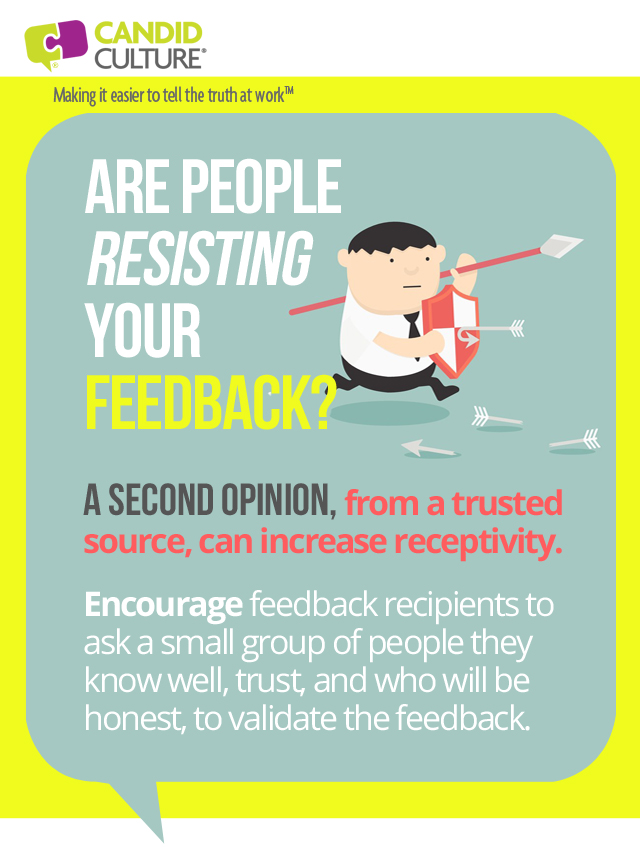
There are several things you can do to reduce others’ defensiveness – ensure you have trusting relationship and thus have earned the right to give feedback, watch your words, deliver feedback in a private setting, etc. But for today, I’m going to focus on getting a second opinion.
If you want people to be more receptive to your feedback, consider encouraging them to get a second, third, or fourth opinion. I’m a fan of casual 360 degree feedback – when we ask for feedback from people we work with both inside and possibly outside the organization. Think of 360 degree feedback like an orange, it’s all the way around, like a sphere. When you get 360 degree feedback, you gather input from all the different types of people you interact with, thus getting a more comprehensive and accurate picture of performance. There are different types of 360 degree feedback. 360 degree feedback ranges from the formal – an online, anonymous survey (I’m not a fan) – to casual conversations (which I recommend). In this instance I’m suggesting something I call The Core Team.
I suggest everyone has a Core Team of about five people who care about you, know you well, and have your back. Most important is that you trust these people. You Core Team may be personal or professional relationships, or a mixture of both. You may have worked with Core Team members or not. What all Core Team members have in common is that they know you well, want what’s best for you, and will tell you the truth when asked.
My core team consists of a friend from high school, two people I used to work with, and my parents. When I get feedback that I’m having a hard time reconciling, I ask people on my Core Team to validate the feedback. It doesn’t matter if they’ve worked with me or not. I am who I am. I do the same annoying stuff in my personal and professional relationships. So a personal Core Team member can provide valid, professional feedback and vice versa. Sometimes they agree with the feedback I’ve been given and sometimes they don’t. But I always get compelling information to think about. And because I trust the people on my Core Team, I listen to what they have to say.
Don’t be disheartened if people don’t trust your feedback and aren’t receptive. Instead, see their resistance as human and encourage them to get a second opinion. And then talk again. Listening to and incorporating feedback is a process. It takes time, courage, and patience.

As crazy as it sounds, your manager is afraid of you – afraid of your defensive reaction to feedback.
The normal reaction to feedback is to get upset. The problem is, no one wants to deal with our upset. It makes them uncomfortable. So managers and peers alike start to pick and choose what to tell us. Not wanting to deal with our reaction, they start to pick their battles. The more defensive we are, the less feedback we get. The less feedback we get, the less information about our performance we have. The less information we have about our performance, the less control we have over our career.
All of us have been passed over for an opportunity at work – a promotion, raise, project, etc. – and for the most part, we have no idea why, because no one wants to risk our defensive response to tell us. This lack of knowledge makes it hard to manage your career. And to be frank, defensive people are extraordinarily difficult to work with. Having to watch every word, walk on egg shells, and be choosy about what to address and what to avoid is exhausting. Be receptive and thus easier to work with.
I teach managers to screen out candidates who aren’t coachable and receptive to feedback. Work is hard enough without hiring people who aren’t coachable. Being open to feedback makes you easier to work with.
Here are three ways to be open to feedback and increase receptiveness:
Tip one to be open to feedback and increase receptiveness: Don’t underestimate the power of your emotions and the intrinsic drive to defend yourself when receiving feedback. Not defending oneself is extremely challenging. And even the most minor reaction sounds defensive. I.e., “Thank you for the feedback. Here’s why we did it that way…”
Tip two to be open to feedback and increase receptiveness: Wait a few minutes, hours or days, and respond to feedback when you’re calm. That could sound like, “Thanks for telling me. I’m sorry that happened. I’m going to think about what you said and get back to you by the end of the day.”
Tip three to be open to feedback and increase receptiveness: Come from a place of curiosity when seeking feedback versus thinking “there’s something wrong here” and “I’m bad.” Be curious about how you impact others and the impression you make. Seek feedback to understand both.
When I landed my first ‘real’ job after graduating from college I was so scared, I almost turned  the job down. It took me five years to finish my first book, How to Say Anything to Anyone, in part because I was afraid no one would like it.
It seems anything worth doing is worth fearing.
I’m not talking about taking risks for the sake of risk – driving as fast as your car can take you, not paying your bills to see what will happen, or offering a counter point of view at work for the sake of doing so. I’m talking about pursuing the things you really want, that speak to your true purpose.
Being afraid doesn’t mean you can’t do something, nor does it mean that you shouldn’t. Feeling some fear just means what you want is outside of what you know you can do. But it’s the edge and the unknown that is juicy and rich.
During the past few years I’ve pursued things I’m terrified of, that I don’t know I can do. Yet I want these things, so I pursue them in the face of fear. And I have to admit, that as I get closer to getting what I want, the fear doesn’t dissipate, it actually gets worse. As I can almost taste having what I want, I get more scared. And sometimes I pull back, thinking, maybe I don’t really won’t those things. Maybe I was wrong. Then I remember why I want what I want and step back into the pursuit, despite the fear.
Don’t misinterpret fear as a reason not to do something.
A few suggestions for how to face your fears at work:
1. Write your desires down and/or tell people what you want.
- You’re more likely to get what you talk about wanting.
2. Take one step towards having what you want.
- Talk to someone who either has what you want or can help you get what you want.
3. Put yourself in the place of most potential, where you can get what you want.
- If you want to work in a certain department, express interest in working on a project that serves that department.
- Tell your boss and people in leadership in your desired work area of your interest.
- Apply for a job in that area.
4. Be positive and persistent.
- No one wants to give a complainer an opportunity, and it takes time to make a shift.
The key is to take one step, then another, then another. And when you feel fear, don’t let it stop you. Fearing the next job or opportunity doesn’t mean you can’t do it well, it just means you haven’t done it yet.
When you need encouragement to face your fears, hang our inspiring magnets at your desk. You have to believe in yourself just as much as the people around you believe in you.

We added to our team at Candid Culture a few weeks ago, so we did what I teach other organizations to do –used Candor Questions to onboard our new team member, and help the entire team get to know each other better.
I sent my team the Candor Questions below and asked them to pick a few additional team building questions for everyone on the team to answer.
- What will keep you working here and what would make you leave?
- What’s the best way to get information to you – voicemail, text, or email?
- What time is too early?
- What time is too late?
- Do you leave your email and/or text alerts on at night/when you go to sleep?
- Would you prefer I send all emails and text messages during regular business hours?
- What frustrates you at work?
- What are your pet peeves?
- What’s something you want to learn, skill or business wise, that you haven’t had a chance to do?
- What’s something you wish I would start, stop, or continuing doing?
We run so fast at work and are so focused on completing goals, we often don’t take the time to really get to know the people we work with. I feel very strongly that asking the team building questions above will help people work better together. We’ll make fewer ‘mistakes’ with each other, and get more done with less stress and more ease. As William Ury said in his book, Getting to Yes, “Go slow to go fast.”

How many times have you sent someone five emails and become frustrated when none were returned? Or you thought an employee was happy, only to be surprised when she quit? Or you needed to talk with someone but couldn’t get her attention, so you walked by her office throughout the day, wondering if it was ok to knock? Working with other people doesn’t have to be so hard.
Taking the time to ask team building questions is much faster than recovering from missteps with other people. Ask the questions at the beginning of anything new – when you hire a new employee, get a new customer, or start a new project. And keep asking the questions as you work with people.
Asking questions about working style preferences and goals is an ongoing process, and it’s never too late. You can ask the team building questions during meetings or just slip them into your conversations. The process doesn’t have to be formal or time consuming. The point is simply, don’t guess what people need and are expecting from you, ask.

Most people wait way too long to give feedback. We wait for the right time, aka when we’re comfortable. That day will not come.
Instead of waiting to give feedback until you’re about to explode in frustration, or until a formal review, give feedback every time you meet with someone.
Managers, make it a practice to meet with each of your employees at least once a month. Twice a month or weekly would be better. But if you’re not doing one-on-one meetings now, start meeting monthly. If you’re meeting monthly, start meeting twice a month. Employees need face time with their boss. Team meetings and casual conversations do not replace individual meetings.
Direct Report One-on-One Meeting Agenda:
The direct report comes to the meeting ready to discuss:
1. What she’s working on that is going well.
2. What she’s working on that is not going well.
3. What she needs help with.
4. Then the manager gives feedback on what went well since the last meeting and what could be improved.
5. And the employee gives the manager feedback on what has gone well since the last meeting and what could be improved.
Feedback goes both directions. Managers, if you want your employees to be open to your feedback, ask for feedback from your employees on what they need from you. Give feedback on both the work and your working relationship. A poor working relationship often motivates employees to leave a job, but it’s the last thing that gets discussed.
Feedback discussions should be short. You can say anything in two minutes or fewer. No one wants to be told she isn’t cutting it for 20 minutes. Say what you need to say and end the conversation or move on to another topic.
If you’re not giving your employees regular feedback, you can use this language to start:
“I’m realizing that I’m not giving you enough feedback. I want to be helpful to you. If I don’t provide regular, timely feedback, I’m not being as helpful as I could be. I’d like to start a regular practice of meeting monthly, getting an update from you on how things are going, and giving each other feedback on what went well and what could be improved since our last meeting.”
 If you work for someone who is not forthcoming with feedback, ask for feedback. You’re 100% accountable for your career. Don’t wait for your manager, customers or peers to give you feedback. Ask for feedback on a regular basis.
Here’s how you can ask for feedback from your manager:
“Your feedback helps ensure I’m focused on the right work. Can we put a monthly meeting on the calendar, and I’ll tell you what I’m working on, where I do and don’t need help, and we can discuss how things are going?”
If meetings get cancelled, reschedule them. If your manager says these meetings aren’t necessary or she doesn’t have time, tell her, “Your regular input is helpful to me. What’s the best way to ensure we catch each other for a few minutes each month?” Meaning, push the issue.
If your manager still doesn’t make time for the meetings or doesn’t provide clear and specific feedback, even when you ask for examples, ask your internal and external customers and coworkers for feedback. The people you work closely with see you work and will likely give feedback, if asked.
No news is not necessarily good news. Waiting six months or a year to receive performance feedback is like going on a road trip from St. Louis to Los Angeles but not consulting a map until you arrive in New York, frustrated and far from your desired destination.
Managers: Meet with employees monthly, semi-monthly or weekly, and give feedback every time you meet.
Employees: Ask your managers, customers, and coworkers for regular feedback, and take control of your career.

Most people avoid giving feedback because they’re concerned about (don’t want to deal with) the other person’s defensive response. It’s easier to say nothing than deal with someone’s defensiveness. So we say things are fine when they’re not.
If you want people to tell you the truth, do the opposite of what they expect when responding to feedback. Rather than become defensive, say, “thank you.”
Saying “thank you for the feedback” is not intended to be a pollyanna response, nor does it mean you agree and that the person is right. Saying “thank you” catches the other person off guard (in a good way) and buys you time to think and respond calmly, making it more likely that you’ll get feedback in the future.
Each of us wants to be thought well of and be seen as competent. Negative feedback calls both into question and the brain responds defensively. The challenge is that defensive responses scare other people into silence. And you only need to get defensive once for people to believe that you don’t deal well with feedback.
Don’t underestimate the power of your emotions and ego. You are likely to respond to feedback defensively, even if you don’t see yourself do it. A seemingly benign ‘explanation’ of why you did something as you did it, is seen as defensive and is thus off putting to others.
Here are six strategies for responding to feedback well:
- Responding to feedback strategy one: Have feedback conversations when you have the time to listen and are rested. If you’re tired, on a deadline, or rushing to your next meeting, the conversation will not go well.
- Responding to feedback strategy two: If someone catches you off guard with feedback and you know you won’t respond well, interrupt the person. Tell him that you appreciate him bringing this to your attention and you want to give the conversation the attention it deserves, but now isn’t a good time. Schedule a time to finish the conversation within a few days.
- Responding to feedback strategy three: Have a plan for how you’re going to respond to scheduled/planned feedback conversations before the conversations start. Tell yourself, “I will say thank you, end the conversation, and ask for another time to talk.”
- Responding to feedback strategy four: If you receive feedback that doesn’t feel accurate, ask others, who you trust, what they think. Just be prepared to hear what they have to say, and, of course, respond with “thank you.”
- Responding to feedback strategy five: Don’t respond to negative feedback in the moment, even if the other person wants you to and you think you can do so without being defensive. Don’t underestimate the power of your emotions. You will be upset, even if you don’t feel upset, and your response will be better after you’ve had time to process. Tell the person who gave you feedback that you take their feedback seriously and want to respond thoughtfully, and thus you’re going to think about what s/he said before responding. People may be frustrated with this response at first, but they’ll be appreciative later.
- Responding to feedback strategy six: Be sure to get back to the person, who has feedback for you, within a few days. Tell him you thought about what he said and then tell him how you feel. You can speak candidly. Your words will be calmer and more thoughtful then when you received the initial feedback.
We know people are hesitant to give feedback. Make giving you feedback easier by responding calmly. No one expects to hear “thank you for the feedback.” Your unemotional response will strengthen your reputation and relationships, and make it more likely that you get more feedback in the future.
Each time we go to the pediatrician’s office, my son’s doctor tells me to relax and enjoy my son more. And each appointment, I’m surprised. “What do you mean,” I ask? “Don’t all parents come to each appointment with a typed list of questions?” Apparently not.

It’s unfathomable that last year at this time, I was getting ready to have a baby. Grayson’s first year has flown by, but not without a lot of lessons. The learning has been fast and at times painful.
Working parent lesson one: Stop trying to be perfect. I’m annoyed with myself, in all aspects of my life, for not being perfect. Regret is amplified with my son. Tonight he fell and shed blood for the first time in his young life. And I was standing right there. He hurt himself on my watch. As I replay the incident in my mind, all I can think is, “How did I let that happen and how do I prevent it happening again?” My family reassured me that every kid hurts himself and it will happen again and again. Intellectually I know this, and yet, I’m in denial about it, thinking if I’m vigilant enough, I can protect Grayson, ensuring that everything is always…perfect.
Working parent lesson two: Go to bed earlier. When Grayson was born I was given the sage advice, “Sleep when he sleeps.” I didn’t. And I’m writing this when I should be asleep. I’m more patient and present when I sleep. I’m a better parent, manager, leader, and business owner when I sleep.
Close out the email. Get off the internet. Go to sleep.
Working parent lesson three: One of my friends told me that most babies’ emergency room visits are for things the parents didn’t know the child could do. Yesterday Grayson crawled out of the tub unassisted. I didn’t know he could do that. He’d never done it before. Each time he does something he’s never done before, I’m caught off guard. He’s fast, agile, curious and smart. I can’t underestimate him. And this isn’t too different from work.
Don’t underestimate the people you work with. They’ll do great things, if you let them. Set big goals. Be clear in your expectations. Coach, support, and get out of the way.
Several people have asked me about my greatest surprise in parenting. I have to say, it’s the love. The huge, limitless, crazy love. Perhaps I need to extend it to myself, and stress less and enjoy more.
Happy first birthday to Grayson. My greatest love and teacher.






The first time my now eleven-month old son stood up in his crib, I didn’t see it. I was sitting in his room watching him at the time. I was literally watching him in his crib, and yet I didn’t notice when he stood up for the first time. I wasn’t looking at my phone or talking with someone else. It was just he and I in the room, and yet I was so distracted with whatever I was thinking about, I didn’t ‘see’ him stand up for the first time.
When he was born, I was given the advice to stay present. And I scoffed at that advice. Of course I would stay present.
Living in the present sounds so simple. When you walk, walk. When you eat, eat. When you work, work. We’ve all heard this advice, and yet, it’s so hard to do.
Before having a baby, I would lie awake in bed at night worrying about the vendor who wasn’t the right fit, a decision I needed to make, or something I needed to finish. Now I think about those things when I’m ‘with’ my son – watching him, but not seeing.
If we’re thinking about anything other than then what we’re doing, we’re not living in the present moment. Instead, we’re focused on either the past or the future. And this is where stress and anxiety live. If we only think about what’s happening now, it’s impossible to be stressed, anxious, or worried. The question is how to stay present when our brains want to do anything but.
Here are seven strategies for living in the present moment:
Live in the present strategy one: Write down everything you need to do, so you can free your brain from thinking about it.
Live in the present strategy two: Don’t over commit or over plan. Plan days with a schedule that you can easily achieve. Over committing causes stress and worry.
Live in the present strategy three: Only commit to do things you really plan (and at least in your personal life, really want) to do.
Live in the present strategy four: Give yourself a limited and prescribed time to talk about a problem and/or to worry about it. When the time is up, let it go and think about something else. Ask the people around you to help hold to this time limit. If you bring the topic up in conversation, ask your colleagues to point out that you’re still focused on the problem and refuse to have the conversation with you.
Live in the present strategy five: Remind yourself (from moment to moment) to be present. When I’m with my son, I remind myself to really be with him and not thinking about or doing something else.
Live in the present strategy six: Compartmentalize your time. Determine how long you’re going to do something, and only do that activity during that time period. When the time is up, move on to something else. When I’m not with clients, I spend half of each workday with my son. And when I’m with him, I don’t have my phone so I’m not tempted to check my email. When I’m with him, I’m really with him.
Live in the present strategy seven: Leave your phone some place you can’t see it. We are addicted to these little people separators. I find that one of the only ways I don’t check my phone, is not to carry the phone with me.
Being in the present moment requires discipline. If you want to feel more peaceful and less stressed, think only about what you’re doing. Let everyone else worry about the rest.

When I had knee surgery a bunch of years ago, the surgeon told me, “I didn’t fix your knee. I altered it.” He was trying to set the expectation that my knee wouldn’t be perfect, it would be different.

Violated expectations are at the root of disappointment, frustration, and broken relationships. We think, “I expect you to do or be a certain way and you’re not, so I’m unhappy.” If you want to be more satisfied and less frustrated, change your expectations. I don’t mean lower your expectations. I really do mean change them.
I had a baby last year and had no idea how difficult it would be have someone I barely knew (our new nanny) take care of him. It was tortuous until I got the sage advice, “You’re not going to get everything you want. Pay attention to the big things and be ok with good enough.” That’s hard for me. I have high standards and I want things done a certain way (my way). But I also don’t want to do everything myself. So I find myself altering my expectations and being ok with good enough. And it’s very, very difficult.
You likely want each of your employees, coworkers, boss, clients, and vendors to do things a certain way. Sometimes they’ll meet those expectations and sometimes they won’t. Decide what you must have, communicate those expectations (repeatedly if necessary), and let the rest go.
Here are four steps for setting expectations at work:
Setting expectations step one: Consider everything you need or want from a person. Make a list, even if it’s just for you.
Setting expectations step two: Determine what that person is capable of providing. What’s realistic given who they are and the constraints they’re under (financial, time, skills, experience, etc.)?
Setting expectations step three: Reset your expectations, if necessary.
Setting expectations step four: Ask for what you want and be specific about your request. Telling someone, “This needs to get better,” will get you nothing. Telling someone, “I’d like to be included in each meeting that relates to this project and cc’d on all pertinent emails,” may just get you what you need.
As William Ury said in his book Getting to Yes, be hard on the problem and easy on the person. When you address violated expectations, simply share what you expected to have happen and what actually did happen. That could sound like, “I thought we agreed I would be invited to each meeting pertaining to this client. There was a meeting last week I wasn’t invited to. What happened?” Watch your tone of voice when asking this question. Be neutral and curious.
Changing your expectations will likely be a daily occurrence. People won’t necessarily do things your way or even in the way you hoped. Decide what you must have, and let the rest go. Just think of all the time and aggravation you’ll save.

Breakdowns happen. There will be days people won’t give you what you need to complete projects. Things will break. And you will look bad. When breakdowns happen, I always ask myself, “What could I have done to prevent this situation?” or “What did I do to help create this situation?” I see myself as accountable for whatever breakdowns occur.
It may sound odd that I always look at myself when breakdowns occur, even when it’s someone else who didn’t do her job, but it’s just easier. I can’t control anyone else. But I can control me (admittedly, some days I do a better job at this than others). When I can identify something I could have done to make a situation go differently, I feel more in control – aka better.
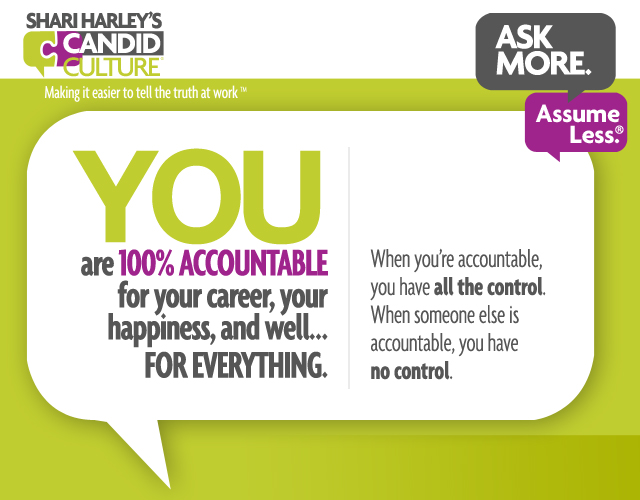
It’s like getting off a highway versus sit in bumper-to-bumper traffic. The alternate route may take longer, but at least I’m moving. I feel like I’m doing something and thus have more control. Taking responsibility for everything that happens to you is similar. When you’re accountable, you can do something to improve your situation. When someone else is accountable, you’re at the mercy of other people and have very little control.
There are, of course, exceptions to the practice that “we’re always accountable.” Terrible acts of violence, crime, and illness happen to people, about which they have no control. But in general, in our day-to-day lives, there is typically something we did to contribute to a bad situation or something we can do to improve it.
Here are four practices for improving difficult situations, even when you didn’t create the mess (alone).
1) Increasing accountability in the workplace: Ask more questions. If you’re not clear about what someone is expecting from you, ask. You’re responsible for doing good work, regardless of the type of direction you receive.
2) Increasing accountability in the workplace: Tell people what you think they’re expecting and what you’re planning to do, to ensure everyone’s expectations are aligned. Clarifying expectations beats doing several weeks worth of work, only to discover what you created isn’t what someone else had it mind.
3) Increasing accountability in the workplace: Ask for specific feedback as projects progress. Don’t wait until the end of a project to find out how you performed.
4) Increasing accountability in the workplace: Say “thank you” to whatever feedback you receive versus defending yourself. People will be pleasantly surprised and their upset will dissipate more quickly. That could sound like, “That’s good feedback. I’m sorry that was your experience. Thank you for telling me.”
5) Increasing accountability in the workplace: Admit when you make a mistake or when you wish you had done something differently. Don’t wait for someone to tell you. Saying, “I’m sorry. How can I make this right with you?” goes a long way.
I am always asking the following questions:
“What could I have done differently?”
“What did I do to contribute to this situation?”
“What can I do now to make this situation better?”
I encourage you to ask these questions, even when someone else drops the ball. You can’t control others, but you can control you. And your happiness and success is your responsibility.