Business Relationships Archive
Conference calls taken on speaker phone, listening to music without headphones, and a posse of visitors, make the people working in a cubicle nearby want to permanently work from home.
The key to being able to ask your coworkers to move the conversation to a conference room is the same as giving any type of feedback –set expectations and ask for permission to speak candidly.
 Working in a cubicle is challenging. Here is some language to make it easier to ask your coworkers to pipe down:
Get the people who sit in your work area together to talk about your working environment.
That conversation could sound like this, “It’s often pretty loud in our work area. I was wondering if we could set some guidelines of how we’ll manage our workspace, so it works for everyone? What do you think of establishing some practices we all agree to follow? For example, when making or taking phone calls, everyone will either use the handset or a headset. We won’t take or make phone calls on speaker phone. We’ll always use earphones if listening to music or watching videos. If a conversation in a cubicle lasts longer than five minutes, people will take the conversation to a conference room. And when these guidelines are broken, and they will because we’re human, it’s ok to say something.
We could even have a system to let people know it’s getting loud and that a guideline is being broken. With everybody’s agreement, we could throw a nerf ball into the loud cube, put a note in front of the person, or simply walk over and ask the person to take the conversation elsewhere. I want our work environment to work for everyone and make it easy for us to speak up without being concerned that we’re going to hurt someone’s feelings or damage relationships. What do you think?”
You DON’T need to be a manager to do this. Take control of your working environment by asking for what you want. Initiating this conversation may feel odd and uncomfortable, but I assure you most of the people you sit with will be grateful you had the courage to start the conversation.
 You can say anything to anyone at work when you have permission to do so. Suffering is optional. Make requests today and follow up when things get loud. You can do it!
Read How to Say Anything to Anyone and get the words to make even the hardest conversations easy!
There are several mistakes most professionals make while attending conferences, training sessions, and other networking events. Avoid these common practices, and you’ll get great value from networking events that will more than justify your time away from the office and far exceed the price of attendance.
Business Networking Tips
Mistake Number One: Skipping meals and other social events.
Many busy professionals have a hard time leaving work to attend networking events, conferences and training sessions. We don’t think we have time and may be worried about how our absence will appear, so we spend ‘down time’ at events catching up on email.
Don’t think of time in the exhibit hall, meals, cocktail hours, and other social events as down time. Think of those events as just as important as keynote and breakout sessions. You never know who at the conference has a vendor you’ve been looking for or a solution to one of your challenges.
Mistake Number Two: Talking with the people you already know during meals and social events.
It’s natural and comfortable to sit and talk with the people you know. The problem is, you already have access to those people. You can already call them to ask questions and problem solve. You’re attending the event to expand your network. The more people you talk to, the bigger your pool of potential future job leads and problem solving peers.
Most people are uncomfortable talking to people they don’t know. When you introduce yourself to new people, they let out a sigh of relief. They are grateful that you took the risk of introducing yourself. When you feel nervous in groups of mostly strangers, remember that everyone is nervous.
Mistake Number Three: Introducing yourself by telling people what you do.
“Hi, I’m Lauren Adler. I’m an Accountant” is a show stopper, not a conversation starter. The other person replies, “I’m Mary Guest. I’m an Analyst.” Then the two of you look at each other and wonder how to get out of the conversation. Rather than introducing yourself with your title, ask a question.
Here are a few questions you can ask when meeting fellow attendees:
- What’s one challenge you’re facing in your organization?
- What’s a resource you need, that I might be able to refer?
These questions are much better conversation starters than “Hi, I’m an attorney. What do you do?”
Ask one question, listen to the answer and then ask the next natural question. Provocative questions are a great way to build new, meaningful relationships.
Mistake Number Four: Not ending conversations soon enough.
We’ve all gotten trapped in a conversation and wondered, “How do I graciously get out of here?” When a conversation is over, end it by saying, “It’s been great talking with you. I’m going to meet some other people.” Just be honest. You’re doing both of you a favor by freeing each other up to meet someone new.
Mistake Number Five: Letting groups of people intimidate you.
Break into groups by walking up to a group of people talking and simply ask, “May I join you?” They will say yes. And when you’re ready to leave the group, who probably knew each other before the event, simply say, “It was great meeting all of you. Enjoy the meeting.”
Mistake Number Six: Hanging out by the buffet, in the bathroom, or in your phone.
The buffet cannot hire you.
It’s very tempting to catch up on email or Facebook updates while waiting for speakers to begin and meals to be served. Hiding out in our phones will not get you your next client nor expand your network. It may feel safer and easier to be distracted by your phone during a networking event or to visit the bathroom more than you really need to. Risk a little. Remember that everyone is just as nervous as you are. Approach someone you don’t know, and ask a question.
Much of the reason we attend events is to tap into the collective years of experience of other attendees. Get the maximum value from events by attending all social events and meals, talking with exhibitors and fellow attendees who you don’t already know, and putting away your phone. You never know who has the solution to your greatest challenge or from where your next customer or job offer will come.
A few years ago, the guy I was dating asked, “We don’t really need to do anything for Valentine’s Day do we?” I was taken aback by his question (which was really a statement) and replied, “No, we don’t.” But I didn’t mean it. And when he blew off the ‘holiday’ I was furious and let him know it. Instead of having dinner on Valentine’s Day, we had an ugly conversation and a lousy rest of the week. Asking for what I wanted upfront would have been much less painful.
Why is it so hard to ask for what we want, especially from the people who love us? Here’s how to get what you want on Valentine’s Day and every day:
We aren’t likely to get what we don’t ask for. The people in our lives can’t read our minds. They don’t know what we want. This is true at home and at work. If you want a report to look a certain way, sketch it out for your employees. If you want a meeting handled in a certain fashion, give detailed instructions. For the most part we expect things to go well and thus we delegate insufficiently at work and hope to be pleasantly surprised at home.
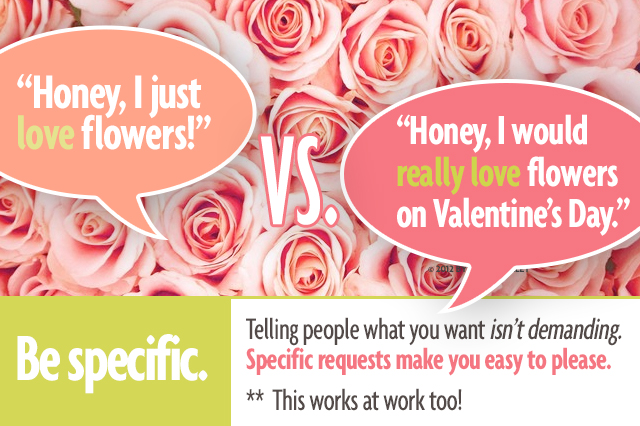
I hope the people who love you, know you well enough and are intuitive enough to give your heart what it wants on Valentine’s Day, and every day. But if they don’t, make it easy for them to please you by telling them what you want. For example, tell the person you love, “I’d love to spend Valentine’s Day together. I don’t care what we do, as long as we’re together.” Or, “I don’t care what you do for Valentine’s Day, but please do something to mark the day.” And if you want something specific, ask for it. “I’d love flowers on Valentine’s Day, despite that they’ll die and are impractical. Anything but roses and carnations would be lovely.”
Ask for what you want and see what happens.
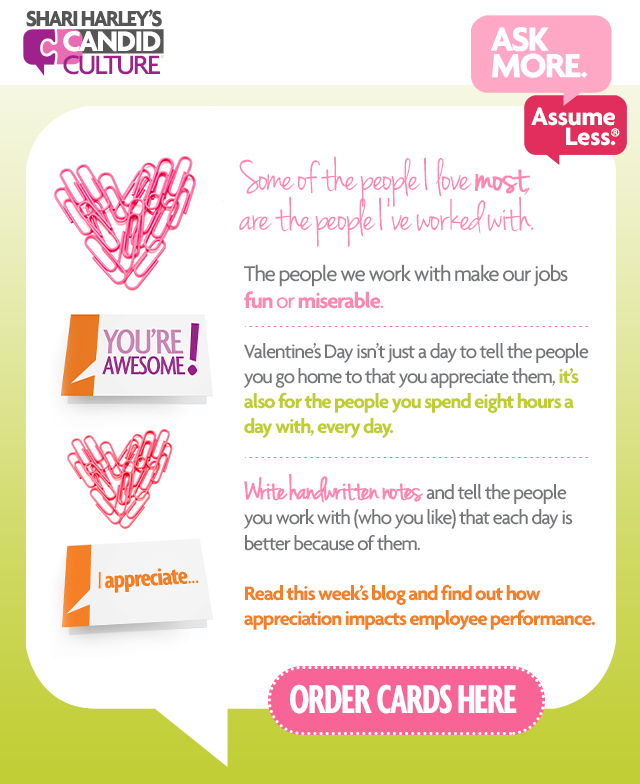 Whenever I leave a job, the thing I take with me are the relationships. The projects and deliverables quickly become distant memories, but the people and the experiences we shared together stay with me. Some of my closet friends and the people most important to me in the world are the people I’ve worked with. It makes sense that we make friends at work; it’s where we spend a lot of time. And the people we work with make work fun or miserable.
There is a considerable amount of research citing the connection between having good business relationships and employee engagement, retention, and high performance. When we feel we belong and have good relationships at work, we are happier and do better work. It makes perfect sense.
As I’m writing this, I’m thinking about my coworkers with whom I spent weeks on the road, who endured a presentation, practice session for an upcoming town hall meeting that lasted until 1:00 am, and the coworkers I worked with in the World Trade Center. As much as I appreciated and cared about the people I worked with, I not sure how often I told them that they made my work world better.
Valentine’s Day is a day we express appreciation for the people closest to us. Don’t limit your appreciation to your loved ones at home; include your coworkers who make your work fun and who help you get things done. Of course, I hope you’ll tell express appreciation more than once a year, but Valentine’s Day is an occasion not to miss.
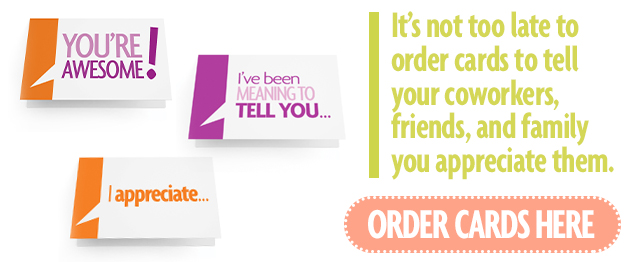
Write the people you work with, who matter most to you, a handwritten note that they’ll keep for a long, long time. You can see our assortment of greeting cards for the workplace here. I’ll admit that I collect stationary and love giving and receiving handwritten notes. I suspect the people you work with will appreciate receiving a handwritten note too.
Click here to see all of our greeting cards:

No one likes to make mistakes. We want to do good work and have people think well of us.
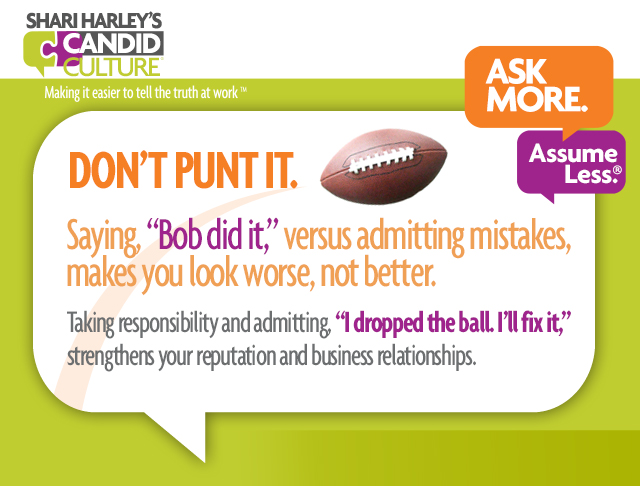
The key to maintaining your relationships and reputation, when you make a mistake, is to take responsibility and make things right as soon as possible. Saying something wasn’t your fault or becoming defensive will only damage your reputation and relationships. As counterintuitive as it sounds, you will gain respect and credibility by admitting fault and correcting problems.
I often get asked if people lose credibility by being humble – asking for feedback and admitting to making mistakes. It takes strength to ask for and be open to feedback and to admit when you drop the ball. So while it may seem counterintuitive, the more you ask for and respond to feedback, and admit when you make mistakes, the stronger you will appear.
I made a mistake at work. Now what?
When you make a mistake say something like:
“I dropped the ball on that. I apologize. I’ll fix it and let you know when it’s been handled.”
Or, “Thank you for the feedback. This clearly didn’t go as planned. I’ll make those changes and let you know when they’re done.”
Also, let people know the steps you’ll take to avoid similar challenges in the future.
You could say something like:
“Thanks for letting me know that our process is causing your department challenges. We certainly want the process to be smooth. My team will fix this month’s report, so your team doesn’t have to invest more time. We’ll update the process for next month and walk you through the changes before the report is due.”
Don’t provide a bunch of reasons for breakdowns. No one cares. Telling people why something occurred can sound like excuse management. People just want to know things will be made right.
Asking for feedback, taking responsibility, and telling people how you will correct errors may not be your natural or first reaction. The more you can train yourself to do these things, the easier you will be to work with and the better your reputation and business relationships will be.

Click here to download free questions to find out what your coworkers and internal and external customers are satisfied with about your performance and what they wish you would do differently.
For the most part, people are afraid to speak up at work. Despite the town hall meetings and roundtable discussions executives host, the feedback training offered, the existence of ask-the-CEO email addresses and blogs, and employee satisfaction and engagement surveys, many employees are still afraid to give feedback at work, citing fear of damaging relationships, being fired, and other forms of retaliation.
Those of you who have worked with me, read How to Say Anything to Anyone, and/or used our tools, know that I am on a quest to make it easier to tell the truth at work.
The Candid Culture Vision:
- Coworkers, leaders, and managers set clear expectations before problems occur. No one has to guess what is expected of them and what a good job looks like.
- Employees ask for and receive regular, balanced and candid feedback and always know where they stand performance wise.
- Managers and leaders are open to and ask for feedback. They always know what’s really happening in the organization and can lead accordingly.
- People talk to each other versus about each other. Gossip and drama is the exception, not the norm.
- Work is a fun place to be. People enjoy working together and produce their best work.
Many of you are taking actions to create the environment I’ve described above. I want to hear from you and want to use this blog to share practices for creating more candid communication at work.

Add a comment and tell us:
- What you are doing to increase the trust and communication in your organization.
- The avenues you are using to give feedback on your team, in your department, or in your entire organization.
We’ll enter you to win 50 of our new door tags. The door tags were designed to tell your coworkers that your office is a place they can speak freely, without concern.
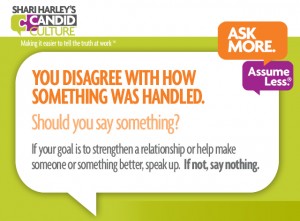 Most of us grapple with whether or not we should give feedback when someone else does or says something frustrating.
Here are a few criteria to help you decide whether or not you should give feedback or say nothing:
- Do you have a relationship with the person? Do you know each other well enough to share your opinion? Aka, have you earned the right?
- Has the other person requested your opinion? Unsolicited feedback often goes on deaf ears.
- If the other person has not requested your opinion, does he appear open to hearing feedback?
- Are you trying to make a difference for the other person or just make him look or feel badly?
- Do you want to strengthen the relationship?
Before you give feedback, do something I call, ‘check your motives at the door.’ If your motives are pure – you want to strengthen the person or the relationship, and you have a good enough relationship that you’ve earned the right to speak up — then do it.
People are more open to feedback when they trust our motives. If we have a good relationship with the person and he knows we’re speaking up to make a difference for him or for the relationship, you’ll be able to say way more than if your motives are questionable – aka you want to be right.

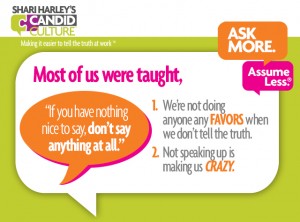 Last week I was on plane and the woman in back of me kicked the back of my seat throughout the flight. It made me nutty. The guy next to her talked so loudly, I’m pretty sure the people six rows in front and behind him could hear the conversation. And no one said anything.
Many of us don’t return food in restaurants that isn’t good. We often say nothing when people drop the ball and make mistakes. We replace ineffective vendors and service providers rather than tell them where they’re falling short.
People usually claim they aren’t giving feedback because they don’t want to hurt the other person’s feelings, think the person is not likely to change, or because they’re not sure if their complaint is valid. I don’t buy most of these reasons.
I think the real reason we aren’t giving feedback is because we don’t want to deal with the other person’s reaction. We are concerned – often rightly so – that the person will kill us off. We will be given the cold shoulder, excluded from projects, or thrown under the bus.
You may be wondering why I, who wrote a book called How to Say Anything to Anyone and who teaches other people to give feedback, didn’t speak up on the plane last week. I too have been trained to pick my battles and that if I have nothing nice to say, say nothing at all. Each day I also grapple with when to speak up and when to let things go.
The concern over giving feedback will get better if the people in our lives – personal and professional relationships – agree it’s ok to tell the truth and agree that there will not be negative consequences for doing so. Open and direct conversations will be had. Disagreements will be discussed and resolved as best they can. And when the conversation is over, it’s over. People can’t hold the conversation over your head or hold a grudge.
It would be difficult to agree to open and honest communication with the people who sit behind you on planes, but you certainly can make that agreement in your office and with your family and friends. Agreeing to tell the truth without consequence can be one of your organization’s values and a practice you establish in your personal relationships.

You can hire people who understand they are expected to speak candidly and then let disagreements go. And you can manage people who don’t speak up, who hold grudges, and who punish people for giving feedback. You can tell friends and family that you want candid relationships in which challenges are dealt with quickly and then the disagreement is over.
Making the request for open and honest communication and assuring people there will be no negative consequence for doing so is the differentiator between being able to speak up when you’re frustrated or say nothing.
Last week I was upset, really upset. I worked hard to practice what I preach when giving feedback – wait to talk until I’m calm, ask questions, and no matter what happens, don’t send a text message. It was hard, really hard.
I was mad and wanted to say, “What the *&^#$@?” But I know that when people receive negative feedback they feel judged. And when people feel judged, they become defensive, making it very difficult to hear what the other person is saying and have a conversation.
When my emotions don’t get the best of me, I plan hard conversations by asking myself these questions:
- What do I want to have happen as a result of the conversation?
- How do I need to approach the conversation to get that result?
Knowing that if I want to have a good conversation, I need to reduce the other person’s defensiveness, I often start feedback conversations by asking the neutral question, “Help me understand; what happened the other day?”
Last week one of my employees tipped me off that the people who work for me are on to me. They’ve read my book. When I ask, “Help me understand; what happened the other day,” they know that feedback will follow.
You don’t want to approach your relationships and conversations in a formulaic and inauthentic way. Inauthenticity stinks and it can damage relationships more than freaking out will do. But it’s not a terrible thing to put someone on notice. If the people who work with me know that negative feedback follows the question “what happened,” they know the conversation is important. Yes, they’ve been tipped off and perhaps as a result they’re on the defensive, but I still think asking “what happened yesterday” is a heck of a lot better than raising your voice, accusing, and asking questions later.
Asking questions to discuss thwarted expectations is hard to practice. It takes great self-management, which I don’t always have. I mostly practice what I teach, and when I don’t, I clean up the mess I’ve made, apologize and recommit to doing so in the future. And you can do the same.
A Few Practices to Consider:
Holiday Promo – $12 a book for 7 or more books.
- Wait to give feedback until you won’t freak out, but don’t let situations fester and become bigger than they need to be. Have the conversation as soon after an event as possible.
- If something is important to you, ask for it. Trying to persuade yourself that it isn’t a big deal and might be your issue, probably won’t help. We want what we want. Be true to yourself.
- Consider starting hard conversations with “help me understand.”
And when you find that you’ve put the other person on the defensive and s/he feels judged, work to do better next time. But in the end, speaking up is always better than stuffing how you feel, even if you handle the conversations differently than you had planned.
When I was 27 my boss gave me a yellow sticky note that said “thanks” for something I had done well at work. When I was 29 he gave me a card when I broke up with a long term boyfriend. I still have both. And I’m way past 27 and 29.
He is the only manager in my entire career who wrote me a personal note. And it meant everything to me. He took the time to do something others didn’t. The notes were personal and thus they meant something to me – they still do. And the notes took him only seconds to write and cost almost nothing.
When is the last time you received a handwritten note? Not a note from Send Out Cards, that is made to look handwritten, or a note written by someone’s assistant, or a note that was typed and then hand signed? Rather, a real handwritten note, with a message, just for you? My guess is not in a long time.
Your employees like perks – paid time off, gift cards, bonuses, onsite yoga classes, concierge service, etc. But perks are not what result in engaged and retained employees. There is a lot of research on what results in employees doing their best work and being loyal to both their manager and to the organization.
Here’s a snap shot of some of the research on engaging and retaining employees.
Employees:
- Need to trust senior management
- Want to work for someone who cares about them, is invested in their success, and with whom they have a good relationship
I won’t tell you not to give bonuses or gift cards, but I will tell you to give each bonus and gift card with a handwritten note. The handwritten note will mean more and last longer. I promise you.
I admit I love stationery. In fact, I collect it. I always have a stash of cards, ready to go for any occasion. And if you know me long and well enough, you will receive a handwritten note from me.
Because I love stationery so much, I’ve always wanted to create a line of greeting cards, and now we have. Today we’re launching Candor Cards. Thank you notes for employees designed to help you say what you want to say.
Use the cards at work and at home to:
- Say thank you
- Provide encouragement
- Give positive feedback
- Say you’re sorry
- Reinforce training
I hope you like and use our thank you notes for employees! Enjoy!
Spend less. Say more.