Indecision plagues many of us at work.
- Hire the person or source additional candidates?
- Let the employee go or keep him?
- Launch the software implementation or wait?
- Gather more technical requirements or move forward with the information you have?
- Ask for different responsibilities or look for a job?
- Announce upcoming organizational changes to all employees or just to the leadership team?
We meet and discuss, meet some more, discuss some more, and still don’t decide. Endless meetings, discussions, and indecision exhausts and discourages employees and costs money.

Do your due diligence:
- involve the people closest to the work in making the decision;
- gather enough information to make an informed decision;
- get key stakeholders’ buy in;
- then decide and act.
And if it’s the wrong decision you’ll know soon enough and can course correct.
The indecision is often worse than making the wrong decision. My friend and colleague Steve Shapiro author of Goal Free Living would say that the only wrong decision is not making one.
But we know there are decisions that have negative consequences, which is why we’re often hesitant to make decisions. If we make the wrong decision families, careers, and companies are impacted.
So we wait and discuss, dialogue, and debate, over and over and over. Follow the steps above regarding due diligence and decide. Don’t wait too long or stay too long. It’s not good for anyone, especially you.
Even after working in the corporate arena for 18 years, I am amazed at how much people talk about other people. I’m a little embarrassed that gossip in the workplace still catches me off guard. I used to live in New York City. How can I be this naïve?
Last week I talked with a friend I used to work with. She still works for the company where we worked together. She told me that Michael, one of our old coworkers, was job hunting. “How do you know that?” I asked. She said Bob the IT manager had told her, and Lisa the marketing director had told Bob. Lisa is friends with Michael. Michael must have confided in Lisa, who told Bob, who told my friend, who told me. I have, by the way, changed everyone’s names, so as not to tell the rest of the world that Michael is job hunting. But in the event that you have an open job that would be a good fit for Michael, perhaps I should put his real name and email address here.
Michael trusts Lisa. But Lisa clearly isn’t trustworthy. I’m sure she thinks she is, but clearly, she can’t keep information to herself. Lisa trusts Bob to keep a secret, but clearly Bob can’t and neither can my friend.
So what does this say? Everyone is a liar and no one keeps confidences? No, I’m actually saying neither of these things.
I really believe that people think they keep a confidence when they share information like this. We rationalize telling ourselves, “I only told one person, and Bob won’t say anything. I trust him. And Michael wouldn’t mind if I told Bob. They’re friends. And even if he did mind, Bob needs to know because if Michael leaves it will impact IT.” And so it goes.
I’m not telling you this to make you paranoid. I’m saying it to make you careful.
I have started to assume that whatever I tell someone will be told to someone else. And it makes me more careful about what I say and write, especially what I write. Don’t put anything in an email you wouldn’t be comfortable being forwarded to someone else.
You may be wondering how this is possible. There is no one who keeps a confidence? How can you run a business like that? Anything I tell someone will be told to someone else? Not if you’re talking to an outside consultant, a business coach, your attorney or accountant, but inside your organization, yes. People have a tendency to share gossip in the workplace with their inner circle –the people in the organization they’re close to. So be careful. Watch what you say and to whom. And assume that whatever you tell someone may go elsewhere. Consider the upside –you can use your coworkers to share news that you don’t have time to broadcast yourself.
Unfortunately people taking phone calls via speaker phone, listening to music without headphones, and entertaining a posse’ of visitors in his/her cube is not limited to the movie Office Space, which should be required viewing for anyone who works with other people.
Cubeland can be loud. And most people are hesitant to ask our coworkers to quiet down. We’re afraid of the conflict. We don’t want our coworkers to dislike us, talk poorly about us when we’re not there, or kill us off. So we suffer in silence, hoping the person will get a clue that he’s making us crazy. He won’t. If he knew the phone calls bugged you, he would have already stopped making them.
You may find it incredulous that your coworkers don’t know how annoying noise in cubeland is. It’s an obvious, no brainer. How could they not know?

Much of Candid Culture’s work is dedicated to people feeling more comfortable telling the truth at work. But even with books, and training on how to establish candid relationships and tell the truth, speaking up is often challenging. So know that if you are doing annoying people at work, they are not likely to tell you.
Here’s what you can do: Avoid annoying people at work. For your convenience, I’ve made a short list.
- Conversations, music, and phone calls taken on speaker phone in cubicles. Take the meeting or conversation to an empty office or conference room.
- People who are late for meetings and text or email throughout meetings.
- People who start most sentences with, “No we can’t do that, and here’s why.”
- People who say they’ll do something and miss the deadline every time.
- People who borrow your stuff and don’t return it.
Look at how much stress I’ve saved you. Now you don’t need to give the people you work with feedback, you can just forward them this blog, which is a passive aggressive form of feedback. But it beats throwing their phone out the window or hiding out in an empty office so you can actually get some work done.
If you choose candor instead (which I, of course, prefer) simply say, “It’s hard to work when music is playing, or when you’re on your speaker phone, or you’ve got visitors in your cube. I know space is at a premium. But if you’d be willing to take the conversations elsewhere, I’d really appreciate it.” Done in twenty seconds or fewer. And no one died. You can do it. And if you can’t, call me, and I’ll do it. It’s always easier to have these conversations when they’re not your own. But it will cost you a bag of chocolate chip cookies or perhaps a Candor Bar.
The sprinkler guy just left my house, after teaching me the nuances of how sprinklers work for TWO hours. I don’t want the details about how the sprinklers function. I don’t care. I just want them to work. And I told the sprinkler guy this. But he insisted on teaching me –a.k.a. dragging me to each broken sprinkler head and having me observe as he repaired it. Exasperating! Then he billed me for his time. Without the lesson the visit would have been 30 minutes and $45. With the lesson, it was two hours and $130.
Read your audience. Are you putting in too much work?
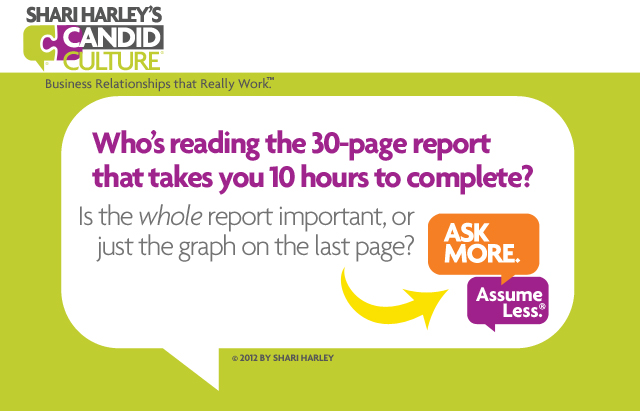
Where are you over communicating? Who’s reading all of those PowerPoint presentations and reports? Just because you’ve created that report for the past five years doesn’t mean it’s still necessary or desired.
Ask your internal and external customers (everyone you work closely with) how they want to receive information, in what format, and how frequently.
Ask internal and external customers:
- Do they prefer to receive information in bullets or narrative form? Detailed or big picture? Graphs and/or charts?
- What information is important and what is unnecessary?
- Who needs to receive the information? People have enough to read. Most people won’t be insulted to receive one fewer email.
- How often do they want to receive the information?
I am hesitant to change processes when I begin working with an organization, assuming there is a good reason they exist. But when I ask why we do certain things as we do, invariably no one can tell me. I am often told, “We’ve just always done it that way.”
Don’t change things just to change them. And before you make a change, consult those who are impacted. Ask what people want and what they don’t. Then make changes. You may just pick up 10 extra hours each week and reduce your and others’ frustration 20 fold.
Most professionals spend their work day constantly checking email. An email comes in, and we feel compelled to reply. We put aside the project we were working on and promise ourselves we’ll get right back to it. But then we receive five more emails, and so most days go. As a result, many people start doing their actual jobs at 5:00 p.m.
When was the last time you did an hour and a half of actual work without being drawn into your inbox? My hunch is, not in years.
Email has become a noose and an albatross.
I too have fallen into the constantly checking email, time-sucking trap. Every email must be returned immediately. Or worse, I open emails, read them and say I will reply later, but never do. I promise myself I’ll go back to the old, unanswered messages only to get distracted by the many more emails that have piled on top of the existing emails. Older messages get buried, never to be returned. And I, in turn, become a seemingly unresponsive flake.
The days that I discipline myself to read my email only after working on a project for a good chunk of time, are the days I get the most done and feel the most in control of my day. We have all started our work day with a well-intentioned list of things to do, only to find that at the end of the day we did none of them. This lack of control feels terrible and is unbelievably stressful.
Most time management books and training programs recommend checking email at certain intervals during the day –once in the morning, once in the afternoon, and once at the end of the day. Read an email once and resolve it. Reply, delete, or forward the message to a more appropriate person. But this is hard to do. What happens if we don’t reply immediately? Will we look bad? What will we miss?
One of the keys to having a balanced life and true down time is to be disciplined about how you spend your working hours.
What if we made July, check-your-email-every-three-hours month? How much more would we get done? How much more relaxed and free would we feel?
I’m going to try it, and I’m expecting you to keep me true to my word. If you send me an email and I reply immediately, you’ll know I have failed and have been sucked into the Outlook vortex of lost time. But if you read my reply, I’ll know you’ve been sucked in too.
I admit it, it’s one of my pet peeves –calling someone and getting a voicemail message that says the person is traveling and will return to the office on May 24th, when it’s July 1st. I don’t know why this bugs me, it just does. It creates the impression that the person is a little out of it.
While we’re on voicemail pet peeves, why not list a few more:
- voicemail messages that sound like the message was recorded from a busy, street corner
- a voicemail message that promises to return your call as soon as possible, when this person never returns calls
- people who leave LONG messages with a phone number that is said so quickly that even after listening to the message four times, you can’t make out the number
- emails that say the person is out of the office, but don’t say when she is returning
Be careful and aware of the impression you’re creating.
Are your voicemails and emails consistent with how you want to be perceived by others? Do you even know? Call your phone and listen to how your voicemail message sounds. And if you don’t think others will like what they hear, change the message.
Unless I’m out of town or steeped in laziness, I go to a yoga class most Monday nights. There is another class in the same studio right after the class I attend. During the last few minutes of this week’s class, people attending the next class began to congregate outside the studio and were talking loudly enough that our class could hear them. The teacher walked outside and asked them to be quiet. Then she walked back into the room and told our class that she just did something she doesn’t typically do–speak up. When the class was over she went back outside and apologized to the people she’d asked to be quiet.
Why!? Why!? Why!?
What is the big deal with giving feedback and asking people to do something differently?
Unless you live in a cave, this happens to you too. People talk near your office or cubicle and it’s distracting, but you don’t feel you can say anything. Someone in your office cc’s your boss every time he wants something from you. It annoys you and makes you distrust the person, but you don’t feel you can say anything. The people sitting in front of you at a movie theater talk throughout a movie, it’s annoying, but you’re hesitant to say anything.
Again, why, why, why!?
I already know what you’re going to say. People will be angry at you for speaking up at work and will kill you off.
That may be true, but what the heck?! That’s crazy. We do stuff. It annoys other people. They tell us. BIG DEAL! No one died.

My entire business, Candid Culture, is focused on helping people feel they can be more candid at work. Speaking up at work is a struggle in every organization. People are afraid to give feedback. They fear retribution –real or imagined.
Make a pact with each other that it’s ok to tell the truth. And that people will take the feedback in the spirit it was intended –to make something better, not to be critical. Give each other permission to be candid without consequence.
The more often you find yourself speaking up at work and giving feedback, the easier it will be.
There are things in our lives that bug us, but we put up with them. They’re often little things like a burned out light bulb or a messy drawer in which we dump stuff that doesn’t have a real home. Maybe the bulb has been out or the drawer has been a mess for so long that we no longer even notice it.
Our workplace isn’t any different. There are things in your organization you’re tolerating. Perhaps a process or software is inefficient, but you don’t say anything to the people in your organization who can do something about it. Or maybe you said something a few times, but you didn’t feel anyone listened and you gave up.
Organizations are comprised of doers and leaders. And organizations need both. If everyone wants to lead, you’ll have trouble. If no one leads, you’ll have even more trouble. Doers keep things going from day-to-day. Leaders create opportunities, fix problems, and upgrade existing conditions.
I’m often asked to coach managers in organizations. The coachees’ boss tells me, “He’s a great employee. But if he wants to move up in this organization, he needs to be a leader.” And more often than not, the employee is confused by what the manager wants. Coachees say things like, “I give my opinion in meetings. I volunteer for stuff. What else does my boss want?”
I tell my coachees the most straightforward thing I know to transition from a doer to a leader –improve processes and look for opportunities to fix things that are broken.
Want to know how to become a leader in an organization? Ask these questions regularly:
- What in the organization frustrates people? What could we do differently to ease people’s frustration?
- Where do we have mediocre results? What’s the breakdown?
- Where are we wasting money? Where are our costs too high? Where are we losing revenue?
- What processes take longer than they need to? Or where is there a lack of process?
- Where do we have inefficiencies and redundancies?
- What practices work in one department that could work in another?
Leaders in organizations are always looking for ways to make things better. They look for opportunities and (picking their battles) pursue solutions. Pursuing a potential change does not mean asking your boss or department leader once or twice. It means telling someone in a position of formal authority about a missed opportunity, asking permission to make a change, and then doing the work required to make it happen. Leaders do not tell their boss about a problem and walk away. Leaders suggest and implement a solution.
If you read your organization’s handbook carefully you will see, in the very fine print, the rule stating that there will be three people in your organization who no one can work with. Everyone knows who these people are. They are the people who employees are afraid of, who tend to make others’ lives hard, and who no one wants to work for.
Employees wonder, doesn’t anyone in management know about these people? Why isn’t anyone DOING anything? Someone is most likely doing something. Dealing with difficult coworkers just take time to work themselves out. And managers can’t talk about others’ performance with you, as you wouldn’t want them talking about your performance with others.
What to do in the face of a crazymaker who doesn’t appear to be going anywhere?
Crazymakers are often bullies and bullies push the people around who let them do so. Despite your fear, give it right back to a bully. Chances are she will back off and find someone else to pick on. Do this professionally. Don’t compromise your own reputation by interacting with a bully in the way she interacts with you.
Work around the person. I’m not giving you a pass to avoid the people you don’t like working with. If you have done everything you can to work well with someone and he won’t work with you, do your minimal best. Be polite and respectful. Keep the person in the loop when necessary. But don’t go out of your way to nurture the relationship. You can’t work with someone who won’t work with you.
Doing everything to work well with someone includes talking to the person about your working relationship, admitting it’s strained, and asking for feedback about what would improve the relationship. Doing everything might involve getting a third party or outside mediator to broker a conversation. It might include weekly meetings to ensure regular communication. If you’ve tried ALL of these things with no outcome, then you can work around the person. But everything is NOT, “I sent three emails and didn’t hear back.”
You can leave your organization to avoid the person who makes you crazy, but s/he will be waiting for you at the next company in a different body.
If you like the work you’re doing and, for the most part, like where you work, don’t let dealing with difficult coworkers drive you from the organization. Ask for help. Let someone who can do something about the situation, assist you or at least give you the go ahead to work around that person, when possible. And if the situation becomes untenable, before you resign, tell someone in a position of formal authority that you’re at the end of your rope and you’re planning to leave. If something is going to change in the short term, he or she will often know and tell you.
Your self esteem is impacting this relationship.
This is a line I’ve always wanted to use. But I won’t. Because although I think it’s true, saying it would be unhelpful. And unhelpful critique is just mean.
People who think highly of themselves are easier to work with than people who don’t. They are more confident and self assured. They don’t need a lot of reinforcement. People who have a high self esteem at work know they’re good. They may appreciate it if you tell them, but they don’t need you to tell them.
People who don’t think highly of themselves need an endless amount of reassurance. No matter how much reinforcement you provide, you will never fill the need. You can’t fill it. No one can make someone else feel good about him or herself. No amount of reassurance or accolades replaces a lack of belief in oneself. That belief must come from within.
People who don’t have high self esteem at work come off as arrogant. They’re the people who tell you how great they are, rather than letting their results speak for themselves. They’re slow to partner and quick to point fingers. They’re often the bully of the organization. They make others’ lives’ hard and take the credit for others’ work. They are the people employees get warned about when they join a new company.

You might be wondering when I became an arm chair psychologist. I didn’t. But I work with a lot of organizations and a lot of people. And the more organizations and people I work with, the more I see how similar people and organizations are.
Every organization has power struggles, egos, and similar communication challenges. I’ll tell you what I tell the organizations who tell me that their companies are worse at feedback and open communication than other companies. You’re special, but you’re not different.
The best thing you can do for your organization is to hire smart, driven, emotionally healthy people. As most of us know, that’s easier said than done. How do you identify emotionally healthy?
I ask these questions of EVERY person I interview both for my company and when I interview candidates for my clients. And a candidate’s answer is often a deal breaker that ends the interview process.
- What’s some negative feedback you’ve gotten in the past?
- What did you learn?
- What did you do with the information?
I will only hire people who are self aware. People who are self aware know where they’re strong and they know where they need to develop. There is no one who has gotten to adulthood without receiving some negative feedback. And if a candidate can’t muster up an example of this, then they’re not open to feedback. And people who are not open to feedback aren’t coachable. People who aren’t coachable are very difficult to work with.
You need coachable, introspective people in your organization. And not having those traits should be a deal breaker in your hiring process.
I would put $1000 on the table and say comfortably that the people in your organization who are difficult to work with are not self aware nor open to feedback.
Add assessing self awareness to your hiring process. Don’t hire people who don’t know themselves and aren’t open to feedback, and your organization culture and performance will improve. I guarantee it.
You can access the rest of our interview questions for hiring managers here and candidates here.


