A few weeks ago I flew an airline whose employees were universally nasty. Every person I interacted with –from the person who checked me in for the flight, to the gate agent who scanned tickets, to the flight attendant on the plane–was nasty without being provoked.
There are two reasons why employees in various roles and locations are universally nasty to customers. Either employees feel they are treated poorly by the organization’s leaders, and they knowingly or unknowingly take their frustration out on customers, or there are insufficient expectations for good customer service. Given the competitive nature of the airline industry, I’m going to assume customer service standards are in place, and employees are reacting to how they feel they’re treated by the organization.
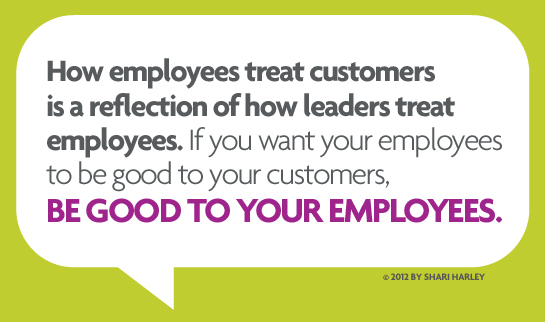
Your employees will not treat customers better than you treat your employees. You get what you give. Expecting employees to treat customers better than the employees feel treated is akin to buying subpar building materials and expecting superior construction. It isn’t going to happen.
Your organization’s handbook and customer service training programs can outline explicit instructions for how customers should be treated, but if the practices for treating employees are markedly different, don’t expect great customer service.
This begs the question, what does it mean to treat employees well? Don’t all employees need different things to be happy? What about the differences between Baby Boomers, Generation X, and Generation Y employees?
In my experience people of all ages need many of the same things to be satisfied in a job. Employees want to learn, grow, and feel challenged. They want to work in an environment in which they feel comfortable–they like the people and feel accepted and respected. They want to make a difference and contribute to something bigger than themselves. And they want the flexibility to control their schedule and personal lives. Depending on an employee’s stage in life and career, some of these things become more important than others.
The difference between Baby Boomers, Generation X, and Generation Y: I don’t think each group needs drastically different things to be satisfied at work. In my experience, the key difference between the groups is that Baby Boomers and Gen X’ers will put up with not having everything they want. Gen Y’ers will not. Baby Boomers and Generation X will put up with a boss or job they don’t like for two years, waiting to see if things improve. Millennials are more impatient. If they don’t think they can get what they want from a job or organization, they move on quickly.
The quickest and easiest thing managers can do to engage and retain employees of all ages and stages in their careers is to ask what employees need to be satisfied. And no, employees may not tell you. There is an almost universal and pervasive fear in organizations to speak candidly with one’s manager. But employees definitely won’t tell you what they need to stay with your organization if you don’t ask. And even if employees aren’t candid about their desires, you still get points for asking the questions most managers don’t.
In every leadership, management and coaching class I teach, I ask managers to answer these questions:
• What are your employees’ career deal breakers? What would make your employees leave your organization?
• What kind of work do your employees like to do most? What kind of work do they like to do least?
• So you can provide personalized recognition they’ll appreciate, what are your employees’ favorite
hobbies, foods, and places to eat or shop?
• What are employees’ pet peeves at work?
I’ve asked these questions of thousands of managers, and few can answer the questions. If you can’t, without absolute certainty, answer these questions about your employees, don’t be surprised that you aren’t getting the performance you desire. How can you manage and motivate employees if you don’t know what’s important to them?
The easiest thing to do today to raise employee performance, and in turn improve customer service, is to ask your employees what they need, and when appropriate, give employees those things. If you can’t provide what employees what, tell employees why you can’t honor their requests. Rationale, the answer to the question why not, goes a long way.
You may be wondering, isn’t it worse to ask employees what they want and have to say no, than not to ask at all?” Quite simply, no. Not asking about employees’ needs because we may not be able to tell them yes is akin to the fallacy that if we don’t talk about something it doesn’t really exist.
Employees want what they want, regardless of whether you talk about those desires or not. I’d much rather have an open discussion about not being able to meet an employee’s needs, and know they will job hunt, then be surprised when they quit. If employees’ desires are truly deal breakers, you’ll lose them anyway. If you know what employees want, you can negotiate and attempt to meet some or all of their needs, giving you more control over employee engagement and retention.
Ask what employees need to stay with your organization and be satisfied, and watch performance, morale, and customer service rise.
PowerPoint is the worst thing that ever happened to speakers and presenters. When used well PowerPoint adds depth to presentations and a visual component that many people need to digest information. But most presenters misuse PowerPoint, overloading slides with too much data and text that is too small to read, that they cover too quickly.
Presenters are thinking through and designing their presentations in PowerPoint. Meaning, most people open a blank presentation and type as they’re thinking about what they want to say. This is not a bad practice in and of itself. It’s only bad if presenters don’t remove the words they should say during a presentation, but not put on the slides.
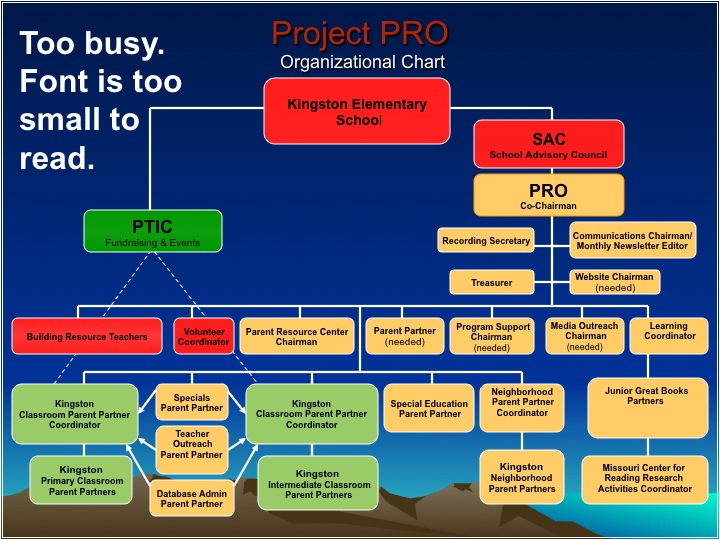
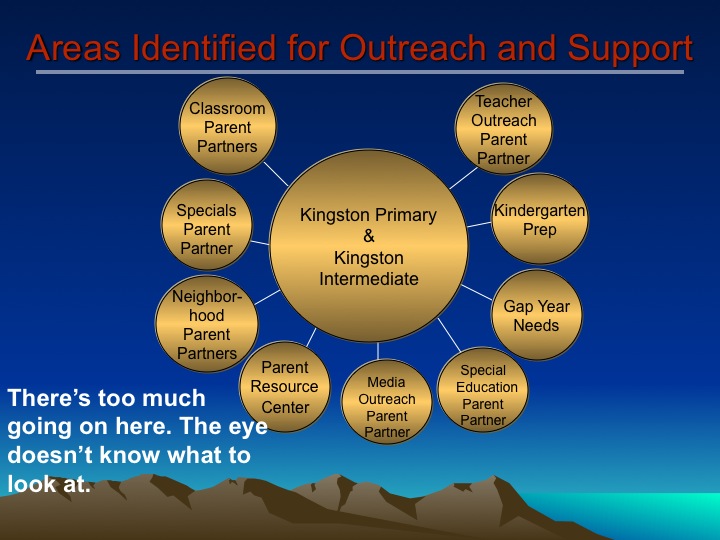
Examples of common but ineffective slides are below.
Creating a presentation should mimic packing for a trip. We throw everything we want to take with us on the bed. Then we stuff everything in a bag. When we see it’s not all going to fit, we take stuff out. Then we realize we’re going to pay an overweight fee, so we take more stuff out, admitting that we don’t need eleven t-shirts. We then get where we’re going with much less stuff than we started with, but still more than we need. Creating a presentation should follow the same process.
Create your presentations in PowerPoint and then remove everything but the necessary points your audience needs to follow your presentation. Leave bullets that you will discuss in greater detail, important numbers, and statistics. Delete the rest. If your slides mimic every word you’re going to say, the audience doesn’t need you. If you’re going to read your slides, save your audience some time, email the presentation, and cancel your meeting.
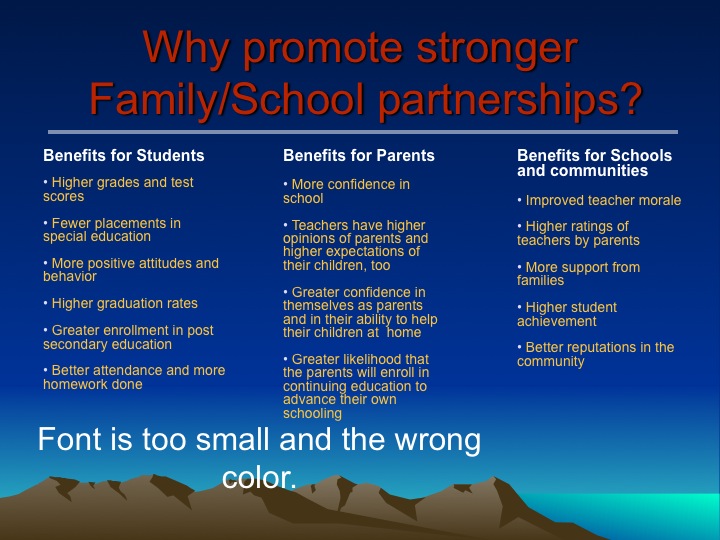
If you want to hand out or use a more detailed version of the presentation to prompt you while you’re speaking, save two versions –version one with all the detail and a parsed down version two to project while you’re speaking. The notes feature is a good place to put extra detail you want to be sure to cover, but don’t want on your slides.
The objection I often get to the suggestion above is, “I have to provide a lot of information. I know it’s too much data for one slide and the text is too small to read. But I have to provide that level of detail.” When you have a lot of information you can put it on a slide, but you should also provide the slide as a handout. Tell people you know they can’t read all the information on the slide, and tell them to follow along on their handout. Use a pointer or a different color to highlight the sections of the slide you’re talking about. If you aren’t going to give a handout, then remove the slide from the deck and email it as follow up. Showing slides that are too small or too detailed to read is frustrating for your audience and doesn’t put you in the most positive light.
Avoid Death By PowerPoint and Make PowerPoint Work For You:
- Use 24-point font or larger. People can’t read 14 or 16 point font on a slide.
- Put 6 to 7 lines of text on a slide, not more.
- Avoid distractions on slides –like images that float in or explode. Make your slides more interesting by adding relevant pictures and videos, versus unrelated images.
- Always speak with the lights full up. NEVER speak in a dim or dark room. YOU are the presentation, not your PowerPoint slides.
- Use a white background and a dark font, so you NEVER have to dim the lights.
- Use fewer slides than you think you need to, and give your audience time to read each slide. If the audience doesn’t have time to read a slide, they will feel ripped off and frustrated, and wonder what they’re missing.
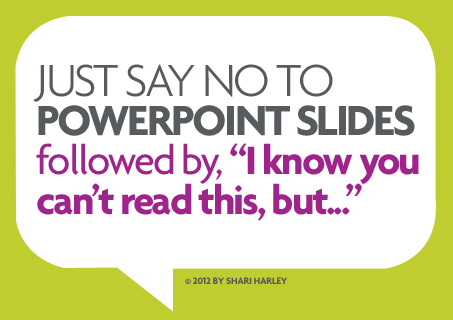
PowerPoint can be a great tool, when used well. If your slides add to, but don’t replace your message, and if everyone in the room can and has time to reach every word on your slides, you’re using PowerPoint as it was intended. If your slides can be followed by the words, “I know you can’t read this but…,” it’s time to start deleting.
Five years ago today, I left my secure, corporate job to start Candid Culture, an international training and consulting firm, bringing candor back to the workplace, making it safe to tell the truth at work. Leaving the security of a regular paycheck was one of the scariest things I’ve ever done, so scary that I talked about it for 12 years before finally taking action. After talking with friends and family about starting this business for so long, that they cut me off, on May 14th, 2007 I quit my job and left for Singapore to speak at my first international conference.
I wasn’t ready. I had no prospects and no plan. I didn’t think I’d be successful. In fact, I was reasonably convinced I’d fail. I was consumed with fear. But for the first time, my desire had become greater than my fear.
 Two things moved me out of vacillation and into action.
Catalyst #1: For the first time in my career, I had a job I didn’t like. Before my last job, I would have done every career-related (a.k.a. real) job I’d had for free. In my last job I made a lot of money but was unhappy. I swore I’d never be someone who kept a job for the money.
Catalyst #2: I didn’t want to look back at the end of my career and wonder, what if? When I was in high school I was captivated by the Henry David Thoreau quote, “I want to live deep and suck the marrow out of life.” I made a decision then that I would not live my life controlled by fear.
So I quit.
My definition of success was low. All I wanted was to be able to pay my mortgage and not live under a bridge or with my parents. Given how low I set the bar, it’s amazing my first year in business with Candid Culture was as good as it was.
The past five years have been the most fun, rewarding time in my life. I’ve had the privilege to speak in seven countries and on three continents, in 23 states, and with organizations of all types and sizes.
Our work is different. It is edgy and direct and rarely what people are expecting. I cherish the feedback from conference attendees and clients, “You are a breadth of fresh air.” I can’t imagine being told anything better. Fresh implies different. And different can be scary.
We help organizations shift from cultures of silence and fear to a climates of candor and trust. Creating a more candid culture takes courage.
Thank you for your courage and your trust, and for believing that your organization can be a place people want to work and where they do their best work. I look forward to the next five years.
Think about all the people in your life who frustrate you. The employees who turn in work without checking for errors. The person who offices next to you and takes phone calls via speaker phone. The person who is always late for meetings and then proceeds to text under the table, like no one can see him. And in personal relationships, our friends who come late, cancel, or just aren’t in touch as often as we’d like.
These situations annoy us, but we often don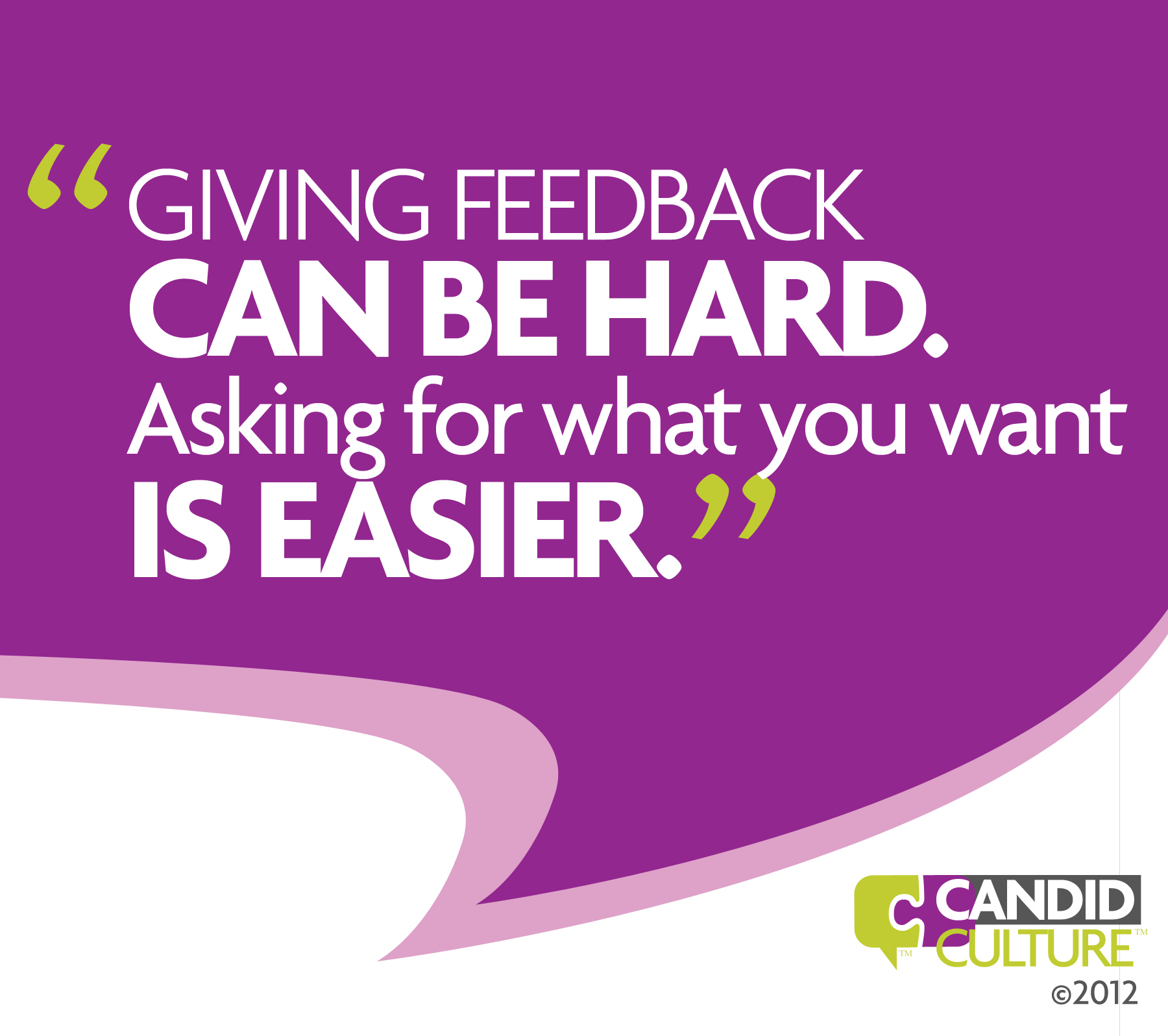 ’t say anything because giving feedback is simply too hard. Why risk the person’s defensiveness? Or we don’t think addressing the situation will make a difference.
Giving feedback can be hard. Asking for what you want is easier, but most of us don’t do it.
The question is why? If making a request is easier than correcting someone’s behavior, why not ask for what you want upfront? Why wait until expectations are violated to make a request? The answer is simple.
We don’t think we should have to make requests. We assume our employees, coworkers, and friends will do things as we do.
We would never turn in work without checking it for accuracy or come to a meeting late. So we assume others won’t either. And when they do, it feels too hard to speak up, so we don’t.
I’m going to suggest you approach relationships differently –more proactively.
Ask for what you want at the beginning of a relationship, project, meeting – anything new. Set clear expectations. If you want to start and end meetings on time, tell people that during your first meeting. And if you have an existing behavior you want to shift, simply say, “I realized I didn’t tell you that starting and ending meetings on time is really important to me. Going forward, we’re going to start and end all meetings on time. So please be ready for that.” If you need a quiet work environment, when you get assigned a new desk or seat mate, tell your coworkers that you are easily distracted by noise and ask them to take all calls via a hand or head set and to limit posses of visitors. If it bugs you when people wear shoes in your house, tell them when they arrive. Don’t expect people to guess you’re frustrated and alter their behavior without you making a request. It’s not going to happen.
Consider all the things that annoy you. Then consider what you did or didn’t ask for. If you haven’t made your expectations clear, it’s not too late. Asking for what you want is easier than you think.
Dating turnoff: A guy who tells me negative things about other women he’s dated. If he’ll talk smack about other women to me, he’ll talk poorly about me to other people. I know I’m special, but I’m not different. And neither are you.
If your coworkers talk to you about other people in your office, why wouldn’t they talk to others about you? Likewise, if you talk to your friends at work about all the dolts you’re forced to work with, why shouldn’t your friends assume you will talk negatively about them. Like you, they’re special, but not different.
Workplace gossip exists in every organization everywhere. It’s been around forever and is here to stay. The problem is that gossip creates environments of suspicion and fear and kills organizational cultures. Employees watch his or her back, wondering from where the next jab and stab will come. And when people are worried about how others will damage them, they work alone versus together. They hoard information and recognition. All of this is, of course, very bad. But the distrust and paranoia that gossip creates isn’t the only reason to reduce the gossip in your organization.
An even more compelling reason to reduce the amount of workplace gossip — it’s exhausting.
My clients split hairs attempting to convince me that gossip and venting are not the same thing. They insist that venting is productive—it allows people to blow off steam and problem solve. Here is my one word reply: Garbage. That is complete garbage.
Although I am the least woo-woo person I know, this next thought may sound a little woo-woo. So hang in there with me. If an hour after a meeting you and your work friends are still talking about how inept the meeting facilitator is, you might as well still be sitting in the meeting. If you go home after work and complain to your spouse about the people you work with who do little work, then you might as well still be at work. You life is what you talk about and with whom. That’s the woo-woo part.
If you want a different experience, say something different. If the meetings in your office are ineffective, talk to the meeting facilitator off line. Offer suggestions; offer to run the meeting, or stop going. Do anything but talk to people who can’t impact the situation. If you’re working harder than the people around you, either talk to them or your manager, or simply do less. Sometimes we have to let things break for others to know they are broken.
Whatever you choose to do, know that talking about the things that frustrate you to people who can’t do anything about them makes you feel worse not better.
I’ve already conceded that workplace gossip isn’t going anywhere. So what to do?
Here are a few things you can do in your office to create a more positive and trusting culture:
- When you find yourself talking negatively about someone who isn’t present, stop.
- If there is something you’re unhappy with at work, tell someone who can do something about it. Just be careful not to dump a problem at a manager’s door. It burdens managers who are already too busy and annoys them. State your observation; recommend a solution; ask for their support if you need it.
- Create a no workplace gossip policy in your office, and charge a $1 every time you hear gossip. The money can go to charity or towards funding company parties. People are hesitant to part with their money. You’ll be surprised at how much $1 can alter behavior. The people you work with may look at you funny, but they know how badly it feels to be thrown under the bus. Others will, in time, appreciate the policy. Working in an environment where you know others won’t talk about you when you’re not there creates an unprecedented feeling of confidence few of us will ever experience.
Ultimately the answer is simply to: Desire to have a different working environment and draw attention to the gossip you hear. That alone will help. You want people to trust you. And you want to work with people you trust. One of the fastest ways to build and repair trust is not to speak negatively about the people you work with. Plain and simple.
I’m reasonably sure I got fired from my college teaching job. Two students went to the Dean to complain about me, and Deans generally don’t like dealing with annoyed students.
What did I do to incense my students to the point of complaint? I gave them a grammar lesson.
I was teaching a graduate level leadership class. While reading my students’ first papers, I found myself correcting their grammar – for an hour, per paper. I found the papers too hard to read without fixing the grammar.
When I handed the papers back I told my students, “You want to be leaders. Not being able to write will hold your career back more than your leadership abilities. So we’re going to work on writing today.” Then I reviewed some basic grammar rules. The students who complained said that they weren’t paying to learn how to write. They were paying to learn how to be leaders.
They missed the lesson.
When I screen resumes, I eliminate candidates whose resumes have typos and spelling errors. And many other managers do as well. A resume is like a first date. You’re working to impress. And as my dad says, it doesn’t get any better than it is at the beginning. If your date behaves badly early on, it will only get worse. If candidates don’t pay attention to their own marketing tool, why would they pay attention to yours?
Some people say that the prevalence of texting and Instant Messenger has changed the standards of what type of writing is acceptable at work. I disagree.
When clients receive proposals with errors, do they want to hire you? When you send an email or report with grammar errors or typos to the people in your office who can impact your career, do they dismiss the errors or make a mental note that you’re careless? I suspect the latter.
Being successful at work is hard enough. Don’t give people a reason to discredit you.
- Spell check your work
- Be succinct. If you can say it in 10 words, eliminate the extra 20 you’ve written.
- If you are struggling with writing, take a class.
Little things matter.
 Meetings start and end late. Attendees slyly send text messages under the table, like no one can see them. Decision makers are absent, requiring you to have another meeting. One person talks most of the time, while everyone else tunes out.
The meeting facilitator wants to do something but feels like s/he can’t. How do you tell someone two levels above you to put away his phone and pay attention?
The majority of meetings are too long and a poor use of time.
You can impact the meetings in your organization, even if you don’t run them.
The bad meeting behavior mentioned above is predictable. It’s happening everywhere.
If you want your meetings to be different, ask for something different, before problems occur.
The reason your meeting facilitators feel as if they can’t tell their boss’s boss to show up and pay attention is because there has been no expectation set that it’s ok to do so. Meeting guidelines have not been established. And if they were established it was done long ago and the expectations were long forgotten.
Running an effective meeting requires courage AND an understanding that the meeting facilitator has permission and is expected to address people who break the rules. Even the most senior person in the room has given the facilitator permission to correct him. Without this permission, your facilitator can’t say anything, which is why s/he doesn’t.
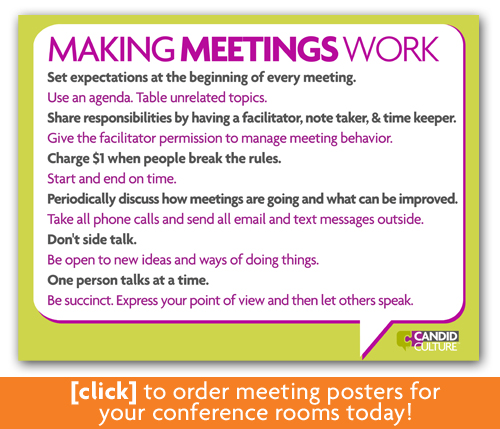
How to have better meetings. Follow these meeting guidelines:
- Get meeting attendees’ agreement on the meeting guidelines.
- Give the meeting facilitator AND attendees permission to enforce the meeting guidelines.
- Take two minutes to set expectations before every meeting. Yes every meeting, even standing meetings. People forget. When you remind people of the rules, it’s easier to enforce them.
- Post the meeting guidelines in all of your conference and training rooms as reminders. Make the posters with large font that can be read from any seat in the room. We’ve made it easy for you with our Make Meetings Work Poster.

- Periodically discuss how meetings are going – what’s working and what can be improved. Create occasions and grant permission to give feedback. If it isn’t safe to tell the truth, nothing will get better.
Stop wasting your time in meetings. It’s never too late to set expectations. Hang them up on the wall for everyone to see. Anyone, at any level, and in any role can suggest setting and adhering to meeting guidelines. People in your organization want someone to take control. Maybe it will be you?
Looking for a 5 10’, 45 year-old with some of his hair. Must enjoy long walks on the beach, dogs, and great conversations. No baggage please!!
At work this might sounds like, looking for employees who will do good work with little to no oversight, be open to feedback, and never get defensive, no matter what bad news we give them. Otherwise known as, no baggage.
Unless you work alone, you know that people come with baggage. I’m calling our negative experiences with other people –parents who lost their tempers when we expressed a counter point-of-view, bosses who punished us for saying what we really thought, and peers who killed us off when we told them the truth – baggage. Every time we got yelled at, in trouble, or punished in any way for giving feedback, we learned it was not safe to speak up.
Your direct reports and coworkers have been trained by every person who came before you, both personally and professionally. We have all been trained.
We all know that when we tell most people what we really think, and they don’t like it, there are negative consequences. So we learn, pretty quickly, to keep our opinions to ourselves.
If you want people to tell you the truth about what’s not working in your organization or about your own performance, you need to retrain them. You need to get your employees and coworkers to believe that it’s safe to tell you the truth, even when the news is bad.
So how do you make people feel safe giving feedback and speaking up? Be open to feedback:
- Ask for their opinion.
- Promise that no matter what they tell you, you will say “thank you”.
- Manage yourself and ensure the other person felt heard. Say “thank you” out loud, regardless of what you say inside your head.
- Then walk away.
- Once you’ve had some time to process the feedback, you can go back to the person to discuss it.
- If you got defensive, apologize and recommit
Every time you get defensive you train people it’s not safe to tell you the truth. The more often you ask for input and are open to feedback, the more information you’ll get.
Posted under
Managing People on December 28, 2011 by Shari Harley. Comments
 I’m in trouble with one of my clients. He asked for something yesterday. I gave it to him yesterday. But he really wanted it last week.
Could and should I have anticipated that he really wanted it last week? Yes. But I’m not unlike your good employees. I’m good at what I do, but I put off the hard stuff that is complex and takes a lot of focus and time until it is due.
I told my client what I tell all the managers I work with, don’t set deadlines as the final, drop dead moment you need something. Build in time to review work and have a few rounds of feedback and edits before final deadlines. The biggest opportunity I see for managers to make their lives easier and less stressful, in addition to giving employees regular and timely feedback, is to how to delegate better.
A sales person I was coaching lost a project because he submitted the RFP on the day of the deadline. The prospect said that because the salesperson waited until the last minute to submit the proposal, she feared he would leave all work to the last minute, and she just couldn’t work with someone like that.
Rather than test people or set them up to fail, just tell people what you really need.
Employees are not you. They don’t do things the way you do. If you have a picture of how a project should look, I’ll bet you any amount of money your employee has a very different picture of how that project should look. As you assign work, if you picture data being put in a table or a graph, your employee most likely has a different picture. If you want a color coded process map, ask for a process map. If you want three bullets rather than a detailed narrative, ask for three bullets, rather than being frustrated by receiving too much information you now have to weed through.
Set realistic and meaningful deadlines. Don’t set short deadlines because you don’t trust your employees to do what they say they will do. If you have an employee who constantly misses deadlines and doesn’t do what he says he will do, that’s a different conversation. That’s a feedback conversation.
You want to give employees enough room to stretch themselves but not enough room to fail. If you have a project that’s due at the end of January, ask to see pieces of the work along the way, perhaps weekly. Give feedback regularly, enabling employees to make changes to small pieces of work rather than to the entire project. Reviewing small pieces of work regularly reduces frustration and rework. Finishing a project and being told to start over because it wasn’t what the other person was looking for has damaged many working relationships.
You get what you ask for. What are you asking for?
Posted under
Managing People on December 19, 2011 by Shari Harley. Comments
Motivating employees can be tough. Aren’t you tired of hearing managers say they have no control and there is nothing they can do about:
- Long time employees who are so-so performers, are at the top of their pay grade and aren’t going anywhere
- Employees who are three to five years from retirement and have no incentive to improve their performance
- Employees who are ‘protected’ by a senior person and are ineffective but untouchable
- And lastly, but most annoying, that HR won’t let managers do anything about employees who are not producing results.
None of these things are true. Managers at any level and with any amount of formal authority can incent a higher level of performance without raising salaries, promoting or rotating employees to a new job. It’s called management. And it isn’t fun, but it does work.
Employees will hit whatever bar managers establish. If the bar is at 80%, employees will hit 80% or below. If the bar is at 50%, employees will hit 50% or below. Exceptional employees will achieve results higher than whatever bar managers set. Managers don’t need to push their best employees to set high expectations and achieve outstanding results. Driven employees excel on his/her own. But it’s not your best employees we are talking about here.
We’re talking about the employees who are coasting, doing their minimal best, clocking in and clocking out, biding time, hoping not be found out. Many people think this kind of performance is limited to the public sector and that corporations are exempt from unmotivated employees. This couldn’t be further from the truth. I hear the same complaints from my clients in corporations, not-for-profits and government agencies. No organization is exempt.
As sexy as it doesn’t sound, managers need to get back to the basics.
The formula for motivating employees:
1) Set clear expectations with employees at the beginning of the year – a.k.a. now!
Write clear, specific and challenging goals either with or for employees. Seasoned employees should write their own goals. Managers should review and edit those goals, if necessary. Managers should write goals with or for resisters.
2) Managers should meet with employees regularly to discuss progress or lack thereof, and give feedback.
Now, for the part no manager wants to do.
There is no employee on earth who enjoys being told s/he is not doing a good job. People have a need to be seen as good, if not perfect. When anyone calls our competence into question – in the form of feedback – we get upset. Being defensive is an inevitable part of being human.
The unsexy, tedious but effective way for managers to motivate even the most blasé employees is to give feedback about unacceptable behavior every time s/he sees it. Every time. If Lauren is late, give Lauren feedback about being late –every time she is late. If Brian is heard complaining about new policies and initiatives, give him feedback about it –every time you hear it. If Amber is late in turning in reports, give her feedback about it –every time a report is late.
No one likes to be told s/he isn’t doing a good job. If managers address behavior often enough, employees will change their behavior or leave. Both achieve the desired result.
Your best employees are watching how you manage your weaker employees. Top performers are annoyed that they are working hard while others are allowed to coast. Moving your so-so performers up or out raises your best employees’ morale and commitment to the company, and raises everyone’s performance.


