Archive for November, 2024
Thanksgiving is coming up in a few days. You might visit family and friends who care about you and want what’s best for you. Sometimes people, in the spirit of caring, give unsolicited feedback and advice.
Unsolicited feedback at best feels like someone is trying to help, at worst it feels like criticism. Underneath the feedback might be the message, “If you were doing this right, I wouldn’t need to give you this advice.” I put unsolicited feedback and advice in the same bucket.
If you find yourself receiving unsolicited advice, you don’t have to smile politely and take it. It’s ok to put an end to feedback and advice.
Simply smile, tell the person you appreciate them caring enough to give you that advice, and say that you’re not looking for advice on that topic at this time. And then smile again. Smiling softens most messages. Say nothing more. Most people will stop talking.
This method of acknowledging the person talking is respectful and firm. To pull it off, watch your tone. If you can safely add the words, “you dummy” to something you say, you have a tone issue. Be genuinely appreciative and enforce boundaries. You’re not the 7/11. You’re not open for feedback and others’ input all the time.
If the person continues giving you advice, simply say the same thing again. “Thank you for caring enough to share that with me. I really appreciate your concern. I’m not looking for advice at this time.” If the person keeps talking, just say, “I’m going to get a drink.” Then get up and go get a drink.
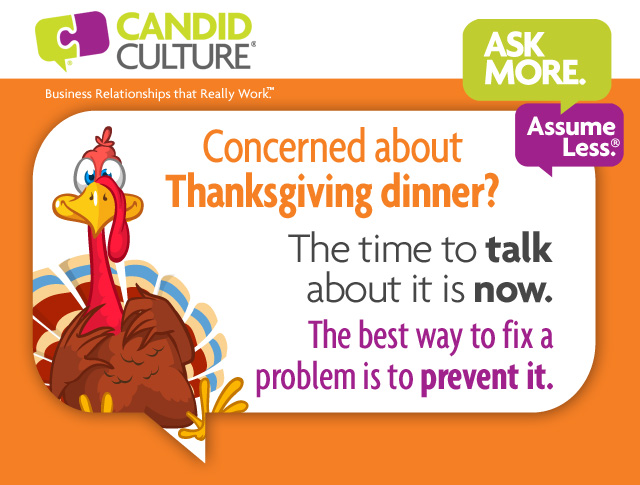
The time to talk about what everyone needs to feel comfortable at Thanksgiving dinner is now. Don’t wait until Thursday. Consider what you need to feel comfortable and make requests today. Breakdowns are predictable, and what you can predict, you can often prevent.
If stopping unsolicited feedback feels uncomfortable, tell people before you see them, “I don’t want to talk about _____________ (fill in the blank). Please don’t bring it up over Thanksgiving.” You can soften that request any way you like.
Most difficult conversation are preventable, and preventing a difficult conversation is always easier than having one. Setting boundaries might be feel uncomfortable, but it’s likely not as uncomfortable as having a conversation you don’t want to have and then feeling like you need to avoid someone for the rest of the evening and possibly year. It’s ok to say, “No thank you. Now please pass the pie.”
When something ‘bad’ happens, my nine-year-old is quick to ask who is at fault, hoping, of course, it’s not him. I’m trying to get him to use the word accountability instead, and to understand that if he has some accountability, he has some control over what happens. If he has no accountability, he has no control. A tough concept for a nine-year-old.
Stuff happens. People won’t give you what you need to complete projects. Things will break. When breakdowns happen, I always ask myself, “What could I have done to prevent this situation?” or “What did I do to help create this situation?”
It may sound odd that I always look at myself when breakdowns occur, even when it’s someone else who didn’t do their job. It’s just easier. When I can identify something I could have done to make a situation go differently, I feel more in control – aka better.
I’m the person who gets off a highway jammed with traffic. The alternative route may end up taking longer, but at least I’m moving. I feel like I’m doing something and thus have more control. Taking responsibility for what happens to you is similar. When you’re accountable for what happens, you can do something to improve your situation. When someone else is accountable, you’re at the mercy of other people and have very little control.
There are, of course, exceptions to the practice that “we’re accountable.” Terrible and unfair acts of violence, crime, and illness happen to people, about which they have no control. But in general, in our day-to-day lives, there is typically something we did to contribute to a bad situation or something we can do to improve it.

Here are four practices for improving difficult situations even when you didn’t create the mess alone.
- Ask more questions. If you’re not clear as to what someone is expecting from you, ask. Even if their instructions aren’t clear, it is you who will likely be held accountable later.
- Tell people what you think they’re expecting and what you’re planning to do, to ensure everyone’s expectations are aligned. This beats doing weeks’ worth of work, only to discover what you created isn’t what someone else had it mind.
- Ask for specific feedback as projects progress. Don’t wait until the end of a project to find out how you performed.
- Admit when you make a mistake or when you wish you had done something differently. Don’t wait for someone to tell you. Saying, “I’m sorry. How can I make this right with you?” goes a long way.
These are really delegation practices — reverse delegation. Help people express their expectations of you clearly, so you can be successful.
I am always asking the questions, “What could I have done differently? What did I do to contribute to this situation, what can I do now to make this situation better?” I encourage you to do the same, even when someone else drops the ball. You can’t control others, but you can control you. And your happiness and success is your responsibility.

Leaders with virtual and hybrid workforces are worried about losing their organization’s culture. Some organizations are calling employees back into the office to retain culture. Others are hosting in-person social events, retreats, and meetings to help employees reconnect and strengthen culture.
Getting together in person is nice but it isn’t always possible. And what happens when everyone goes home? Culture is built on a daily basis.
Organizational culture is an outcome of the decisions we make and how those decisions get made, how we treat people, and how we communicate and work together. If you want to strengthen your organization’s culture, do it every day.
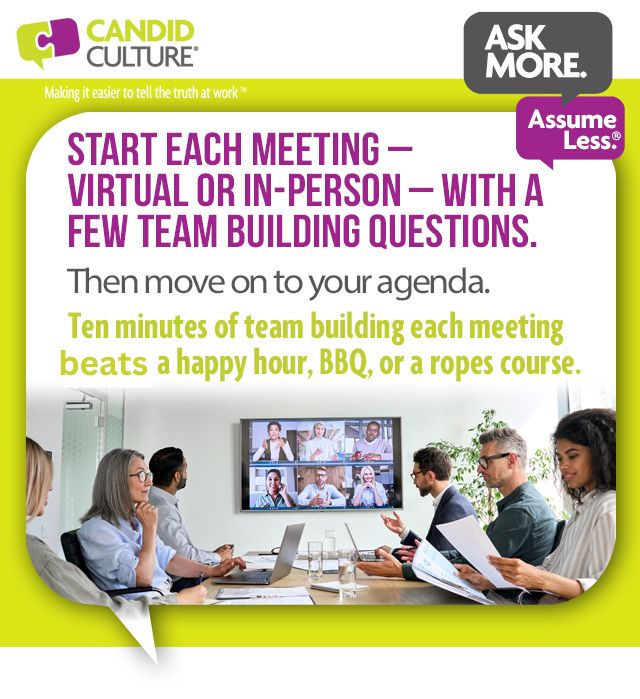
To strengthen your culture, take small regular actions.
Start each meeting helping employees get to know each other better, from a work perspective.
Host town halls at least twice a year.
Host roundtable discussions between senior leaders and a diverse sample of your workforce.
Have leaders and managers leave employees a weekly voicemail. Share a recent success, challenge, or goal. Keep messages short and authentic. Set the tone for the week.
All of these actions can be done virtually or in a hybrid setting.
Give employees opportunities to talk to each other about the things that matter most at work. Do this regularly – at least a few times a year.
You don’t need to spend a lot of money to strengthen and retain your culture. Go small – regularly.
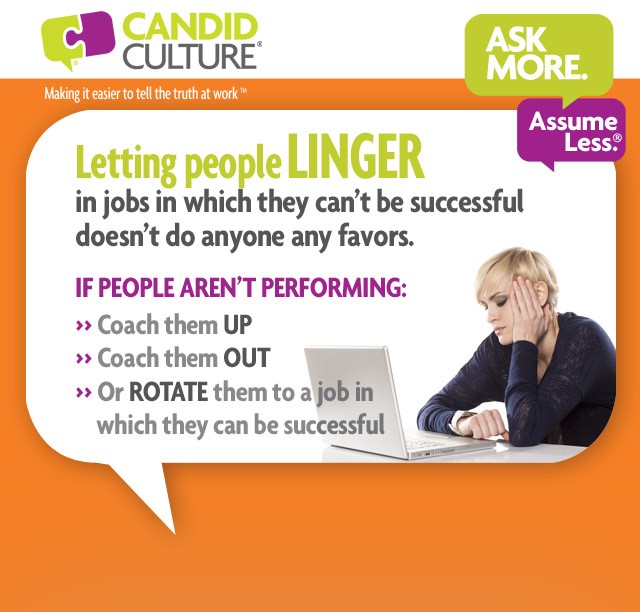
Being in the wrong job feels terrible. It’s not unlike being in the wrong romantic relationship or group of friends. We feel misplaced. Everything is a struggle. Feeling like we don’t fit and can’t be successful is one of the worst feelings in the world.
The ideal situation is for an underperforming employee to decide to move on. But when this doesn’t happen, managers need to help employees make a change.
The first step in helping an underperforming employee move on to something where they can be more successful is to accept that giving upgrade (negative) feedback and managing employee performance is not unkind. When managers have an underperforming employee, they often think it isn’t nice to say something. Managers don’t want to hurt employees’ feelings or deal with their defensive reactions. When we help someone move on to a job that they will enjoy and where they can excel, we do the employee a favor. We set them free from a difficult situation that they were not able to leave out of their own volition.
I get asked the question, “How do I know when it’s time to let an employee go?” a lot.
Here’s what I teach managers in our coaching training program. There are four reasons employees don’t do what they need to do:
- They don’t know how.
- They don’t think they know how.
- They don’t want to.
- They can’t. Even with coaching and training, they don’t have the ability to do what you’re asking.
Numbers one and two are coachable. With the right training and coaching, employees will likely be able to do what you’re asking them to do.
Giving consistent feedback works well for number three.
Number four is not coachable. No amount of training, coaching, or feedback will make a difference.
When you’re confronted with someone who simply can’t do what you need them to do, it’s time to help the person make a change.
The way you discover whether or not someone can do something is to:
- Set clear expectations
- Observe performance
- Train, coach, and give feedback
- Repeat
After you’ve trained, coached, and given feedback for a period of time, and the person still can’t do what you’re asking them to do, it’s time to make a change.
Making a change does not mean firing someone. You have options:
- Take away responsibilities the person can’t do well and give them responsibilities they can do well.
- Rotate the person to a different job.
Firing someone is always a last resort.
Sometimes we get too attached to job descriptions. When the job description outlines a specific responsibility that the person can’t do, we fire the person versus considering who else in the organization could do that task? Be open-minded. If you have a person who is engaged, committed, and able to do most of their job, be flexible and creative. Swap responsibilities, when you can. Employees who are failing in one job, may do very well in a different job.
If you’ve stripped away the parts of a job an underperforming employee can’t do well, and the person is still not performing – it’s time to make a change. This is a difficult conversation that no manager wants to have. Yet I promise you, this conversation feels better to your employee than suffering in a job in which they can’t be successful. After you’ve set expectations, observed performance, and coached and given feedback repeatedly, letting someone go or rotating to the person to a different role is kinder than letting the employee flounder in a job in which they cannot be successful.