Archive for May, 2019
Employees leave managers not jobs. We’ve all heard this 100 times.
One of the most prevalent reasons for employee turnover is boredom and lack of growth. We’ve also heard this many times.
We know why employees leave jobs. The question is what must managers do to engage and retain their best people. The answer is actually quite simple, although possibly not easy to execute.
 Employees want to know that their manager:
- Knows them
- Cares about and is invested in their careers
- Gives feedback so they can improve
- Provides opportunities so they can develop
In other words, employees need attention, and attention requires time – time many managers may not feel they have.
Here is a five-step formula for employee retention and employee engagement:
- Get to know employees better and differently.
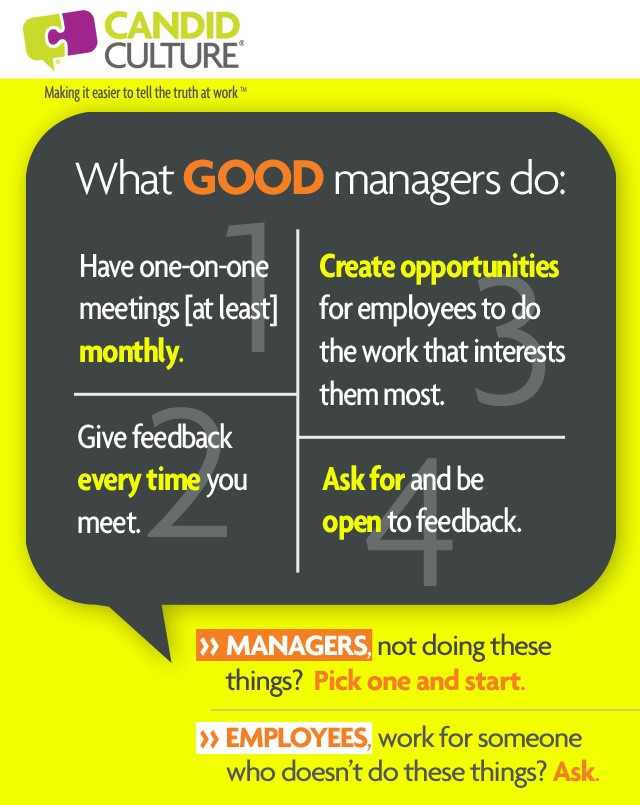
- Have meaningful, one-on-one meetings [at least] monthly.
- Give feedback every time you meet.
- Ask for and be open to feedback.
- Create opportunities for employees to do the work that interests them most.
Managers, how do you make time for these meetings when you are busy and have several direct reports?
- Meet for 15-30 minutes.
- Meet over the phone while commuting or waiting for flights.
- Ask direct reports to create an agenda and run the meetings.
- Ask direct reports to send follow-up notes of decisions and plans made during meetings. Give some of the accountability away.
- If meetings get cancelled, reschedule as soon as possible. Direct reports take cancelled meetings personally. Cancelled meetings that are not rescheduled send the message that managers don’t care about employees and their careers.
Employees, if your manager doesn’t schedule meetings with you:
- Ask permission to put a monthly meeting on your manager’s calendar.
- Provide rationale for why you want to meet – to get your manager’s feedback and ensure you’re focused on the right work.
- Ask permission to reschedule meetings when they get cancelled.
- Don’t take cancelled meetings personally.
- Offer to meet with your manager via the phone when it’s convenient for him/her. Leverage commute and travel time.
Employees need time with their managers. Meaningful discussions and work result in employee engagement and employee retention. So managers, make the time, even when you don’t feel you have it. Ask questions you don’t ask now. Give feedback, even if it’s uncomfortable. Give your employees an opportunity to do the work that interests them most. And watch your employee engagement and employee retention improve. And if your manager doesn’t do these things, politely and persistently ask. You won’t get what you don’t ask for. We are all 100% accountable for our careers.

 Concerned about something happening in your workplace? Don’t just tell someone about the problem, propose a solution. It’s fine to raise challenges. It’s better to raise challenges you’re willing to do something about. If you think two departments don’t talk to each other, bring them together. If you think a process is inefficient, propose a different way to get the work done. If you’re dissatisfied with software you’re using, offer to source three potential vendors and set up a demo. You’re doing the legwork and asking for a small investment of time.
When we ask for something at work, our request often requires time, money, or both. Thus when an employee asks for something, it’s easier for a manager to say no than it is to say yes. “No” requires no work and no financial outlay. A “yes” may require both.
You make it easy to say yes to requests when you’re acting as a change agent:
- Propose a solution to a problem.
- Offer to do the work to solve the problem.
- Ask for small things that are easy to approve.
If you’re overwhelmed and want to hire an additional person, but your boss isn’t convinced you need the headcount, ask for a temp for a finite number of hours. It’s much easier for a manager to say yes to a small and known investment amount than to the long-term commitment of hiring someone new. The point is to ask for something that is easy for your manager to approve.
The word “pilot” is your friend. If you want to make a major change, pilot a scaled down version of your proposed solution in one or two locations, rather than in your organization’s 10 locations. Again, asking for something small makes it more likely that you’ll be told yes.
The bottom line is to be part of the solution – as trite and overused as that phrase is. Don’t be the person who says, “That’s broken” without also saying, “and here’s how we can fix it. Can I give it a try?”

 Last week some unknown person sent me emails predicting my future. According to the anonymous clairvoyant, in ten years my life will be going well. I’ll have a second child who is amazingly athletic, and I will be offered a job in Oshkosh that I shouldn’t take. After the third predictive email, the sender wanted to know if I had questions about my future. I didn’t.
- The whole thing was wildly creepy.
- No one should take advice from someone with this much discretionary time. The emailer needs a volunteer job.
- Why would I want someone else to tell me my future? That’s something I enjoy creating.
I see myself as 100% responsible for everything that happens to me. As antithetical as it sounds, life is easier when I’m accountable. If I miss a plane because of traffic, I should have left for the airport earlier. If I get overcharged in a restaurant, I should have checked the bill more carefully. If I do a bunch of work for a client and later find out that the work I did isn’t what the client really wanted, I should have asked more questions upfront and asked for feedback earlier.
When I’m responsible for what happens to me, I have some control. When someone else is responsible, I have no control.
Instead of seeking answers about what might happen, pursue the things you want. If you want a different job in your organization, tell someone who can do something about it. If you got passed over for a job, ask the hiring manager for feedback of what would have made you a better candidate. If the hiring manager doesn’t give you any information, ask your current boss to get the information for you. If one of your co-workers excludes you from projects, ask him why. If someone you work with seems to dislike you, ask for feedback about what you did to damage the relationship. Regardless of how challenging the situation and how disappointing the results, there is ALWAYS something you did to either contribute to the situation or something you can do to change the situation.
I don’t mean to tell you what to do. Nor do I mean to minimize how hard some life circumstances are. But I do want you to see yourself as in charge of what happens to you.
Create the life you want by:
- Asking, “What do I really want, and what’s one thing I can do right now to get closer to that goal?” Then take one step. Then take one more, and so on.
- If negative things are happening, ask, “What could I have done differently to have a different outcome?” Or, ask, “If I could do this over again, what would I do differently?” Then next time, do it differently.
Regardless of how hard or bad something is, there is ALWAYS something you can do to make the situation better. Take your life, your career, and your relationships into your own hands where they belong.
 Vague communication is unhelpful. Being vague instills doubt in the people around you and reduces your credibility.
When a customer service agent answers my questions with words like, “That sounds right, I think so, or that should work,” I hang up and call back, hoping to get someone who can give me an affirmative answer. People do this to you, too…they just don’t tell you about it.
Watch your language. If the answer is yes, say “Yes.” If the answer is no, say “No.” “I think so,” says neither yes nor no. Saying, “I think so” tells people you don’t really know.
A few phrases to avoid and what to say instead:
Avoid: “That should be done by Friday.”
Instead, be specific and give a final date. “That will be complete by Friday. If I can’t get it done by Friday, I’ll call you to let you know by 5:00 pm on Thursday.”
Avoid: “Sounds right.”
Instead, be specific and say, “That’s correct.”
Avoid: “We should be able to do that.”
Instead, be specific and say, “We can do that.”
Avoid: “I guess.”
Instead, be specific and say, “Yes” or “No.”
When I teach feedback training, the biggest thing training participants struggle with is specificity. “You’re difficult to work with.” “Your clothing is inappropriate.” “I just find you to be negative.” “You did a good job on that.” “It’s a pleasure to have you on the team.” All of this is vague and thus unhelpful to the feedback recipient. And the same is true when answering questions and making promises.
Tell people exactly what to expect. Be specific. Even if they don’t like your answer, they’ll be happy to have a clear answer.