Breakdowns happen. There will be days people won’t give you what you need to complete projects. Things will break. And you will look bad. When breakdowns happen, I always ask myself, “What could I have done to prevent this situation?” or “What did I do to help create this situation?” I see myself as accountable for whatever breakdowns occur.
It may sound odd that I always look at myself when breakdowns occur, even when it’s someone else who didn’t do their job, but it’s just easier. I can’t control anyone else. But I can control me (admittedly, some days I do a better job at this than others). When I can identify something I could have done to make a situation go differently, I feel more in control – aka better.
It’s like getting off a highway versus sitting in bumper-to-bumper traffic. The alternate route may take longer, but at least I’m moving. I feel like I’m doing something and thus have more control. Taking responsibility for everything that happens to you is similar. When you’re accountable, you can do something to improve your situation. When someone else is accountable, you’re at the mercy of other people and have very little control.
There are, of course, exceptions to the practice that “we’re always accountable.” Terrible acts of violence, crime, and illness happen to people, about which they have no control. But in general, in our day-to-day lives, there is typically something we did to contribute to a bad situation or something we can do to improve it.
Here are five practices for improving difficult situations at work, even when you didn’t create the mess (alone).
1) Ask more questions. If you’re not clear about what someone is expecting from you, ask. You’re responsible for doing good work, regardless of the type of direction you receive.
2) Tell people what you think they’re expecting and how you’re planning to approach a project or task, to ensure everyone’s expectations are aligned. Clarifying expectations beats doing several weeks worth of work, only to discover what you created isn’t what someone else had it mind.
3) Ask for specific feedback as projects progress. Don’t wait until the end of a project to find out how you performed.
4) Say “thank you” for whatever feedback you receive versus defending yourself. The person providing feedback will be pleasantly surprised at your receptivity, and their frustration will dissipate more quickly. This could sound like, “That’s good feedback. I’m sorry that happened. Thank you for telling me.”
5) Admit when you make a mistake or when you wish you had done something differently. Don’t wait for someone to tell you. Saying, “I’m sorry. How can I make this right with you?” goes a long way.
I consistently ask the following questions:
“What could I have done differently?”
“What did I do to contribute to this situation?”
“What can I do now to make this situation better?”
“What can I do to prevent this from happening again?”
I encourage you to ask these questions, even when someone else drops the ball. You can’t control others, but you can control you. And your happiness and success is your responsibility.
Posted under Career Management on October 6, 2025 by Shari Harley. 0 Comments
You might be lucky enough to have a manager who helps you advance your career, but you might not. Either way, you deserve to have the career you want, and ultimately, it’s your job to advance your career.
Advance Your Career Step One: Learn about different areas of your organization and become clear on what you want to learn and what areas of the business you want exposure to. You won’t know what to ask for from your manager if you don’t know what your organization does and the opportunities that are available.
Advance Your Career Step Two: Get to know the leaders and employees in other departments. Find out what they do on a daily basis, the initiatives they’re working on, and their short and long-term goals.
If you’re working virtually or in a hybrid environment, you may be wondering how to learn more about your organization and build relationships from a distance. How do you meet with people you never see? Anything you can do in-person, you can do over the phone or via video. It’s nice to be able to walk into someone’s office and ask a question or connect with someone in the hallway or a breakroom, but it isn’t essential.
Reach out to people in the organization you already know. You can make these connections via email or phone. I recommend phone. Tell people you want to learn more about the organization’s objectives and different departments. Ask who they can connect you with. Networking and building new business relationships virtually takes more upfront work than walking into someone’s office, but it can be done. Ask people to make virtual connections for you and then follow up on those connections within one business day.
Remember the job search advice you were given early in your career, to have informational interviews with people doing the work you wanted to do? Getting to know your current organization better is similar. Ask for informational meetings within your organization. And then communicate with the people you’re connected with in the way THEY like to communicate. Tell a person you’ve been connected with that you’d appreciate 15 minutes of their time and ask how they’d like to meet – via phone or video? Then schedule a short meeting via their preferred medium. When the 15-minutes is up, tell the person, you’re watching the time and you respect their time. Ask if they’d like to end or continue the conversation. And then honor their request. If you’d like to meet again, ask for another meeting. If there are next steps, make those steps clear and follow up via email, if it’s appropriate.
Advance Your Career Step Three: Ask your manager, your peers, and other organizational leaders who you need a good working relationship with and who can influence your next career opportunity.
You never know who talks to whom and who can influence your future opportunities. Department heads talk to other department heads. Don’t assume who can or can’t influence your next opportunity or lack thereof.
Advance Your Career Step Four: Tell people who can influence your career what you want to do. Don’t assume people know what you want to do in the future. In fact, assume others have no idea about the work you want to do and the things you want to learn. Tell people, “I’m really interested in learning more about ___________. I’d like exposure to __________ part of our organization.”
Your career is your responsibility. Don’t wait for your manager make your career happen. Take matters into your own hands. Follow the steps above and get more of what you want at work.
Posted under Career Management on September 7, 2025 by Shari Harley. 2 Comments
Every day I’m annoyed that I’m not perfect. I want to be a combination of Mary Poppins, Super Woman, and Kate Middleton, but I’m not. I’m a business owner, working mom, who just yelled at my son, on his birthday, and ate a large piece of birthday cake with a lot of green icing and sprinkles, despite that I “don’t eat sugar”.
Some days are going to be bad. On those bad days, it’s easy to feel like we’re messing things up and that we are indeed a mess. Instead, give yourself a break. The thing to know and remember, in the moment, is that you’re a human being, doing the best you can.
Here is a list of five ways to give yourself a break and as a result, do your best work.
Set realistic deadlines so you’re not constantly running against time, and overestimate how long everything will take to do.
Before agreeing to a new commitment, ask yourself, “Do I really want to do this?” Try not to commit yourself to things you know, at your core, you don’t want to do. You’ll just resent that commitment when it rolls around and aren’t likely to do your best work.
Turn off the alerts on your phone and laptop when you’re working. You’ll be more focused and get more work done.
Take a day off. Your company offers vacation time for a reason. People do better work when they take time to relax and rejuvenate.
Say “thank you” more and “I’m sorry” less. “Thank you for letting me know” is more empowering than “I’m sorry I missed that.” I’m guilty of apologizing for everything, so much so that one of my employees and I play a game that whoever says she’s sorry first has to throw a dollar in a communal collection pot. Whatever you put attention on will improve.
Some of these things are business focused, some are personal. You bring yourself – your whole self – to work. It’s why you’re good at what you do. People want to work with real people. And real people over commit, make mistakes, and spend too much time on social media at 11:30 pm. Give yourself a break.
At some point in your career, you will likely get feedback that doesn’t feel accurate. When receiving feedback you question, rather than dismiss it, vet the feedback with the people who know you best. Assemble a core team of people who know you well, love you, and have your back. The relationships may be personal or professional. These are people who will tell you the truth (as they see it) if you ask.
You might think that you’re a different person at home and at work, thus your friends’ and family’s input isn’t valid in the workplace. I don’t think that’s true. You are who you are, and you’re not a completely different person at home and at work. It’s just not possible to be your real self and turn it on and off at work. Sure, you might have a communication style that you only use when working. You may make decisions at work differently than in your personal life. But you’re not a completely different person after 5:00 pm. If you’re often late, don’t keep confidences, talk too much and too long, or wear clothing that is not your friend, your personal relationships can tell you that.
It’s important to know how you come across, your reputation, and your wins and losses at work. Having this information allows you to manage your reputation and in turn, your career.
The question is, with whom should you vet feedback that doesn’t feel quite right? Here are four criteria for core team members:
Your core team should be made up of a small number of people (five or fewer) who know you well, love you, and have your back.
You should respect core team members’ opinions.
You must trust your core team and their motives, in relation to your well-being.
You must be open to core team members’ feedback.
Core team members don’t need to be told they’re on your core team. Simply call these people individually when you need input. Tell them the feedback you’ve received and then ask for their opinion. And be sure to tell them that you’ll take their feedback graciously, by saying “thank you”.
It’s easy to dismiss feedback that’s hard to hear. The feedback you receive might just be that person’s opinion. But people talk. And one person’s experience of you can impact your career greatly. Manage your career assertively and powerfully by knowing your reputation. Find out the impressions you create. Then you can make decisions about changes you will and won’t make.
You’ve undoubtedly heard that it takes fewer than 30 seconds to form a first impression. The question is how frequently is your first impression wrong?
If the person sitting next to you on a plane doesn’t speak to you during the entire flight, you may initially think they are unfriendly, only to strike up a conversation as the plane is landing and find out that’s not the case. If a job candidate is outgoing, you may decide the person has good people skills, only to experience contrary behavior when they start the job. If someone is late to arrive for an initial meeting, you may decide they have an issue with time management, versus they were just running late that day.
Your first impression may be right, and it may be wrong, but it takes more than 30 seconds to be sure.
If you’ve participated in job interview training, you were probably trained to look for contrary evidence when forming an opinion about a candidate. Looking for contrary evidence is an attempt to disprove your first impression. If you quickly dismiss a candidate for lacking knowledge of your industry, you should ask interview questions to disprove your opinion before making a final decision.
Why not follow this practice in all settings? If you initially decide someone is trustworthy and reliable, spend more time with that person to be sure. If you quickly decide someone is unhelpful and uncommitted, give the person additional opportunities to behave differently before making a final judgment.
Snap judgments eliminate lots of great people and experiences from our lives.
Unfortunately, just as we prematurely exclude potential employees, friends, and life partners without having enough information, people do this to us as well, which is why it’s important to know the first impression you, your department, and your company make. If you don’t know the first impression you create, there’s nothing you can do to shift behaviors that may be costing you friends and customers.
When I was new to a job, early in my career, I asked my new coworkers to give me feedback if they saw me do anything that got in the way of my being successful at work. They agreed. But when they had negative feedback, they didn’t give it to me, they told my boss instead. That’s when I got the hard and painful lesson that people have a tendency to talk about us, not to us. It’s also when I began asking the people closest to me, who I know love me and care enough to tell me the truth, the first impression I create.
Opinions are formed quickly and they’re hard to break. Give people more than one chance and see how they show up. And know that many people will eliminate you, your department, and your company after just one interaction. So, find out the impression you create, giving you the power to do something about that impression.
Download some of the questions I ask to learn my reputation.
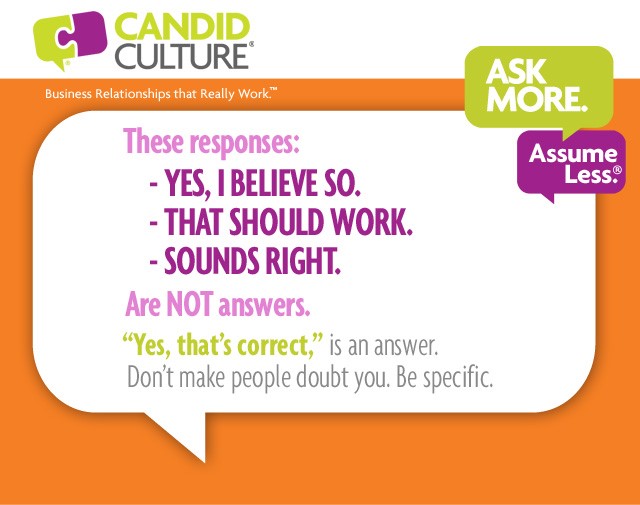
When a customer service agent answers my questions with words like, “That sounds right, I think so, or that should work,” I hang up and call back, hoping to get someone who can give me an affirmative answer. People do this to you too; they just don’t tell you about it.
Vague communication is unhelpful. Being vague instills doubt in the people around you and reduces your credibility.
Pay attention to your language. If the answer is yes, say “Yes.” If the answer is no, say “No.” “I think so,” says neither yes nor no. Saying, “I think so” tells people you don’t really know.
A few phrases to avoid and what to say instead:
Avoid: “That should be done by Friday.”
Instead, be specific and give a final date. “That will be complete by Friday. If I can’t get it done by Friday, I’ll call you to let you know by 5:00 pm on Thursday.”
Avoid: “Sounds right.”
Instead, be specific and say, “That’s correct.”
Avoid: “We should be able to do that.”
Instead, be specific and say, “We can do that.”
Avoid: “I guess.”
Instead, be specific and say, “Yes” or “No.”
When I teach feedback training, the biggest thing training participants struggle with is specificity. “You’re difficult to work with.” “Your clothing is inappropriate.” “I just find you to be negative.” “You did a good job on that.” “It’s a pleasure to have you on the team.” All of this is vague and thus unhelpful to the feedback recipient. And the same is true when answering questions and making promises.
Tell people exactly what to expect. Be specific. Even if they don’t like your answer, they’ll be happy to have a clear answer.
Who have you fired lately? The person who cuts your hair or lawn? A doctor, accountant, or restaurant where you had a bad experience? Did you call any of those providers and tell them why you were replacing them? My hunch is no. There’s little incentive to do so. Why risk their defensiveness? It’s easier to just replace them. And the same is true for you.
There’s little incentive for the people you work with to tell you when you frustrate them. The perceived cost seems too high. The people you work (and live) with have experienced others’ defensive responses to negative feedback (which is no fun) and they don’t want to experience your reaction. As a result, when you disappoint or frustrate others, it’s easier to say nothing than tell you the truth.
The tendency for others to tell you things are fine when they’re not, will prevent you from managing your career and relationships. People will go missing and you’ll be passed over for professional opportunities and never know why.
To make it more likely that people will tell you when you disappoint or frustrate them, make it easy to tell you the truth.
Here are seven practices for receiving feedback:
Receiving Feedback Practice #1: When you begin new relationships, tell people you want their feedback.
Receiving Feedback Practice #2: Promise that no matter what people say, you’ll respond with “thank you.” This is very hard to do.
Receiving Feedback Practice #3: Tell people you already have relationships with, that if you haven’t said it in the past, you really want their feedback and promise to respond graciously with “thank you.”
Receiving Feedback Practice #4: Ask people who matter to you for feedback regularly.
Receiving Feedback Practice #5: Resist the urge to get defensive.
Receiving Feedback Practice #6: Catch yourself when you start to become defensive and apologize. Say something like, “I’m getting defensive. I’m sorry. Tell me again. I’ll do a better job of listening.”
Receiving Feedback Practice #7: Take a break from conversations during which you find yourself responding defensively. Say something like, “I’m not responding as well as I’d like. How about we take a break? Give me a few minutes (hours or days) and I’ll come back to you to talk more. I really want to hear what you have to say.”
The aforementioned list provides recommendations for asking for and receiving feedback you want, not feedback you don’t. You are not a dumping ground. Don’t ask for feedback you don’t want. And when you do ask for feedback, qualify what type of feedback you’re looking for. Telling people “I want your feedback” doesn’t mean they’re welcome to say whatever they want.
The purpose of asking for feedback and making it safe to tell the truth is to give you more control over your career and relationships. It’s ok to be passed over for opportunities and relationships, but it’s unhelpful not to know why.
At some point, you’ll get passed over for a promotion, project, or piece of work, and no one will tell you why. Why should they? There is little incentive to deal with your likely (human and normal) defensive response. It’s easier to say nothing.
The problem is that this lack of information gives you no ability to manage your career.
Most people get almost no feedback at work. “Good job” isn’t feedback. Neither is, “You seem distracted.” And being told, “You just weren’t the right fit,” is utterly unhelpful.
If you want to manage your career, you need more information. Getting this information might seem scary. You might be thinking, “What if I don’t want to hear what people have to say? What happens if I hear something really bad?” People are so hesitant to give feedback, they’ll likely go easy on you. You won’t hear anything you can’t handle.
There are people in your life who will tell you the impression you create, what you’re like to work with, and why you might not have gotten a job you really want. They’ll tell you, if you ask and make it safe to tell you the truth. Making it safe means you can’t defend yourself. No matter what the person says and how hard it may be to hear, you must respond with, “Thank you for telling me that,” even if you’re convinced they’re wrong.
The easier it is to give you feedback, the more feedback you’ll get. The harder it is to give you feedback, the less you’ll get. Remember, no one wants to deal with your defensive response. It’s easier to say nothing.
Identify three to five people in your life who care about you, who you trust. They might work with you now, but perhaps not. Don’t overlook your friends, family, spouse and past co-workers. Tell each person, individually, that you want to know more about the impression you make and what you’re like to work/interact with. Do this over the phone or in-person. Emailing the request doesn’t demonstrate seriousness. Ask the person to schedule a conversation with you. Send your questions in advance, so the person is prepared. Have the scheduled meeting; don’t cancel it, even if something important comes up. Consider asking: The first impression you make; what you’re like to work/interact with; the best thing about you; and one change you could make. Say, “thank you,” for the information and not more. Don’t underestimate the power of your emotions. Everyone gets defensive when receiving feedback. Defensiveness can be off-putting and scary to others. Don’t do anything to limit future feedback.
Ask these questions a few times a year. You don’t necessarily need to make any changes, based on what you learned. The point isn’t to act on the information, it’s merely to have it. Information is power, and power is control.
When the people we work with don’t do their jobs, we might find ourselves saying, “They should be more on top of things.” “They shouldn’t make commitments they can’t keep.” “They don’t know what they’re doing, and that’s not my problem.” The challenge is, when your coworkers don’t perform, it is your problem.
When your coworkers don’t get you the information you need in a timely way, you miss deadlines. When you work from incorrect information, your reports are wrong. When others don’t work with you, you look bad. So, you can be right all day about how others perform, and your reputation will still be negatively impacted.
I don’t suggest you enable your coworkers by doing the work others don’t. I do suggest you help your coworkers be successful by holding them accountable.
Here are a few things you can do to manage your career and get what you need from your business relationships:
Don’t assume others will meet deadlines. Check in periodically and ask, “What’s been done so far with the XYZ project?” Notice, I didn’t suggest asking, “How are things going with the XYZ project.” “How are things going” is a greeting, not a question.
Set iterative deadlines. If August 25th is your drop-dead deadline, ask to see pieces of work incrementally. “Can I see the results of the survey on August 10th, the write-up on August 15th, and the draft report on August 20th?” One of the biggest mistakes managers and project managers make is not practicing good delegation by setting iterative deadlines and reviewing work as it’s completed.
Don’t just email and ask for updates. The people you work with are overwhelmed with email, and email is too passive. Visit people’s offices or pick up the phone.
You might be thinking, “Holding my coworkers accountable is awkward. I don’t have the formal authority, and I don’t want my coworkers to think I’m bossy or damage my business relationships.”
It’s all in the how you make requests.
If you’ve seen me speak or have read the business book How to Say Anything to Anyone, you know I believe in setting clear expectations at the beginning of anything new. That could sound something like, “I’m looking forward to working with you on the XYZ project. How would you feel if we set iterative deadlines, so we can discuss work as it is completed? You’ll get just-in-time input, making any necessary adjustments as we go, and we’ll stay ahead of schedule. How does that sound? How are the 10th, 15th, and 20th as mini deadlines for you?”
Many people put large projects off until the last minute. People procrastinate less when large projects are broken into smaller chunks with correlating deadlines. You strengthen your business relationships and support people in meeting deadlines and not procrastinating when you agree on completion dates when projects begin. Also, most of us unfortunately know what it’s like to put a lot of work into a project, have someone review our completed work, and then be told we went down the wrong path and need to start over.
Ask more. Assume less. Don’t assume your coworkers will do what they’re supposed to do. Ask upfront to see pieces of work on agreed-upon dates. Pick up the phone versus rely on email to communicate and know that the people you work closely with are a reflection of you. Get people working with you, and everyone will look good.
Many years ago, before starting Candid Culture, during my annual performance review, my manager said, “You had a great year. You rolled out 18 new training programs and got more participation in those programs than we’ve ever seen in the past. But you’re all substance and no sizzle. You’re not good at sharing the work you’re doing, and as a result my boss doesn’t know enough about what you’re doing to support a significant salary increase for you, so I can’t even suggest one.”
That happened to me ONCE, and I swore it would never happen again.
Too many people believe that if they do good work, the right people will notice, and they will be rewarded appropriately. Part of this thinking is accurate. To be rewarded appropriately, you need to be doing good work. But the people in a position to reward you also need to know what you’re doing and the value you’re adding.
You need to find a way to share the value you’re providing without going over your boss’s head, sucking up, or alienating your coworkers.
All of these practices work whether you’re working virtually, hybrid, or in the office full-time.
Manage up tip number one: Ask your manager’s permission to send them a monthly update of what you accomplished during the month. The update should be a one-page, easy-to-read, bulleted list of accomplishments or areas of focus.
Your boss is busy doing their own work. As a result, you need to let managers know about the work you’re doing. Don’t make them guess.
Manage up tip number two: Periodically share what you’re doing with the people your manager works for and with. That can sound like, “I just wanted to share what my department is accomplishing. We’re really excited about it.” Ask your manager’s permission to do this and tell them why you want to do it (to ensure that the senior people in your organization are in-the-know about what your department’s accomplishments).
If you’re not sure who can impact your career and thus who you should inform about your work, ask your manager. Managers know and will tell you, if you ask.
Manage up tip number three: Use the word “we” versus “I.” “We accomplished…..” “We’re really excited about….” Using the word “we” is more inclusive and makes you sound like a team player versus a lone ranger.
Don’t assume people know what you’re doing or the value you’re adding to your organization. Instead, assume people have no idea and find appropriate ways to tell them. You are 100% accountable for your career.