When my son started school, I went to new parent orientation. At the orientation I sat next to parents who told me their questions about the program, but they never asked the people running the meeting their questions. They wondered in silence, whispering to seat mates who didn’t know any more than they knew. I’m always flabbergasted by these situations until I remind myself that people don’t like to admit they don’t know something. No one wants to look stupid.
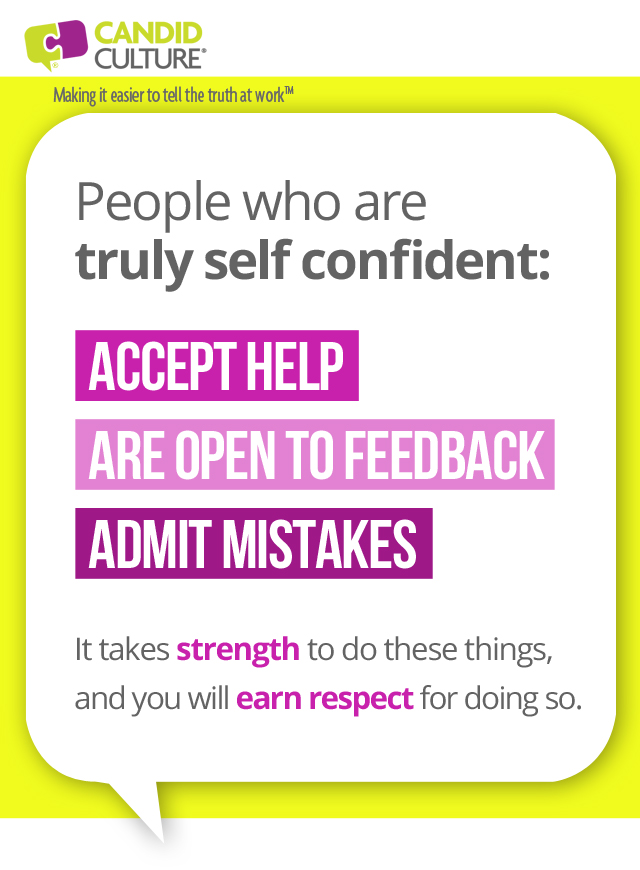
Most of us aren’t eager to admit when we don’t know something, need help, or make a mistake. We fear these things will damage our reputation and make us appear less than to others. But neither are true. It takes strength and self-confidence to admit mistakes, accept feedback, and ask for help. Strong, self-confident people do all of these things.
When someone who works for me is willing to admit mistakes, I think more of them. When employees ask for help rather than spin their wheels unnecessarily, I’m appreciative. When they’re open to feedback, I’m grateful they’re easy to work with. And the same is likely true for you.
Before launching Candid Culture, I worked for a CEO who frequently led with, “I may not be the smartest guy in the room, but…” The CEO was trying to appear humble and relatable, but he was the smartest guy in the room, and we all knew it, thus his attempts were false and came off as such. Arrogance masquerades as self-confidence. People who are arrogant come off as strong and self-confident, but it’s a façade.
It may seem like your personal power and reputation will be diminished by admitting mistakes and accepting help. But this couldn’t be further from the truth. It takes strength to say you don’t know how to do something, to embrace feedback that stings, and to admit bad choices. And strong, self-confident people do all of these things, regularly.
You won’t lose credibility or damage your reputation by being humble, instead you’ll be seen as real, relatable, and willing to admit a lack of perfection. And all of those things take strength that ingratiate you to others. So be yourself. Don’t pretend you’re better or more knowledgeable than you are. Authenticity goes a long way.
Employees are often afraid of the most senior people in organizations, simply because of their titles. The better the title, the scarier people are. And if employees are scared of organizational leaders, they’re not going to give those leaders negative feedback. The most senior people in an organization get the least information of anyone.
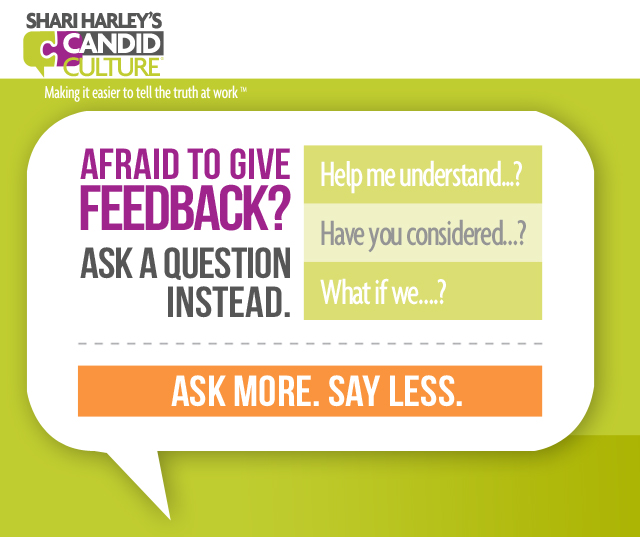
No one likes to be told that he is wrong. Negative feedback tells the person he did something wrong. But there is more than one way to give feedback. Asking questions can be equally as effective as giving direct feedback.
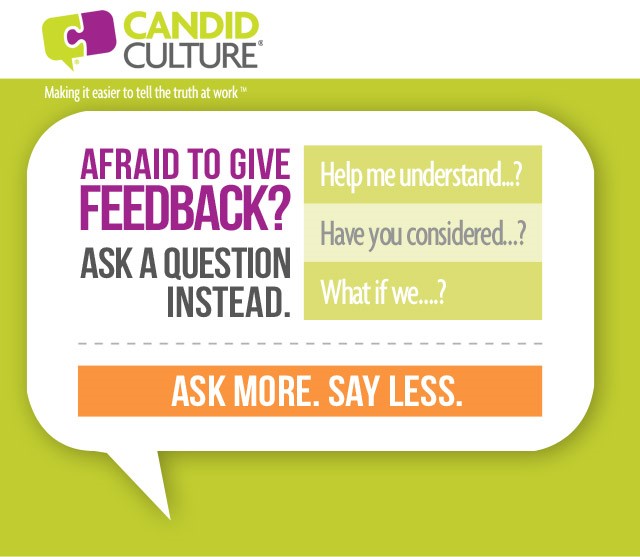
If you want to give a senior person negative feedback, but you’re afraid of the consequences, manage up by asking more and saying less.
Here are some ways to manage up by asking questions:
Rather than saying, “I disagree, I think you’re wrong, or this is a mistake,” consider managing up by asking questions like:
We’ve chosen to invest a lot in this software. I wasn’t here when the software was chosen. What’s the history of this initiative?
What were the criteria for selection?
What are you concerned about?
What are you satisfied with?
What else have we tried?
What are your thoughts about…?
What if we tried…?
Asking questions gets the person involved in a discussion, during which you can eventually express your point of view. When you ask questions, you say very little, and definitely don’t call the person’s decision-making into question.
Human beings are wired for survival. Receiving negative feedback kicks the need to defend oneself into gear, hence why people become defensive when they receive negative feedback. Negative feedback calls survival into question. If you don’t want people to become defensive, don’t require them to defend themselves. A discussion, during which you ask questions, is much less threatening than overtly disagreeing with someone’s point of view.
Asking questions takes more time and more patience than giving direct feedback. But it also takes less courage, and the quality of your relationship doesn’t have to be as good. You need a pretty good relationship to give direct feedback. If you don’t have that relationship, manage up by asking questions instead of being so direct.
If you do choose to ask questions, watch your tone. If you can safely add the words “you dummy” to a question, you aren’t really asking a question, you’re giving feedback, which is likely to evoke the defensive response you’re seeking to avoid.
It’s important to be able to express your point-of-view at work. Staying in a job or organization in which you can’t speak up, doesn’t feel great and doesn’t leverage the best of what you have to offer. But if you’re concerned about giving direct feedback, manage up by asking questions. Say less. Ask more.
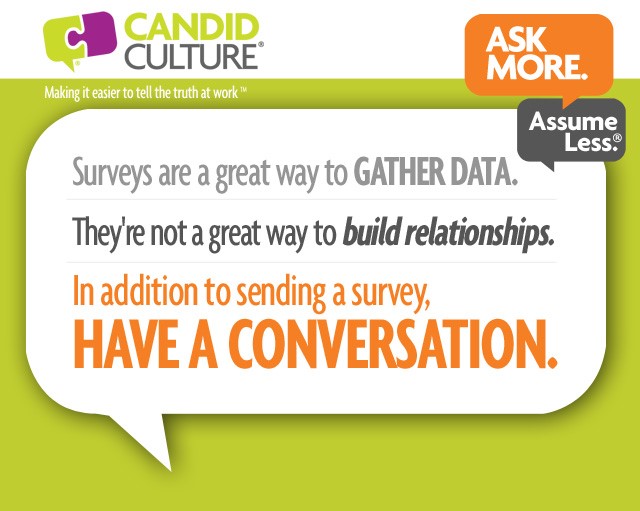
Surveys are a great way to gather data. They’re not a great way to build relationships. In addition to sending out employee engagement surveys, ask questions live. Employees want to talk about their experience working with your organization. And employees will give you real, honest, and salient data, if you ask them and make it safe to tell the truth.
Here are a few methods of gathering data, in addition to sending employee engagement surveys:
Managers, ask questions during every one-on-one and team meeting with employees.
Managers, consider asking:
What’s being talked about in the rumor mill?
What do I need to know about that you suspect I don’t?
What makes your job harder than it has to be? What would make your job easier?
What meetings are not a good use of time?
Listen and be careful not to defend. Employees want to be heard. Respond if you’re able, but don’t deflect the feedback you’ve received.
Leaders, conduct roundtable discussions with small groups of employees throughout the year. I’d suggest discussions with groups of six employees. Have lunch or coffee. Keep the meetings informal.
Leaders, consider asking:
What’s a good decision we made in the last six months? What’s a decision we made that you question?
What would need to happen for you to be comfortable referring your friends to work here?
What’s something happening in the organization that you’re concerned about?
How to Get the Truth:
Share as much information as you can. Trust your employees.
Ensure there are no negative consequences for people who tell you the truth.
Give positive attention to the people who risk and give you negative information.
Tell employees what you learn during these discussions and what you will and won’t be doing with the information.
You don’t need to act on every piece of data you receive. Just acknowledge what you heard and explain why you will or won’t be taking action.
Employees are loyal to managers and organizations they feel connected to, and connections are formed through conversations. So in addition to sending employee engagement surveys, ask questions during every conversation and make it clear that you’re listening to the answers.
Lots of organizations send out employee engagement surveys with the desire of improving employee engagement and retention; unfortunately they often damage both in the process.
There are a few employee engagement survey pitfalls that are luckily easy to avoid.
Here are three practices to follow when sending out employee engagement surveys:
Shorter is better. I hate to say this, but no one wants to fill out your employee engagement survey. It’s time consuming, employees doubt the survey will yield results, and employees worry that their feedback isn’t really confidential.
Make your employee engagement survey easy to fill out by making it short. And by short, I mean 10 questions or fewer. You’ll get a better response rate to a 10-question survey than a 65-question one. And do you really need more information than the answers to ten well-written questions?
Provide employees with survey results quickly. Most organizations ask for too much information. Leaders are overwhelmed by the survey information, so they spend months and months reviewing it, while employees comment on yet another employee survey with no communication.
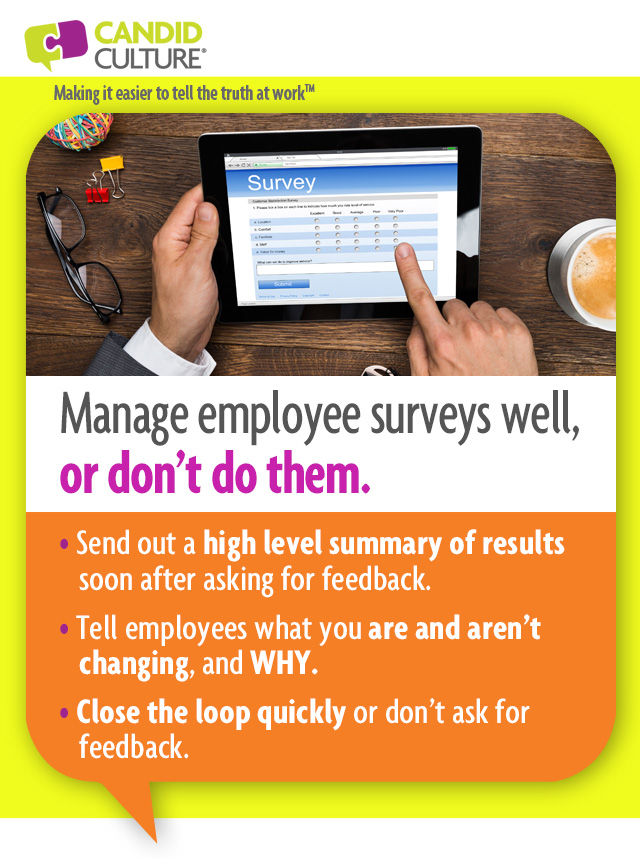
Send out a communication sharing the top few learnings – the good and the not-so-good — within a few weeks of sending out the survey. You don’t need to take action at the same time. Simply keep employees in the loop by communicating a quick summary of what you learned. If you wait too long to share the feedback, it often never gets communicated. And the next time you send out a survey, employees will remember the absence of information and be hesitant to fill it out.
Within 90-days, tell employees what you will and won’t be changing, based on the survey feedback, and tell them why. Employees don’t need or expect all of their input to be utilized. Closing the loop with clear communication about what you are and aren’t changing, and why, is often sufficient.
All of that being said, I’m going to recommend you send out fewer surveys. Employee engagement surveys are a good way to quickly collect lots of information. Engagement surveys are not a good way of building trust and relationships with employees, which is what leads to employee engagement and retention. Employees don’t feel closer to an organization’s leadership team after filling out an employee engagement survey. Trust isn’t built. Instead of sending out so many surveys, I’d suggest cutting the number in half and have leaders and managers hold roundtable discussions with groups of 6-8 employees a few times a year instead. Roundtable discussions achieve several goals at once—they give leaders visibility, which builds trust, they help leaders build rapport and relationships, and gather the same data that a written survey provides.
When leaders participate in our Be a Best Place to Work program, we teach the five things leaders need to do to engage and retain employees. Holding roundtable discussions and asking these questions is a key recommendation of the training. Sending out written surveys is not. Engage and retain employees by talking with employees. Ask employees for their input. Listen. And watch your employee engagement survey scores sky rocket.
There are three reasons people say “that’s above or below my paygrade” or “that’s not my job” –they don’t feel empowered to make decisions, they think they’re being unfairly compensated for the challenges at hand, or they aren’t particularly motivated (read lazy).
“That’s not my job” (aka, I don’t do things that are outside of my job description) is a mindset, and if someone has it, I’d suggest not hiring that person. People who think they should only have to do what’s on their job description aren’t utility players, and your organization is likely too lean to afford employees who only want to perform in a narrow box.
“That’s not my job” can also be an outcome of leaders and managers who can’t let go and let employees take risks and make decisions. If that’s your management style, hire people who will follow directions and don’t want to create new things and solve problems. Problem solvers will be frustrated if they only get to follow instructions.
Here are six steps to steer clear of “that’s not my job” syndrome and advance your career, regardless of your current role in your organization:
Never say the words “that’s above or below my paygrade” or “that’s not my job.” Even if it’s true.
If you don’t have the latitude to solve certain problems, ask the people you work for how they want you to handle those types of issues when you see or hear about them. That’s a subtle way to provide feedback that you don’t have the latitude you need to solve certain problems.
When you see an impending train wreck, say something. I see lots of very capable employees see the train wreck coming, comment to themselves or others who can’t do anything about the problem (aka gossip), and then nod knowingly when the *&#@ hits the fan. Don’t be that person. Look out for your organization and the people you work with.
If you see a broken or lacking process, raise the issue with someone who can do something about it, and offer to take a stab at fixing the problem. One of managers’ biggest complaints is employees who dump and run – “I’ve identified a problem. I’m leaving it for you to fix.”
Go out of your way to do the right thing, even if you are uncomfortable or don’t want to. If it’s easier to email someone, but you know the right thing to do is to pick up the phone, pick up the phone. If an internal or external customer expresses concern and you can’t solve the problem, find someone who can. There are lots of ways to make an impact.
Ask more questions. Find a non-judgmental way to ask, “Why do we do this this way?” “Have we considered…?” “Would you be open to trying…?” Status quo can be the right thing and what’s necessary. It can also be the death of organizations.
Make stuff happen. Don’t pass the buck. And if you are going to pass the buck, don’t announce it. It only makes you look disempowered and uncommitted.
Lots of organizations send out employee engagement surveys with the desire of improving employee engagement and retention; unfortunately they often damage both in the process.
There are a few employee engagement survey pitfalls that are luckily easy to avoid.
Here are three practices to follow when sending out employee engagement surveys:
Shorter is better. I hate to say this, but no one wants to fill out your employee engagement survey. It’s time consuming, employees doubt the survey will yield results, and employees worry that their feedback isn’t really confidential.
Make your employee engagement survey easy to fill out by making it short. And by short, I mean 10 questions or fewer. You’ll get a better response rate to a 10-question survey than a 65-question one. And do you really need more information than the answers to ten well-written questions?
Provide employees with survey results quickly. Most organizations ask for too much information. Leaders are overwhelmed by the survey information, so they spend months and months reviewing it, while employees comment on yet another employee survey with no communication.
Send out a communication sharing the top few learnings – the good and the not-so-good — within a few weeks of sending out the survey. You don’t need to take action at the same time. Simply keep employees in the loop by communicating a quick summary of what you learned. If you wait too long to share the feedback, it often never gets communicated. And the next time you send out a survey, employees will remember the absence of information and be hesitant to fill it out.
Within 90-days, tell employees what you will and won’t be changing, based on the survey feedback, and tell them why. Employees don’t need or expect all of their input to be utilized. Closing the loop with clear communication about what you are and aren’t changing, and why, is often sufficient.
All of that being said, I’m going to recommend you send out fewer surveys. Employee engagement surveys are a good way to quickly collect lots of information. Engagement surveys are not a good way of building trust and relationships with employees, which is what leads to employee engagement and retention. Employees don’t feel closer to an organization’s leadership team after filling out an employee engagement survey. Trust isn’t built. Instead of sending out so many surveys, I’d suggest cutting the number in half and have leaders and managers hold roundtable discussions with groups of 6-8 employees a few times a year instead. Roundtable discussions achieve several goals at once—they give leaders visibility, which builds trust, they help leaders build rapport and relationships, and gather the same data that a written survey provides.
When leaders participate in our Be a Best Place to Work program, we teach the five things leaders need to do to engage and retain employees. Holding roundtable discussions and asking these questions is a key recommendation of the training. Sending out written surveys is not. Engage and retain employees by talking with employees. Ask employees for their input. Listen. And watch your employee engagement survey scores sky rocket.
There are three reasons people say “that’s above or below my paygrade” or “that’s not my job” –they don’t feel empowered to make decisions, they think they’re being unfairly compensated for the challenges at hand, or they aren’t particularly motivated (read lazy).
“That’s not my job” (aka, I don’t do things that are outside of my job description) is a mindset, and if someone has it, I’d suggest not hiring that person. People who think they should only have to do what’s on their job description aren’t utility players, and your organization is likely too lean to afford employees who only want to perform in a narrow box.
“That’s not my job” can also be an outcome of leaders and managers who can’t let go and let employees take risks and make decisions. If that’s your management style, hire people who will follow directions and don’t want to create new things and solve problems. Problem solvers will be frustrated if they only get to follow instructions.
Here are six steps to steer clear of “that’s not my job” syndrome and advance your career, regardless of your current role in your organization:
Never say the words “that’s above or below my paygrade” or “that’s not my job.” Even if it’s true.
If you don’t have the latitude to solve certain problems, ask the people you work for how they want you to handle those types of issues when you see or hear about them. That’s a subtle way to provide feedback that you don’t have the latitude you need to solve certain problems.
When you see an impending train wreck, say something. I see lots of very capable employees see the train wreck coming, comment to themselves or others who can’t do anything about the problem (aka gossip), and then nod knowingly when the *&#@ hits the fan. Don’t be that person. Look out for your organization and the people you work with.
If you see a broken or lacking process, raise the issue with someone who can do something about it, and offer to take a stab at fixing the problem. One of managers’ biggest complaints is employees who dump and run – “I’ve identified a problem. I’m leaving it for you to fix.”
Go out of your way to do the right thing, even if you are uncomfortable or don’t want to. If it’s easier to email someone, but you know the right thing to do is to pick up the phone, pick up the phone. If an internal or external customer expresses concern and you can’t solve the problem, find someone who can. There are lots of ways to make an impact.
Ask more questions. Find a non-judgmental way to ask, “Why do we do this this way?” “Have we considered…?” “Would you be open to trying…?” Status quo can be the right thing and what’s necessary. It can also be the death of organizations.
Make stuff happen. Don’t pass the buck. And if you are going to pass the buck, don’t announce it. It only makes you look disempowered and uncommitted.
Most employees are afraid of getting fired. As a result, employees are often afraid of the most senior people in organizations, simply because of their titles. The better the title, the scarier people are. And if employees are scared of organizational leaders, they’re not going to be inclined to give those leaders negative feedback. The most senior people in an organization get the least information of anyone.
No one likes to be told that he is wrong. Negative feedback tells the person he did something wrong. But there is more than one way to give feedback. Asking questions can be equally as effective as giving direct feedback.
If you want to give a senior person negative feedback, but you’re afraid of the consequences, manage up by asking more and saying less..
Here are some ways to manage up by asking questions:
Rather than saying, “I disagree, I think you’re wrong, or this is a mistake,” consider managing up by asking questions like:
We’ve chosen to invest a lot in this software. I wasn’t here when the software was chosen. What’s the history of this initiative?
What were the criteria for selection?
How do you think it’s going?
What are you concerned about?
What are you satisfied with?
What else have we tried?
What are your thoughts about…?
What if we tried…?
Asking questions gets the person involved in a discussion, during which you can eventually express your point of view. When you ask questions, you say very little, and definitely don’t call the person’s decision-making into question.
Human beings are wired for survival. Receiving negative feedback kicks the need to defend oneself into gear, hence why people become defensive when they receive negative feedback. Negative feedback calls survival into question. If you don’t want people to become defensive, don’t require them to defend themselves. A discussion, during which you ask questions, is much less threatening than overtly disagreeing with someone’s point of view.
Asking questions takes more time and more patience than giving direct feedback. But it also takes less courage, and the quality of your relationship doesn’t have to be as good. You need a pretty good relationship to give direct feedback. If you don’t have that relationship, manage up by asking questions instead of being so direct.
If you do choose to ask questions, watch your tone. If you can safely add the words “you dummy” to a question, you aren’t really asking a question, you’re giving feedback, which is likely to evoke the defensive response you’re seeking to avoid.
It’s important to be able to express your point-of-view at work. Staying in a job or organization in which you can’t speak up, doesn’t feel great and doesn’t leverage the best of what you have to offer. But if you’re concerned about giving direct feedback, manage up by asking questions. Say less. Ask more.
Surveys are a great way to gather data. They’re not a great way to build relationships. In addition to sending out employee engagement surveys, ask questions live. Employees want to talk about their experience working with your organization. And employees will give you real, honest, and salient data, if you ask them and make it safe to tell the truth.
Here are a few methods of gathering data, in addition to sending employee engagement surveys:
Managers, ask questions during every one-on-one and team meeting with employees.
Managers, consider asking:
What’s being talked about in the rumor mill?
What do I need to know about that you suspect I don’t?
What makes your job harder than it has to be? What would make your job easier?
What meetings are not a good use of time?
Listen and be careful not to defend. Employees want to be heard. Respond if you’re able, but don’t deflect the feedback you’ve received.
Leaders, conduct roundtable discussions with small groups of employees throughout the year. I’d suggest discussions with groups of six employees. Have lunch or coffee. Keep the meetings informal.
Leaders, consider asking:
What’s a good decision we made in the last six months. What’s a decision we made that you question?
What would need to happen for you to be comfortable referring your friends to work here?
What’s something happening in the organization that you’re concerned about?
How to Get the Truth:
Share as much information as you can. Trust your employees.
Ensure there are no negative consequences for people who tell you the truth.
Give positive attention to the people who risk and give you negative information.
Tell employees what you learn during these discussions and what you will and won’t be doing with the information.
You don’t need to act on every piece of data you receive. Just acknowledge what you heard and explain why you will or won’t be taking action.
Employees are loyal to managers and organizations they feel connected to. And connections are formed through conversations. So in addition to sending employee engagement surveys, ask questions during every conversation and make it clear that you’re listening to the answers.
For the most part, people are afraid to speak up at work. Despite the town hall meetings and roundtable discussions executives host, the feedback training offered, the existence of ask-the-CEO email addresses and blogs, and employee satisfaction and engagement surveys, many employees are still afraid to give feedback at work, citing fear of damaging relationships, being fired, and other forms of retaliation.
Coworkers, leaders, and managers set clear expectations before problems occur. No one has to guess what is expected of them and what a good job looks like.
Employees ask for and receive regular, balanced and candid feedback and always know where they stand performance wise.
Managers and leaders are open to and ask for feedback. They always know what’s really happening in the organization and can lead accordingly.
People talk to each other versus about each other. Gossip and drama is the exception, not the norm.
Work is a fun place to be. People enjoy working together and produce their best work.
Many of you are taking actions to create the environment I’ve described above. I want to hear from you and want to use this blog to share practices for creating more candid communication at work.
Add a comment and tell us:
What you are doing to increase the trust and communication in your organization.
The avenues you are using to give feedback on your team, in your department, or in your entire organization.
We’ll enter you to win 50 of our new door tags. The door tags were designed to tell your coworkers that your office is a place they can speak freely, without concern.



 Surveys are a great way to gather data. They’re not a great way to build relationships. In addition to sending out employee engagement surveys, ask questions live. Employees want to talk about their experience working with your organization. And employees will give you real, honest, and salient data, if you ask them and make it safe to tell the truth.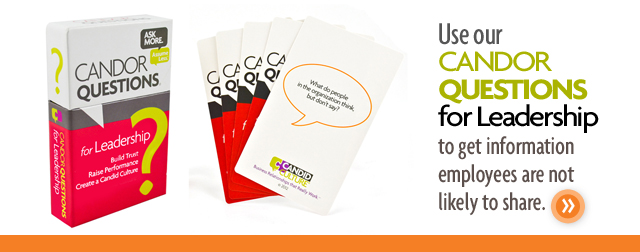
 ots of organizations send out employee engagement surveys with the desire of improving employee engagement and retention; unfortunately they often damage both in the process.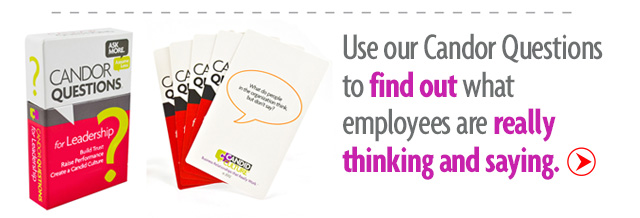


 inclined to give those leaders negative feedback. The most senior people in an organization get the least information of anyone.
 Surveys are a great way to gather data. They’re not a great way to build relationships. In addition to sending out employee engagement surveys, ask questions live. Employees want to talk about their experience working with your organization. And employees will give you real, honest, and salient data, if you ask them and make it safe to tell the truth.