Posts Tagged ‘how to give negative feedback at work’
We’ve all received work via email from another person that wasn’t what we were expecting, hit reply, and told the other person what we thought. Then we dealt with the consequences.
A few tips for giving feedback to get more of what you want and less of what you don’t:
Don’t give feedback via email. Ever. You can’t manage your tone or see the person’s reaction.
Practice the 24-hour rule and the one-week guideline. Wait until you’re not upset to give feedback, but don’t wait longer than a week.
It’s almost impossible to give negative feedback without putting the other person on the defensive. Becoming defensive when receiving feedback is normal and natural. It’s a way to protect ourselves when we feel judged.
When people are defensive, it’s hard to listen and respond. The less defensive the other person becomes, the easier it is to communicate with that person. People will be less defensive if you give feedback when you’re calm and choose your words carefully.
Communicate in a way that the relationship needs versus what you need in the moment.
When we give feedback when we’re upset, we’re really communicating for ourselves, not for the other person. I didn’t get what I want, I’m upset, and I’m going to tell you about it. Then the other person gets upset and now, in addition to you not getting what you wanted in the first place, you have to do damage control.
Communicating in a way the relationship needs means choosing the timing, words, and method of communication that is likely to produce the result you want – the other person being able to hear you, while becoming minimally defensive, and taking action. Giving feedback when you’re upset, especially via email, will not produce the result you want. You’ll only damage your relationship.
Being an effective communicator and maintaining good business relationships requires patience and self-discipline. Wait to give feedback until you’re not upset. Don’t send an email. Pick up the phone, meet via video, or walk to the person’s desk. Deliver the feedback in a way the other person can hear you. Be ready for the person to become defensive. It’s human to become defensive. You can’t eliminate defensiveness, but how you deliver feedback can greatly reduce defensiveness, and you’ll get more of what you want and less of what you don’t.
Most ‘feedback’ sounds like this:
- You’re awesome.
- Good job.
- Nicely done.
- You’re cutting corners.
- You have a bad attitude.
- You’re not committed.
- You’re careless.
- You’re disengaged.
I’m not sure why, I wish I could give you a good reason, but the vague phrases above are what most people say when attempting to give feedback. To prevent giving vague, unhelpful (a.k.a. fake) feedback, you need to prepare.

There is a reason you think the person is awesome or has a bad attitude. What did they do that created that impression? Until you can describe what the person did to create an impression, you’re not ready to give feedback. You’re better off saying nothing.
All of the phrases above are opinions with no facts. Opinions are judgments. Feeling judged makes people defensive. When people are defensive, it’s hard to listen.
The purpose of feedback is to help another person. Give the person enough information they know what behaviors to replicate and what to change. Before you give feedback, write down three things the person did that created your impression. If you can’t give an example, wait to have the conversation until you can. It’s better to say nothing than to say something vague.
Vague, positive feedback sounds inauthentic. Vague, negative feedback is judgmental. Neither vague positive or negative feedback strengthens relationships or helps the recipient.
If you want to be heard and helpful, provide an example. No example, no feedback.

Most of us avoid giving negative feedback because we don’t want to deal with the recipient’s defensive behavior. We’re waiting for what I call, The Freak Out. The Freak Out is the predictable response to negative feedback.
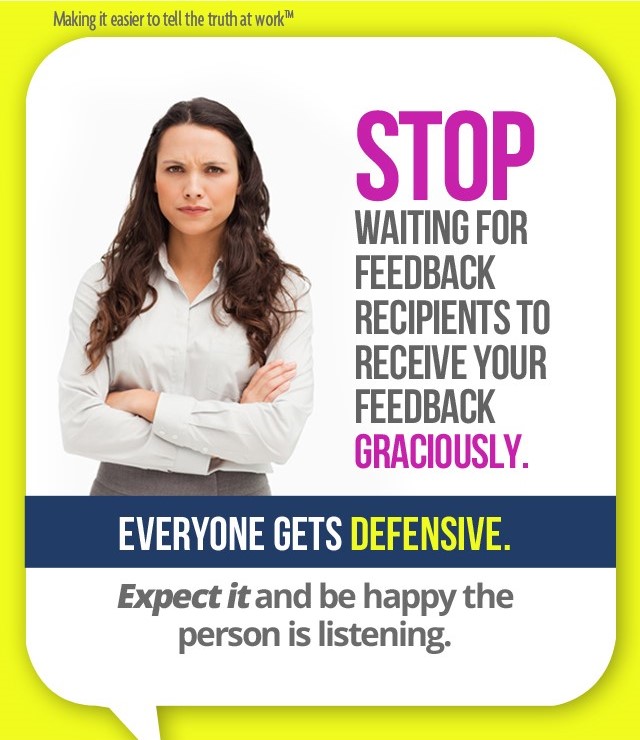
Everyone wants to be seen as competent and adding value. When we give people negative feedback, we call those two things into question and the brain instinctively reacts. It’s as if you were driving down the road and the person in front of you slammed on their brakes. As an act of survival, you’d hit your brakes too. Becoming defensive when receiving negative feedback is the same instinctual response. We (almost) can’t help ourselves. So rather than dread and avoid others’ defensive behavior, expect it and have a plan.
Here are five ways to deal with defensive behavior:
- Plan your conversation by writing notes and bringing them to the conversation. I’m a fan of typed, double-spaced bulleted notes that are easy to follow.
- Practice what you want to say out loud. What you say in your head is often different than what comes out of your mouth.
- Ask others for help. Change names and details to protect the feedback recipient and ask how someone else might deliver the feedback. Someone who is not emotionally involved will likely handle the conversation better.
- When the feedback recipient exhibits defensive behavior, take a breath and pause. Remember that you expected this. Don’t retract what you’ve said. Just let the person speak.
- Stay on track. Defensive behavior is designed to derail conversations. Keep the conversation focused on the feedback. Don’t become distracted.
What to say when people respond to feedback defensively:
Defensive behavior: “Why are you talking to me? I’m not the only one doing this.”
Appropriate response: “If others are doing this, I promise you that I’m managing it. Right now we’re talking about you. I know this is difficult. Let’s stay here.”
Defensive behavior: “You’re wrong. Everyone else has given me positive feedback.”
Appropriate response: “I know this is difficult. I’m asking you to __________. Please do that.”
Defensive behavior: “You don’t like me and you’re picking on me.”
Appropriate response: “I’m sorry you feel that way. The reason I’m asking you to ________ is _______.”
Defensive behavior: “I disagree.”
Appropriate response: “I know that we disagree. And I’m asking you to __________.”
The key is not to get baited by defensive behavior. This is why I suggest preparing and bringing typed, bulleted notes. When I’m having a particularly difficult conversation and the other person becomes defensive, I often become flustered and either forget what I want to say or back pedal. Do neither. Expect defensive behavior. Don’t get distracted. Stay on track. You can handle anything someone says.