You get an email that annoys you, hit reply, type your thoughts, hit send, and feel instant regret. We’ve all done this. We’re frustrated and we let the other person know.
Feedback via email is always a bad idea. You don’t know how the recipient will read and interpret your message. You can’t manage the tone of the message or give the person a chance to respond. And more often than not, the recipient will reply equally frustrated. And now the non-conversation begins –back and forth, back and forth.
Email is for wimps and voicemail isn’t any better. No texting feedback either. End the madness and pick up the phone or take a shower and meet via video. Things are resolved most quickly and easily by talking about them.
I’m consistently surprised at how much feedback is delivered via email. And it’s only gotten worse with people working virtually. I’ll admit to occasionally being guilty of it too. I’m in a hurry and I want to get something done quickly. Or my emotions get the best of me, and I feel compelled to respond to a situation quickly, so I send an email or a text message that I know I shouldn’t send. Then I regret it and spend the rest of the day apologizing and feeling badly for communicating impulsively.
If we want people to want to work with us and perform at their best, we need to consider how our actions impact them. Yes, it’s easier to send a quick email or text. But doing so invariably annoys the other person and damages your relationship. Slow down. When you need to give feedback, consider what you want the other person to do. Then ask yourself, how do I need to communicate to get the result I want? Then pause, breathe, and pick up the phone.
Posted under Uncategorized on November 28, 2025 by Shari Harley. 0 Comments
Many people worry about giving feedback because they fear they don’t have the ‘right’ words. They’re concerned they’ll say ‘it’ wrong and damage relationships.
Feedback is hard enough to give without worrying about saying everything perfectly. Worry less about having all the right words and more about whether or not people trust your motives.
When people trust your motives – why you’re giving feedback – you can say almost anything. When they don’t trust your motives, you can say almost nothing.
Getting negative feedback is hard. It’s easier to listen to feedback when we trust the person who’s giving us the feedback – we know their intentions are to help versus to judge or hurt us.
Speak from the heart, be authentic, and worry less. Be yourself. If you’re nervous to say what you want to say, tell the other person you’re nervous. If you’re struggling to find the right words, say so. If you’re worried you’ll damage the relationship or that it isn’t your role to give the feedback, say that. Authenticity goes a long way.
Here’s how to give feedback you’re apprehensive about:
How to give feedback example one: Consider saying, “There’s something I need to talk with you about, but I’m concerned that I won’t use the right words and will damage our relationship.”
How to give feedback example two: “There’s something I want to talk with you about, but I’m concerned how it will come across. Is it ok if I say what I need to say?”
How to give feedback example three: “I want to share my thoughts on something, but I’m concerned it’s not my place to do so. Is it ok if I share my ideas about _________?”
Other people aren’t expecting you to be perfect, but they do want to know they’re working with a human being. And human beings are fallible. We have fears. We make mistakes. And sometimes we don’t say things perfectly. You don’t have to be perfect; you just have to be real.
The people you live and work with are hesitant to give you negative feedback. They’re afraid you’ll freak out, and they don’t want to deal your freak out. It’s easier to say nothing.
When I started teaching how to give and receive feedback, I provided elaborate explanations as to the predictable response to feedback and the rationale for that response. Now I’ve boiled the natural response to receiving feedback to three words: The Freak Out.
Every person you know – personally and professionally – wants to be liked and approved of. Even the people in your organization who you think are lazy, want you to think highly of them. And when anyone calls another person’s competence into question, that person is likely to freak out (become defensive).
It’s very difficult not to get at least a little bit defensive when receiving feedback. A defensive response often sounds something like, “Thanks for the telling me that. Can I tell you why I did it that way?” The problem with that slightly defensive response is that what the other person hears is, “You’re not listening. I’m wasting my time talking to you.” People want to feel heard. And when the feedback recipient becomes defensive, the person giving feedback doesn’t feel heard.
Don’t feel badly about becoming defensive when you receive negative feedback. Becoming defensive when receiving bad news just means you’re a living, breathing human being with feelings. But The Freak Out scares people. They don’t want to deal with your mild, moderate, or very defensive reactions.
Because people want to avoid The Freak Out, they keep negative feedback to themselves, or worse, tell someone else. If you want more truth, you need to make it clear there won’t be negative repercussions for speaking up.
Here are seven steps to get others comfortable giving you negative feedback:
1. Ask for feedback.
2. Be specific about the type of feedback you want.
3. Tell the person from whom you’re asking for feedback when and where they can observe you in action.
An ineffective way to ask for feedback: “I really want your feedback. Feel free to give it anytime.” This is too vague and doesn’t demonstrate seriousness on your part.
A more effective way to ask for feedback: “I really want your feedback on the pace of the new-hire-orientation program. Are you available to call into the first hour of orientation next Wednesday at 9:00 a.m. and tell me what you think of the pace and why?” This request tells the person specifically what you want and demonstrates you’re serious about wanting feedback.
4. When you receive feedback, say, “Thank you for telling me. I’m going to think about what you’ve said and may come back to you in a few days to talk more.”
5. Don’t respond to negative feedback immediately. End that part of the conversation instead of responding.
6. If you’d like more information or want to tell the person you disagree with what they said, wait until you’re calm to have that conversation. That can be minutes or a few days later.
7. You can express a counterpoint of view, just don’t do it immediately after receiving feedback. Anything you say in the moment will likely sound defensive.
No matter what a person’s role in your life – your boss, a peer, external customer, or even a friend or spouse – it takes courage to give you feedback. When a conversation requires courage, the speaker’s emotions are heightened. If the feedback recipient’s emotions rise in response to the feedback, conversations escalate. This is how arguments start. If you want to put the other person at ease and get more feedback in the future, do the opposite of what people are expecting. Rather than getting even the slightest bit defensive, do the opposite. Say, “Thank you for the feedback. I’m sorry you had that experience. I’m going to think about what you’ve said and may come back to you to talk more.” Then end that part of the conversation. You’re not being dismissive; you’re ensuring your emotions don’t take over. If you want to have a second conversation, have it within a week. Revisiting the conversation in a timely way shows you respect what the other person is saying and both of you will remember the topic at hand.
Ending a conversation, when all you want to do is react, is very difficult. Putting a conversation on hold will require a good deal of self-control, but the rewards are great. You will build trust, strengthen relationships, and get more information than you have in the past – information you need to manage your career, reputation, and business.
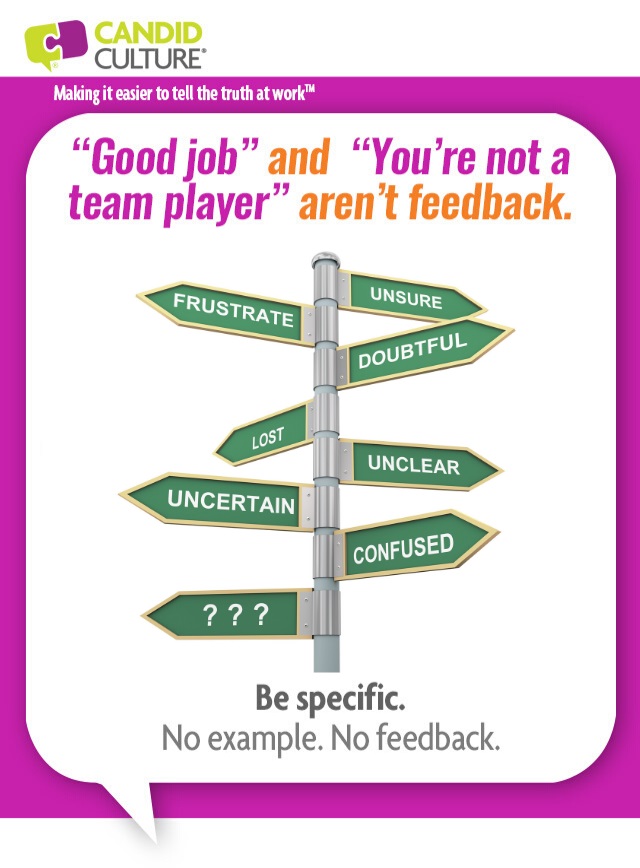
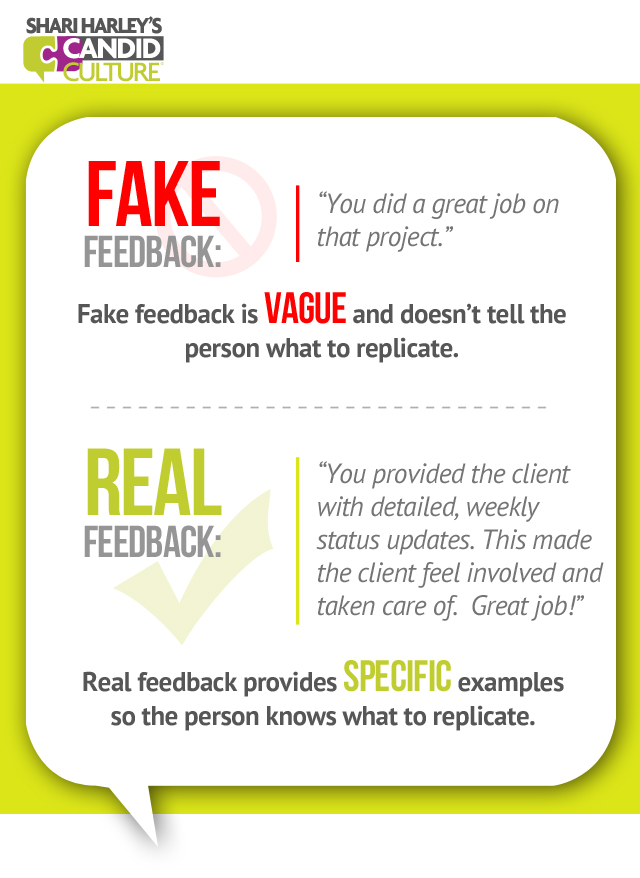
Most of the feedback people receive in the workplace isn’t feedback at all, it’s what I fondly refer to as Cap’n Crunch – vague and unhelpful words that put people on the defensive but don’t change behavior. If you want people to do something differently, give specific feedback.
Most of the fake Cap’n Crunchfeedback people get sounds like this:
“You did a great job on that.”
“You’re doing really good work.”
“You’re dressing inappropriately.”
“You’re difficult to work with.”
None of this is feedback. It’s all Cap’n Crunch. Vague, vague, and more vague.
The first words out of your mouth will invariably be Cap’n Crunch. Follow those words with, “for example” and you’ll be headed in the right direction.
“You did a great job on that. For example, I never had to ask about the status of the project. You gave me an update every Friday, and that made me feel comfortable that we were on track.”
“You dressed inappropriately for that meeting. For example, the client was dressed in business casual; you wore jeans and a t-shirt. Next time, please dress as the client dresses or a step above in khaki pants or slacks and a jacket.”
Most people are afraid to give feedback because they don’t want to deal with the defensive reaction they anticipate. The more vague you are, the more defensive people will be, because they don’t know what you’re talking about and they feel judged. Vague feedback is subjective. Subjective is judgmental. Feeling judged puts people on the defensive.
If employees shop your feedback around, asking what others think of the feedback you provided, it’s because you were vague, they disagree with you, or they’re being defensive. Feedback will be received better and resisted less if you’re specific.
Specific feedback can be captured on video. Meaning, you can video someone calling into a meeting late, rolling their eyes, and texting on their phone. I dare you to video “you were disrespectful in the meeting, you dressed inappropriately, or you’re difficult to work with.” If you can’t capture the feedback on video, you don’t yet have specific feedback. You have Cap’n Crunch.
When I teach managers to give feedback I ask the managers to, “Describe the situation to me. What did the person do?” Managers often reply with, “They were negative.” This is Cap’n Crunch. So, I keep asking questions. “What did they do that was negative? What did it look like?” After two or three questions the manager tells me, “I overheard them complaining to other employees about the decisions the company is making. I’d rather they ask me questions about the direction we’re going versus gossip to peers.” Now we have specific feedback.
Wait to give feedback until you have a specific example. If you don’t have a specific example, go get one. Without an example, employees will look at you in a confused way, question the validity of what you’re saying, and become defensive. And they’ll be justified in doing all of these things.
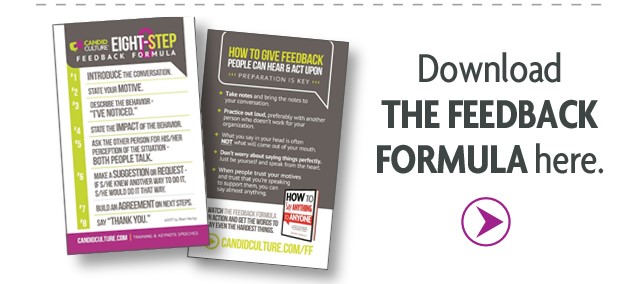
Most of us dread giving feedback because we don’t want to deal with people’s defensive responses. If you want more help, chapters nine through twelve of How to Say Anything to Anyone provide a clear and easy-to-follow formula for giving specific feedback.
Remember, if you’re not using the words “for example” you’re not giving specific feedback.
Want to know one of the reasons people get defensive when you give feedback and why they often don’t change their behavior? Because what you’re giving them isn’t actually feedback.
“You’re awesome to work with” isn’t feedback. Neither is “You did a great job.” “Your work isn’t thorough” isn’t either. Neither is, “You were inappropriate.” Most of what we consider feedback isn’t feedback at all. It’s vague, unhelpful language that leaves people wondering what they need to do more, better, or differently.
There are only two reasons to give feedback – to encourage someone to either change or replicate a behavior. Unfortunately, most of the ‘information’ we give is too vague to help people do either.
When you coach or give feedback, you serve as someone’s GPS. Like the GPS on your phone, you need to be so specific the person knows precisely what to change or replicate. If you were driving and your GPS said, “Good job” or “I think you’re off track,” you’d throw the GPS out the window and get a map.
If you give someone what you consider feedback and the person responds with, “I don’t know what you mean. Can I have an example?” you’ll know you weren’t helpful.
Here are six tips for giving helpful feedback:
Giving feedback tip one: Write down what you plan to say, then strip out half the words. Shorter feedback with fewer words is better.
Giving feedback tip two: Practice what you plan to say out loud. Have you noticed that what you ‘practice’ in your head is typically not what comes out of your mouth?
Giving feedback tip three: Before having a conversation, give the feedback to an independent, third-party and ask the person to tell you what they heard. If that person is clear, the feedback recipient likely will be too. Ensure who you practice with will maintain confidentiality. Your organization doesn’t need more gossip.
Giving feedback tip four: Tell someone else about the conversation you need to have and ask that person what they would say. Anyone not emotionally involved in the situation will do a better job than you will. It’s our emotional involvement that makes feedback conversations so challenging. Again, ensure confidentiality.
Giving feedback tip five: Ask the feedback recipient what they heard you say. Asking, “Does that make sense?” is an ineffective question. “Do you have any questions?” isn’t any better. You ask questions to get information. Yes or no questions don’t teach you anything. Require people to tell you what they know and don’t know by asking open-ended questions.
Giving feedback tip six: Give one to three examples of what the person did or didn’t do, during the conversation. If you don’t have an example, you’re not ready to provide feedback, and anything you say will evoke defensiveness rather than behavior change.
Giving feedback doesn’t have to be so hard. Be so specific that your feedback could be used as driving directions. The purpose of feedback is to be helpful.
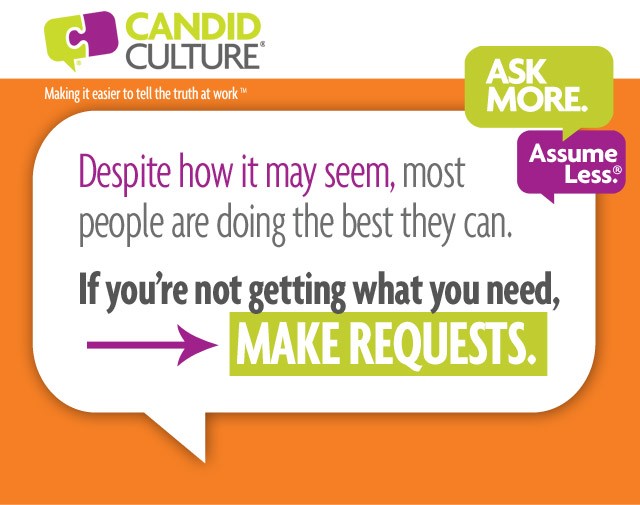
The people you work with want to do a good job. They want you to think highly of them. Yes, even the people you think do little work. Give people the benefit of the doubt. Assume people are doing their best. And when you don’t get what you want, make requests.
There are two ways to give feedback and get your needs met at work. You can give direct feedback, or you can ask for what you want.
Version one – give direct feedback: “You did this thing and here’s why it’s a problem.”
Version two is less direct. Rather than telling the person what went wrong, simply make a request.
Version two – ask versus tell: “Will you…” Or, “It would be helpful to get this report on Mondays instead of Wednesday. Are you able to do that?”
It’s very difficult to give feedback directly without the other person feeling judged. Making a request is much more neutral than giving direct feedback, doesn’t evoke as much defensiveness, and achieves the same result. You still get what you want.
When I teach giving feedback, I often give the example of asking a waitstaff in a restaurant for ketchup. Let’s say your waiter comes to your table to ask how your food is, and your table doesn’t have any ketchup.
Option one: Give direct feedback. “Our table doesn’t have any ketchup.”
Option two: Make a request. “Can we please get some ketchup?”
Both methods achieve the desired result. Option one overtly tells the waiter, “You’re not doing your job.” Option two still tells the waiter he isn’t doing his job, but the method is more subtle and thus is less likely to put him on the defensive.
You are always dealing with people’s egos. And when egos get bruised, defenses rise. When defenses rise, it’s hard to have a productive conversation. People stop listening and start defending themselves. Defending oneself is a normal and natural reaction to negative feedback. It’s a survival instinct.
You’re more likely to get what you want from others when they don’t feel attacked and don’t feel the need to defend themselves. Consider simply asking for what you want, rather than telling people what they’re doing wrong, and see what happens.
I will admit, asking for what you want in a neutral and non-judgmental way when you’re frustrated is very hard to do. The antidote is to anticipate your needs and ask for what you want at the onset of anything new. And when things go awry, wait until you’re not upset to make a request. If you are critical, apologize and promise to do better next time. Communication is all trial and error.
Last week I had lunch with a friend. When I returned from lunch, I noticed I had something stuck in my teeth. I was embarrassed and wondered why my friend hadn’t told me.
It’s quite possible she hadn’t noticed. But we all know people who notice and say nothing. We could walk around all day with toilet paper on our shoe, lipstick on our teeth, or our fly down, and the people around us won’t tell us.
If you read my blog weekly, you already know that people have been trained not to tell you the truth.
But I think there is more preventing people from telling us the truth. Complete this sentence: “If you have nothing nice to say, _________________________________. Who told you that? Your mother!!!
I do think there’s something to this. We’re raised to believe that it’s not nice to say something to another person that isn’t positive. And in the past, when we did speak up, it’s likely the other person got defensive, so it’s no wonder that we don’t readily give people bad news.
Here are five tips for getting feedback from the people around you:
Establish a core team of people who will always tell you the truth. These can be friends, coworkers, clients, vendors, your boss, etc.
Give people permission, to be honest with you. “Let’s make a deal. I always want you to tell me the truth. If I have something stuck in my teeth, or I’m inappropriately dressed for a meeting, or I’m doing something that damages my reputation, I want you to tell me.”
Make it easy to tell you the truth. “I promise no matter what you tell me and how hard it is to hear, I will say thank you. I won’t get defensive. And if I do, I’ll apologize and try to do better next time.”
Offer to do the same for them. “And if you want me to do the same thing for you, I’m happy to do it.”
Periodically check in with people and ask for feedback. “A few months ago I asked you to tell me anything I said, did, or wore that got in the way of my success. Is there anything you’ve seen that you want to tell me?”
Every time you ask for feedback and take it graciously, you train the person to give you more feedback. On the contrary, every time you get defensive, you make it hard for people to give you feedback, making it likely they won’t do it again.
If you don’t want to walk around looking silly all day, create a safe environment where friends and co-workers can tell the truth.
Most training programs about giving feedback focus on negative feedback, because giving negative feedback is hard and makes us uncomfortable. But most people aren’t any better at giving positive feedback.
Most of the positive feedback people get at work really isn’t feedback at all. It’s vague, fluffy, and unhelpful. Aka, Cap’n Crunch – sweet but useless.
“Great job.” “You’re awesome.” “You’re great to work with.” None of this qualifies as real feedback.
The purpose of positive feedback is to make people feel valued and appreciated and to get them to replicate a behavior. Telling someone, “great job” or “you’re doing great work” will make the person feel good (momentarily), but won’t tell them what to replicate. These phrases are vague, and vague positive comments come across as inauthentic at best and unhelpful at worst.
Here are a few examples of what I refer to as real vs. fake feedback:
Example of positive feedback:
Fake feedback: “Great job.”
Real feedback: “You researched three vendors when making a proposal of who we should choose to manage our payroll operations. You included all the necessary information for us to make a decision and presented the information in a one-page table that was easy to read. Your work made it really easy to make a decision.”
Example of positive feedback:
Fake feedback: “You’re really reliable.”
Real feedback: “I know that whatever I give you to do will get done the first time I ask and will be accurate. I don’t have to ask again or check your work. You check your work for typos and mistakes before submitting it.”
Example of positive feedback:
Fake feedback: “You make my job easy.”
Real feedback: “Last week you noticed an invoice that didn’t seem accurate. You researched the invoice and got the mistake corrected before I even knew there was a problem.”
Example of positive feedback:
Fake feedback: “You’re awesome.”
Real feedback: “You always do what’s right for the company. Last week you called a vendor whose service has been spotty. You provided them with feedback and asked for their plan to improve their service levels. This added a lot of value to our organization.”
The guidelines for giving positive feedback are the same as giving negative feedback:
Be specific.
Give an example.
Give feedback close to the time an event happens.
To give specific and meaningful positive comments, you will have to observe performance, and that takes time. But if you want someone to replicate a behavior, tell the person specifically what they did well.
At some point in your career, you will likely get feedback that doesn’t feel accurate. When receiving feedback you question, rather than dismiss it, vet the feedback with the people who know you best. Assemble a core team of people who know you well, love you, and have your back. The relationships may be personal or professional. These are people who will tell you the truth (as they see it) if you ask.
You might think that you’re a different person at home and at work, thus your friends’ and family’s input isn’t valid in the workplace. I don’t think that’s true. You are who you are, and you’re not a completely different person at home and at work. It’s just not possible to be your real self and turn it on and off at work. Sure, you might have a communication style that you only use at work. You may make decisions at work differently than you do personally. And you are likely to dress differently at work than at home. But you’re not a completely different person after 5:00 pm. If you’re often late, don’t keep confidences, talk too much and too long, or wear clothing that is not your friend, your personal relationships can tell you that.
It’s important to know how you come across, your reputation, and your wins and losses at work. Having this information allows you to manage your reputation and in turn, your career.
The question is, with whom should you vet feedback that doesn’t feel quite right?
Here are four criteria for core team members:
Your core team should be made up of a small number of people (five or fewer) who know you well, love you, and have your back.
You should respect core team members’ opinions.
You must trust your core team and their motives, in relation to your well-being.
You must be open to core team members’ feedback.
Core team members don’t need to be told they’re on your core team. Simply call these people individually when you need input. Tell them the feedback you’ve received and then ask for their opinion.
It’s easy to dismiss feedback that’s hard to hear. The feedback you receive might just be that person’s opinion. But people talk. And one person’s experience of you can impact your career greatly. Manage your career assertively and powerfully by knowing your reputation. Find out the impressions you create. Then you can make decisions about changes you will and won’t make.
You get an email that annoys you, hit reply, type your thoughts, hit send, and feel instant regret. We’ve all done this. We’re frustrated and we let the other person know.
Feedback via email is always a bad idea. You don’t know how the recipient will read and interpret your message. You can’t manage the tone of the message or give the person a chance to respond. And more often than not, the recipient will reply equally frustrated. And now the non-conversation begins –back and forth, back and forth.
Email is for wimps and voicemail isn’t any better! No texting either. End the madness and pick up the phone or take a shower and meet via video. Things are resolved most quickly and easily by talking about them.
I’m consistently surprised at how much feedback is delivered via email. And it’s only gotten worse with people working virtually. I’ll admit to occasionally being guilty of it too. I’m in a hurry and I want to get something done quickly. Or my emotions get the best of me and I feel compelled to respond to a situation quickly. So I send an email or a text message that I know I shouldn’t send. Then I regret it and spend the rest of the day apologizing and feeling badly for communicating impulsively.
If we want people to want to work with us and perform at their best, we need to consider how our actions impact them. Yes, it’s easier to send a quick email or text. But doing so invariably annoys the other person and damages your relationship. People can work with you, around you, and against you. If people want to work with you, they’ll work harder and produce better work.
Slow down. When you need to give feedback, ask yourself what you want the other person to do. Then ask yourself, how do I need to communicate to get the result I want? Then pause, breathe, and pick up the phone.