The fear of saying what we think and asking for what we want at work is prevalent across organizations. We want more money, but don’t know how to ask for it. We want to advance our careers but are concerned about the impression we’ll make if we ask for more. Instead of making requests, many employees assume they won’t get their needs met and choose to leave their jobs, either physically or emotionally.
How to Retain Good Employees:
The key to keeping the best employees engaged and doing their best work is to ask more questions and make it safe to tell the truth.
Managers:
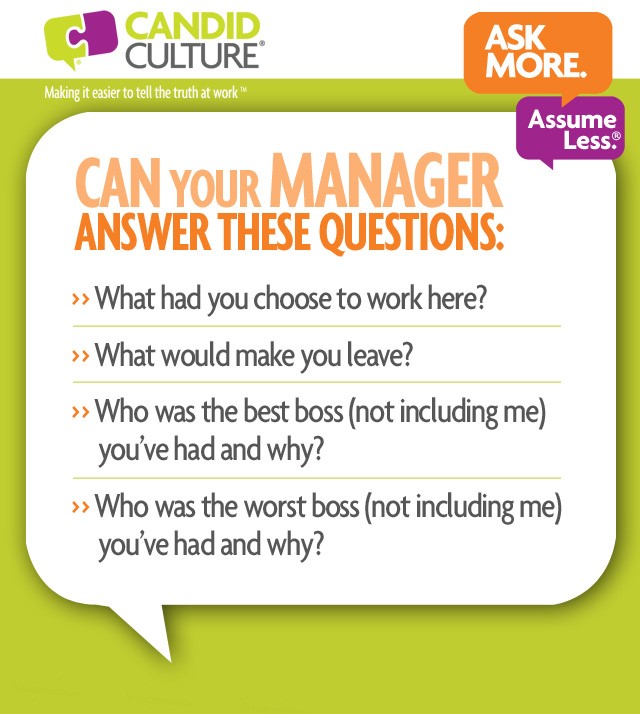
Do you know why your employees chose your organization and what would make them leave?
Do you know your employees’ best and worst boss?
The answers to these questions tells managers what employees need from the organization, job, and from the manager/employee working relationship.
Can your manager answer these questions – that I call Candor Questions – about you? For most people, the answer is no. Most managers don’t ask these questions. And most employees are not comfortable giving this information, especially if the manager hasn’t asked for it.
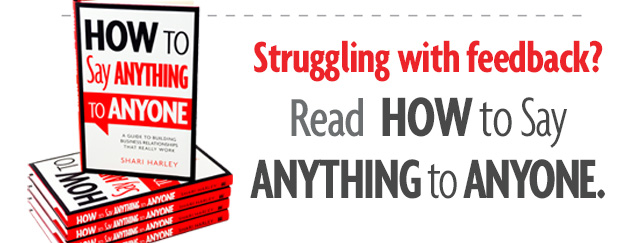
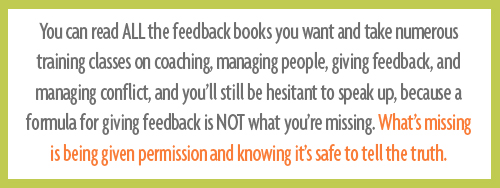
It’s easy to mistake my book, How to Say Anything to Anyone, as a book about giving feedback. It’s not. It takes me nine chapters to get to feedback. The first eight chapters of the book are about how to create relationships in which you can tell the truth without fear. You can read all the feedback books you want and take numerous training classes on coaching, managing people, giving feedback, and managing conflict, and you’ll still be hesitant to speak up, because a formula for giving feedback is not what you’re missing. What’s missing is being given permission and knowing it’s safe to tell the truth.
Managers, here’s how to retain good employees:
“I appreciate you choosing to work here. I want this to be the best career move you’ve made, and I want to be the best boss you’ve had. I don’t want to have to guess what’s important to you. I’d like to ask you some questions to get to know you and your career goals better. Please tell me anything you’re comfortable saying. And if you’re not comfortable answering a question, just know that I’m interested and I care. And if, at any point, you’re comfortable telling me, I’d like to know.”
Then ask the Candor Questions during job interviews, one-on-one, and team meetings. We’re always learning how to work with people. So continue asking questions throughout your relationships. These conversations are not one-time events.
If you work for someone who isn’t asking you these questions, offer the information. You could say:
“I wanted to tell you why I chose this organization and job, and what keeps me here. I also want to tell you the things I really need to be happy and do my best work. Is it ok if I share?”
Your manager will be caught off guard, but it is likely that she will also be grateful. It’s much easier to manage people when you know what they need and why. Most managers want this information, it just may not occur to them to ask.
If the language above makes you uncomfortable, you can always blame me. You could say:
“I read this blog and the author suggested I tell you what brought me to this organization and what I really need to be happy here and do my best work. She said I’d be easier to manage if you had that information. Is it ok if I share?”
Yes, this might feel a little awkward at first, but the conversation will flow, and both you and your manager will learn a great deal about each other.
The ability to tell the truth starts with asking questions, giving people permission to speak candidly, and listening to the answers.
When I led leadership development training for a large mutual fund company we offered a lot of training focused on helping people have hard conversations. Over time I realized that despite that I’d bought and offered the best training programs I could find, the training wasn’t helping. Managers didn’t give enough feedback, and when they did give feedback, employees were often left confused, wondering what they needed to do differently.
I decided that what was missing was the conversation before the crucial conversation. It wasn’t that managers didn’t know what they wanted to say, but many managers felt they couldn’t say what they wanted to say. There wasn’t sufficient safety or permission for giving feedback, so managers said little or delivered messages that were so vague, employees were left wondering if there was a problem. This is when the idea for Candid Culture was born.
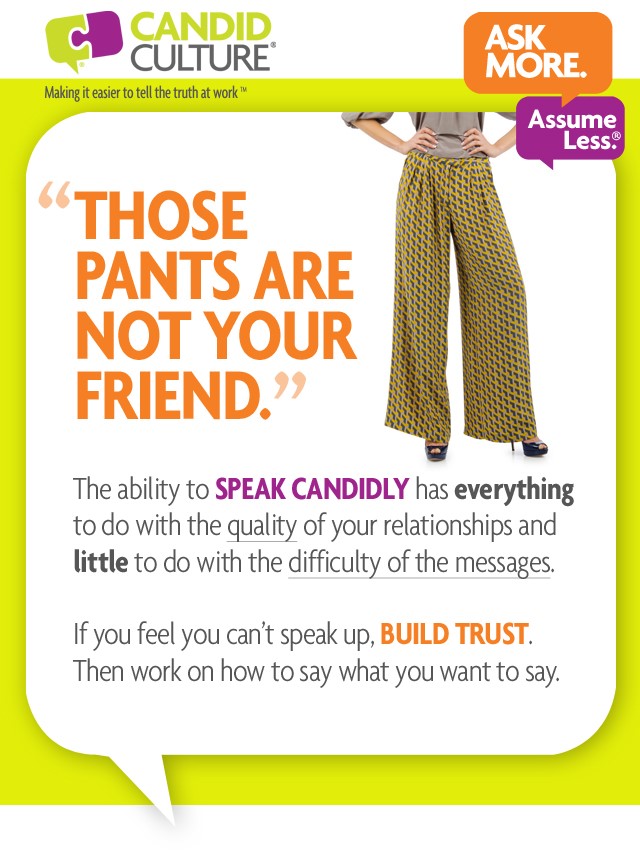
If you’re struggling with giving feedback, I doubt it’s the message that’s the challenge. The distinction between being able to tell the truth (as you see it) and saying nothing, is the quality of your relationship.
Think about the people – personal and professional – who can say anything to you. These are the people who can tell you that the person you’re dating is wrong for you, that a piece of clothing is not flattering, that you disappointed them, or that you dropped the ball. You may not enjoy getting the feedback, but you’re able to hear what they have to say and take it in because you know they care about you and have your best interests at heart. You trust their motives. When you trust people’s motives, they can say anything to you. When you don’t trust people’s motives, there is little they can say.
If you’re struggling to give feedback, evaluate your relationship by asking these three questions:
Does this person know that I have her back under any circumstances?
Does this person trust me?
Does this person know that I accept her just as she is?
If the answer to any of the questions above is no, it’s not giving feedback you’re struggling with, it’s the quality of your relationship. Work on building trust with this person and you’ll be able to say whatever you feel you need to say.
Here are five steps to building trusting relationships:
Get to know people better than you know them now. Get five free conversation-starting Candor Questions to have these conversations.
Tell people you want them to succeed and demonstrate that by being supportive of their efforts.
Don’t be judgy. No one likes to be told that she is wrong.
Set the expectation that you will give both positive and negative feedback when appropriate, because you want the person to win. And if you remain silent, you are of no help to the other person.
When you deliver feedback, be extremely specific. Feedback that is specific will be received much better than vague feedback, which is typically judgmental.
When people know that you respect and want good things for them, you have a great deal of freedom to speak up. When people don’t trust your motives, giving feedback is almost impossible. The recipient will become defensive and dismiss whatever you say, rationalizing that you don’t like her and never have.
Worry less about giving feedback – for now. Instead, build trust. Get to know people better, then work on giving feedback.
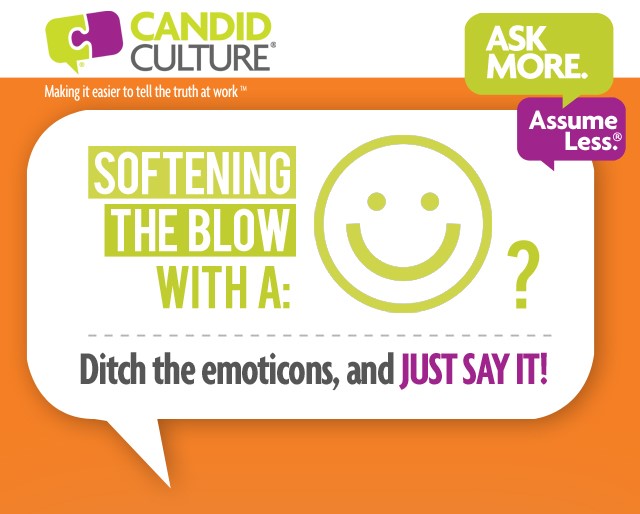
You’re more likely to get an email or text message with emojis at work than a phone call or an in-person visit. Email, text messages, and instant messenger have become the primary modes of communication in most workplaces. And as we know, it’s difficult to manage tone of voice in written communication. Not wanting to sound angry or demanding, we add emoticons at work so the reader doesn’t misinterpret our message.
I believe email and text messages are overused. But I know most people won’t pick up the phone as often as they could or should. So instead of recommending that you pick up the phone more frequently, I’ll suggest you give people the benefit of the doubt, and make it a general rule not to take things personally.
If you’ve seen me teach how to give feedback or have read How to Say Anything to Anyone, you know I believe that one of the keys to being able to tell the truth is to ask for and gain permission to do so. What would happen if everyone in your workplace assumed that every email had a positive tone and that if something is a problem or a big deal, people will talk to you live? What if you made a deal that people won’t take emails or text messages personally?
When I teach feedback, I tell people not to give feedback via email and to instead talk with people. And we can’t always do that. Sometimes we need email to ensure feedback is timely. But email recipients are often hurt by the implied tone of an email or the brevity of a text message. Intended meanings are often misconstrued, feelings are hurt, and relationships are damaged, hence why we add emoticons at work.
There is a lot written on the value of emoticons at work and how we need to embrace the change in the way we communicate. I just wish we didn’t need emoticons at work. I wish, instead, we thought, “I trust you and assume good. I know that if you’re annoyed with me, you’ll tell me, because we’ve built a relationship in which we deal with challenges overtly, as they happen.” And perhaps I’m living on another planet – the planet of utopic candor. But the aforementioned are my goals. It’s why I do the work I do at Candid Culture. I envision workplaces in which we assume good and ask questions if we don’t. Do you?
Who have you fired lately? The person who cuts your hair or lawn? A doctor, accountant, or restaurant where you had a bad experience? Did you call any of those providers and tell them why you were replacing them? My hunch is no. There’s little incentive to do so. Why risk their defensiveness? It’s easier to just replace them. And the same is true for you.
There’s little incentive for the people you work with to tell you when you frustrate them. The perceived cost seems too high. The people you work (and live) with have experienced others’ defensive responses to negative feedback (which is no fun) and they don’t want to experience your reaction. As a result, when you disappoint or frustrate others, it’s easier to say nothing than tell you the truth.
The tendency for others to tell you things are fine when they’re not will prevent you from managing your career and relationships. People will go missing and/or you’ll be passed over for professional opportunities and never know why.
To make it more likely that people will tell you when you disappoint or frustrate them, make it easy to tell you the truth.
Here are seven practices for receiving feedback:
Receiving Feedback Practice #1: When you begin new relationships, tell people you want their feedback.
Receiving Feedback Practice #2: Promise that no matter what people say, you’ll respond with “thank you.” This is very hard to do.
Receiving Feedback Practice #3: Tell people you already have relationships with that if you haven’t said it in the past, you really want their feedback and promise to respond graciously with “thank you.”
Receiving Feedback Practice #4: Ask people who matter to you for feedback regularly.
Receiving Feedback Practice #5: Resist the urge to get defensive.
Receiving Feedback Practice #6: Catch yourself when you start to become defensive and apologize. Say something like, “I’m getting defensive. I’m sorry. Tell me again. I’ll do a better job of listening.”
Receiving Feedback Practice #7: Take a break from conversations during which you find yourself responding defensively. Say something like, “I’m not responding as well as I’d like. How about we take a break? Give me a few minutes (hours or days) and I’ll come back to you to talk more. I really want to hear what you have to say.”
The aforementioned list provides recommendations for asking for and receiving feedback you want, not feedback you don’t. You are not a dumping ground. Don’t ask for feedback you don’t want. And when you do ask for feedback, qualify what type of feedback you’re looking for. Telling people “I want your feedback” doesn’t mean they’re welcome to say whatever they want.
The purpose of asking for feedback and making it safe to tell the truth is to give you more control over your career and relationships. It’s ok to be passed over for opportunities and relationships, but it’s unhelpful not to know why.
Chances are, at some point in your career, you’ve worked with someone you wished would go away. Maybe the person repeatedly threw you under the bus, took credit for your work, or didn’t keep his commitments. And at some point, you wrote the person off, and have been merely tolerating him ever since.
Damaged relationships can be repaired, if you’re willing to do some work.
The first step in repairing a damaged relationship is to decide that you really want to do so. Managing conflict in the workplace isn’t easy. It will take effort and will likely be uncomfortable. So before you take action, decide if you really want to work on the relationship.
How to know if you should even try resolving conflict in the workplace: Ask yourself how much you need the relationship. This probably sounds political, and it is. If you work on projects together, need to give or receive information, or have to work together regularly, then it’s likely worth working on the relationship. If you don’t need to work together regularly, then perhaps don’t work on the relationship.
If you decide to attempt to strengthen a relationship, plan what you’re going to say. Never trust the first thing that comes out of your mouth during a difficult conversation.
Step one for resolving conflict in the workplace: Like any feedback conversation, start with the end in mind. Consider what you want to have happen as a result of the conversation.
Step two for resolving conflict in the workplace: Plan what you’re going to say by taking notes and practicing out loud. What you say in your head is usually not what comes out of your mouth.
Step three for resolving conflict in the workplace: Ask the person for time on his calendar. People don’t like surprises. You’ll have a better outcome if the person has blocked time to talk with you. Have the conversation in-person whenever possible. If you can’t speak in-person, talk on the phone. Do not attempt to fix your relationship via email. 1. Email is wimpy. 2. It will not work.
Tell the person, “Our relationship is strained. I don’t think I’m saying anything we’re not both aware of. I’d really like a good working relationship. Would you be willing to have coffee or lunch with me, and we can talk about what has happened and perhaps start in a new way?”
Step four for resolving conflict in the workplace: Ask for a meeting to work on the relationship up to three times. If, after the third time, the person hasn’t made time, stop asking. You can’t work with someone who won’t work with you. If the person doesn’t make time to meet, be polite, professional, and inclusive, but stop trying to nurture the relationship. Inclusive means: cc’ing him on necessary emails, inviting him to appropriate meetings, and providing necessary data.
Step five for resolving conflict in the workplace: If the person makes time to meet, speak candidly, be yourself, and be vulnerable. I don’t mean set yourself up to be killed. I do mean be authentic.
Ask for feedback about how you’ve damaged the relationship.
Listen to what you hear, and resist the urge to defend yourself.
Ask for permission to tell him how he’s damaged the relationship.
Give small amounts of feedback, with a few specific examples.
Make agreements of what each of you will do differently in the future.
Thank the person for the conversation and schedule another meeting.
Step six for resolving conflict in the workplace: Build in follow-up. Most people have one conversation and expect things to be fixed, forever. Relationships don’t work that way. Agree to meet monthly, for the first few months, until you’ve rebuilt trust and learned how to communicate and work together. During the monthly meetings, give each other permission to give candid feedback about how you’re working together. I call these Relationship Inventory Meetings™.
During monthly Relationship Inventory Meetings™ ask:
What’s working about how we work together?
What’s not working?
What working agreements did we keep?
What working agreements did we break?
Which working agreements are helpful?
What working agreements need to change?
You might be thinking, “I don’t like this person. I don’t want to work with him. And I definitely don’t want to have these uncomfortable conversations.”
If the nature of your relationship is impacting your ability to do your job, your professional reputation, or your happiness, all of those consequences are far worse and more long-lasting than any conversation will be.
The conversations won’t be as bad as you think. No one will tell you anything you can’t handle, because for the most part, they’re afraid of your reaction and they know they’ll be next.
Conflict in the workplace and damaged relationships keep people up at night, reduce job satisfaction, and often motivate people to leave jobs. If you’re experiencing any of these things, all of them are worse than any conversation will be. The anticipation of the conversation is far worse than the conversation itself.
Decide if you want to strengthen the relationship.
Plan the conversation.
Ask for time to meet.
Have the conversation. Speak honestly, but responsibly.
Plan to have another conversation before ending this conversation.
Congratulate yourself for being courageous and picking happiness over anxiety and frustration. Suffering is optional.
Several years ago I hired a vendor that wasn’t a good fit. Try as we might to work together, we didn’t communicate well. Everything was a struggle. After a frustrating few weeks, the owner of the business offered to refund my money and amicably part ways. His company had already done work on our behalf and I didn’t want to lose momentum. I turned him down. That was a mistake. When a small business owner, who needs your business (money), tells you to go elsewhere, listen. We parted ways a few months later in a much more costly and less amicable way.
You don’t want to work with people who don’t want to work with you. The same is true for friends and romantic relationships. Don’t chase people. If they don’t want you, move on. There are lots of other people who will see your value.
There are differing schools of thought on whether or not you should try to retain unhappy employees who quit. I’d be interested in seeing statistics on how long employees who quit but are then retained, stay with an organization and how well they perform. I’d let them go. Again, you don’t want people who don’t want you.
The challenge is that most people are afraid to speak up in organizations and relationships (of all kinds) when they’re unhappy. Unhappy employees typically quit versus make requests and give feedback.
The antidote is to create a culture in which employees, vendors, and customers openly make requests and talk about what is and isn’t working. Create a climate of candor in which feedback is exchanged regularly versus just during exit interviews, which is too late.
How to know when to cut bait with unhappy employees and vendors:
You’ve had several open discussions and can’t meet each others’ needs. If you don’t have a job the employee wants, that’s a good reason to part ways.
It’s not a good culture fit. You talk and talk but don’t communicate. Issues don’t get resolved. Frustration is the norm. This is also a good reason to end a working (or personal) relationship.
Five steps to create a more candid culture:
Discuss employees’, customers’, and vendors’ needs and requests at the beginning of working relationships. Agree upon what success and a good job looks like. Ask lots and lots of questions, and listen closely to the answers.
Ask for feedback regularly. Conduct a weekly plus/delta (a discussion of what is and isn’t working) during which all parties are invited and expected to speak freely. The more you have these discussions, the easier they will be and the more candid people will become.
Address challenges as they come up.
Discuss challenges that can’t be fixed.
If a relationship isn’t working, end it sooner rather than later. Be slow to hire and quick to fire.
There are lots of talented vendors and employees. Find employees and suppliers who are easy to work with (for you) and who can meet your needs, and vice versa. If you can’t meet each others’ needs or the relationship is a constant struggle, those are good reasons to move on. Don’t chase.
Giving feedback upwards is hard. Giving feedback downward is hard. Giving feedback to peers can be the hardest of all. We work closely with our peers. They’re often our friends. And still, we need to be able to speak freely when our coworkers violate our expectations.
The key to being able to give peers feedback (to give anyone feedback) is to agree that doing so is not only acceptable but expected. Before agreeing to give and receive feedback, peers need to set clear expectations of how they’ll work together and treat each other.
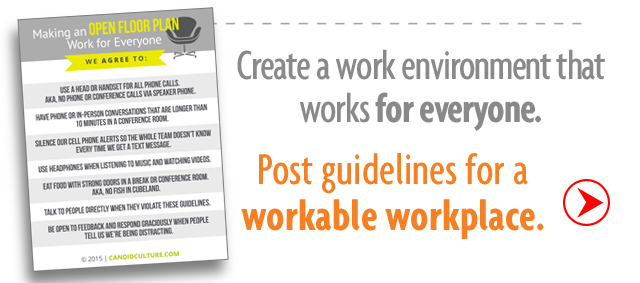
Telling people how you want them to behave is always easier than correcting a behavior. But it often just doesn’t occur to us to tell our peers what we want and need from them. We’re busy. They’re busy. And don’t they already know what courteous workplace behavior looks like? Return all emails within a day or two, keep your workspace quiet so others can focus, turn off your personal cell phone alerts at work, take personal calls away from your desk, and don’t wear anything scented at work. Aren’t all of these behaviors fairly obvious? Do I really need to people these are my expectations? Uh….yes, you do.
If you don’t want employees dumping these challenges at their managers’ doors, help employees talk to each other.
Here are seven steps to help people who work closely together set expectations and hold each other accountable:
Schedule a meeting during which people working together can discuss the working environment they need to be satisfied and productive. Then facilitate a discussion during which the group creates 5 – 7 behavior guidelines each person agrees to follow.
Post the list of agreed-upon behaviors on a poster that is large enough to be read from any place in the work environment, or virtually. Leave the guidelines posted indefinitely.
Give each person in the group permission to talk to individuals who violate the guidelines. This is very, very important. For the most part, employees won’t tell a peer s/he is missing deadlines, gossiping, talking too loudly, has too many visitors at her desk, listens to music or videos without headphones, or is distracted with personal calls/texts. People will suffer in silence and avoid the offender rather than speak up about the behaviors that frustrate them.
Ask the group to grant each other permission to speak up when guidelines are violated. Giving each other permission to speak up will make future conversations possible – difficult but possible. Without permission and these agreed-upon behaviors in place, people will suffer in silence or talk about each other, not to each other.
Ask everyone in the work group to take feedback graciously, responding with “thank you for telling me,” rather than with defensiveness.
Two weeks after making the list of guidelines, get the group together to review the list and make any necessary changes to it. Discuss behaviors that were omitted, aren’t realistic, and are realistic but aren’t being followed.
Then follow up by facilitating a monthly conversation during which group members give honest feedback about which guidelines are being followed and which are not, and problem solve as a group. These conversations aren’t a chance to embarrass or call people out in front of a large group. If one person is violating a guideline, that conversation should happen individually. Group conversations keep the lines of communication open – which is essential to making working with others work.
You will need a strong facilitator for the group discussions. The facilitator must tease out people’s thoughts, while making sure no one gets blasted in front of the group. Don’t let concerns, that you know exist, be brushed under the rug. Group members must openly and regularly discuss what is and isn’t working about their work environment, or frustrations will build, and unhappiness and dissension will ensue.
It’s not too late to put these practices in place, even with a group that has been working together for a long time. Just schedule the conversation and explain why you’re having it. People will be relieved and grateful.
1. Introduce the conversation so feedback recipients know what to expect.
2. Share your motive for speaking so both the feedback provider and the recipient feel as comfortable as possible.
3. Describe the observed behavior so the recipient can picture a specific, recent example of what you’re referring to. The more specific you are, the less defensive he will be, and the more likely he’ll be to hear you and take corrective action.
4. Sharing the impact or result describes the consequences of the behavior. It’s what happened as a result of the person’s actions.
5. Having some dialogue gives both people a chance to speak and ensures that the conversation is not one-sided. Many feedback conversations are not conversations at all; they’re monologues. One person talks and the other person pretends to listen, while thinking what an idiot you are. Good feedback conversations are dialogues during which the recipient can ask questions, share his point of view, and explore next steps.
6. Make a suggestion or request so the recipient has another way to approach the situation or task in the future. Most feedback conversations tell the person what he did wrong and the impact of the behavior; only rarely do they offer an alternative. Give people the benefit of the doubt. If people knew a better way to do something, they would do it another way.
7. Building an agreement on next steps ensures there is a plan for what the person will do going forward. Too many feedback conversations do not result in behavior change. Agreeing on next steps creates accountability.
8. Say “Thank you” to create closure and to express appreciation for the recipient’s willingness to have a difficult conversation.
If you’re giving more than one piece of feedback during a conversation, address each issue individually. For example, if you need to tell someone that she needs to arrive on time and also check her work for errors, first go through the eight steps in the formula to address lateness. When you’ve discussed an agreement of next steps about being on time, go back to step one and address the errors. But talk about one issue at a time so the person clearly understands what she’s supposed to do.
Here’s how a conversation could sound, using the eight-step Feedback Formula:
Step One: Introduce the conversation.
“John, I need to talk with you.”
Step Two: Share your motive for speaking.
“This is a little awkward, and it may be uncomfortable. I want you to know that while I wish I didn’t have to tell you this, I’m doing it because I care about you and I want you to be successful.”
Just because you’re direct doesn’t mean you’re not empathetic. But remember, these are my words. You’ll need to find your own words that you feel comfortable using to deliver such a difficult message.
Step Three: Describe the observed behavior.
“John, I’ve noticed that you have an odor.”
Step Four: Share the impact or result of the behavior.
“I know this is a very awkward subject (more empathy). We work in a small space. I don’t want others to avoid working with you or say negative things about you. And as awkward as this is, I would rather you hear this from me than from someone else. Sometimes health conditions can cause certain odors, as can eating certain foods.”
Step Five: Have some dialogue. Ask the recipient for his perception of the situation.
“What are your thoughts?”
Give John time to say whatever he wishes to say.
Step Six: Make a suggestion or request for what to do next time.
“Again, I’m really sorry to have to tell you this. Please make sure you shower every day before coming to work and wash your clothes regularly. And please tell me if there’s something else you’d like me to know.”
Because of the awkwardness of this subject, skip step seven, and go to step eight.
“Thank you for being willing to have this conversation with me.”
You Can Say More Than You Think You Can
You might be gasping, thinking there is no way you could ever tell someone he smells. It’s definitely an awkward conversation, one I hope you never have to have. I used one of the most difficult things you will ever have to say to demonstrate that even the most awkward feedback can be delivered empathetically and quickly.
The short and concise body-odor conversation is a lot less uncomfortable for the recipient than the drawn-out, evasive first version. Just think, would you rather listen to someone tell you that you smell for two minutes or for twenty?
You may also think, “I shouldn’t have to tell someone to take a shower and wash their clothes.” That’s true, you shouldn’t. But if you’re working with someone who doesn’t do these things, clearly someone needs to tell him. Remember, other people are not you and don’t do things the way you do, even when those things appear to be no-brainer basics.
Lastly, you may think that telling someone to shower and wash his clothes is insulting and demeaning. It’s true: No matter how you spin it, there’s nothing nice about this message. But which is worse, having your coworkers ask for different desks and be unwilling to work with you, or having someone who has your best interests at heart tell you privately to clean it up—quite literally? When you tell people the truth, you do them a favor.
Here’s another example: A few years ago I had a coworker who was a lingerer. Lisa would hover outside my office until she saw an opportunity to interrupt. She then walked in uninvited and started talking. I was still mid-thought about whatever I’d been working on and wasn’t ready to listen. After a few sentences, I would interrupt Lisa, saying, “I’m sorry. I don’t know what you’re talking about. Will you please start over?”
Embarrassing as it sounds, this went on for more than a year. I wanted to be seen as accessible and open, yet this “lingering” method of interrupting was driving me crazy. And it was a waste of both of our time. After many months of frustration, I decided to use the eight-step Formula.
Step One: Introduce the conversation.
“Lisa, I want to talk about something I’ve noticed.”
Step Two: Share your motive for speaking.
“I probably should have said something a long time ago. I’m sorry I didn’t.”
Step Three: Describe the observed behavior.
“I’ve noticed that when you want to talk to me you stand at my door, waiting for a good time to interrupt. When you come into my office, you’re often in the middle of a thought or problem that you’ve probably been thinking about for a while.”
Steps Four and Six: Share the impact or result of the behavior and make a suggestion or request for what to do next time.
“Because I’m in the middle of something completely different, it takes me a few seconds to catch up. By the time I have, I’ve missed key points about your question and I have to ask you to start over. This isn’t a good use of either of our time.
“Here is my request: When I’m in my office working and you need something, knock and ask if it’s a good time. If it is, I’ll say yes. Give me a few seconds to finish whatever I’m working on, so I’m focused on you when we start talking. I’ll tell you when I’m ready. Then start at the beginning, giving me a little background, so I have some context. And if it isn’t a good time for me, I’ll tell you that and come find you as soon as I can.”
Step Five: Have some dialogue. Allow the recipient to say whatever she needs to say.
“What do you think?”
Step Seven: Agree on next steps.
“Okay, so next time you want to talk with me, you’re going to tap on the door and ask if it’s a good time to talk. If it’s not, I’ll tell you that and come find you as soon as I can. If it is a good time, you’re going to give me a second to finish whatever I’m working on and give me some background about the issue at hand. Does that work for you?”
We have just managed “the lingerer”—a challenge you probably have, unless you work from home or in a closet.
You may have noticed that I changed the order of the Feedback Formula during this conversation. It’s not the order of the conversation that’s important. It’s that you provide specific feedback, offer alternative actions, and have some dialogue before the conversation ends.
Summary: Good Feedback Is Specific, Succinct, and Direct.
Provided you have a trusting relationship with someone and have secured permission to give feedback, there is very little you can’t say in two minutes or less. The shorter and more direct the message, the easier it is to hear and act upon. Follow the eight-step Feedback Formula. Be empathetic and direct. Cite specific examples. Give the other person a chance to talk. Come to agreement about next steps. Remember, you do people a favor by being honest with them. People may not like what you have to say, but they will invariably thank you for being candid.
Wearing too much perfume or cologne will make people scatter, or wish they could. Unfortunately, rather than tell you that you’re wearing too much, people will just avoid sitting near you. Scent is such a personal thing, like clothing, that people are hesitant to comment on it.
I suggest not wearing anything scented at work, on airplanes, or when you’ll be in close proximity with other people you don’t know well. But if I can’t persuade you to skip the scent, here are a few guidelines when putting on cologne and perfume:
• Spray the air ten inches in front of you, and walk through the mist, rather than spraying your skin.
• If you can smell the scent on yourself or people who are more than a few inches from you can smell it, you’re wearing too much.
• You should never be able to smell a person’s cologne after they’ve left a room.
No, I’m not an expert on how to wear perfume. I googled it.
The next step is to ask a few people you trust to tell you when you wear too much perfume or cologne. Give people permission to give you this feedback, and promise you won’t bite their head off when they do. This could sound something like, “I want to be sure I’m not wearing too much perfume. Would you be willing to tell me when I do? I promise I won’t freak out or jump down your throat. I really want to know.”
Let’s say you work with someone who wears too much perfume. She hasn’t asked if she’s wearing too much, and you want to say something. You could say something like, “This is a bit awkward, but the perfume you wear is a bit overwhelming. Would you be willing to wear less or none at all when you’re in the office?” This is an awkward conversation that most people don’t want to have. Consider that you’re doing the person a favor. Would you rather know the amount of scent you wear keeps other people away, or would you rather alienate the people around you?
If the relationship is a personal one, you could say, “You wear the most lovely perfume. And I’ve noticed that the smell is quite strong. Would you be willing to wear less of it?” Again, this is an awkward conversation. But you won’t die from having it and the other person won’t either. When she gets over being embarrassed and defensive, your relationship will be fine. And if it’s not, you didn’t have much of a relationship to begin with.
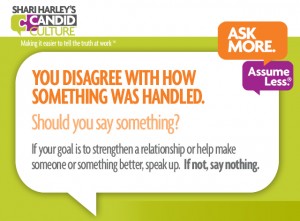
Most of us grapple with whether or not we should give feedback when someone else does or says something frustrating.
Here are a few criteria to help you decide whether or not you should give feedback or say nothing:
Do you have a relationship with the person? Do you know each other well enough to share your opinion? Aka, have you earned the right?
Has the other person requested your opinion? Unsolicited feedback often goes on deaf ears.
If the other person has not requested your opinion, does he appear open to hearing feedback?
Are you trying to make a difference for the other person or just make him look or feel badly?
Do you want to strengthen the relationship?
Before you give feedback, do something I call, ‘check your motives at the door.’ If your motives are pure – you want to strengthen the person or the relationship, and you have a good enough relationship that you’ve earned the right to speak up — then do it.
People are more open to feedback when they trust our motives. If we have a good relationship with the person and he knows we’re speaking up to make a difference for him or for the relationship, you’ll be able to say way more than if your motives are questionable – aka you want to be right.


 Then ask the Candor Questions during job interviews, one-on-one, and team meetings. We’re always learning how to work with people. So continue asking questions throughout your relationships. These conversations are not one-time events.
 If you’re struggling with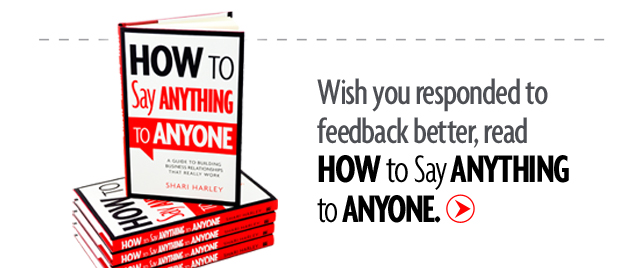
 You’re more likely to get an email or text message with emojis at work than a phone call or an in-person visit. Email, text messages, and instant messenger have become the primary modes of communication in most workplaces. And as we know, it’s difficult to manage tone of voice in written communication. Not wanting to sound angry or demanding, we add emoticons at work so the reader doesn’t misinterpret our message.
 . And the same is true for you.
 Chances are, at some point in your career, you’ve worked with someone you wished would go away. Maybe the person repeatedly threw you under the bus, took credit for your work, or didn’t keep his commitments. And at some point, you wrote the person off, and have been merely tolerating him ever since.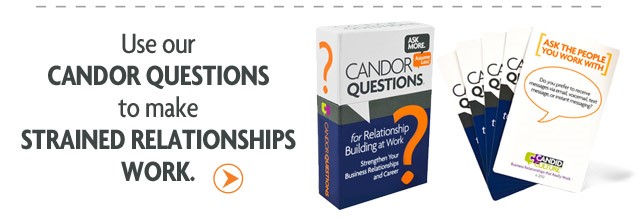
 Several years ago I hired a vendor that wasn’t a good fit. Try as we might to work together, we didn’t communicate well. Everything was a struggle. After a frustrating few weeks, the owner of the business offered to refund my money and amicably part ways. His company had already done work on our behalf and I didn’t want to lose momentum. I turned him down. That was a mistake. When a small business owner, who needs your business (money), tells you to go elsewhere, listen. We parted ways a few months later in a much more costly and less amicable way.

 Wearing too much perfume or cologne will make people scatter, or wish they could. Unfortunately, rather than tell you that you’re wearing too much, people will just avoid sitting near you. Scent is such a personal thing, like clothing, that people are hesitant to comment on it.
 frustrating.