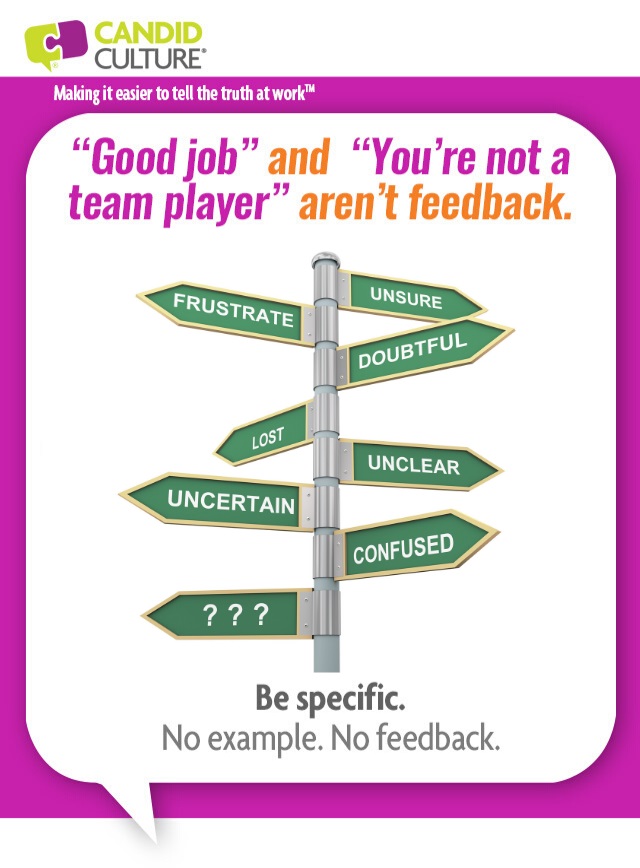
Want to know one of the reasons people get defensive when you give feedback and why they often don’t change their behavior? Because what you’re giving them isn’t actually feedback.
“You’re awesome to work with” isn’t feedback. Neither is “You did a great job.” “Your work isn’t thorough” isn’t either. Neither is, “You were inappropriate.” Most of what we consider feedback isn’t feedback at all. It’s vague, unhelpful language that leaves people wondering what they need to do more, better, or differently.
There are only two reasons to give feedback – to encourage someone to either change or replicate a behavior. Unfortunately, most of the ‘information’ we give is too vague to help people do either.
When you coach or give feedback, you serve as someone’s GPS. Like the GPS on your phone, you need to be so specific the person knows precisely what to change or replicate. If you were driving and your GPS said, “Good job” or “I think you’re off track,” you’d throw the GPS out the window and get a map.
If you give someone what you consider feedback and the person responds with, “I don’t know what you mean. Can I have an example?” you’ll know you weren’t helpful.
Here are six tips for giving helpful feedback:
Giving feedback tip one: Write down what you plan to say, then strip out half the words. Shorter feedback with fewer words is better.
Giving feedback tip two: Practice what you plan to say out loud. Have you noticed that what you ‘practice’ in your head is typically not what comes out of your mouth?
Giving feedback tip three: Before having a conversation, give the feedback to an independent, third-party and ask the person to tell you what they heard. If that person is clear, the feedback recipient likely will be too. Ensure who you practice with will maintain confidentiality. Your organization doesn’t need more gossip.
Giving feedback tip four: Tell someone else about the conversation you need to have and ask that person what they would say. Anyone not emotionally involved in the situation will do a better job than you will. It’s our emotional involvement that makes feedback conversations so challenging. Again, ensure confidentiality.
Giving feedback tip five: Ask the feedback recipient what they heard you say. Asking, “Does that make sense?” is an ineffective question. “Do you have any questions?” isn’t any better. You ask questions to get information. Yes or no questions don’t teach you anything. Require people to tell you what they know and don’t know by asking open-ended questions.
Giving feedback tip six: Give one to three examples of what the person did or didn’t do, during the conversation. If you don’t have an example, you’re not ready to provide feedback, and anything you say will evoke defensiveness rather than behavior change.
Giving feedback doesn’t have to be so hard. Be so specific that your feedback could be used as driving directions. The purpose of feedback is to be helpful.
Need to give negative feedback? Practice out loud. The words you say in your head while driving to work will not be what comes out of your mouth when you give the actual feedback. Ask a friend, family member, or even your pet (aka someone you don’t work with) to listen to you deliver the feedback. If people outside of your industry and organization understand the feedback, the feedback recipient will be clear, too.
Giving feedback is stressful for both the person giving the feedback and the feedback recipient. The best way to manage the stress of giving feedback is to be prepared.
Here are three ways to prepare for difficult feedback conversations:
Write out the feedback, save your notes, and walk away. Read your notes later and ask yourself, “Have I been clear?” Then see if you can cut the notes in half. Shorter feedback is better.
Practice out loud. Use our 8- step Feedback Formula as a guide. The Formula will ensure you give clear, specific, and succinct feedback without emotion.
Bring type-written notes to your feedback conversations. When the feedback recipient becomes defensive (and they will) or you become flustered (and you might), your notes will help you keep the conversation on track.
During every feedback training I teach, I am asked how to reduce feedback recipient’s defensiveness. Defensiveness is a normal, healthy response to feedback. When you give someone negative feedback, you (subtly) tell the person they did something wrong. No one wants to hear that, so the brain goes on the defensive. It’s a normal survival mechanism. Instead of avoiding and dreading defensiveness during feedback conversations, prepare for it. And the best way to prepare is to practice what you want to say out loud. Speaking a message is not the same as practicing the conversation silently in your head. Speaking out loud is more stressful and takes more time. So, if a conversation is particularly difficult or awkward, practice out loud!
I’d like to give a huge shout out to Angela Fusaro of Physician 360 for sharing this video with us. Angela practiced my eight-step Feedback Formula on her dog, Thor. I thought it was so funny and thought you would, too.
As crazy as it sounds, your manager is afraid of you – afraid of your defensive reaction to feedback.
The normal reaction to feedback is to get upset. The problem is, no one wants to deal with our upset. It makes them uncomfortable. So managers and peers alike start to pick and choose what to tell us. Not wanting to deal with our reaction, they start to pick their battles. The more defensive we are, the less feedback we get. The less feedback we get, the less information about our performance we have. The less information we have about our performance, the less control we have over our career
All of us have been passed over for an opportunity at work – a promotion, raise, project, etc. – and for the most part, we have no idea why, because no one wants to risk our defensive response to tell us. This lack of knowledge makes it hard to manage your career. And to be frank, defensive people are extraordinarily difficult to work with. Having to watch every word, walk on egg shells, and be choosy about what to address and what to avoid is exhausting. Be receptive and thus easier to work with.
I teach managers to screen out candidates who aren’t coachable and receptive to feedback. Work is hard enough without hiring people who aren’t coachable. Being open to feedback makes you easier to work with.
Here are three ways to be open to feedback and increase receptiveness:
Tip one to be open to feedback and increase receptiveness: Don’t underestimate the power of your emotions and the intrinsic drive to defend yourself when receiving feedback. Not defending oneself is extremely challenging. And even the most minor reaction sounds defensive. I.e., “Thank you for the feedback. Here’s why we did it that way…”
Tip two to be open to feedback and increase receptiveness: Wait a few minutes, hours or days, and respond to feedback when you’re calm. That could sound like, “Thanks for telling me. I’m sorry that happened. I’m going to think about what you said and get back to you by the end of the day.”
Tip three to be open to feedback and increase receptiveness: Come from a place of curiosity when seeking feedback versus thinking “there’s something wrong here” and “I’m bad.” Be curious about how you impact others and the impression you make. Seek feedback to understand both.
As crazy as it sounds, your manager is afraid of you – afraid of your defensive reaction to feedback.
The normal reaction to feedback is to get upset. The problem is, no one wants to deal with our upset. It makes them uncomfortable. So managers and peers alike start to pick and choose what to tell us. Not wanting to deal with our reaction, they start to pick their battles. The more defensive we are, the less feedback we get. The less feedback we get, the less information about our performance we have. The less information we have about our performance, the less control we have over our career.
All of us have been passed over for an opportunity at work – a promotion, raise, project, etc. – and for the most part, we have no idea why, because no one wants to risk our defensive response to tell us. This lack of knowledge makes it hard to manage your career. And to be frank, defensive people are extraordinarily difficult to work with. Having to watch every word, walk on egg shells, and be choosy about what to address and what to avoid is exhausting. Be receptive and thus easier to work with.
I teach managers to screen out candidates who aren’t coachable and receptive to feedback. Work is hard enough without hiring people who aren’t coachable. Being open to feedback makes you easier to work with.
Here are three ways to be open to feedback and increase receptiveness:
Tip one to be open to feedback and increase receptiveness: Don’t underestimate the power of your emotions and the intrinsic drive to defend yourself when receiving feedback. Not defending oneself is extremely challenging. And even the most minor reaction sounds defensive. I.e., “Thank you for the feedback. Here’s why we did it that way…”
Tip two to be open to feedback and increase receptiveness: Wait a few minutes, hours or days, and respond to feedback when you’re calm. That could sound like, “Thanks for telling me. I’m sorry that happened. I’m going to think about what you said and get back to you by the end of the day.”
Tip three to be open to feedback and increase receptiveness: Come from a place of curiosity when seeking feedback versus thinking “there’s something wrong here” and “I’m bad.” Be curious about how you impact others and the impression you make. Seek feedback to understand both.
Sign Up
Career tips you won't get elsewhere. Sign up to get a free tip card.