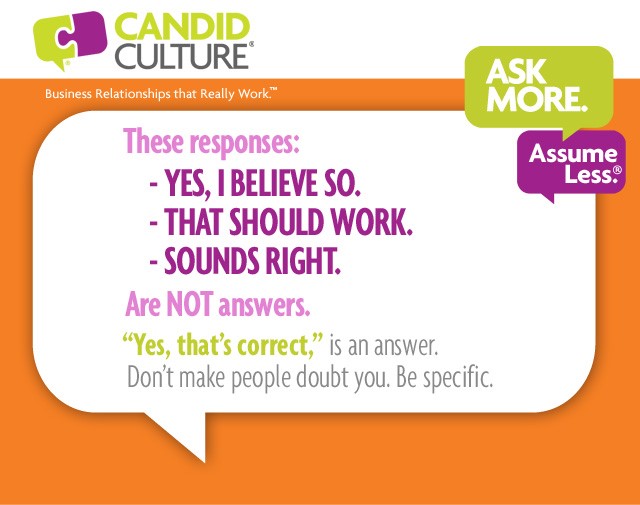
Vague communication is unhelpful. Being vague instills doubt in the people around you and reduces your credibility.
When a customer service agent answers my questions with words like, “That sounds right, I think so, or that should work,” I hang up and call back, hoping to get someone who can give me an affirmative answer. People do this to you, too…they just don’t tell you about it.
Watch your language. If the answer is yes, say “Yes.” If the answer is no, say “No.” “I think so,” says neither yes nor no. Saying, “I think so” tells people you don’t really know.
A few phrases to avoid and what to say instead:
Avoid: “That should be done by Friday.”
Instead, be specific and give a final date. “That will be complete by Friday. If I can’t get it done by Friday, I’ll call you to let you know by 5:00 pm on Thursday.”
Avoid: “Sounds right.”
Instead, be specific and say, “That’s correct.”
Avoid: “We should be able to do that.”
Instead, be specific and say, “We can do that.”
Avoid: “I guess.”
Instead, be specific and say, “Yes” or “No.”
When I teach feedback training, the biggest thing training participants struggle with is specificity. “You’re difficult to work with.” “Your clothing is inappropriate.” “I just find you to be negative.” “You did a good job on that.” “It’s a pleasure to have you on the team.” All of this is vague and thus unhelpful to the feedback recipient. And the same is true when answering questions and making promises.
Tell people exactly what to expect. Be specific. Even if they don’t like your answer, they’ll be happy to have a clear answer.
When the people we work with don’t do their jobs, we might find ourselves saying, “He should be more on top of things.” “She shouldn’t make commitments she can’t keep.” “He doesn’t know what he’s doing, and that’s not my problem.” The challenge is, when your coworkers don’t perform, it is your problem.
When your coworkers don’t get you the information you need in a timely way, you miss deadlines. When you work from incorrect information, your reports are wrong. When others don’t work with you, you look bad. So you can be right all day about how others perform, and your reputation will still be negatively impacted.
I don’t suggest you enable your coworkers by doing the work others don’t. I do suggest you help your coworkers be successful by holding them accountable.
Here are a few things you can do to manage your career and get what you need from your business relationships:
Don’t assume others will meet deadlines. Check in periodically and ask, “What’s been done so far with the XYZ project?” Notice, I didn’t suggest asking, “How are things going with the XYZ project.” “How are things going” is a greeting, not a question.
Set iterative deadlines. If May 20th is your drop-dead deadline, ask to see pieces of work incrementally. “Can I see the results of the survey on May 5th, the write-up on May 10th, and the draft report on May 15th?” One of the biggest mistakes managers and project managers make is not practicing good delegation by setting iterative deadlines and reviewing work as it’s completed.
Don’t just email and ask for updates. The people you work with are overwhelmed with email, and email is too passive. Visit people’s offices or pick up the phone.
You might be thinking, “Holding my coworkers accountable is awkward. I don’t have the formal authority, and I don’t want my coworkers to think I’m bossy or damage my business relationships.”
It’s all in the how you make requests.
If you’ve seen me speak or have read the business book How to Say Anything to Anyone, you know I believe in setting clear expectations at the beginning of anything new. That could sound something like, “I’m looking forward to working with you on the XYZ project. How would you feel if we set iterative deadlines, so we can discuss work as it is completed? You’ll get just-in-time input, making any necessary adjustments as we go, and we’ll stay ahead of schedule. How does that sound? How are the 5th, 10th, and 15th as mini deadlines for you?”
Many people put large projects off until the last minute. People procrastinate less when large projects are broken into smaller chunks with correlating deadlines. You strengthen your business relationships and support people in meeting deadlines and not procrastinating when you agree on completion dates when projects begin. Also, most of us unfortunately know what it’s like to put a lot of work into a project, have someone review our completed work, and then be told we went down the wrong path and need to start over.
Ask more. Assume less. Don’t assume your coworkers will do what they’re supposed to do. Ask upfront to see pieces of work on agreed-upon dates. Pick up the phone versus rely on email to communicate, and know that the people you work closely with are a reflection of you. Get people working with you, and everyone will look good.
Who have you fired lately? The person who cuts your hair or lawn? A doctor, accountant, or restaurant where you had a bad experience? Did you call any of those providers and tell them why you were replacing them? My hunch is no. There’s little incentive to do so. Why risk their defensiveness? It’s easier to just replace them. And the same is true for you.
There’s little incentive for the people you work with to tell you when you frustrate them. The perceived cost seems too high. The people you work (and live) with have experienced others’ defensive responses to negative feedback (which is no fun) and they don’t want to experience your reaction. As a result, when you disappoint or frustrate others, it’s easier to say nothing than tell you the truth.
The tendency for others to tell you things are fine when they’re not will prevent you from managing your career and relationships. People will go missing and/or you’ll be passed over for professional opportunities and never know why.
To make it more likely that people will tell you when you disappoint or frustrate them, make it easy to tell you the truth.
Here are seven practices for receiving feedback:
Receiving Feedback Practice #1: When you begin new relationships, tell people you want their feedback.
Receiving Feedback Practice #2: Promise that no matter what people say, you’ll respond with “thank you.” This is very hard to do.
Receiving Feedback Practice #3: Tell people you already have relationships with that if you haven’t said it in the past, you really want their feedback and promise to respond graciously with “thank you.”
Receiving Feedback Practice #4: Ask people who matter to you for feedback regularly.
Receiving Feedback Practice #5: Resist the urge to get defensive.
Receiving Feedback Practice #6: Catch yourself when you start to become defensive and apologize. Say something like, “I’m getting defensive. I’m sorry. Tell me again. I’ll do a better job of listening.”
Receiving Feedback Practice #7: Take a break from conversations during which you find yourself responding defensively. Say something like, “I’m not responding as well as I’d like. How about we take a break? Give me a few minutes (hours or days) and I’ll come back to you to talk more. I really want to hear what you have to say.”
The aforementioned list provides recommendations for asking for and receiving feedback you want, not feedback you don’t. You are not a dumping ground. Don’t ask for feedback you don’t want. And when you do ask for feedback, qualify what type of feedback you’re looking for. Telling people “I want your feedback” doesn’t mean they’re welcome to say whatever they want.
The purpose of asking for feedback and making it safe to tell the truth is to give you more control over your career and relationships. It’s ok to be passed over for opportunities and relationships, but it’s unhelpful not to know why.
Last week I had some really, really terrible moments. Our office WIFI went out during a webinar. Not even the phone worked. I missed the deadline to speak at a conference that’s almost in my backyard and an event that I really want to participate in, I double booked myself and had to cancel a few appointments, and I hit my son’s teacher’s car, leaving her side mirror dangling like a Christmas tree ornament.
Some days are going to be terrible. On those terrible days, it’s so easy to feel like we’re screwing things up and that we are indeed a screw up. Instead, give yourself a break. The thing to know and remember, in the moment, is that you’re not terrible. You’re a human being, doing the best you can.
Here is a list of ways to give yourself a break and as a result, do your best work. I’ll admit, I’m working on doing these things too. Every day I’m annoyed that I’m not perfect. I want to be a combination of Mary Poppins, Super Woman, and Kate Middleton, but I’m not. I’m a business owner, working mom, who hasn’t seen the inside of a gym since my son was born, who recommits to better self-care every day, only to break that commitment in eleven different ways by 10:00 am.
Here are Nine Way to Give Yourself a Break:
Set realistic deadlines so you’re not constantly running against time and overestimate how long everything will take to do. Set yourself up to win.
Before agreeing to a new commitment, ask yourself, “Do I really want to do this?” Try not to commit yourself to things you know, at your core, you don’t want to do. You’ll just resent that commitment when it rolls around and aren’t likely to do your best work.
Turn off the alerts on your phone and laptop when you’re working. You’ll be more focused and get more work done.
Ask for help. If there is someone who can help with a project (and it won’t make you look bad) let them.
Go to bed earlier than you think you need to and leave your phone in the kitchen.
Take a day off. Your company offers vacation time for a reason. People do better work when they take time to relax and rejuvenate.
Take time for yourself, even if it’s 30 minutes.
Drink more water and make sure you eat breakfast and lunch. I’m starting to sound like your mom.
Say “thank you” more and “I’m sorry” less. “Thank you for letting me know” is more empowering than “I’m sorry I missed that.” I’m guilty of apologizing for everything, so much so that one of my employees and I play a game that whoever says she’s sorry first has to throw a dollar in a communal collection pot. Whatever you put attention on will improve.
Some of these things are business focused, some are personal. You bring yourself – your whole self – to work. It’s why you’re good at what you do. People want to work with real people. And real people over commit, make mistakes, and spend too much time on Facebook at 11:30 pm. Give yourself a break.
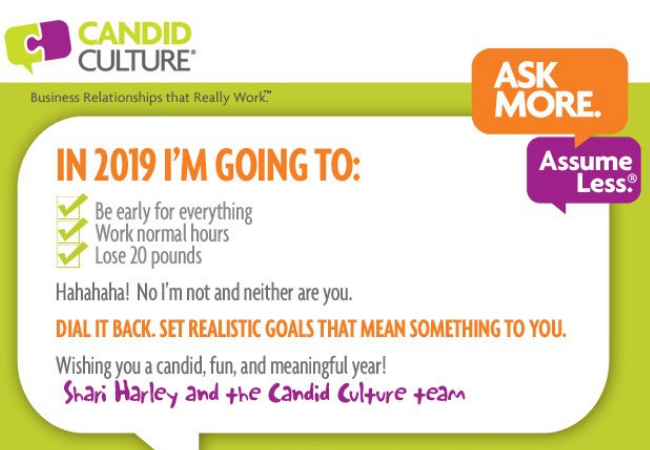
It’s the start of a new year, when many of us begin thinking about New Year’s Resolutions. We vow to lose 20 pounds, save 10% of our income, get promoted at work, take an exotic vacation, be a better partner, etc. etc. Also known as “how to set yourself up to fail” in five easy steps. The reality is, we might do one or two of those things, if that.
Why not set yourself up to win instead? Instead of setting huge goals that are unlikely to happen, why not set more realistic goals that you can and will likely do?
If you manage people, perhaps you’re thinking about how you can be a better manager in 2019. Or you may be thinking about how you can accelerate your career. You may decide to meet with your employees more frequently, or ask your boss for more feedback, or ask for new and different work. You may think that doing these things will help you strengthen your relationships with your employees and your reputation, and advance your career. Doing any of these things might help you strengthen your business relationships and help you get ahead. But they might not, if those things are not important to your employees, your boss and/or your organization.
In 2019, put energy and resources into the things that truly matter to the people you work with, rather than the things you think they think are important. And the only way to know what the people around you really want and need, is to ask them. Don’t assume you know what is important to your boss, direct reports and coworkers, ask them. Ask more. Assume less.
There are countless examples of managers who went to great lengths to make their employees happy. They gave bonuses, cool projects, and time off. And their employees quit anyway. Or, trying to make a manager happy, employees stayed late, beat deadlines, and took on additional work, and still got a mediocre review. Rather than doing what you think others want, ask them!
How about this for a New Year’s resolution — ask your boss, direct reports and key customers these questions as you begin the New Year:
What’s the most important work I did in the past 12 months?
What’s an area, in 2018, I exceeded your expectations?
How did I let you down?
If I could do one thing differently this year that would make the biggest difference for you and/or the organization, what would it be?
Where do you think I should focus my energy in 2019?
It may be intimidating to ask for feedback from your peers and direct reports. But you won’t know what to do more, better, or differently if you don’t ask.
The right answer to feedback is always “thank you,” regardless of what you really want to say. Saying “thank you” makes you a safe person to whom to tell the truth and makes it more likely you’ll get more information in the future. So bite your tongue and respond to all feedback with, “Thank you for telling me that. I’m going to think about what you’ve said and may come back to you to discuss further.” They’ll be relieved, and you’ll strengthen your professional image.
It’s easy to assume what others want and are expecting from us. The problem is, we’re not always correct. Thus we expend energy doing things that others don’t find valuable or important, otherwise known as wasting time and resources.
Your time and budget dollars are valuable. Use your time and money for things that others actually want, versus what you think they want. In 2019, dial it back. Make realistic, attainable goals that are aligned with what the people around want and need. And in return, you too will get what you want and need.
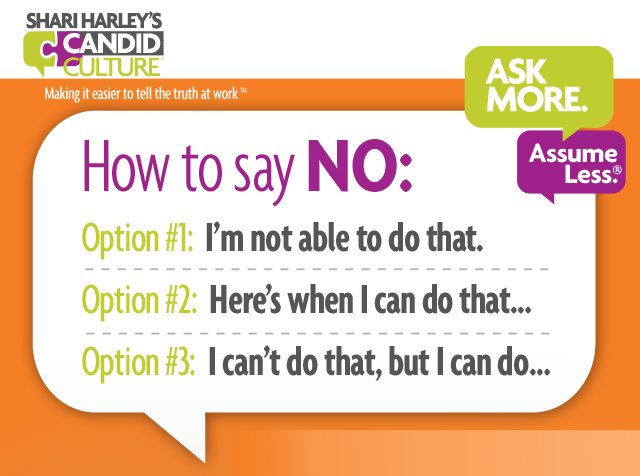
Saying no is hard. We don’t want to disappoint or let people down. And yet, you can’t say yes to everything. You can say no and still sound like a responsible, easy-to-work-with, accommodating professional.
Here are four techniques for how to say no:
Thank the person for asking. “Thank you for asking me.”
1. Saying “thank you” acknowledges the other person and buys you time to think about his request.
2. Tell the person you need some time to think about his request. Ask, “Can I have a few days to think about it? I’ll get back to you by Friday.”
You don’t need to reply in the moment. I often regret things I agree to without thinking through the request thoroughly.
3. Consider what you really want and are willing to do. It’s much worse to over commit and under deliver than to simply say no or renegotiate requests.
4. Get back to the person in a timely way (when you said you would) and tell him what you’re willing to do.
How to Say No Option One: Simply say no.
Example: “I really appreciate you asking me to write the proposal for the __________ RFP. I’m not able to do that. Can I recommend someone else who has the expertise and will do a great job?”
Don’t give a bunch of reasons for saying no. People aren’t interested in why we can or can’t do something. They just want to know if we will do it.
How to Say No Option Two: Agree and negotiate the time frame.
Example: “I’d be happy to do that. I can’t do it before the last week of the month. Would that work for you?” If the answer is no, negotiate further. Ask, “When do you really need it? I can certainly do pieces by then, but not the whole thing. Given that I can’t meet your timeline, who else can work on this in tandem or instead of me?”
How to Say No Option Three: Say no to the request but say what you can do.
Example: “I can’t do _______. But I can do ________. How would that work?”
A review of how to say no:
Acknowledge the request by getting back to the requestor within 24 hours.
Give yourself time to think about and respond to requests.
Negotiate requests to your and the requestor’s satisfaction.
Agree on what you can and are willing to do.
Keep your commitments.
Saying no is always hard. But it’s always better to say no than to ignore requests, or to say yes and do nothing.
When I landed my first ‘real’ job after graduating from college I was so scared, I almost turned the job down. It took me five years to finish my first book, How to Say Anything to Anyone, in part because I was afraid no one would like it.
It seems anything worth doing is worth fearing.
I’m not talking about taking risks for the sake of risk – driving as fast as your car can take you, not paying your bills to see what will happen, or offering a counter point of view at work for the sake of doing so. I’m talking about pursuing the things you really want, that speak to your true purpose.
Being afraid doesn’t mean you can’t do something, nor does it mean that you shouldn’t. Feeling some fear just means what you want is outside of what you know you can do. But it’s the edge and the unknown that is juicy and rich.
During the past few years I’ve pursued things I’m terrified of, that I don’t know I can do. Yet I want these things, so I pursue them in the face of fear. And I have to admit, that as I get closer to getting what I want, the fear doesn’t dissipate, it actually gets worse. As I can almost taste having what I want, I get more scared. And sometimes I pull back, thinking, maybe I don’t really won’t those things. Maybe I was wrong. Then I remember why I want what I want and step back into the pursuit, despite the fear.
Don’t misinterpret fear as a reason not to do something.
A few suggestions for how to face your fears at work:
1. Write your desires down and/or tell people what you want.
You’re more likely to get what you talk about wanting.
2. Take one step towards having what you want.
Talk to someone who either has what you want or can help you get what you want.
3. Put yourself in the place of most potential, where you can get what you want.
If you want to work in a certain department, express interest in working on a project that serves that department.
Tell your boss and people in leadership in your desired work area of your interest.
Apply for a job in that area.
4. Be positive and persistent.
No one wants to give a complainer an opportunity, and it takes time to make a shift.
The key is to take one step, then another, then another. And when you feel fear, don’t let it stop you. Fearing the next job or opportunity doesn’t mean you can’t do it well, it just means you haven’t done it yet.
When you need encouragement to face your fears, hang our inspiring magnets at your desk. You have to believe in yourself just as much as the people around you believe in you.
You will be passed over for jobs, projects, and second dates and never know why. Being passed over isn’t necessarily a bad thing, not knowing why is problematic. If you don’t know why you’re being passed over, how can you be prepared for next time?
Organizations are political. People talk. You’ve undoubtedly already experienced this.
If you want to manage your professional reputation, one thing you must know is who talks about you and what they say. How decisions get made in organizations isn’t always obvious. There are the obvious channels of decision making, like your boss and your boss’s boss. But there are also the people who talk to your boss and boss’s boss and have an opinion about you, who you may not be aware of.
Everyone in an organization has people they trust, who they listen to and confide in. Who those trusted people are isn’t always obvious. When you’re being considered for a new position or project, the decision makers will invariably ask others for their opinion. Knowing who does and doesn’t support you in a future role is essential to managing your professional reputation and career.
I don’t want you to be nervous, paranoid, or suspicious at work. I do want you to be savvy, smart, and aware.
It’s not difficult to find out who can impact your professional reputation at work, you just need to ask the people who know. Start with your boss. S/he likely knows and will tell you, if you ask.
To ensure you know who can impact your professional reputation, tell your boss:
“I really enjoy working here. I enjoy the people, the work and our industry. I’m committed to growing my career with this organization.”
Then ask:
Who in the organization should I have a good relationship with?
Who/what departments should I be working closely with?
Who impacts my professional reputation and the opportunities I have?
What skills do I have that the organization values most?
What contributions have I made that the organization values most?
What mistakes have I made from which I need to recover?
Your manager doesn’t walk around thinking about the answers to these questions. If you want thoughtful answers, set a time to meet with your boss, tell him/her the purpose of the meeting – to get feedback on your professional reputation so you can adeptly manage your career – and send the questions in advance, giving your boss time to prepare for the meeting. You will get more thoughtful and complete answers if your boss has two weeks to think about the questions and ask others for input.
Don’t be caught off guard by a less-than-stellar professional reputation. Take control of your reputation and career. Ask more. Assume less.
Write a comment about this week’s blog and we’ll enter your organization to win 50 professional reputation bookmarks!
Working in a matrix management structure often means being accountable to several people/having multiple bosses, and having lots of accountability without much authority – both challenging. The key to making a matrix management structure work is lots and lots of good communication.
It’s not uncommon for people working in a matrix management structure to be frustrated. People with dotted line employees or managers often say they’re unsure of who they really work for, who to go to with challenges and needs, and that they don’t have the authority to lead people or processes. All of these frustrations are avoidable and manageable.
If you work in a matrix management environment and are thus accountable to multiple people, take charge of the management structure by asking the questions:
Who is my ultimate boss?
Who has input on my performance feedback and review?
Who writes my performance review?
Who decides on raises and promotion opportunities?
Who do I go to when I need help?
Request:
Quarterly (at a minimum) joint meetings with all the managers you answer to
That all the managers you’re accountable to provide input on your performance appraisal
That all the managers your report to participate in your performance discussion(s)
Follow the same practices for people who dotted line report to you. If you’re accountable for someone’s results, but you’re not his/her direct supervisor, ask for quarterly meetings with the employees’ boss. Ask to participate in the appraisal process, and keep the lines of communication between you, the employee, and the direct supervisor transparent and open. Talk regularly. Agree on who sets expectations and gives feedback. Be sure you know your role and the direct supervisor’s role.
The key to making a matrix management structure work is:
Everyone knows who does what and who has what authority
A professional athlete would never get on the court or field without knowing exactly what will score him points and penalties. But many of us go to work every day without knowing how we’re being evaluated.
If you’ve ever had a performance review or received feedback that caught you off guard, or have completed a project and were told your work wasn’t quite what was expected, you didn’t have enough information upfront. Don’t wait for people to tell you what they need and expect (which often happens after breakdowns occur), set clear expectations at the beginning of anything new and as you make progress.
The people you work for and with should tell you what they expect. They should give you feedback along the way. And many won’t. Your career management is in your hands, and that’s a very good thing.
When you start a new job, project, or any responsibility ask the person delegating the work some of these questions:
Career Management Question one: What does a good job look like?
Career Management Question two: What’s the criteria for success?
Career Management Question three: How will you know you picked the right person for the job?
Career Management Question four: Why is this project a priority right now? How will it impact the organization?
Career Management Question five: What kind of updates would you like? In what format, how frequently, and with what level of detail?
Career Management Question six: How often do you want to review my work?
Career Management Question seven: Who in the organization should I include or work with on this project?
Career Management Question eight: What history, pitfalls, or landmines do I need to be aware of? Has anyone tried to do this before, with what outcomes? Who in the organization supports this project? Who doesn’t?
If you’ve been in your job for a long time or have been working on a project for a while, it’s not too late to ask these questions. Simply approach the person with whom you’re working and say, “I want to be sure I’m doing great work on _____________ project. Can I ask you a couple of questions about the desired end results and how we should be communicating as I make progress?”
Lots of people aren’t the best delegators. They give us a project, ask if we have any questions, and provide a due date. Don’t fall into the trap of completing an entire project and then asking for feedback. Even if the person delegating the work doesn’t want to see your progress, ask for that feedback. Schedule weekly or monthly review meetings, present the work you’ve done, and ask for feedback. If you get to the end of a project or responsibility and are surprised by the reaction, you didn’t ask enough questions at the beginning and middle of the project.
People will tell you everything you need to do a good job, if you ask. Take control of your career. Ask more. Assume less.


 Vague communication is unhelpful. Being vague instills doubt in the people around you and reduces your credibility.
 When the people we work with don’t do their jobs, we might find ourselves saying, “He should be more on top of things.” “She shouldn’t make commitments she can’t keep.” “He doesn’t know what he’s doing, and that’s not my problem.” The challenge is, when your coworkers don’t perform, it is your problem.
 . And the same is true for you.
 Tis’ the season to over commit.

 the job down. It took me five years to finish my first book,
 You will be passed over for jobs, projects, and second dates and never know why. Being passed over isn’t necessarily a bad thing, not knowing why is problematic. If you don’t know why you’re being passed over, how can you be prepared for next time?


 tell you what they need and expect (which often happens after breakdowns occur), set clear expectations at the beginning of anything new and as you make progress.