Most employees need only a handful of things to be satisfied and productive at work. The key is getting employees to tell you what those things are. And they might just tell you, if you ask.
Effective management involves asking questions during the interview process, after an employee starts, and again 90-days to six months into the job.
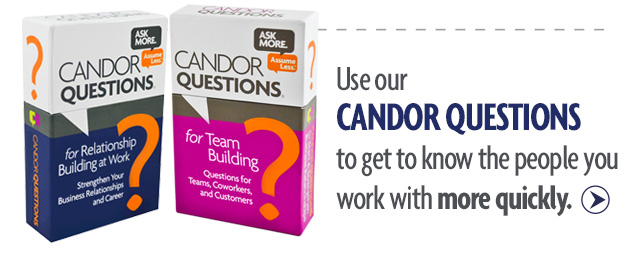
I recommend asking the seven questions below. I call the questions, Candor Questions.
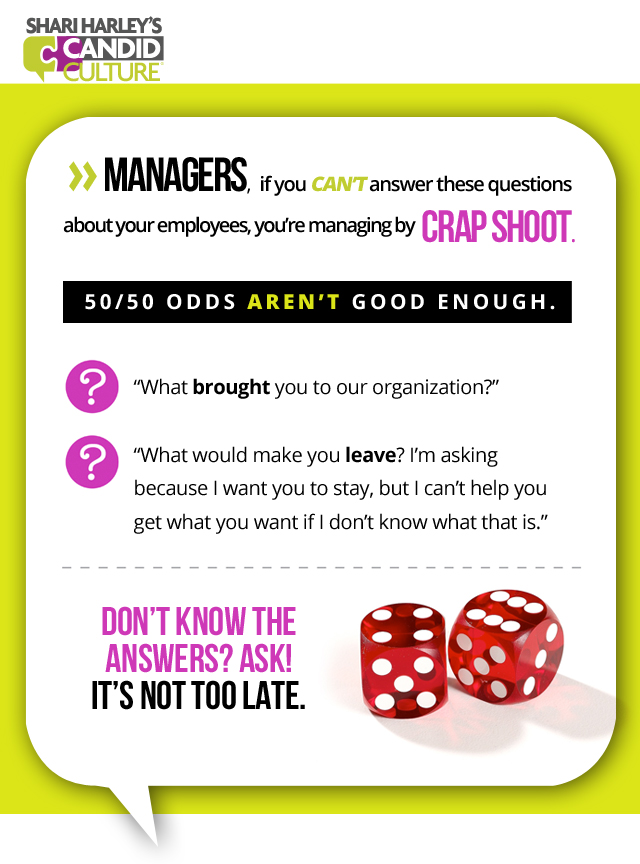
Candor Question number one: “What brought you to this company? Why did you accept this job? What are you hoping the job will provide?” Ask one of these three questions. Pick the one you like best.
Candor Question number two: “What would make you leave this job? What are your career deal breakers, things you just can’t tolerate at work?” Ask either of these questions.
Candor Question number three: “What type of work, skills, and/or areas of our business do you want to learn more about?”
Candor Question number four: “Tell me about the best manager you ever had. What made him/her the best manager?” This will tell you what the employee needs from you as a manager and is a much better question than, “What do you need from me as your manager?” That is a hard question to answer. Telling you the best manager s/he ever had is easy.
Candor Question number five: “Tell me about the worst manager you ever had? What made him/her the worst manager?”
Candor Question number six: “What are your pet peeves at work? What will frustrate you?” Why find out the hard way what frustrates employees when it’s so easy to ask. This question demonstrates that you want your employees to be happy and that you will flex your own preferences, when possible, to meet employees’ needs.
Candor Question number seven: “How do you feel about being contacted via cell phone or text outside of business hours? How do you feel about receiving emails during the evenings and weekends?”
Regardless of age, work, and educational background, employees have a few things in common.
Employees want to:
• Work for someone who takes an interest in and knows them
• Feel valued and appreciated for their contributions
• Be part of and contribute to something greater than themselves
• Feel respected as a person. Managers respect their time, expertise, and needs
Taking the time to get to know employees throughout your working relationship accomplishes many employee needs.
If you have long time employees, it’s never too late to ask these questions. Regardless of for how long employees have worked for you, they’ll appreciate you asking. Don’t worry that employees will raise an eyebrow and wonder why you’re asking now. They’ll just be happy you’re asking. You can simply say, “I realized that I’ve never overtly asked these questions. I just assume I know. But I don’t want to do that. During our next one-on-one meeting I’d like to ask you these questions and you can ask me anything you’d like.”
If you have a manager who will never ask you these questions, provide him/her the information. Don’t wait to be asked. You’re 100% accountable for your career. Tell your manager, “There are a few things about myself I want to share with you. I think this information will help ensure I do great work for the organization for a long time.”
Managers, the better your relationship with your employees and the more you know about what your employees need from you, the organization, and the job, the easier employees are to engage, retain, and manage. Stop guessing and start asking.
When my son started pre-school, I attended new parent orientation. I had never sent my son to school and I had lots of questions. I asked my questions at the orientation; I was the only parent who asked questions. The mom sitting next to me wasn’t even sure she qualified for the program. Her child was enrolled in a parent-tot program; parents had to attend with their child and couldn’t send a caregiver. The mom worked full-time and couldn’t attend herself. Even though she wasn’t sure her child could participate in the program, she didn’t ask any questions. It was just me asking all the questions. By the end if the evening, I could feel the other parents’ eyes on me, wishing I’d shut up so they could go home and relieve their babysitter.
One of managers’ and employers’ biggest complaints is the inability to hire critical thinkers – employees who question. I hear this complaint all the time. Yet we often find the people who ask questions irritating and bothersome. “Why do they have to look for what’s wrong? Why do they have to question?”
Questioners are often seen as boat rockers, challenging the status quo. They are ‘difficult’.
We can’t have it both ways. We can’t hire people who think critically, who don’t question.
I’m not talking about people who can’t make a decision and are constantly asking managers to validate their solutions or employees who use managers as google rather than doing their own research. I’m talking about squelching the counter-point-of-view.
If you want employees who identify and solve problems and create new products and ways of working, then you need to reward those who question.
One of the reasons employees may not ask questions is the fear of appearing as if they don’t know. Who likes to admit they don’t know something at work? Not knowing makes us appear less valuable, less reliable. It takes strength to admit, “I don’t know.” Managers and leaders need to model the behaviors they want to see. We need to ask our own questions visibly and regularly. We need to admit when we don’t know. We need to be willing to be wrong and to let others see it.
There is an old workplace adage, you get what you reward. Does your organization have an award for the employee who asks the most questions? If not, create one. Do you recognize employees publicly who are willing to point out inefficient processes and costly systems? Do you have a reward system in place for employees who fail trying to fix a problem or create something new? If we get what we reward, what are we rewarding?
There was way too much guessing at work before most people began working from home. Without visual cues, figuring out how to work with people is even harder. You may find yourself thinking, “I’m going to miss this deadline. I wonder what the consequences will be?” Or perhaps, “She said she wanted input on this project. I wonder if she really meant that, and how much feedback is ok to provide?” Or maybe, “He asked for a proposal. Is he expecting something elaborate, or will a one-pager do?”
We often don’t know what others are expecting from us, so we guess. The problem with guessing is that we may do more work than we actually need to, and not in the way the other person wants it. Even worse, when we don’t work according to others’ expectations, they aren’t likely to tell us. Instead, they tell others and make decisions about us that aren’t positive.
I’m a fan of asking lots and lots of questions, preferably at the beginning of anything new. Anticipate all that can happen, get in front of breakdowns, and set clear expectations by asking questions. The people who participate in virtual and in-person training with me get an entire box of questions to ask. And the homework is to go ask more questions of the people they work most closely with. Asking questions will always be easier than recovering from violated and often unstated expectations.
If you want fewer breakdowns and frustrations at work, ask the following questions of the people you work with:
What do you want to do, on this project, and what do you want me to do?
What does a good job look like?
What will be different in the organization when this project is finished?
How would I frustrate you and not even know it?
How often do you want to receive updates from me?
Do you want to receive all the details or just big picture information?
Do you want to receive the information in bullet form or paragraphs?
It’s never too late to ask questions like these. It’s ideal to ask the question at the beginning of a piece of work. But asking in the middle or even towards the end is fine too. People will appreciate that you asked, whenever you ask.