Business Communication Archive
I’m going to admit that I’m terrible at what I’m recommending today – taking time for yourself. Often my weekly blog is something I too am working on, and this week is no exception.

Many of you know that I have a small child and run a business. I work, travel, parent, and attempt to cook and keep my house clean. I’ll admit, I haven’t seen a gym or any form of real exercise since my son was born. I haven’t had lunch with a friend without my son in tow, haven’t seen a movie, and only talk to friends when I’m traveling.
The value of downtime and taking time for yourself is well documented. There is a lot written on the need to take breaks to recharge, rejuvenate, and avoid burn out. The question is how to do so without feeling like something else is getting short shrift.
Here are seven tips for taking time for yourself:
Taking time for yourself tip one: Give yourself permission after a really busy few days or week(s) to take a day and do nothing. If you’ve been on the road for four days or worked really long hours, plan to sleep in on the fifth day. Don’t schedule early morning meetings and a full day. Know that you won’t be productive on day five anyway, so you might as well plan to do very little, which is what you’re likely to do anyway.
Taking time for yourself tip two: Plan a day doing non-work-related things you really want to do. When is the last time you did something you really love to do, just because? You’re more likely to dedicate time off to doing something you love than just lying around. But, if a day of planned recreational activities feels like another ‘to do,’ you’re better off doing nothing and not feeling badly about it.
Taking time for yourself tip three: Plan time to see one or two friends a week. I’ll admit that I have to schedule phone calls to catch up with friends and schedule time to see people I care about. Yes, I admit, this seems wrong. But do whatever it takes. If you have to put lunch or a phone call with a friend in Outlook for it to happen, do it.
Taking time for yourself tip four: Don’t feel badly about taking time off. Many employees don’t take their allotted vacation time – for a variety of reasons. Just do what you need to feel rested and refreshed. Stop judging yourself.
Taking time for yourself tip five: If you take a day off or sleep late, don’t work until two in the morning the next day to compensate. Doing so defeats the purpose and will put you in a hole the next day.
Taking time for yourself tip six: Watch where your time goes when you’re ‘working.’ I know that I squander lots of time while I’m ‘working.’ I allow myself to get distracted reading emails as they come in, texting, and chatting in our office. You could work fewer hours if you reduced these distractions.
Taking time for yourself tip seven: Decide what you really want your life to be about and what’s really important to you. Do you want work to be your focus or do you want an equal balance of friendships, family, and community activities? You likely have what it is that you really want.
If what you really want is a career-centric life, then just admit that and don’t judge yourself for it. But do take enough time off that you are rested, productive, and don’t resent your work.
Most of us avoid giving negative feedback  because we don’t want to deal with the recipient’s defensive behavior. We’re waiting for what I call, The Freak Out. The Freak Out is the predictable response to negative feedback.
Everyone wants to be seen as competent and adding value. When we give people negative feedback, we call those two things into question and the brain instinctively reacts. It’s as if you were driving down the road and the person in front of you slammed on their brakes. As an act of survival, you’d hit your brakes too. Becoming defensive when receiving negative feedback is the same instinctual response. We (almost) can’t help ourselves. So rather than dread and avoid others’ defensive behavior, expect it and have a plan.
Here are five ways to deal with defensive behavior:
- Plan your conversation by writing notes and bringing them to your conversation. I’m a fan of typed, double-spaced bullets that are easy to follow.
- Practice what you want to say out loud. What you say in your head is often different than what comes out of your mouth.
- Ask others for help. Change names and details to protect the feedback recipient and ask how someone else might deliver the feedback. Someone who is not emotionally involved will likely handle the conversation better.
- When the feedback recipient exhibits defensive behavior, take a breath and pause. Remember that you expected this. Don’t retract what you’ve said. Just let the person speak.
- Stay on track. Defensive behavior is designed to derail conversations. Keep the conversation focused on the feedback. Don’t become distracted.
What to say when people respond to feedback defensively:
Defensive behavior: “Why are you talking to me? I’m not the only one doing this.”
Appropriate response: “If others are doing this, be assured that I’m managing it. Right now we’re talking about you. I know this is difficult. Let’s stay focused.”
Defensive behavior: “You’re wrong. Everyone else thinks I’m awesome.”
Appropriate response: “I know this is difficult. I’m asking you to __________. Please do that.”
Defensive behavior: “You don’t like me and you’re picking on me.”
Appropriate response: “I’m sorry you feel that way. The reason I’m asking you to ________ is _______.”
Defensive behavior: “I disagree.”
Appropriate response: “I know that we disagree. And I’m asking you to __________.”
The key is not to get baited by defensive behavior. This is why I suggest preparing and bringing notes. When I’m having a particularly difficult conversation and the other person becomes defensive, I often become flustered and either forget what I want to say or back pedal. Do neither. Expect defensive behavior. Don’t get distracted. Stay on track. You can handle anything someone says.
A professional athlete would never get on the court or field without knowing exactly what will score him points and penalties. But many of us go to work every day without knowing how we’re being evaluated.
If you’ve ever had a performance review or received feedback that caught you off guard, or have completed a project and were told your work wasn’t quite what was expected, you didn’t have enough information upfront. Don’t wait for people to tell you what they need and expect (which often happens after breakdowns occur), set clear expectations at the beginning of anything new and as you make progress.
The people you work for and with should tell you what they expect. They should give you feedback along the way. And many won’t. Your career management is in your hands, and that’s a very good thing.
When you start a new job, project, or any responsibility ask the person delegating the work some of these questions:
Career Management Question one: What does a good job look like?
Career Management Question two: What’s the criteria for success?
Career Management Question three: How will you know you picked the right person for the job?
Career Management Question four: Why is this project a priority right now? How will it impact the organization?
Career Management Question five: What kind of updates would you like? In what format, how frequently, and with what level of detail?
Career Management Question six: How often do you want to review my work?
Career Management Question seven: Who in the organization should I include or work with on this project?
Career Management Question eight: What history, pitfalls, or landmines do I need to be aware of? Has anyone tried to do this before, with what outcomes? Who in the organization supports this project? Who doesn’t?
If you’ve been in your job for a long time or have been working on a project for a while, it’s not too late to ask these questions. Simply approach the person with whom you’re working and say, “I want to be sure I’m doing great work on _____________ project. Can I ask you a couple of questions about the desired end results and how we should be communicating as I make progress?”
Lots of people aren’t the best delegators. They give us a project, ask if we have any questions, and provide a due date. Don’t fall into the trap of completing an entire project and then asking for feedback. Even if the person delegating the work doesn’t want to see your progress, ask for that feedback. Schedule weekly or monthly review meetings, present the work you’ve done, and ask for feedback. If you get to the end of a project or responsibility and are surprised by the reaction, you didn’t ask enough questions at the beginning and middle of the project.
People will tell you everything you need to do a good job, if you ask. Take control of your career. Ask more. Assume less.
In a previous blog, I advocated for picking up the phone, even when you don’t want to, being patient, and asking questions versus accusing. Admittedly, it’s easier to be generous with some people than with others. Some people are just hard to work with. And no matter how much you want to do the right thing, when difficult people’s na mes show up on your caller-id, it’s tempting to let them go to voicemail, indefinitely.
There are a few behaviors that make people difficult people to work with. Avoid these communication blunders, and help ensure your calls don’t go to voicemail.
Five tips to be easy to work with:
How to be easy to work with tip 1: Don’t take things personally. Human beings are wired for survival. Most people are so worried about themselves – looking good and doing well – they’re not all that worried about you. When you get overlooked for a project or a meeting, rather than feeling slighted, ask what happened that you weren’t included. Or just be grateful you have one fewer meeting to attend.
How to be easy to work with tip 2: Remember it’s not all about you. People who think everything is about them are exhausting to be with. Be humble. Take an interest in others. And remember that no matter how talented and fabulous you are, you’re not the only one in your organization who is producing results.
How to be easy to work with tip 3: Give other people the benefit of the doubt. Most people are genuinely trying to do the right thing. If you question someone’s motives or actions, ask a question before making a decision about that person.
I like the question, “Help me understand…?” It’s neutral and invites the other person to speak. If you choose to ask this question, watch your tone of voice. If you can safely add the words “you dummy” to a question, you have a tone issue.
How to be easy to work with tip 4: Temper your emotions at work. You’re human and human beings have feelings. But sometimes our feelings can be off putting to others. Most people are uncomfortable when managers and coworkers yell, cry, or give the silent treatment. Manage your emotions at work. Wait to have conversations until you’re not upset. And if you can’t manage your emotions during a conversation, excuse yourself until you can.
How to be easy to work with tip 5: Be introspective and self-aware. The better you know yourself and how you impact others, the more you can work with others how they like to work. Periodically ask people you trust for feedback on the impression you make and what you’re like to work with. Listen to their feedback and adjust your communication habits to be easier to work with.
The bottom line – to be easy to work with you need to be sensitive to how you impact others. People who pay attention to how they impact others and make changes to work better with others, are enjoyable to work with. People who don’t pay attention to how they impact others and aren’t open to altering their working styles get sent to voicemail.

If you were on a diet and stepped on a scale that said, “Pretty good. Keep up the good work,” you’d return the scale, claiming it didn’t work. Likewise, if your GPS told you that it “seemed you were going the right way,” you’d probably use a different app, or heaven forbid, buy a map. Scales and GPS provide us with feedback, but vague feedback is unhelpful. It doesn’t tell us what to do more, better, or differently, which is the purpose of feedback.
Vague, positive feedback is also inauthentic, and inauthenticity smells. Hearing you did a great job is nice, but utterly unhelpful because the feedback recipient doesn’t know what he did well and what to replicate. If you want people to replicate a behavior, tell them precisely what they did well that you want them to do again.
Most feedback training focuses on giving negative feedback, because it’s so hard to do, but we’re not much better at giving positive feedback. Giving useful, positive feedback takes attention, observation, and timely communication. In short, it’s difficult.

I too find myself telling my team members, “You did a great job on…” I know vague words like these serve as a short pick-me-up. My team probably smiles and appreciates the recognition, but I also know I haven’t given them substantive direction of what actions I want them to replicate. Those of you who have participated in feedback training with me know that I call vague input Cap’n Crunch – all of the sweetness, with none of the nutrients.
To give effective, positive feedback, simply state one or more specific actions you want the person to replicate.
Here are a few examples of positive feedback:
Cap’n Crunch: “You did a great job on……”
Positive feedback example one: “You did a great job onboarding our new analyst. You outlined what he needed to do during his first 90-days to be successful. He now knows precisely what he has to do and won’t have to guess.”
Cap’n Crunch: “Thanks for being so committed to our business.”
Positive feedback example two: “Thanks for calling in to today’s team meeting on a day you had off. Your participation helped us make a decision that would have taken much longer without your participation. I appreciate your commitment to our business.”
Cap’n Crunch: “Thanks for paying attention to the things that may impact us negatively in the marketplace.” This is not terrible, but not as effective as it could be.
Positive feedback example three: “Thanks for paying attention to the things that may impact us negatively in the marketplace. I appreciate you tracking the new products our competitors are launching. It helps me know where we are ahead and behind.”
Don’t assume people know what they did well and that they will replicate positive behavior without receiving positive feedback. Watch people’s actions and tell them, shortly after they do something, what they did well. And watch those positive behaviors be repeated.

Last week I was on plane and the woman in back of me kicked the back of my seat throughout the flight. It made me nutty. The guy next to her talked so loudly, I’m pretty sure the people six rows in front and behind him could hear the conversation. And no one said anything.
Many of us don’t return food in restaurant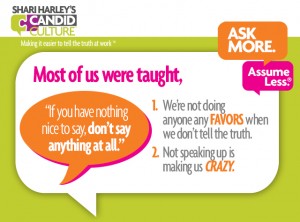 s that isn’t good. We often say nothing when people drop the ball and make mistakes. We replace ineffective vendors and service providers rather than tell them where they’re falling short.
People usually claim they aren’t giving feedback because they don’t want to hurt the other person’s feelings, think the person is not likely to change, or because they’re not sure if their complaint is valid. I don’t buy most of these reasons.
I think the real reason we aren’t giving feedback is because we don’t want to deal with the other person’s reaction. We are concerned – often rightly so – that the person will kill us off. We will be given the cold shoulder, excluded from projects, or thrown under the bus.
You may be wondering why I, who wrote a book called How to Say Anything to Anyone and who teaches other people to give feedback, didn’t speak up on the plane last week. I too have been trained to pick my battles and that if I have nothing nice to say, say nothing at all. Each day I also grapple with when to speak up and when to let things go.
The concern over giving feedback will get better if the people in our lives – personal and professional relationships – agree it’s ok to tell the truth and agree that there will not be negative consequences for doing so. Open and direct conversations will be had. Disagreements will be discussed and resolved as best they can. And when the conversation is over, it’s over. People can’t hold the conversation over your head or hold a grudge.
It would be difficult to agree to open and honest communication with the people who sit behind you on planes, but you certainly can make that agreement in your office and with your family and friends. Agreeing to tell the truth without consequence can be one of your organization’s values and a practice you establish in your personal relationships.

You can hire people who understand they are expected to speak candidly and then let disagreements go. And you can manage people who don’t speak up, who hold grudges, and who punish people for giving feedback. You can tell friends and family that you want candid relationships in which challenges are dealt with quickly and then the disagreement is over.
Making the request for open and honest communication and assuring people there will be no negative consequence for doing so is the differentiator between being able to speak up when you’re frustrated or say nothing.
People get defensive when they receive negative feedback. It’s hard not to. Everyone wants to be seen as competent, and when we receive negative feedback, our competence is called into question. So we react.
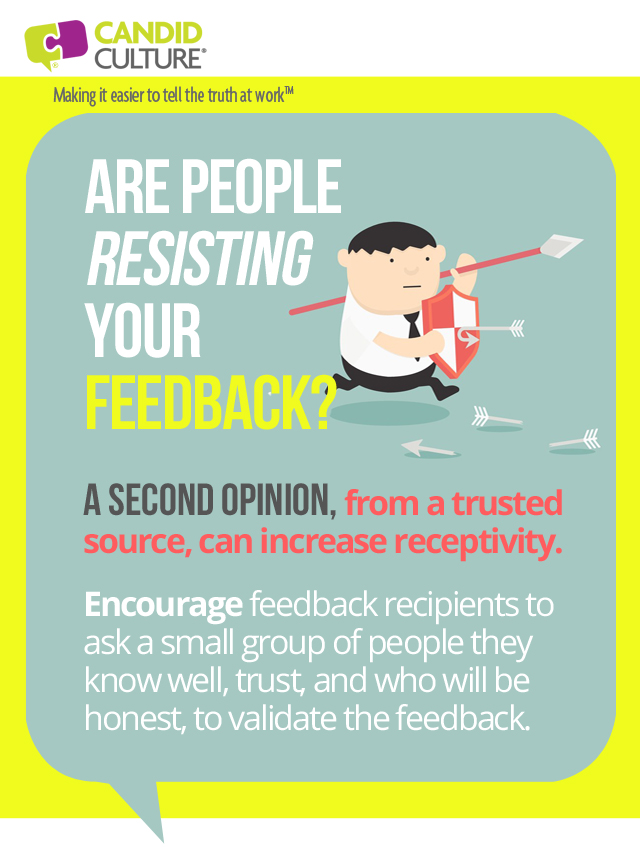
There are several things you can do to reduce others’ defensiveness – ensure you have trusting relationship and thus have earned the right to give feedback, watch your words, deliver feedback in a private setting, etc. But for today, I’m going to focus on getting a second opinion.
If you want people to be more receptive to your feedback, consider encouraging them to get a second, third, or fourth opinion. I’m a fan of casual 360 degree feedback – when we ask for feedback from people we work with both inside and possibly outside the organization. Think of 360 degree feedback like an orange, it’s all the way around, like a sphere. When you get 360 degree feedback, you gather input from all the different types of people you interact with, thus getting a more comprehensive and accurate picture of performance. There are different types of 360 degree feedback. 360 degree feedback ranges from the formal – an online, anonymous survey (I’m not a fan) – to casual conversations (which I recommend). In this instance I’m suggesting something I call The Core Team.
I suggest everyone has a Core Team of about five people who love you, know you well, and have your back. Most important is that you trust these people. You Core Team may be personal or professional relationships, or a mixture of both. You may have worked with Core Team members or not. What all Core Team members have in common is that they know you well, want what’s best for you, and will tell you the truth when asked.
My core team consists of a friend from high school, two people I used to work with, and my parents. When I get feedback that I’m having a hard time reconciling, I ask people on my Core Team to validate the feedback. It doesn’t matter if they’ve worked with me or not. I am who I am. I do the same annoying stuff in my personal and professional relationships. So a personal Core Team member can provide valid, professional feedback and vice versa. Sometimes they agree with the feedback I’ve been given and sometimes they don’t. But I always get compelling information to think about. And because I trust the people on my Core Team, I listen to what they have to say.
Don’t be disheartened if people don’t trust your feedback and aren’t receptive. Instead, see their resistance as human and encourage them to get a second opinion. And then talk again. Listening to and incorporating feedback is a process. It takes time, courage, and patience.
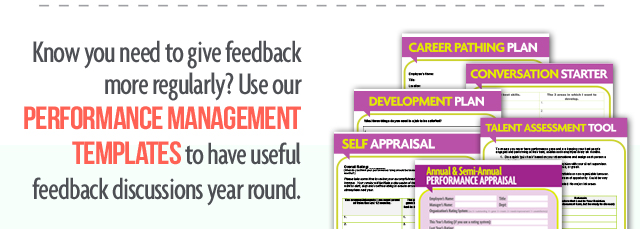
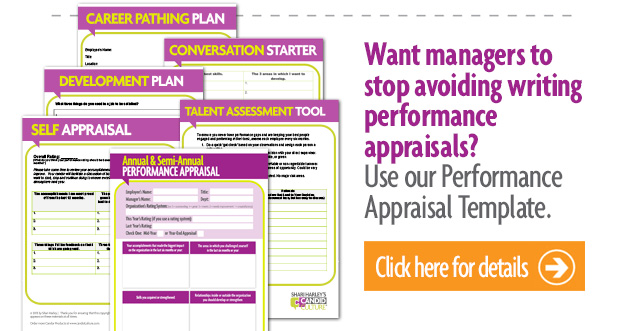
No one (I know) enjoys writing, delivering or receiving performance feedback. It’s time consuming to write, challenging to deliver, and can be difficult to hear. Unfortunately, most performance management systems – goal setting forms, performance appraisal templates and online templates – don’t make the process easier. Ins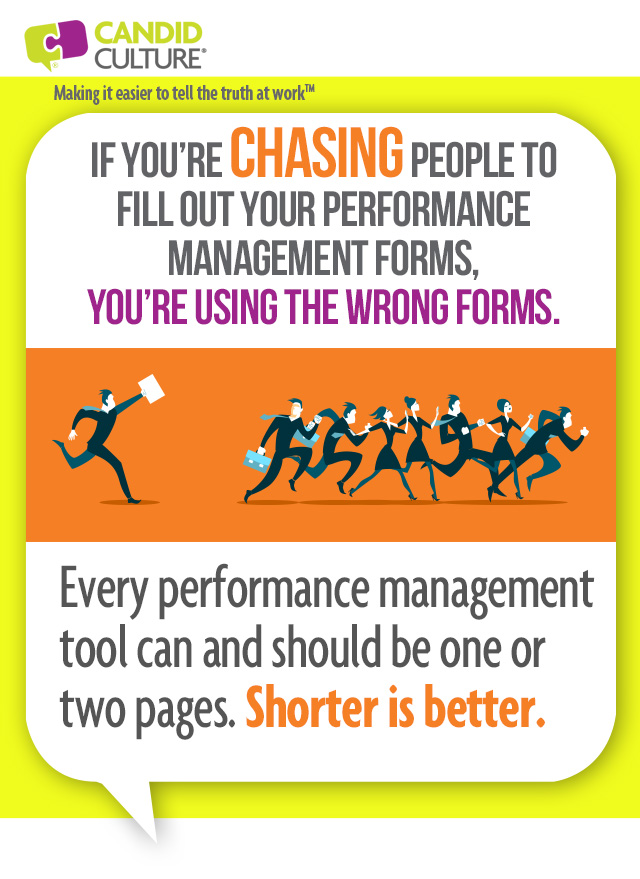 tead, they make it harder. Short and simple is best.
When I started managing leadership development for a large company, I inherited a 12-page performance appraisal form and what seemed like 89 competencies. One of the business leaders I supported told me, “I’m not asking my people to use this form. If you can give me something that’s one page, I’ll have my managers use it.” That conversation sent me on a mission to make all performance management forms one or two pages. And really, why shouldn’t they be? People can only focus on leveraging and changing a few things at a time. Why give more feedback than that at any given time?
If you’re chasing people to use your performance management tools and templates, you have the wrong forms. In my experience, when people find something easy to use and valuable, they’ll use it. If something is difficult to use or doesn’t seem to add value, people drag their heels.
Here are a few ideas for making your performance management process easier:
Make your forms and templates simple. No performance management tool should be more than two pages. In a performance appraisal – quarterly, annual, or otherwise – identify up to three things the person did well and a max of three things s/he can either do more, better, or differently next year. Anything more is overwhelming and a set up for disappointment, frustration, and overwhelm.
If you have additional areas for the person to work on, meet again in 90-days and assess how the person has done with the three pieces of feedback already provided. If s/he has made significant progress on the things they were already working on, add a few new things to work on. If significant progress hasn’t been made on the existing feedback, wait to add more.
I know your existing performance management templates may not allow for what I’m suggesting. If you’re working with a template that requires more input, write up to three clear, succinct, and actionable bullets in each required area and not more. Bullets are better than paragraphs. Be specific. “Great job” is not feedback. Neither is, “needs improvement.” Give a specific example or two. No example, no feedback.
Resist the urge to write paragraphs of vague feedback or to accept that type of feedback in a self-appraisal. Paragraphs of feedback take too long to write and often say little. I’d suggest spending less time writing performance feedback and instead spend the time observing performance, asking others for input on the person’s performance, and writing three succinct, specific bullets that describe an action taken or outcome produced. Specific feedback is meaningful, useful, and received with less defensiveness.
Keeping with the theme of happiness and well-being during this holiday season, I’m hoping you’ll steer clear of the people and things that don’t make you feel good.
If you have a friend who talks only about herself, even after you’ve repeatedly given her this feedback, perhaps stop hanging out with her.
If you have a habit that you know isn’t in your best interest, perhaps break it.
The suggestions above are hard to do, but even harder is navigating relationships with people you can’t avoid. These are the people who when they show up on your caller ID, you often think, “not today,” and let the call go to voicemail.
Here are eight techniques for managing challenging relationships and conflict resolution in the workplace:
Conflict Resolution in the Workplace Technique #1: Know that there are difficult people in every organization. You can leave your job to get away from the person who makes you crazy. But I promise you, he will be waiting for you at the next organization in a different body.
Conflict Resolution in the Workplace Technique #2: Don’t ignore challenging relationships and expect things to get better without your intervention. They won’t. Deal with strained relationships head on.
Conflict Resolution in the Workplace Technique #3: Work on relationships in person or over the phone, not via email.
Conflict Resolution in the Workplace Technique #4: The time to fix a relationship is when there’s nothing wrong. Have hard conversations when things in your relationship are calm and you’re not upset, otherwise the conversations are likely to quickly escalate.
Conflict Resolution in the Workplace Technique #5: Give people the benefit of the doubt. People are doing the best they can. If people knew another way to do something, they would do it that way.
Conflict Resolution in the Workplace Technique #6: Let the other person save face. The more critical we are, the more the other person will feel compelled to defend himself. It’s almost impossible to have a useful conversation with someone who is in defense mode.
Conflict Resolution in the Workplace Technique #7: Ask for what you want. Rather than telling people everything they do wrong, make requests. That could sound something like, “Would you be willing to talk with me directly when my team is frustrating your team? I’ll do everything I can to make things right.” Or, “If you need something from me that you’re not getting, will you give me a call? I’d rather hear about challenges directly from you than from someone else.”
Conflict Resolution in the Workplace Technique #8: Be vulnerable. If you want a better relationship with someone, tell her. If a relationship is strained or broken, chances are, the other person knows. You could say something like, “I think we both know this relationship is strained. I want you to know that I’d really like a good working relationship with you. If you’d like to get together for lunch or coffee and talk about what has gone on, I’d really like that. Perhaps we can start in a new way.”
If you don’t want to be that direct, perhaps considering saying something like, “I just want you to know that I really want a good working relationship with you. What can I do to ensure you and your department get what you need from me? What’s one change I can make that would make the biggest difference for you?”
Damaged and strained relationships won’t get better without your intervention. Ask for what you want. Be positive, be yourself, and be honest. And if the person doesn’t play ball with you, you’ll know that you’ve done what you can.

Just because you can say something, doesn’t mean you should.
There can be too much candor and feedback.
A few guidelines to consider before giving feedback:
- Ask yourself, was the feedback solicited? Unsolicited feedback rarely goes over well.
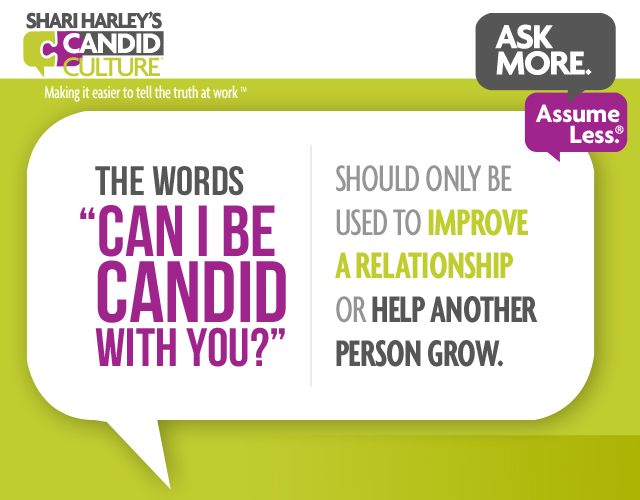
- Assess if you have the relationship to give feedback. I’m offered all sorts of feedback from people I don’t even know. People I don’t know haven’t earned the right to give me feedback.
- Determine if you’re trying to strengthen the person or the relationship. If you aren’t trying to help someone improve, AND the feedback isn’t requested, AND you don’t have the rapport to give feedback, say nothing.
Feedback recipients don’t have to accept unsolicited input or advice. It’s perfectly acceptable to put limits and boundaries on the input you’re open to from peers, friends and family.
Here are two tips for how to handle negative feedback:
How to handle negative feedback tip one:
When you ask for feedback, be very specific about what type of feedback you want.
For example, you could say something like, “We’re picking a new software application to track leads. I’ve already narrowed the choice down to three vendors and vetted what each software application can and can’t do. I want to know about things I may not be aware of, like software that’s being phased out and won’t be supported and potential bankruptcies.”
There’s nothing wrong with asking for targeted feedback. Simply tell people what kind of feedback you want and why. And avoid asking open ended questions like, “What do you think?” If you ask a broad question, you’ll likely get a broad answer.
How to handle negative feedback tip two:
Tell people if you aren’t looking for feedback.
For example, you could say something like, “Thank you so much for your concern. I really appreciate it. I’m actually not looking for feedback at this time. But I really appreciate your concern.”
There’s NOTHING wrong with setting limits and boundaries about what kind of input you’re seeking. And when you do set those limits, intrusive people will think twice before offering unsolicited advice in the future.