Career Management Archive
 There are three reasons people say “that’s above or below my paygrade” or “that’s not my job” –they don’t feel empowered to make decisions, they think they’re being unfairly compensated for the challenges at hand, or they aren’t particularly motivated (read lazy).
“That’s not my job” (aka, I don’t do things that are outside of my job description) is a mindset, and if someone has it, I’d suggest not hiring that person. People who think they should only have to do what’s on their job description aren’t utility players, and your organization is likely too lean to afford employees who only want to perform in a narrow box.
“That’s not my job” can also be an outcome of leaders and managers who can’t let go and let employees take risks and make decisions. If that’s your management style, hire people who will follow directions and don’t want to create new things and solve problems. Problem solvers will be frustrated if they only get to follow instructions.
Here are six steps to steer clear of “that’s not my job” syndrome and advance your career, regardless of your current role in your organization:
- Never say the words “that’s above or below my paygrade” or “that’s not my job.” Even if it’s true.
- If you don’t have the latitude to solve certain problems, ask the people you work for how they want you to handle those types of issues when you see or hear about them. That’s a subtle way to provide feedback that you don’t have the latitude you need to solve certain problems.
- When you see an impending train wreck, say something. I see lots of very capable employees see the train wreck coming, comment to themselves or others who can’t do anything about the problem (aka gossip), and then nod knowingly when the *&#@ hits the fan. Don’t be that person. Look out for your organization and the people you work with.
- If you see a broken or lacking process, raise the issue with someone who can do something about it, and offer to take a stab at fixing the problem. One of managers’ biggest complaints is employees who dump and run – “I’ve identified a problem. I’m leaving it for you to fix.”
- Go out of your way to do the right thing, even if you are uncomfortable or don’t want to. If it’s easier to email someone, but you know the right thing to do is to pick up the phone, pick up the phone. If an internal or external customer expresses concern and you can’t solve the problem, find someone who can. There are lots of ways to make an impact.
- Ask more questions. Find a non-judgmental way to ask, “Why do we do this this way?” “Have we considered…?” “Would you be open to trying…?” Status quo can be the right thing and what’s necessary. It can also be the death of organizations.
Make stuff happen. Don’t pass the buck. And if you are going to pass the buck, don’t announce it. It only makes you look disempowered and uncommitted.

 It’s often not the work we do that makes work hard; sometimes it’s the people we work with that makes work harder than it has to be.
Below are seven practices that distinguish people we want to work with from those we wish would go work for a competitor.
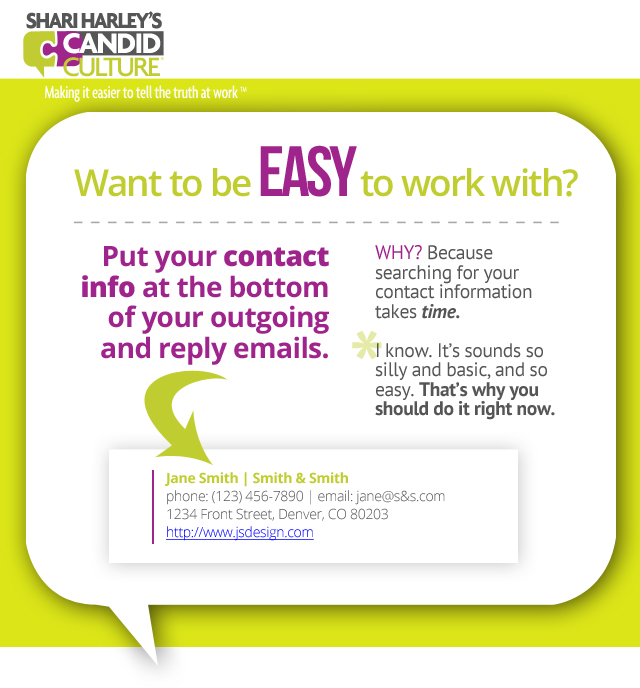
How to Be Easy to Work with Tip Number One: The simplest thing you can do right now to be easy to work with is to put all of your contact information in your email salutation in a format that can be easily copied and pasted or called from a cell phone, aka not an image.
How to Be Easy to Work with Tip Number Two; Update your out-of-office message when you return from a trip.
How to Be Easy to Work with Tip Number Three: Accept and deny meeting requests when you receive them, even if you’re not sure you’ll be able to attend. Knowing who can and can’t attend helps the meeting organizer plan. You can always update your status if something changes.
How to Be Easy to Work with Tip Number Four: Reply to emails within 48-hours, even if you don’t have the information for which you’re being asked. Tell people you got their message and when they can expect to receive the information they asked for.
How to Be Easy to Work with Tip Number Five: Don’t gossip. I could say a lot about this, but you don’t have time to read it. So I won’t. I’ll leave it at this, don’t talk about other people when they’re not present and you’ll be someone people will line up to work with.
How to Be Easy to Work with Tip Number Six: Do the things you say you will do, when you say you will do them. When you realize you can’t keep a commitment, tell people as soon as you know, so they can plan. Most of us don’t want to admit that we’re going to miss a deadline, so we wait until the 11th hour to tell the people who will be impacted. Waiting to renegotiate a deadline puts people in a worse position than telling people as soon as you know.
How to Be Easy to Work with Tip Number Seven: Avoid doing the things that you know annoy others. I’ll get us started with a list of the things that most commonly annoy people at work. Please add a comment to the blog with all the things I missed. It will be fun! Sanctioned venting. Who can turn that down?
- Leaving dishes in the sink like mommy works there
- Taking phone calls from a cubicle via speaker phone
- Almost finishing a pot of coffee, but not making more
- Listening to music and videos without headphones from your desk
- Having lots of regular visitors or loud phone conversations from your cubicle
- Surfing the internet versus working
- Leaving your alerts on your cell phone, so everyone in your vicinity knows each time you get a text message
I could go on, but I’ll leave the rest to you. Add a comment with the simple things people can start or stop doing to be easy to work with!

No one likes to hear people complain, especially people who go on, and on, and on. But there is a reason people complain for longer than may seem necessary. For the most part, the people who sound like a broken record don’t feel heard. And when people don’t feel heard, they repeat themselves, again, and again, and again.
One of the first practices for how to handle customer complaints taught during any decent customer service training class is to acknowledge the other person’s concern. Demonstrate that you listened and heard. We often think that complainers want us to solve their problems. That’s not always the case. Sometimes feeling heard is enough, even if there is no resolution to the complaint.
Last week I had a horrible experience in a hotel. I called the front desk staff to voice my concerns with how an incident was handled. Her response: “Ok….ok….ok.” I wasn’t satisfied. So the next morning I spoke to the front desk manager. She responded by explaining why her staff had done what they did. Still, no apology or demonstration of understanding my frustration. So I went to the hotel general manager, who did all the right things. She listened and apologized. She didn’t defend or explain. And then I stopped escalating my complaint.
Here are a eight tips for how to handle customer complaints:
How to handle customer complaints tip #1: Resist the temptation to defend yourself, your team, or your organization.
How to handle customer complaints tip #2: Watch your tone of voice. If you sound annoyed, the other person will just become more upset and will, you guessed it, continue complaining.
How to handle customer complaints tip #3: Tell the person you’re sorry for his experience. Apologizing doesn’t mean he is right or that you agree. You are simply sorry he had the experience he did.That could sound like, “I’m sorry that was your experience. That sounds frustrating. That’s certainly not the experience we want customers to have.”
How to handle customer complaints tip #4: Ask clarifying questions, if you need to. That could sound like, “Can I ask you a few questions, so I fully understand the situation?”
How to handle customer complaints tip #5: Paraphrase what the person said to ensure you understand his complaint and to demonstrate that you heard. Nothing sounds better to someone who is upset than another person who understands his concerns. That could sound like, “I just want to be sure I understand your concern. You’re concerned that _______ “ (repeat or paraphrase what the person said.)
How to handle customer complaints tip #6: Apologize again for the person’s experience. Often, all the person wants is an authentic apology. An apology doesn’t admit fault or wrong doing. You are simply apologizing for the person’s perception of their experience.
How to handle customer complaints tip #7: Tell the person what action(s) you’ll take, in any. People like to know that they’re complaints aren’t wasted.
How to handle customer complaints tip #8: Don’t be a black hole. Circle back to the person and let him know what action was or wasn’t taken.
The key to getting someone to stop complaining is to make the other person feel heard. Acknowledge the complaint. Watch your tone of voice. Apologize for the person’s experience. And watch people’s complaints dissipate more quickly than you thought possible.

When I’m not sure what to do, I do nothing. And my hunch is I’m not alone. When something feels big, it’s easier to do nothing than something.
Time management experts will tell you to divide a big project into small pieces, to make it manageable. That’s good advice. The universe – as woo-woo as it sounds – rewards action. Momentum, like inertia, is very powerful. As we know, a body that’s in motion is likely to stay in motion. A body at rest is likely to stay at rest.
The key to getting through anything large, scary, or intimidating is to start. Any action will do. The key is simply taking action.
Here are five keys to make taking action more likely:
Taking action key #1: What often stands in the way of taking action is that we aren’t sure what to do. Perhaps we aren’t sure we can do the task at hand. Or we can’t see what the end result should look like. Or the project feels so big that even thinking about starting is tiring. Ask questions and ask for help.
Most managers aren’t great delegators. When assigning a project, managers often ask, “Do you have any questions?” This is an ineffective question because few people want to admit to having questions about a project that feels so big, all they want to do is avoid it and take a nap. Or managers ask, “What do you need from me?” when most people have no idea what they need.
Don’t be afraid to ask questions until you’re clear about what a good job looks like, and ask for help.
Taking action key #2: Do one small thing, anything, towards achieving the goal. And do it now. Don’t wait until the right time. There is no right time.
Taking action key #3: Then do one more thing. Don’t wait six weeks or months to take another action. Momentum is very powerful. Keep things moving.
Taking action key #4: Give yourself small windows of time to work on a project. If you give yourself 30 uninterrupted minutes to work, you’re likely to invest that time. If you dedicate a day, you’re likely to get distracted and fill the time with other things.
Taking action key #5: Trust that you can do what’s in front of you. Someone wouldn’t have asked you to do something if they’d didn’t have confidence that you could do it. And if this is a goal you set for yourself, and it’s something you really want, deep down, you know you’re capable of doing it.
If you’re overwhelmed or don’t believe you can do something, call someone who has more faith in you than you have in yourself, at this present moment. Let that person fill you with confidence until you can generate it for yourself. When I started Candid Culture, I was filled with fear and quite honestly, was convinced I was going to fail. But everyone around me believed I could do it. And their confidence carried me until I could generate my own.
The way out is always through. Ask for help. Take one small action, then another. Dedicate small pieces of uninterrupted time to work on a large project. Trust that you can do it. Things don’t get done without your action. Take one action, then the next, then the next.


In last week’s blog, I advocated for picking up the phone, even when you don’t want to, being patient, and asking questions versus accusing. Admittedly, it’s easier to be generous with some people than with others. Some people are just hard to work with. And no matter how much you want to do the right thing, when difficult people’s names show up on your caller-id, it’s tempting to let them go to voicemail, indefinitely.
There are a few behaviors that make people difficult people to work with. Avoid these communication blunders, and help ensure your calls don’t go to voicemail.
Five tips to be easy to work with:
How to be easy to work with tip 1: Don’t take things personally. Human beings are wired for survival. Most people are so worried about themselves – looking good and doing well – they’re not all that worried about you. When you get overlooked for a project or a meeting, rather than feeling slighted, ask what happened that you weren’t included. Or just be grateful you have one fewer meeting to attend.
How to be easy to work with tip 2: Remember it’s not all about you. People who think everything is about them are exhausting to be with. Be humble. Take an interest in others. And remember that no matter how talented and fabulous you are, you’re not the only one in your organization who is producing results.
How to be easy to work with tip 3: Give other people the benefit of the doubt. Most people are genuinely trying to do the right thing. If you question someone’s motives or actions, ask a question before making a decision about that person.
I like the question, “Help me understand…?” It’s neutral and invites the other person to speak. If you choose to ask this question, watch your tone of voice. If you can safely add the words “you dummy” to a question, you have a tone issue.
How to be easy to work with tip 4: Temper your emotions at work. You’re human and human beings have feelings. But sometimes our feelings can be off putting to others. Most people are uncomfortable when managers and coworkers yell, cry, or give the silent treatment. Manage your emotions at work. Wait to have conversations until you’re not upset. And if you can’t manage your emotions during a conversation, excuse yourself until you can.
How to be easy to work with tip 5: Be introspective and self-aware. The better you know yourself and how you impact others, the more you can work with others how they like to work. Periodically ask people you trust for feedback on the impression you make and what you’re like to work with. Listen to their feedback and adjust your communication habits to be easier to work with.
The bottom line – to be easy to work with you need to be sensitive to how you impact others. People who pay attention to how they impact others and make changes to work better with others, are enjoyable to work with. People who don’t pay attention to how they impact others and aren’t open to altering their working styles get sent to voicemail.

 As someone who writes and teaches about effective communication in the workplace, the people I work and socialize with are expecting me to model good communication skills all the time. The good news: I try really hard to always do the right thing and impact people positively. The bad news, I’m human and sometimes I don’t get it right.
One of the things I’m proud of about Candid Culture, is that we are real people, working with real people. We work very hard to practice effective communication in the workplace and to always model what we’re teaching. And yet, like all people, we get busy, rushed, and tired. We read emails we intend to reply to, but then forget to do so. We occasionally send emails, when we should pick up the phone.
In my world, a good communicator is not someone who always communicates perfectly.
A good communicator who practices effective communication in the workplace is someone who:
- Cares about people and consistently works to communicate in the way others need.
- Asks for and is open to feedback about how s/he impacts people.
- Listens and watches other people’s verbal and non-verbal communication.
- Alters his/her communication style to meet other people’s needs.
- Takes responsibility when things don’t go well.
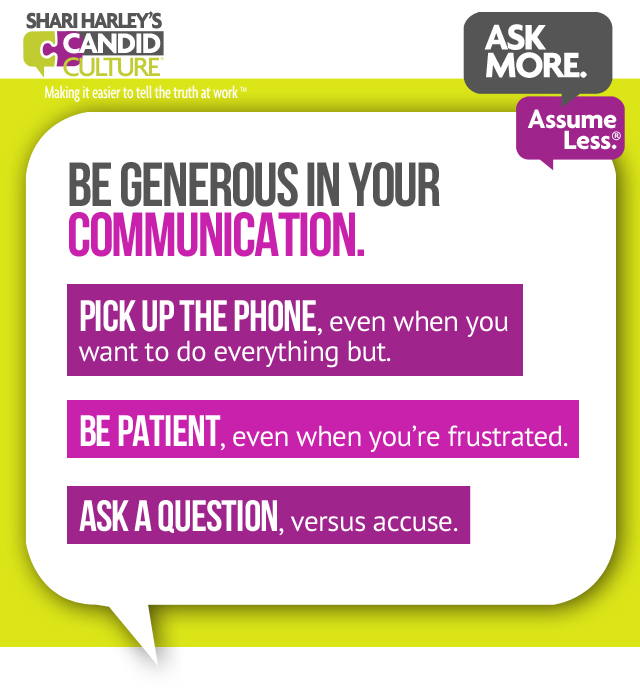
This week I’m advocating for picking up the phone, even when you want to do everything but, being patient, even when you’re frustrated, and asking questions, versus accusing. And I’m going to admit, I’m working to do these things too. Sometimes I get it right, and sometimes I don’t. I’m in the trenches with you, working to say and do the right things every day.
I promised you five tips to practice effective communication in the workplace and to be generous with people:
- Only call people when you have adequate time, attention, and patience to have whatever conversation needs to be had.
- If you need a few days to return a call, say so. Let the person know when you’ll call.
- Prepare for conversations. Plan what you’re going to say and how you’re going to say it.
- Don’t have hard conversations when you’re frustrated, tired, or busy. They won’t go well.
- If the conversation goes poorly, call back later and clean it up.
Being a good communicator doesn’t mean being perfect. It means caring enough to notice when you miss the mark, cleaning up your messes, and working to do it better next time. I’ll be working on the above recommendations too this week. And when I screw it up, you can be assured that my mistakes will become examples in our training programs of what not to do, followed by a new technique that will hopefully work for all of us.

Avoiding having difficult conversations because you’re uncomfortable? Afraid you’ll hurt someone’s feelings? Worried you’ll damage your relationship? Why not just say so?
The people you work with want to work with other human beings. And part of being human is expressing how you feel.
It may seem that admitting that you’re nervous or uncomfortable weakens your position and diminishes your power. This couldn’t be further from the truth. Saying how you feel and being willing to be vulnerable are signs of strength. People with strong egos can admit when they are uncomfortable, people with weak egos feel too threatened to do so. Vulnerability and authenticity help other people see you as human, and make people feel closer to you. And people want to work with other human beings, not emotionless androids who never show their cards.
If you’re nervous, say you’re nervous. If you’re afraid you’ll negatively impact your relationship by speaking up, say so. If you’re not sure it’s your place to raise an issue, say that. You won’t lose anything by stating your concerns. You only stand to gain.
Starting difficult conversations could sound like this:
Having difficult conversations option one: “I’m not sure it’s my place to talk about our department’s Customer Service Survey results, but I care about our reputation and have a few thoughts. Is it ok if I talk about them with you?”
Having difficult conversations option two: “I’ve got some input for you that I’ve been hesitant to share, but I think the information could be helpful to you. I care about you and your career, and I want you to be successful. Is it ok if I share my thoughts?”
Having difficult conversations option three: “I’ve got a few things to talk with you about, but haven’t brought them up because I’m a bit concerned about how you’ll react. Is it ok if I share them with you? I’m saying these things because I care about our department, and I’m noticing a few things I think we can do differently, for better results.”
You probably noticed that in the examples above, I stated that I was concerned about speaking up, asked for permission to do so, and stated the reason I wanted to provide input. Your motive for having difficult conversations is very important. When people trust your motives you can say anything. When they don’t trust your motives, you can say little.
Don’t be afraid to say how you feel. If you’re afraid to speak up, saying so won’t reduce your credibility, it will likely increase it. State your concerns, explain why you’re speaking, and ask for permission to give feedback. Doing those three things will help any message be well received and is likely to make it easier for you to say what you want to say.

 As crazy as it sounds, it can be difficult to get work done at work. There are the drive bys –people who want your opinion on EVERYTHING before they make decisions, the interrupters who have just one question, several times a day, the visitors who want to update you on EVERYTHING happening in their personal lives, and coworkers who host meetings at their workstation, take phone calls on speaker phone, and who listen to music without headphones, while loudly eating potato chips. All of these distractions are enough to make many employees want to find a quieter place to work.
The concept that it can be hard to get work done at work is crazy. We’re at work to work. And yet many employees, with and without a door, get in at 7:00 am, before others arrive, so they can “get some work done” and stay late because they “got nothing done all day.”
Open work environments can be productive and interruptions can be minimized, but managing interruptions at work will require some clear guidelines and direct communication, which many workplaces are missing.
Managing interruptions at work – practices for creating a work environment that works for everyone:
Write workspace practices down, share them with all employees, post the practices in every work area, and discuss them frequently.
Examples of practices for managing interruptions at work:
- Use a headset for all phone calls.
- Pay attention to your volume. Speak as quietly as possible.
- If you have visitors at your desk for business or non-business related conversations that last longer than five minutes, take the conversation to a conference room, empty office, or local coffee shop.
- Use headphones to watch videos and listen to music.
- Avoid prairie dogging—calling down a row, hallway, or over a cubicle wall. Instead, walk to the person’s desk, call, or send an email or text message.
- Turn off all auditory alerts on computers and cell phones, so your coworkers don’t have to hear pinging and ringing all day. The people you sit with don’t need to know every time you receive an email, text, or Facebook message.
- Finally, but MOST IMPORTANTLY, give all employees permission to make requests and give feedback when workspace guidelines are broken. It must not only be acceptable but expected that employees will say something when a guideline is broken and the workspace gets too loud.
Most employees will not speak up when others are being loud. It’s easier to find another location to work than risk a coworker’s defensive response. And no one wants to be ‘that person’ who complains about how loud someone is. If employees aren’t comfortable speaking up and making requests, offer training on how to have these conversations, and provide written examples of what employees can say that is respectful and clear.
Guidelines for dealing with interruptions at work:
You’d think that having a door would make people immune to work place distractions, but that’s not the case. Employees with offices also deal with drive bys and interruptions. The key to dealing with both is communication.
- Don’t wait for problems to occur. Anticipate challenges and talk about them before guidelines are broken. It’s much easier to make a request than to give feedback.
- Each time a new person joins a team, department, or workspace, ask everyone on the team to share their work-related pet peeves, how they like to communicate, and how they prefer to be interrupted. Everyone deals with interruptions, so you might as well express a preference. If you’d prefer people email you and ask when you have time for a quick question, make that request. If you’re ok with people interrupting you without notice, let people know. If you’re not distracted by noise, tell people. If you are, make that preference known.
People are too hesitant to speak up at work for fear of damaging relationships and hurting people’s feelings. The best thing leaders can do to improve the working environment (or any workplace challenge) is to set clear expectations, create opportunities to talk about how things are going, and make it ok to speak up.
Suffering at work is optional. Everyone is accountable for the work environment, and you won’t get what you don’t ask for.
You will be passed over for jobs, projects, and opportunities – personally and professionally. People will choose not to buy from you and they’ll choose not to be your friend and romantic partner. And that’s ok. Not everyone is our right “customer.” The key isn’t to win every opportunity. Rather, it’s what we do when we don’t get what we want.
When you’re done feeling disappointed, mad, and frustrated, get curious. Find out why you were passed over. I’ll never suggest you make changes. I simply want you to know what’s standing in your way, so you have power – the power to choose. Eliminate your business blind spots.
All of us have blind spots – things we do that are off putting to others, that we’re not aware of. For the most part, people won’t tell us our business blind spots, instead, they simply pass us over. Being rejected is feedback, it’s just not specific enough to help us make different choices. If you want to be able to change your behavior, you need to know what behaviors are standing in your way. Then you can choose what, if anything, to do about those behaviors.
When you get turned town for an opportunity, practice these strategies to eliminate your business blind spots:
- Allow yourself to have an emotional reaction, to feel disappointed and grieve the loss.
- When your emotions dissipate, call people who can tell you why you were turned down, and ask for feedback. The goal of the conversation: Eliminate your business blind spots.
- Be humble and open.
Consider saying something like, “Thank you so much for considering me/us to support your needs. We were disappointed not to win your business. Would you willing to share what had you choose a different provider and what we could have done differently to be a stronger candidate? I’ll be grateful for anything you’re willing to tell me.”
Depending on the circumstances, you could also say something like, “I wasn’t put on the _______ project. I wonder if you have any information as to why? I appreciate anything you’re able to tell me. Your input will help me grow and eliminate by business blind spots.”
- Regardless of what you hear, thank the person for the feedback. You can ask for additional information and ask who else you can talk with, but don’t become defensive. The less defensive you get, the more feedback you’ll get. Make it easy to tell you the truth (as the other person sees it).
Remember, information is power, and power is control. Many people don’t give direct feedback because they’re afraid of the other person’s reaction. Surprise people by being open to feedback, and eliminate your business blind spots.
- Validate feedback that doesn’t feel right to you. If you’re not sure what someone told you is accurate, vet the feedback with other people you trust. Simply ask other people, who are aware of your performance, “I received this feedback. Does that resonate with you?”
- Sit with the feedback for a few days before taking any action.
- When your emotions have passed, decide what, if anything, you want to do with the input you’ve received. Perhaps you want to make changes. Perhaps you don’t. Either way, you have more power than you did before you received any input.
You won’t win them all. The key isn’t avoiding rejection, it’s what you do when you don’t get what you want. Be brave. Be open. Ask for feedback. And you’ll have the power to make different choices next time, if you want to.

Stuff happens. People won’t give you what you need to complete projects. Things will break. And you will look bad. When breakdowns happen, I always ask myself, “What could I have done to prevent this situation?” or “What did I do to help create this situation?”
It may sound odd that I always look at myself when breakdowns occur, even when it’s someone else who didn’t do her job, but it’s just easier. I can’t control anyone else. But I can control me (admittedly, some days I do a better job at this than others). When I can identify something I could have done to make a situation go differently, I feel more in control – aka better.
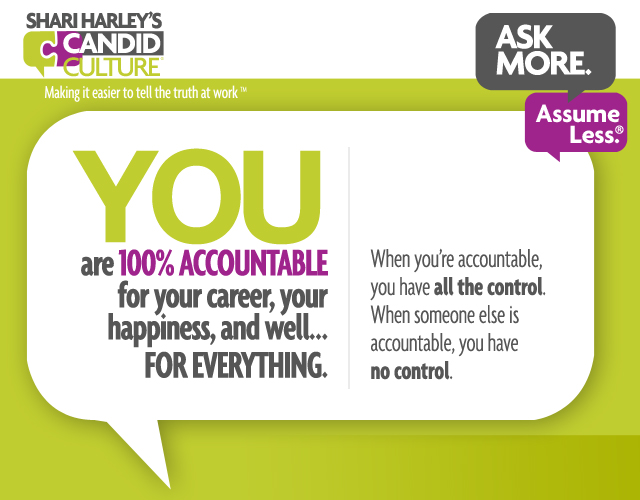
It’s like getting off a highway with bumper-to-bumper traffic. Your alternate route may take longer, but at least you’re moving. You feel like you’re doing something and thus have more control. Taking responsibility for everything that happens to you is similar. When you’re accountable, you can do something to improve your situation. When someone else is accountable, you’re at the mercy of other people and have very little control.
There are, of course, exceptions to the practice that “we’re always accountable.” Terrible acts of violence, crime, and illness happen to people, about which they have no control. But in general, in our day-to-day lives, there is typically something we did to contribute to a bad situation or something we can do to improve it.
Here are four practices for improving difficult situations, even when you didn’t create the mess (alone).
1) Increasing accountability in the workplace: Ask more questions. If you’re not clear about what someone is expecting from you, ask. You’re responsible for doing good work, regardless of the type of direction you receive.
2) Increasing accountability in the workplace: Tell people what you think they’re expecting and what you’re planning to do, to ensure everyone’s expectations are aligned. Clarifying expectations beats doing weeks’ worth of work, only to discover what you created isn’t what someone else had it mind.
3) Increasing accountability in the workplace: Ask for specific feedback as projects progress. Don’t wait until the end of a project to find out how you performed.
4) Increasing accountability in the workplace: Say “thank you” to whatever feedback you receive versus defending yourself. People will be pleasantly surprised and their upset will dissipate more quickly. That could sound like, “That’s good feedback. I’m sorry that was your experience. Thank you for telling me.”
5) Increasing accountability in the workplace: Admit when you make a mistake or when you wish you had done something differently. Don’t wait for someone to tell you. Saying, “I’m sorry. How can I make this right with you?” goes a long way.
I am always asking these questions:
“What could I have done differently?”
“What did I do to contribute to this situation?”
“What can I do now to make this situation better?”
And I encourage you to do the same, even when someone else drops the ball. You can’t control others, but you can control you. And your happiness and success is your responsibility.