Career Management Archive
 Wearing too much perfume or cologne will make people scatter, or wish they could. Unfortunately, rather than tell you that you’re wearing too much, people will just avoid sitting near you. Scent is such a personal thing, like clothing, that people are hesitant to comment on it.
I suggest not wearing anything scented at work, on airplanes, or when you’ll be in close proximity with other people you don’t know well. But if I can’t persuade you to skip the scent, here are a few guidelines when putting on cologne and perfume:
• Spray the air ten inches in front of you, and walk through the mist, rather than spraying your skin.
• If you can smell the scent on yourself or people who are more than a few inches from you can smell it, you’re wearing too much.
• You should never be able to smell a person’s cologne after they’ve left a room.
No, I’m not an expert on how to wear perfume. I googled it.
The next step is to ask a few people you trust to tell you when you wear too much perfume or cologne. Give people permission to give you this feedback, and promise you won’t bite their head off when they do. This could sound something like, “I want to be sure I’m not wearing too much perfume. Would you be willing to tell me when I do? I promise I won’t freak out or jump down your throat. I really want to know.”
Let’s say you work with someone who wears too much perfume. She hasn’t asked if she’s wearing too much, and you want to say something. You could say something like, “This is a bit awkward, but the perfume you wear is a bit overwhelming. Would you be willing to wear less or none at all when you’re in the office?” This is an awkward conversation that most people don’t want to have. Consider that you’re doing the person a favor. Would you rather know the amount of scent you wear keeps other people away, or would you rather alienate the people around you?
If the relationship is a personal one, you could say, “You wear the most lovely perfume. And I’ve noticed that the smell is quite strong. Would you be willing to wear less of it?” Again, this is an awkward conversation. But you won’t die from having it and the other person won’t either. When she gets over being embarrassed and defensive, your relationship will be fine. And if it’s not, you didn’t have much of a relationship to begin with.
 Use our Candor Questions for Relationship Building at Work to find out what people say about you when you’re not there.
Saying no is hard. We don’t want to disappoint or let people down. And yet, you can’t say yes to everything. You can say no and still sound like a responsible, easy-to-work-with, accommodating professional.
Here are four techniques for how to say no:
Thank the person for asking. “Thank you for asking me.”
1. Saying “thank you” acknowledges the other person and buys you time to think about his request.
2. Tell the person you need some time to think about his request. Ask, “Can I have a few days to think about it? I’ll get back to you by Friday.”
You don’t need to reply in the moment. I often regret things I agree to without thinking through the request thoroughly.
3. Consider what you really want and are willing to do. It’s much worse to over commit and under deliver than to simply say no or renegotiate requests.
4. Get back to the person in a timely way (when you said you would) and tell him what you’re willing to do.
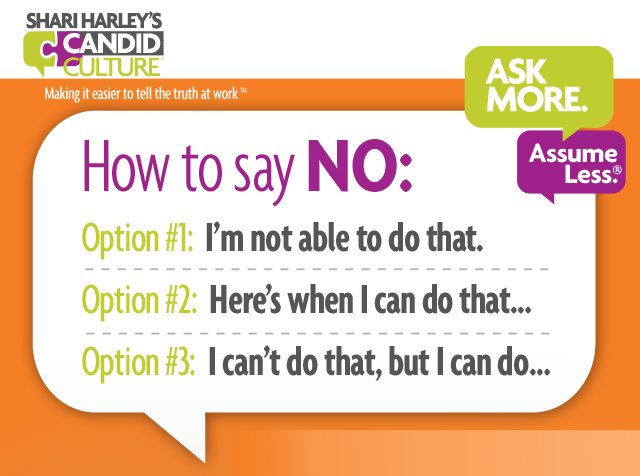
How to Say No Option One: Simply say no.
Example: “I really appreciate you asking me to write the proposal for the __________ RFP. I’m not able to do that. Can I recommend someone else who has the expertise and will do a great job?”
Don’t give a bunch of reasons for saying no. People aren’t interested in why we can or can’t do something. They just want to know if we will do it.
How to Say No Option Two: Agree and negotiate the time frame.
Example: “I’d be happy to do that. I can’t do it before the last week of the month. Would that work for you?” If the answer is no, negotiate further. Ask, “When do you really need it? I can certainly do pieces by then, but not the whole thing. Given that I can’t meet your timeline, who else can work on this in tandem or instead of me?”
How to Say No Option Three: Say no to the request but say what you can do.
Example: “I can’t do _______. But I can do ________. How would that work?”
A review of how to say no:
- Acknowledge the request by getting back to the requestor within 24 hours.
- Give yourself time to think about and respond to requests.
- Negotiate requests to your and the requestor’s satisfaction.
- Agree on what you can and are willing to do.
- Keep your commitments.
Saying no is always hard. But it’s always better to say no than to ignore requests, or to say yes and do nothing.

I had a colleague at my last job, prior to starting Candid Culture, who was a peer and a friend. We were at a similar level and would periodically sit in one of our offices, with the door closed, engaging in office gossip, talking about the bad decisions our company’s senior leaders made. One day I realized that these conversations were exhausting to me. They were negative and didn’t make me feel better. In fact, they made me feel worse.
Some people distinguish between office gossip and venting, asserting that venting is cathartic and makes people feel better. It doesn’t. Venting and office gossip are one in the same and both will make you tired and feel worse about your job and organization.
I’ll use an analogy I read in one of Deepak Chopra’s books. When you put a plant in the closet and don’t give it light or water, it withers and dies. When you put a plant in the sunlight and water it, it grows. And the same is true for people. Wherever you put your attention will get bigger and stronger. Whatever you deprive attention will become smaller.
In addition to draining you of energy and ensuring you focus on the things that frustrate you, office gossip kills organizations’ cultures. If employees can’t trust that their peers won’t talk about them when they’re not there, there is no trust in the organization. And this lack of trust feels terrible. It makes employees nervous and paranoid. A lack of trust sucks the enjoyment out of working because we feel we have to continuously watch our back.
Office gossip isn’t going anywhere. It’s a human phenomenon and is here to stay. But you can reduce office gossip.
Here are five steps to reduce the office gossip in your workplace:
Reducing gossip in the workplace step one: Address the gossip head on.
Tell your employees, “I’ve been hearing a lot of gossip, which is not good for our culture.”
Reducing gossip in the workplace step two: Hold regular town hall meetings, and give employees more information than you think you need to about initiatives, organizational changes, profitability, etc. Employees want to know how the organization is doing and what they can do to contribute. In the absence of knowledge, people make stuff up, not because they’re malicious, but because they have a need to know. Employees don’t have to fill in the gaps with office gossip when you inform them.
Reducing gossip in the workplace step three: Create a no-gossip-in-the-workplace policy.
Tell your employees, “We want people talking directly to each other, rather than about each other. As a result, we’re putting a no-gossip policy in place.”
Reducing gossip in the workplace step four: Draw attention to gossip.
Perhaps suggest, “Every time you hear gossip, wave two fingers in the air (or something else that’s equally visual).” This will draw attention to office gossip without calling anyone out.
Also, ask your peers and friends not to gossip with you. End conversations that contain gossip. This will be hard to do, but if everyone does it, it will become much easier.”
Reducing gossip in the workplace step five: Have an agreed-upon consequence for gossip.
Tell employees, “Every time we hear gossip in the workplace, the gossiper owes a dollar. Every quarter the gossipers will buy the office lunch from the office gossip jar.”
The keys to reducing office gossip are to draw attention to the gossip, have a consequence for gossiping, and over communicate so your employees don’t have to fill in the gaps themselves.
Venting and office gossip are the same. If you’re talking about someone else, unless you’re planning a conversation with a coworker or friend to address a challenge or problem, you’re gossiping. And talking about what frustrates you will only make you more frustrated.
My advice: Do something about the things you can impact and let the other stuff go. Talk about the things that matter to you. Resist the temptation to speak negatively about the people around you. And know that anyone who will gossip about someone to you, will also gossip about you.

Organizations are working hard at retaining employees. Employees are watching how their organization’s leaders and managers work, and often make career decisions based on the hours the most senior people keep. Not a recipe for retaining employees.
Many employees pay particular attention to how often managers and senior leaders take vacations and whether or not leaders attend meetings and respond to emails while they’re ‘off.’ Employees observe the late nights leaders and managers put in and the emails sent at 11:00 pm and on the weekends. I’ve heard lots of employees say, “If I need to work like my boss works to get ahead in this organization, I’m not interested.”

Managers, the key to retaining employees is to communicate expectations. If you’re available while you’re on vacation, but don’t expect your employees to do the same, set that expectation. If you send an email outside of regular business hours but don’t expect employees to respond until the next business day, tell them so. They don’t know. Many employees assume that if you email them at night, you expect a reply.
Instead of allowing employees to make assumptions about what managers do and don’t expect, set clear expectations. Be overt and clear. Tell employees, “I work most evenings and weekends, but don’t expect you to do so. And I work these hours because I enjoy it, not because I have to. If I email you outside of regular business hours, I am not expecting you to reply.” Retaining good employees begins during the interview process, when initial expectations are first set.
Managers, if you expect employees to check and respond to emails outside of regular business hours and to be available while on vacation, tell them. If working long hours is a criteria for promotion, set that expectation preferably during the interview process. It’s completely fine to expect long hours and for employees to be accessible outside of regular business hours. There is nothing wrong with either expectation. There is only a problem if employees don’t know that’s the expectation.
Employees, if your manager emails you outside of regular business hours and she doesn’t tell you whether or not she expects you to reply, ask. Simply say, “I often receive emails outside of regular business hours. How will I know when you need me to reply?” Likewise, if you notice your manager emails you on vacation, you can say, “I typically hear from you when you’re on vacation. Are you expecting me to check in while I’m off?”
The need to ask questions and set expectations goes both ways. Don’t wait to be told. Ask.
Managers and employees, ask these Candor Questions about working style preferences to aid in retaining employees:
- How do you feel about being contacted outside of regular business hours?
- If I need to reach you over a weekend or in the evening, what method is best?
- Would you prefer I text you so you don’t have to check your email outside of business hours?
- What time is too early and too late to call, text, and/or email?
Ask more. Assume less and make retaining employees easier.
As crazy as it sounds, your manager is afraid of you – afraid of your defensive reaction to feedback.
The normal reaction to feedback is to get upset. The problem is, no one wants to deal with our upset. It makes them uncomfortable. So managers and peers alike start to pick and choose what to tell us. Not wanting to deal with our reaction, they start to pick their battles. The more defensive we are, the less feedback we get. The less feedback we get, the less information about our performance we have. The less information we have about our performance, the less control we have over our career
All of us have been passed over for an opportunity at work – a promotion, raise, project, etc. – and for the most part, we have no idea why, because no one wants to risk our defensive response to tell us. This lack of knowledge makes it hard to manage your career. And to be frank, defensive people are extraordinarily difficult to work with. Having to watch every word, walk on egg shells, and be choosy about what to address and what to avoid is exhausting. Be receptive and thus easier to work with.
I teach managers to screen out candidates who aren’t coachable and receptive to feedback. Work is hard enough without hiring people who aren’t coachable. Being open to feedback makes you easier to work with.
Here are three ways to be open to feedback and increase receptiveness:
Tip one to be open to feedback and increase receptiveness: Don’t underestimate the power of your emotions and the intrinsic drive to defend yourself when receiving feedback. Not defending oneself is extremely challenging. And even the most minor reaction sounds defensive. I.e., “Thank you for the feedback. Here’s why we did it that way…”
Tip two to be open to feedback and increase receptiveness: Wait a few minutes, hours or days, and respond to feedback when you’re calm. That could sound like, “Thanks for telling me. I’m sorry that happened. I’m going to think about what you said and get back to you by the end of the day.”
Tip three to be open to feedback and increase receptiveness: Come from a place of curiosity when seeking feedback versus thinking “there’s something wrong here” and “I’m bad.” Be curious about how you impact others and the impression you make. Seek feedback to understand both.
When I landed my first ‘real’ job after graduating from college I was so scared, I almost turned  the job down. It took me five years to finish my first book, How to Say Anything to Anyone, in part because I was afraid no one would like it.
It seems anything worth doing is worth fearing.
I’m not talking about taking risks for the sake of risk – driving as fast as your car can take you, not paying your bills to see what will happen, or offering a counter point of view at work for the sake of doing so. I’m talking about pursuing the things you really want, that speak to your true purpose.
Being afraid doesn’t mean you can’t do something, nor does it mean that you shouldn’t. Feeling some fear just means what you want is outside of what you know you can do. But it’s the edge and the unknown that is juicy and rich.
During the past few years I’ve pursued things I’m terrified of, that I don’t know I can do. Yet I want these things, so I pursue them in the face of fear. And I have to admit, that as I get closer to getting what I want, the fear doesn’t dissipate, it actually gets worse. As I can almost taste having what I want, I get more scared. And sometimes I pull back, thinking, maybe I don’t really won’t those things. Maybe I was wrong. Then I remember why I want what I want and step back into the pursuit, despite the fear.
Don’t misinterpret fear as a reason not to do something.
A few suggestions for how to face your fears at work:
1. Write your desires down and/or tell people what you want.
- You’re more likely to get what you talk about wanting.
2. Take one step towards having what you want.
- Talk to someone who either has what you want or can help you get what you want.
3. Put yourself in the place of most potential, where you can get what you want.
- If you want to work in a certain department, express interest in working on a project that serves that department.
- Tell your boss and people in leadership in your desired work area of your interest.
- Apply for a job in that area.
4. Be positive and persistent.
- No one wants to give a complainer an opportunity, and it takes time to make a shift.
The key is to take one step, then another, then another. And when you feel fear, don’t let it stop you. Fearing the next job or opportunity doesn’t mean you can’t do it well, it just means you haven’t done it yet.
When you need encouragement to face your fears, hang our inspiring magnets at your desk. You have to believe in yourself just as much as the people around you believe in you.

Most people wait way too long to give feedback. We wait for the right time, aka when we’re comfortable. That day will not come.
Instead of waiting to give feedback until you’re about to explode in frustration, or until a formal review, give feedback every time you meet with someone.
Managers, make it a practice to meet with each of your employees at least once a month. Twice a month or weekly would be better. But if you’re not doing one-on-one meetings now, start meeting monthly. If you’re meeting monthly, start meeting twice a month. Employees need face time with their boss. Team meetings and casual conversations do not replace individual meetings.
Direct Report One-on-One Meeting Agenda:
The direct report comes to the meeting ready to discuss:
1. What she’s working on that is going well.
2. What she’s working on that is not going well.
3. What she needs help with.
4. Then the manager gives feedback on what went well since the last meeting and what could be improved.
5. And the employee gives the manager feedback on what has gone well since the last meeting and what could be improved.
Feedback goes both directions. Managers, if you want your employees to be open to your feedback, ask for feedback from your employees on what they need from you. Give feedback on both the work and your working relationship. A poor working relationship often motivates employees to leave a job, but it’s the last thing that gets discussed.
Feedback discussions should be short. You can say anything in two minutes or fewer. No one wants to be told she isn’t cutting it for 20 minutes. Say what you need to say and end the conversation or move on to another topic.
If you’re not giving your employees regular feedback, you can use this language to start:
“I’m realizing that I’m not giving you enough feedback. I want to be helpful to you. If I don’t provide regular, timely feedback, I’m not being as helpful as I could be. I’d like to start a regular practice of meeting monthly, getting an update from you on how things are going, and giving each other feedback on what went well and what could be improved since our last meeting.”
 If you work for someone who is not forthcoming with feedback, ask for feedback. You’re 100% accountable for your career. Don’t wait for your manager, customers or peers to give you feedback. Ask for feedback on a regular basis.
Here’s how you can ask for feedback from your manager:
“Your feedback helps ensure I’m focused on the right work. Can we put a monthly meeting on the calendar, and I’ll tell you what I’m working on, where I do and don’t need help, and we can discuss how things are going?”
If meetings get cancelled, reschedule them. If your manager says these meetings aren’t necessary or she doesn’t have time, tell her, “Your regular input is helpful to me. What’s the best way to ensure we catch each other for a few minutes each month?” Meaning, push the issue.
If your manager still doesn’t make time for the meetings or doesn’t provide clear and specific feedback, even when you ask for examples, ask your internal and external customers and coworkers for feedback. The people you work closely with see you work and will likely give feedback, if asked.
No news is not necessarily good news. Waiting six months or a year to receive performance feedback is like going on a road trip from St. Louis to Los Angeles but not consulting a map until you arrive in New York, frustrated and far from your desired destination.
Managers: Meet with employees monthly, semi-monthly or weekly, and give feedback every time you meet.
Employees: Ask your managers, customers, and coworkers for regular feedback, and take control of your career.
 You will be passed over for jobs, projects, and second dates and never know why. Being passed over isn’t necessarily a bad thing, not knowing why is problematic. If you don’t know why you’re being passed over, how can you be prepared for next time?
Organizations are political. People talk. You’ve undoubtedly already experienced this.
If you want to manage your professional reputation, one thing you must know is who talks about you and what they say. How decisions get made in organizations isn’t always obvious. There are the obvious channels of decision making, like your boss and your boss’s boss. But there are also the people who talk to your boss and boss’s boss and have an opinion about you, who you may not be aware of.
Everyone in an organization has people they trust, who they listen to and confide in. Who those trusted people are isn’t always obvious. When you’re being considered for a new position or project, the decision makers will invariably ask others for their opinion. Knowing who does and doesn’t support you in a future role is essential to managing your professional reputation and career.
I don’t want you to be nervous, paranoid, or suspicious at work. I do want you to be savvy, smart, and aware.
It’s not difficult to find out who can impact your professional reputation at work, you just need to ask the people who know. Start with your boss. S/he likely knows and will tell you, if you ask.
To ensure you know who can impact your professional reputation, tell your boss:
“I really enjoy working here. I enjoy the people, the work and our industry. I’m committed to growing my career with this organization.”
Then ask:
- Who in the organization should I have a good relationship with?
- Who/what departments should I be working closely with?
- Who impacts my professional reputation and the opportunities I have?
- What skills do I have that the organization values most?
- What contributions have I made that the organization values most?
- What mistakes have I made from which I need to recover?
Your manager doesn’t walk around thinking about the answers to these questions. If you want thoughtful answers, set a time to meet with your boss, tell him/her the purpose of the meeting – to get feedback on your professional reputation so you can adeptly manage your career – and send the questions in advance, giving your boss time to prepare for the meeting. You will get more thoughtful and complete answers if your boss has two weeks to think about the questions and ask others for input.
Don’t be caught off guard by a less-than-stellar professional reputation. Take control of your reputation and career. Ask more. Assume less.
Write a comment about this week’s blog and we’ll enter your organization to win 50 professional reputation bookmarks!

 Last week I was talking with a friend who works for a large investment bank. He said, “I don’t believe in the premise of your book. There is no place for negative feedback in the workplace. It’s just not possible.” And I’m seeing firsthand how hard it is for people to receive negative feedback. All kinds of people – sensitive people and less sensitive people, Type A and laid back types. No one wants to hear she made a mistake, could have done something better, or any other type of negative feedback. It’s just too hard.
This is a massive conflict for me. At Candid Culture, we teach people how to give and receive feedback and yet, here I am wondering if it’s even possible.
We need to be able to tell people what they can do better. And the truth, is, while people may not want to hear negative feedback, most people do want to know what they can do to improve their performance and get ahead, hence the quandary. Give negative feedback and evoke others’ defensiveness or say nothing and put up with whatever isn’t working? I, of course, would prefer that you give the feedback, believing that it empowers people to make better personal and professional choices. The question is how?
Here are six steps to make giving negative feedback possible:
- Set the expectation at the onset of working relationships that you will give and receive balanced (positive and negative) feedback regularly. If you’ve worked with people for years and have not set this expectation, it’s not too late. Simply say, “I realized we don’t give each other a lot of feedback. In the spirit of continuous improvement, I’d like to implement a weekly debrief during which we talk about what’s working and not working. We’ll give each other feedback during the meetings.”
- Assess candidate’s openness to feedback when you interview, and don’t hire people who don’t accept negative feedback. We do practical interviews at Candid Culture. We give candidates a chance to do some of the work they’ll be doing on the job and tell candidates what they can do to improve, during the interview. Then we see how they accept our feedback. We also ask interview questions that help elucidate whether or not candidates are open to feedback and we ask candidates’ references how well the person accepts negative feedback.
- Observe performance regularly and provide balanced feedback from the start. Don’t wait until a problem occurs or until you have time to give feedback. Begin the practice of meeting weekly to review and discuss work, setting the precedent that this is the way you do business.
- Provide positive feedback regularly so people know the good stuff and aren’t solely focused on the negative feedback they receive.
- Ask for and be open to feedback. When you demonstrate being open to feedback, you earn the right to give feedback.
- Lastly, don’t underestimate how hard it is to hear negative feedback. When some people receive negative feedback, they begin to question themselves, their skills, and their value. So tread lightly. Pick your battles. Address only what you really need to and say things gingerly, remembering that you’re talking to a sensitive person, no matter how tough he may seem.
 Most people avoid giving feedback because they’re concerned about (don’t want to deal with) the other person’s defensive response. It’s easier to say nothing than deal with someone’s defensiveness. So we say things are fine when they’re not.
If you want people to tell you the truth, do the opposite of what they expect when responding to feedback. Rather than become defensive, say, “thank you.”
Saying “thank you for the feedback” is not intended to be a pollyanna response, nor does it mean you agree and that the person is right. Saying “thank you” catches the other person off guard (in a good way) and buys you time to think and respond calmly, making it more likely that you’ll get feedback in the future.
Each of us wants to be thought well of and be seen as competent. Negative feedback calls both into question and the brain responds defensively. The challenge is that defensive responses scare other people into silence. And you only need to get defensive once for people to believe that you don’t deal well with feedback.
Don’t underestimate the power of your emotions and ego. You are likely to respond to feedback defensively, even if you don’t see yourself do it. A seemingly benign ‘explanation’ of why you did something as you did it, is seen as defensive and is thus off putting to others.
Here are six strategies for responding to feedback well:
- Responding to feedback strategy one: Have feedback conversations when you have the time to listen and are rested. If you’re tired, on a deadline, or rushing to your next meeting, the conversation will not go well.
- Responding to feedback strategy two: If someone catches you off guard with feedback and you know you won’t respond well, interrupt the person. Tell him that you appreciate him bringing this to your attention and you want to give the conversation the attention it deserves, but now isn’t a good time. Schedule a time to finish the conversation within a few days.
- Responding to feedback strategy three: Have a plan for how you’re going to respond to scheduled/planned feedback conversations before the conversations start. Tell yourself, “I will say thank you, end the conversation, and ask for another time to talk.”
- Responding to feedback strategy four: If you receive feedback that doesn’t feel accurate, ask others, who you trust, what they think. Just be prepared to hear what they have to say, and, of course, respond with “thank you.”
- Responding to feedback strategy five: Don’t respond to negative feedback in the moment, even if the other person wants you to and you think you can do so without being defensive. Don’t underestimate the power of your emotions. You will be upset, even if you don’t feel upset, and your response will be better after you’ve had time to process. Tell the person who gave you feedback that you take their feedback seriously and want to respond thoughtfully, and thus you’re going to think about what s/he said before responding. People may be frustrated with this response at first, but they’ll be appreciative later.
- Responding to feedback strategy six: Be sure to get back to the person, who has feedback for you, within a few days. Tell him you thought about what he said and then tell him how you feel. You can speak candidly. Your words will be calmer and more thoughtful then when you received the initial feedback.
We know people are hesitant to give feedback. Make giving you feedback easier by responding calmly. No one expects to hear “thank you for the feedback.” Your unemotional response will strengthen your reputation and relationships, and make it more likely that you get more feedback in the future.