The fear of saying what we think and asking for what we want at work is prevalent across organizations. We want more money, but don’t know how to ask for it. We want to advance our careers but are concerned about the impression we’ll make if we ask for more. Many employees assume they won’t get their needs met and choose to leave their jobs, either physically or emotionally, rather than make requests.
How to Retain Good Employees:
The key to keeping your best employees engaged and doing their best work, is to ask more questions and make it safe to tell the truth.
Managers:
Do you know why your employees chose your organization and what would make them leave?
Do you know your employees’ best and worst boss?
The answers to these questions tells managers what employees need from the organization, job, and from the manager/employee working relationship.
Team members:
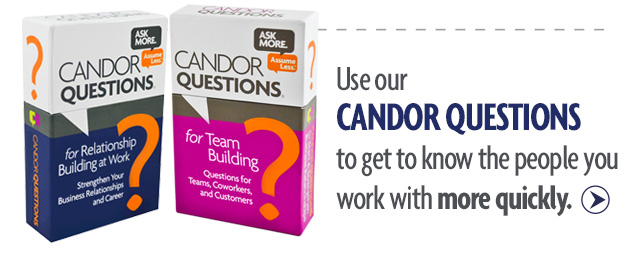
Can your manager answer these questions – that I call Candor Questions – about you? For most people, the answer is no. Most managers don’t ask these questions. And most employees are not comfortable giving this information, especially if the manager hasn’t asked for it.
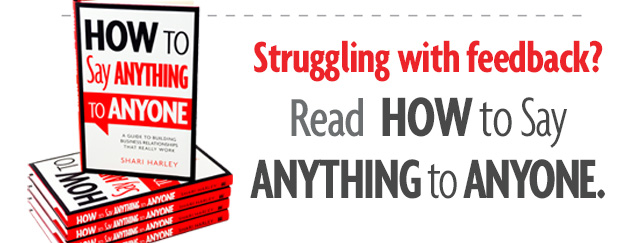
It’s easy to mistake my book, How to Say Anything to Anyone, as a book about giving feedback. It’s not. It takes me nine chapters to get to feedback. The first eight chapters of the book are about how to create relationships in which you can tell the truth without fear. You can read all the feedback books you want and take numerous training classes on coaching, managing people, giving feedback, and managing conflict, and you’ll still be hesitant to speak up, because a formula for giving feedback is not what you’re missing. What’s missing is being given permission and knowing it’s safe to tell the truth.
Managers, here’s how to retain good employees:
Tell your employees, “I appreciate you choosing to work here. I want this to be the best career move you’ve made, and I want to be the best boss you’ve had. I don’t want to have to guess what’s important to you. I’d like to ask you some questions to get to know you and your career goals better. Please tell me anything you’re comfortable saying. And if you’re not comfortable answering a question, just know that I’m interested and I care. And if, at any point, you’re comfortable telling me, I’d like to know.”
Then ask the Candor Questions during job interviews, one-on-one, and team meetings. We’re always learning how to work with people, so continue asking questions throughout your relationships. These conversations are not one-time events.
If you work for someone who isn’t asking you these questions, offer the information. You could say:
“I wanted to tell you why I chose this organization and job, and what keeps me here. I also want to tell you the things I really need to be happy and do my best work. Is it ok if I share?”
Your manager will be caught off guard, but it is likely that they will also be grateful. It’s much easier to manage people when you know what they need and why. Most managers want this information, it just may not occur to them to ask.
If the language above makes you uncomfortable, you can always blame me. You could say:
“I read this blog and the author suggested I tell you what brought me to this organization and what I really need to be happy here and do my best work. She said I’d be easier to manage if you had that information. Is it ok if I share?”
Yes, this might feel a little awkward at first, but the conversation will flow, and both you and your manager will learn a great deal about each other.
The ability to tell the truth starts with asking questions, giving people permission to speak candidly, and listening to the answers.
I had a colleague at my last job, before I started Candid Culture, who was a peer and a friend. We were at a similar level and would periodically sit in one of our offices, with the door closed, talking about the bad decisions our company’s senior leaders made. One day I realized that these conversations were exhausting to me. They were negative and didn’t make me feel better. In fact, they made me feel worse.
Some people assert that venting is cathartic and makes people feel better. It doesn’t.
I’ll use an analogy I read in one of Deepak Chopra’s books. When you put a plant in the closet and don’t give it light or water, it withers and dies. When you put a plant in the sunlight and water it, it grows. And the same is true for people. What you give attention to gets bigger. What you deprive attention goes away.
Your life is made up of the people you spend time with and what you talk about. What are you talking about?
If you’re complaining, unless you’re planning a conversation to address a challenge or problem, you’re venting. And talking about what frustrates you will only make you more frustrated.
My advice: Do something about the things you can impact and let the other stuff go.
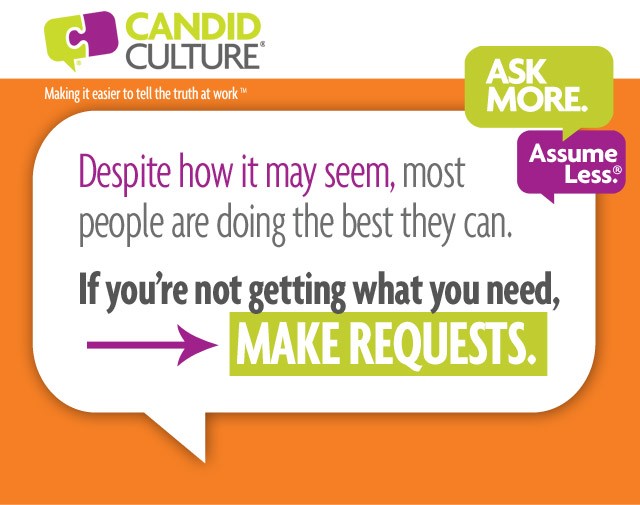
The people you work with want to do a good job. They want you to think highly of them. Yes, even the people you think do little work. Give people the benefit of the doubt. Assume people are doing their best. And when you don’t get what you want, make requests.
There are two ways to give feedback and get your needs met at work. You can give direct feedback, or you can ask for what you want.
Version one – give direct feedback: “You did this thing and here’s why it’s a problem.”
Version two is less direct. Rather than telling the person what went wrong, simply make a request.
Version two – ask versus tell: “Will you…” Or, “It would be helpful to get this report on Mondays instead of Wednesday. Are you able to do that?”
It’s very difficult to give feedback directly without the other person feeling judged. Making a request is much more neutral than giving direct feedback, doesn’t evoke as much defensiveness, and achieves the same result. You still get what you want.
When I teach giving feedback, I often give the example of asking a waitstaff in a restaurant for ketchup. Let’s say your waiter comes to your table to ask how your food is, and your table doesn’t have any ketchup.
Option one: Give direct feedback. “Our table doesn’t have any ketchup.”
Option two: Make a request. “Can we please get some ketchup?”
Both methods achieve the desired result. Option one overtly tells the waiter, “You’re not doing your job.” Option two still tells the waiter he isn’t doing his job, but the method is more subtle and thus is less likely to put him on the defensive.
You are always dealing with people’s egos. And when egos get bruised, defenses rise. When defenses rise, it’s hard to have a productive conversation. People stop listening and start defending themselves. Defending oneself is a normal and natural reaction to negative feedback. It’s a survival instinct.
You’re more likely to get what you want from others when they don’t feel attacked and don’t feel the need to defend themselves. Consider simply asking for what you want, rather than telling people what they’re doing wrong, and see what happens.
I will admit, asking for what you want in a neutral and non-judgmental way when you’re frustrated is very hard to do. The antidote is to anticipate your needs and ask for what you want at the onset of anything new. And when things go awry, wait until you’re not upset to make a request. If you are critical, apologize and promise to do better next time. Communication is all trial and error.
You will be passed over for jobs, projects, and opportunities, and never know why. Being passed over isn’t necessarily a bad thing, not knowing why you were passed over is problematic. If you don’t know why you’re being passed over, how can you be prepared next time?
Organizations are political. People talk. You’ve undoubtedly already experienced this.
If you want to manage your professional reputation, one thing you must know is who talks about you and what they say. How decisions get made in organizations isn’t always obvious. There are the obvious channels of decision making, like your boss and your boss’s boss. But there are also the people who talk to your boss and boss’s boss and have an opinion about you, who you may not be aware of.
Everyone in an organization has people they trust, who they listen to and confide in. Who those trusted people are isn’t always obvious. When you’re being considered for a new position or project, the decision makers will invariably ask others for their opinion. Knowing who does and doesn’t support you in a future role is essential to managing your professional reputation and career.
I don’t want you to be nervous, paranoid, or suspicious at work. I do want you to be savvy, smart, and aware.
It’s not difficult to find out who can impact your professional reputation at work, you just need to ask the people who know. Start with your manager. Your manager likely knows and will tell you, if you ask.
To ensure you know who can impact your professional reputation, tell your manager:
“I really enjoy working here. I enjoy the people, the work and our industry. I’m committed to growing my career with this organization.”
Who in the organization should I have a good relationship with?
Who/what departments should I be working closely with?
Who impacts my professional reputation and the opportunities I have?
What skills do I have that the organization values most?
What contributions have I made that the organization values most?
What mistakes have I made from which I need to recover?
Your manager doesn’t walk around thinking about the answers to these questions. If you want thoughtful answers, set a time to meet with your manager. Tell your manager the purpose of the meeting – to get feedback on your professional reputation so you can adeptly manage your career – and send the questions in advance, giving your manager time to prepare for the meeting. You will get more thoughtful and complete answers if your manager has two weeks to think about the questions and ask others for input.
Don’t be caught off guard by a less-than-stellar professional reputation. Take control of your reputation and career. Ask more. Assume less.
Hire people using whatever legal criteria you like. Compensate employees however you like. Charge for your products and services however you like. Run your business however you like. But be transparent about your practices. People want to work with those they trust. Transparency builds leadership trust.
A few weeks ago, one of our vendors gave me a bill that was higher than what I expected, so I asked for an itemized invoice. I never heard from the company again. Poof: they disappeared. Not a great way to build leadership trust nor a reputation.
Another vendor was very delayed in filling our product orders. When I asked questions about how such a thing could happen, I got a vague answer. “I guess we have communication issues, and you got lost in the shuffle.” It was an insufficient and thus bad answer that didn’t instill confidence in the company. Instead, it created doubt that they could reliably meet our needs, and we’re going to replace them.
One of my friends recently got turned down for an internal job. She was told, “You’re just not the right fit – an unhelpful and yet typical way to decline an internal candidate.
You don’t owe your employees or customers answers, but if you want people to want to work with you, have confidence in you, and trust you, you’ll provide more information than you think you need to.
Employees and customers can handle the truth. And while you may not think you need to provide it, people want to work with those they trust. We trust people who give us the whole truth, or at least more of it than, “I guess you got lost in the shuffle.”
Increase business trust: Be clear and transparent about your pricing.
Increase corporate trust: Tell employees how and why you make the hiring decisions you do. They’ll refer friends to work for you, even when you decline them.
Increase leadership trust: Tell employees how the organization makes money, the feedback you’re getting from prospects and customers, and why you’re making the business decisions you’re making. Employees will feel more connected and thus committed to the organization.
Knowledge makes people feel comfortable. The people who work for and with you want to understand how and why decisions are made. If you want your customers and employees to trust you, give them a little more truth than you might think necessary.
People sometimes leave giving and receiving feedback training confused. Armed with the skills to be candid, they think they have the right to say anything they want. Not the case. Feedback isn’t a weapon or a license to dump your opinion on people. Unsolicited and unwelcome feedback is like fish you left on your countertop for too long. It stinks.
You have the right to ask for and accept the feedback you want from peers and customers and reject the feedback you don’t. Help people know the feedback you want by providing clear parameters on what type of input you do and don’t want. You are not a dumping ground.
Follow these steps to manage the feedback you get from others:
Giving and receiving feedback tip one: Don’t ask for feedback because you think you’re supposed to. There are lots of leadership books and training programs that tell leaders to be open to and ask for others’ input. Only ask for input you want. If you’ve made a decision or don’t want others’ input, don’t ask for it. While you might get more buy in by asking people for their input on decisions that impact them, you’re allowed to decide without forming a committee.
Giving and receiving feedback tip two: When you ask for input, be very specific about the type of input you want. Guide people. Tell them, “I’m specifically looking for input on ____________. I’m not looking for input on ____________.” And if you still receive unwanted feedback, remind people about the input you are and aren’t looking for. In the spirit of being helpful, people can overstep their bounds.
Giving and receiving feedback tip three: Don’t be afraid to shut people down who provide unsolicited feedback. The words, “Thank you for your concern. I’m not looking for input on that at this time” will do the trick. Yes, you really can say that.
Giving and receiving feedback tip four: Don’t take feedback personally. While most people don’t think about it in this way, giving feedback subtly tells you that you’re doing something wrong, or at least not how the other person would do it. There are lots of ways to achieve a result. Their way may or may not be better than yours.
Giving and receiving feedback tip five: Trust yourself. You likely know what you want to do a lot of the time. If you find yourself asking for input when you know what you want to do, stop asking. Listen to your gut and decide.
Feedback has a time and a place. I ask for and listen to a lot of feedback, but not all the time and not about everything. Sometimes, you know best.
If you’ve gotten courageous and given someone negative feedback or questioned a decision or action, you probably didn’t get a shiny, happy reply in return. The normal and natural reaction to negative feedback is to defend ourselves. It’s human. Defending yourself when receiving negative feedback is an act of self-preservation, not unlike hitting your brakes when the person driving in front of you unexpectedly slams on their brakes.
The problem with reacting defensively to negative feedback is that it’s scary and off-putting to others. As normal as a defensive reaction is to negative feedback, it makes others so uncomfortable that they’ll be hesitant to give you negative feedback again. And this lack of knowledge of what others really think is dangerous. Silence inhibits career growth and leads to bad business decisions. You want people to tell you the truth, as they see it, so you need to make it easy to speak freely.
If you want more of what others see as the truth, do the opposite of what people expect. Rather than defending or going silent, say “thank you.” “Thank you for telling me that. I’ll think about what you said and will likely come back to you to discuss further,” buys you time and puts the other person at ease.
Here are five ways to make it easier to say thank you for the feedback:
Only accept feedback when you’re ready to listen. You’re allowed to request a conversation at a time that works for you. Bad days, when you have five minutes between meetings, or are about to leave for a vacation, are not the times to accept negative information. Set up a time to talk, as soon as you have the bandwidth to listen.
Take breaks during hard conversations. You’re allowed to say, “I need a few minutes.” Go get coffee. Take a walk. Go outside. Regain your composure. Then continue the conversation.
Have feedback conversations when you’re rested and have eaten. Everything seems bigger and more difficult when we’re tired or hungry.
Accept that “thank you” isn’t the same as telling the other person they are right or that you agree. “Thank you” is a mere acknowledgment that you heard. It buys you time and gives you a chance to gather your thoughts and respond when you’re not emotional.
Don’t have conversations when you’re upset, and we often don’t know when we’re upset. Your emotions will run the show. Give yourself time to get through your emotional response, and then talk.
People are more hesitant than you think to tell you when they disagree. Make it easy to speak up. Do the opposite of what others expect. Say “thank you” rather than reacting, and you’ll get more data than you do now.
There was way too much guessing at work before most people began working from home. Without visual cues, figuring out how to work with people is even harder. You may find yourself thinking, “I’m going to miss this deadline. I wonder what the consequences will be?” Or perhaps, “They said they wanted input on this project. I wonder if they really meant that, and how much feedback is ok to provide?” Or maybe, “They asked for a proposal. Are they expecting something elaborate, or will a one-pager do?”
We often don’t know what others are expecting from us, so we guess. The problem with guessing is that we may do more work than we actually need to, and not in the way the other person wants it. Even worse, when we don’t work according to others’ expectations, they aren’t likely to tell us. Instead, they tell others and make decisions about us that aren’t positive.
I’m a fan of asking lots and lots of questions, preferably at the beginning of anything new. Anticipate all that can happen, get in front of breakdowns, and set clear expectations by asking questions. The people who participate in virtual and in-person training with me get an entire box of questions to ask. And the homework is to go ask more questions of the people they work most closely with. Asking questions will always be easier than recovering from violated and often unstated expectations.
If you want fewer breakdowns and frustrations at work, ask the following questions of the people you work with:
What do you want to do, on this project, and what do you want me to do?
What does a good job look like?
What will be different in the organization when this project is finished?
How would I frustrate you and not even know it?
How often do you want to receive updates from me?
Do you want to receive all the details or just big picture information?
Do you want to receive the information in bullet form or paragraphs?
It’s never too late to ask questions like these. It’s ideal to ask the question at the beginning of a piece of work. But asking in the middle or even towards the end is fine too. People will appreciate that you asked, whenever you ask.
Last week I had lunch with a friend. When I returned from lunch, I noticed I had something stuck in my teeth. I was embarrassed and wondered why my friend hadn’t told me.
It’s quite possible she hadn’t noticed. But we all know people who notice and say nothing. We could walk around all day with toilet paper on our shoe, lipstick on our teeth, or our fly down, and the people around us won’t tell us.
If you read my blog weekly, you already know that people have been trained not to tell you the truth.
But I think there is more preventing people from telling us the truth. Complete this sentence: “If you have nothing nice to say, _________________________________. Who told you that? Your mother!!!
I do think there’s something to this. We’re raised to believe that it’s not nice to say something to another person that isn’t positive. And in the past, when we did speak up, it’s likely the other person got defensive, so it’s no wonder that we don’t readily give people bad news.
Here are five tips for getting feedback from the people around you:
Establish a core team of people who will always tell you the truth. These can be friends, coworkers, clients, vendors, your boss, etc.
Give people permission, to be honest with you. “Let’s make a deal. I always want you to tell me the truth. If I have something stuck in my teeth, or I’m inappropriately dressed for a meeting, or I’m doing something that damages my reputation, I want you to tell me.”
Make it easy to tell you the truth. “I promise no matter what you tell me and how hard it is to hear, I will say thank you. I won’t get defensive. And if I do, I’ll apologize and try to do better next time.”
Offer to do the same for them. “And if you want me to do the same thing for you, I’m happy to do it.”
Periodically check in with people and ask for feedback. “A few months ago I asked you to tell me anything I said, did, or wore that got in the way of my success. Is there anything you’ve seen that you want to tell me?”
Every time you ask for feedback and take it graciously, you train the person to give you more feedback. On the contrary, every time you get defensive, you make it hard for people to give you feedback, making it likely they won’t do it again.
If you don’t want to walk around looking silly all day, create a safe environment where friends and co-workers can tell the truth.
Companies want people who make things happen, and to make things happen, you have to speak up. Anticipating the train wreck and commenting after the train goes off the tracks, doesn’t count.
What if you said what you thought, in a way other people could hear you, when you had the right to do so? Meaning, you have the relationship with the other person to tell the truth and you’ve asked permission to be candid?
6 Courageous Steps to Advance Your Career:
Look for opportunities to make things better.
Ask for permission to take the ball and run with it.
Find a way to say no, while engaging the other person in a conversation so a new approach is generated.
Be willing to go out on a limb, work hard, and fail.
Here’s how to speak up for change without being labeled as the problem person who finds flaws in everything:
Look for and present solutions, not just problems.
Offer to do the work to move towards a better way of doing things. Don’t drop problems at other people’s doors.
Ask questions versus overtly say that something is wrong. That could sound something like, “I’d love to help. Tell me more about how this works. Maybe we can insert a step to make the process better. What do you think of trying ________?” No one likes to be told they’re wrong. Asking questions elicits participation more than overtly saying, “This is broken. We need to fix it.”
Many people are afraid to speak up at work and believe that people who speak up get fired. I haven’t found this to be the case. People who work hard and produce results are typically the last people to be let go.
Say what you think in a way that is not critical. Offer solutions, not just problems. Be a force for good and take an active role in making things better, and my hunch is your career will accelerate faster than you ever thought possible.



 Then ask the Candor Questions during job interviews, one-on-one, and team meetings. We’re always learning how to work with people, so continue asking questions throughout your relationships. These conversations are not one-time events.