Business Relationships Archive
You will be passed over for jobs, projects, and opportunities – personally and professionally. People will choose not to buy from you and they’ll choose not to be your friend and romantic partner. And that’s ok. Not everyone is our right “customer.” The key isn’t to win every opportunity. Rather, it’s what we do when we don’t get what we want.
When you’re done feeling disappointed, mad, and frustrated, get curious. Find out why you were passed over. I’ll never suggest you make changes. I simply want you to know what’s standing in your way, so you have power – the power to choose. Eliminate your business blind spots.
All of us have blind spots – things we do that are off putting to others, that we’re not aware of. For the most part, people won’t tell us our business blind spots, instead, they simply pass us over. Being rejected is feedback, it’s just not specific enough to help us make different choices. If you want to be able to change your behavior, you need to know what behaviors are standing in your way. Then you can choose what, if anything, to do about those behaviors.
When you get turned town for an opportunity, practice these strategies to eliminate your business blind spots:
- Allow yourself to have an emotional reaction, to feel disappointed and grieve the loss.
- When your emotions dissipate, call people who can tell you why you were turned down, and ask for feedback. The goal of the conversation: Eliminate your business blind spots.
- Be humble and open.
Consider saying something like, “Thank you so much for considering me/us to support your needs. We were disappointed not to win your business. Would you willing to share what had you choose a different provider and what we could have done differently to be a stronger candidate? I’ll be grateful for anything you’re willing to tell me.”
Depending on the circumstances, you could also say something like, “I wasn’t put on the _______ project. I wonder if you have any information as to why? I appreciate anything you’re able to tell me. Your input will help me grow and eliminate by business blind spots.”
- Regardless of what you hear, thank the person for the feedback. You can ask for additional information and ask who else you can talk with, but don’t become defensive. The less defensive you get, the more feedback you’ll get. Make it easy to tell you the truth (as the other person sees it).
Remember, information is power, and power is control. Many people don’t give direct feedback because they’re afraid of the other person’s reaction. Surprise people by being open to feedback, and eliminate your business blind spots.
- Validate feedback that doesn’t feel right to you. If you’re not sure what someone told you is accurate, vet the feedback with other people you trust. Simply ask other people, who are aware of your performance, “I received this feedback. Does that resonate with you?”
- Sit with the feedback for a few days before taking any action.
- When your emotions have passed, decide what, if anything, you want to do with the input you’ve received. Perhaps you want to make changes. Perhaps you don’t. Either way, you have more power than you did before you received any input.
You won’t win them all. The key isn’t avoiding rejection, it’s what you do when you don’t get what you want. Be brave. Be open. Ask for feedback. And you’ll have the power to make different choices next time, if you want to.

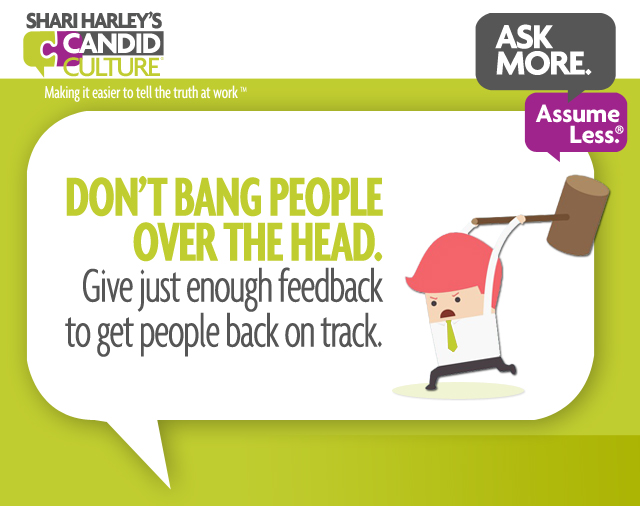 People often hoard feedback until a situation becomes so frustrating that they can’t help but speak up. And because they waited too long to say what they think, many more words come tumbling out than is either necessary or helpful.
When it comes to giving feedback, less is more. Be specific, give an example or two, and stop talking.
If you want people to be receptive to your feedback, make it easier to hear by saying less. By saying less, I don’t mean don’t tell the truth or provide enough information that the person knows precisely what to do differently. I do mean, don’t provide more information than is necessary.
You are likely familiar with the phrase “let someone save face.” Allowing someone to save face requires saying just enough that the person knows what to do differently, but not so much that the person feels attacked.
Here are two examples of giving feedback do’s and don’ts:
Too much feedback: Last week you turned in a report that had five typos and had important pieces of information missing. I’m surprised you’d be so careless. It made our entire department look bad. I’m perplexed that you’d submit work without checking it first. What is leading you not to check your work and submit incomplete reports?
Don’t repeat feedback. Say it once and move on. And remove unnecessary judgments (careless) and share just the facts.
Just the right amount of feedback: The report you gave me last week had a few typos and was missing some important information. The report went to the client with those errors which didn’t reflect well on our department. What happened?
Too much feedback: I noticed you didn’t speak up during last week’s department meeting. People won’t know the value you provide if you don’t share what you’re working on. You need to be more vocal. People’s only exposure to you is often during our team meetings. If you don’t speak up, you won’t establish yourself as a leader in your department. People really need to know what you’re working on and the impact you’re making.
Too much feedback sounds like nagging. Most people don’t want to work with their parents.
Just the right amount of feedback: I noticed you didn’t speak during last week’s department meeting. Often, team members’ only exposure to you is during our weekly meetings. How can I help you feel comfortable speaking up so you can establish yourself as a leader in the department?
It’s easy to get carried away when giving feedback. We’re likely frustrated. And when our emotions run the show, it’s easy to say too much.
Here are three practices for giving feedback:
- Practice the 24-hour guideline and the one-week-rule. If you’re upset, wait 24-hours to give feedback, but not longer than a week after an event.
- Plan what you’re going to say both in writing and out loud. Practicing a conversation in your head is not the same as speaking it.
- Let someone you trust hear what you’re planning to say and ask that person how you can improve the feedback. Ask what you can remove without losing any of the message.
Planning a conversation is like packing for a trip. When packing for a trip, many people put their clothes on the bed, then put the clothing in a suitcase. Realizing they have way more than they need, they start taking things out of the suitcase. Eventually they arrive at their destination with much less than they initially packed, but still more than they need.
Use the same principles when planning a feedback conversation. Put every thought you have on paper, and then remove what you don’t need, leaving only the necessary points that tell the person just what he needs to do differently.
When giving feedback, less is more. Tell the person what happened, why it’s a problem, and what she needs to do differently. Then stop talking and let her save face.
Stuff happens. People won’t give you what you need to complete projects. Things will break. And you will look bad. When breakdowns happen, I always ask myself, “What could I have done to prevent this situation?” or “What did I do to help create this situation?”
It may sound odd that I always look at myself when breakdowns occur, even when it’s someone else who didn’t do her job, but it’s just easier. I can’t control anyone else. But I can control me (admittedly, some days I do a better job at this than others). When I can identify something I could have done to make a situation go differently, I feel more in control – aka better.
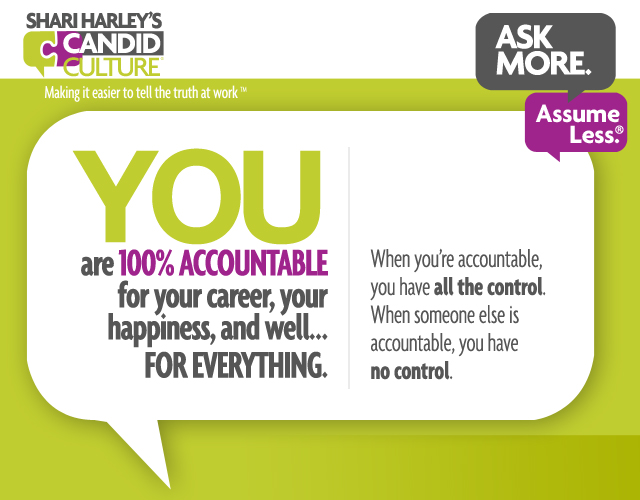
It’s like getting off a highway with bumper-to-bumper traffic. Your alternate route may take longer, but at least you’re moving. You feel like you’re doing something and thus have more control. Taking responsibility for everything that happens to you is similar. When you’re accountable, you can do something to improve your situation. When someone else is accountable, you’re at the mercy of other people and have very little control.
There are, of course, exceptions to the practice that “we’re always accountable.” Terrible acts of violence, crime, and illness happen to people, about which they have no control. But in general, in our day-to-day lives, there is typically something we did to contribute to a bad situation or something we can do to improve it.
Here are four practices for improving difficult situations, even when you didn’t create the mess (alone).
1) Increasing accountability in the workplace: Ask more questions. If you’re not clear about what someone is expecting from you, ask. You’re responsible for doing good work, regardless of the type of direction you receive.
2) Increasing accountability in the workplace: Tell people what you think they’re expecting and what you’re planning to do, to ensure everyone’s expectations are aligned. Clarifying expectations beats doing weeks’ worth of work, only to discover what you created isn’t what someone else had it mind.
3) Increasing accountability in the workplace: Ask for specific feedback as projects progress. Don’t wait until the end of a project to find out how you performed.
4) Increasing accountability in the workplace: Say “thank you” to whatever feedback you receive versus defending yourself. People will be pleasantly surprised and their upset will dissipate more quickly. That could sound like, “That’s good feedback. I’m sorry that was your experience. Thank you for telling me.”
5) Increasing accountability in the workplace: Admit when you make a mistake or when you wish you had done something differently. Don’t wait for someone to tell you. Saying, “I’m sorry. How can I make this right with you?” goes a long way.
I am always asking these questions:
“What could I have done differently?”
“What did I do to contribute to this situation?”
“What can I do now to make this situation better?”
And I encourage you to do the same, even when someone else drops the ball. You can’t control others, but you can control you. And your happiness and success is your responsibility.

Now is when people set New Year’s goals. Our goal at Candid Culture is to help you have a year filled with the people and things you enjoy most. Here are 12 of our best tips for creating the best year yet.

Goals for the New Year #1: Do what feels good.
How many ‘friends’ do you have that after you spend time with them, you actually feel worse? How often do you eat food you know you’ll regret later? Or procrastinate on a project that leads to late nights and lots of stress? If you know something doesn’t make you feel good, stop doing it. If you know someone makes you feel worse, stop spending time with that person.
Goals for the New Year #2: Pick your battles.
There are a lot of things you could legitimately get upset about. Wait to get annoyed. Time brings clarity. Chances are that what’s upsetting today, won’t be nearly as frustrating tomorrow.
Goals for the New Year #3: Help someone else be successful.
Make time to be available for your friends, coworkers, and family, and help them get what they want. The world is better when we focus on someone other than ourselves.
Goals for the New Year #4: Ask for more. Do something that scares you.
It’s so easy to play it safe. But safe is not where the juice is. I’m not suggesting you invest your life savings in risky investments or quit your job before having another one. I am suggesting you try something you’re not sure you can do and say yes, when you’re filled with fear.
Goals for the New Year #5: Avoid drama. Reduce the gossip.
Drama is just a way to say that you need attention. And we all need attention. Just tell the people in your life you need a little love, don’t be shy about it.
Gossip is inherently negative. Avoid people who are always complaining. Spending time with them is exhausting.
Goals for the New Year #6: Wear clothes that make you feel fantastic.
We always feel better when we look good. Take the time to look good. And then periodically lie around your house in clothing that should never see the light of day. And order a pizza, or two.
Goals for the New Year #7: Sleep more. Take time off.
Everything is bigger and feels worse when we’re tired. We get more done, are more patient, and feel better about everything when we’ve had enough sleep.
This ‘thing’ in our country that it looks bad to take time off and someone can’t possibly take all of their vacation time is, forgive me for being so direct, the most stupid thing I have ever heard. People aren’t judging you for taking a vacation. And if they are, then the company shouldn’t have given you the time off in the first place. Get a passport and use it!
Goals for the New Year #8: Do one thing at a time.
Multitasking is bunk. It doesn’t exist, unless you’re driving and talking on the phone, or washing dishes and talking on the phone. Working on a project, while intermittently checking and responding to emails is why you can’t take a vacation.
Goals for the New Year #9: Ask people’s expectations. Don’t assume.
Other people don’t necessarily need, want, or expect what you do. If you’re killing yourself to do something in the way you think someone else wants, perhaps ask what the other person is expecting, and give yourself a break.
Goals for the New Year #10: Ask for feedback. Wait 24-hours before responding.
Be courageous. Ask for feedback (when you’re in a good mood and have had a full night’s sleep), and wait to respond. We’ll say crazy stuff, that we’ll surely regret later, when we’re upset.
Goals for the New Year #11: Give people the benefit of the doubt.
It’s so easy to judge, make assumptions, and jump to conclusions. It’s so much harder and more time consuming to suspend doubt, inquire, and decide later. Many careers and relationships have been damaged by assuming first and asking later, if at all.
Goals for the New Year #12: Know that you’re a rock star. Don’t let anyone tell you differently.
If you don’t think you’re great – at something –none of the nice things anyone else tells you will matter. Fill your own bucket.
Add a comment to the blog about which of the 12 practices you aim to do regularly, and we’ll enter your company into a drawing for a $1000 off your next training with us, because what makes me feel good, is working with you.
Happy New Year! Wishing you a year like no other.
Chances are, at some point in your career, you’ve worked with someone you wished would go away. Maybe the person repeatedly threw you under the bus, took credit for your work, or didn’t keep his commitments. And at some point, you wrote the person off, and have been merely tolerating him ever since.
Damaged relationships can be repaired, if you’re willing to do some work.
The first step in repairing a damaged relationship is to decide that you really want to do so. Managing conflict in the workplace isn’t easy. It will take effort and will likely be uncomfortable. So before you take action, decide if you really want to work on the relationship.
How to know if you should even try resolving conflict in the workplace: Ask yourself how much you need the relationship. This probably sounds political, and it is. If you work on projects together, need to give or receive information, or have to work together regularly, then it’s likely worth working on the relationship. If you don’t need to work together regularly, then perhaps don’t work on the relationship.
If you decide to attempt to strengthen a relationship, plan what you’re going to say. Never trust the first thing that comes out of your mouth during a difficult conversation.

Step one for resolving conflict in the workplace: Like any feedback conversation, start with the end in mind. Consider what you want to have happen as a result of the conversation.
Step two for resolving conflict in the workplace: Plan what you’re going to say by taking notes and practicing out loud. What you say in your head is usually not what comes out of your mouth.
Step three for resolving conflict in the workplace: Ask the person for time on his calendar. People don’t like surprises. You’ll have a better outcome if the person has blocked time to talk with you. Have the conversation in-person whenever possible. If you can’t speak in-person, talk on the phone. Do not attempt to fix your relationship via email. 1. Email is wimpy. 2. It will not work.
Tell the person, “Our relationship is strained. I don’t think I’m saying anything we’re not both aware of. I’d really like a good working relationship. Would you be willing to have coffee or lunch with me, and we can talk about what has happened and perhaps start in a new way?”
Step four for resolving conflict in the workplace: Ask for a meeting to work on the relationship up to three times. If, after the third time, the person hasn’t made time, stop asking. You can’t work with someone who won’t work with you. If the person doesn’t make time to meet, be polite, professional, and inclusive, but stop trying to nurture the relationship. Inclusive means: cc’ing him on necessary emails, inviting him to appropriate meetings, and providing necessary data.
Step five for resolving conflict in the workplace: If the person makes time to meet, speak candidly, be yourself, and be vulnerable. I don’t mean set yourself up to be killed. I do mean be authentic.
How to Manage Difficult Conversations:
- Tell the person what you want.
- Ask for feedback about how you’ve damaged the relationship.
- Listen to what you hear, and resist the urge to defend yourself.
- Ask for permission to tell him how he’s damaged the relationship.
- Give small amounts of feedback, with a few specific examples.
- Make agreements of what each of you will do differently in the future.
- Thank the person for the conversation and schedule another meeting.
Step six for resolving conflict in the workplace: Build in follow-up. Most people have one conversation and expect things to be fixed, forever. Relationships don’t work that way. Agree to meet monthly, for the first few months, until you’ve rebuilt trust and learned how to communicate and work together. During the monthly meetings, give each other permission to give candid feedback about how you’re working together. I call these Relationship Inventory Meetings™.
During monthly Relationship Inventory Meetings™ ask:
- What’s working about how we work together?
- What’s not working?
- What working agreements did we keep?
- What working agreements did we break?
- Which working agreements are helpful?
- What working agreements need to change?
You might be thinking, “I don’t like this person. I don’t want to work with him. And I definitely don’t want to have these uncomfortable conversations.”
- If the nature of your relationship is impacting your ability to do your job, your professional reputation, or your happiness, all of those consequences are far worse and more long-lasting than any conversation will be.
- The conversations won’t be as bad as you think. No one will tell you anything you can’t handle, because for the most part, they’re afraid of your reaction and they know they’ll be next.
Conflict in the workplace and damaged relationships keep people up at night, reduce job satisfaction, and often motivate people to leave jobs. If you’re experiencing any of these things, all of them are worse than any conversation will be. The anticipation of the conversation is far worse than the conversation itself.
- Decide if you want to strengthen the relationship.
- Plan the conversation.
- Ask for time to meet.
- Have the conversation. Speak honestly, but responsibly.
- Plan to have another conversation before ending this conversation.
- Congratulate yourself for being courageous and picking happiness over anxiety and frustration. Suffering is optional.

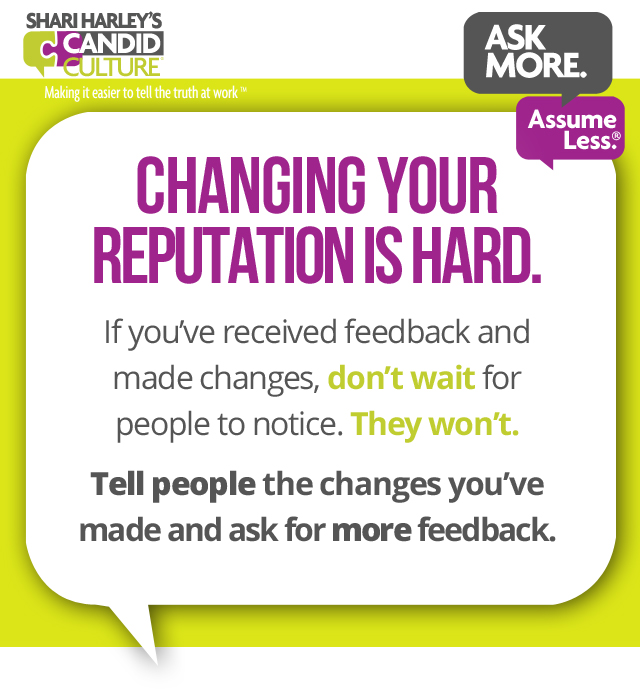
Changing a damaged reputation is challenging. My number one piece of advice: Be very overt about the changes you’re making.
Here are eight steps to discover and repair your professional reputation:
Step one to repair your professional reputation: Make a list of people who observe your performance and who can impact your career. If you’re not sure who these people are, ask your boss and peers. They know.
Step two to repair your professional reputation: Ask for specific, candid feedback at least twice a year, and tell people why you’re asking for the information.
Asking, “How am I doing?” is not specific. Instead, say something like, “I want to learn more about my reputation in the office and want to eliminate my blind spots. I’d be grateful for any input you can provide on my reputation and what people say about me when I’m not there.” Then schedule a specific time in the near future to discuss the feedback, so you don’t catch people off guard. You’ll get better feedback when people have had a chance to observe your behavior and think about what they’d like to say.
Step three to repair your professional reputation: Listen to the feedback and no matter how hard the feedback is to hear, say, “Thank you for telling me that.” Don’t defend yourself. Instead, leave the conversation, think about what the person has said, and then go back to him a few days later with questions, if you need to.
Step four to repair your professional reputation: If the feedback you receive doesn’t feel accurate, tell others who you trust about the feedback and ask them to provide input.
Step five to repair your professional reputation: Sit with the feedback before taking action. Let yourself be emotional. You might feel angry, sad, or betrayed. All of those are normal responses to feedback.
Step six to repair your professional reputation: Take action. Make changes that feedback providers suggested.
Step seven to repair your professional reputation: Tell people who provided input and who are impacted by your behavior about the changes you’ve made. You could say, “I recently received feedback that I’m not careful enough and that my work often has errors. I’m really working on this. Will you pay attention to the accuracy of what you receive from me and let me know if you see changes? I’d really appreciate your input.”
Step seven is very important and something people rarely do. Don’t assume people will notice the changes you’ve made. Instead, assume they won’t. Without being told what to look for, the decisions people have already made about you will supersede changes you’ve made. It takes a lot of effort to see people differently. Validating what we already know and think about someone is much easier and more likely than noticing changes.
Step eight to repair your professional reputation: Continue to ask for feedback. Receiving feedback is not a one-time-event. It’s an ongoing process. Don’t ask for feedback weekly, rather check in once a quarter, tell people the changes you’ve made, and ask for specific input.
You can change your reputation, if you want to. Doing so will require courage, openness, and effort on your part. Work on one or two things at a time, not ten. And then reward yourself for the changes you’ve made with a pint of Ben & Jerry’s, because too often we’re hard on ourselves and forget to celebrate wins.

Most employees are afraid of getting fired. As a result, employees are often afraid of the most senior people in organizations, simply because of their titles. The better the title, the scarier people are. And if employees are scared of organizational leaders, they’re not going to be 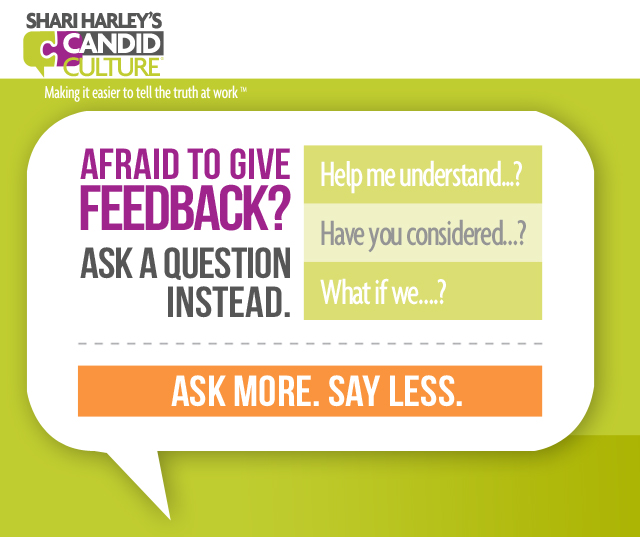 inclined to give those leaders negative feedback. The most senior people in an organization get the least information of anyone.
No one likes to be told that he is wrong. Negative feedback tells the person he did something wrong. But there is more than one way to give feedback. Asking questions can be equally as effective as giving direct feedback.
If you want to give a senior person negative feedback, but you’re afraid of the consequences, manage up by asking more and saying less..
Here are some ways to manage up by asking questions:
Rather than saying, “I disagree, I think you’re wrong, or this is a mistake,” consider managing up by asking questions like:
- We’ve chosen to invest a lot in this software. I wasn’t here when the software was chosen. What’s the history of this initiative?
- What were the criteria for selection?
- How do you think it’s going?
- What are you concerned about?
- What are you satisfied with?
- What else have we tried?
- What are your thoughts about…?
- What if we tried…?
Asking questions gets the person involved in a discussion, during which you can eventually express your point of view. When you ask questions, you say very little, and definitely don’t call the person’s decision-making into question.
Human beings are wired for survival. Receiving negative feedback kicks the need to defend oneself into gear, hence why people become defensive when they receive negative feedback. Negative feedback calls survival into question. If you don’t want people to become defensive, don’t require them to defend themselves. A discussion, during which you ask questions, is much less threatening than overtly disagreeing with someone’s point of view.
Asking questions takes more time and more patience than giving direct feedback. But it also takes less courage, and the quality of your relationship doesn’t have to be as good. You need a pretty good relationship to give direct feedback. If you don’t have that relationship, manage up by asking questions instead of being so direct.
If you do choose to ask questions, watch your tone. If you can safely add the words “you dummy” to a question, you aren’t really asking a question, you’re giving feedback, which is likely to evoke the defensive response you’re seeking to avoid.
It’s important to be able to express your point-of-view at work. Staying in a job or organization in which you can’t speak up, doesn’t feel great and doesn’t leverage the best of what you have to offer. But if you’re concerned about giving direct feedback, manage up by asking questions. Say less. Ask more.

Keeping with the theme of happiness and well-being during this holiday season, I’m hoping you’ll steer clear of the people and things that don’t make you feel good.
If you have a friend who talks only about herself, even after you’ve repeatedly given her this feedback, perhaps stop hanging out with her.
If you have a habit that you know isn’t in your best interest, perhaps break it.
The suggestions above are hard to do, but even harder is navigating relationships with people you can’t avoid. These are the people who when they show up on your caller ID, you often think, “not today,” and let the call go to voicemail.
Here are eight techniques for managing challenging relationships and conflict resolution in the workplace:
Conflict Resolution in the Workplace Technique #1: Know that there are difficult people in every organization. You can leave your job to get away from the person who makes you crazy. But I promise you, he will be waiting for you at the next organization in a different body.
Conflict Resolution in the Workplace Technique #2: Don’t ignore challenging relationships and expect things to get better without your intervention. They won’t. Deal with strained relationships head on.
Conflict Resolution in the Workplace Technique #3: Work on relationships in person or over the phone, not via email.
Conflict Resolution in the Workplace Technique #4: The time to fix a relationship is when there’s nothing wrong. Have hard conversations when things in your relationship are calm and you’re not upset, otherwise the conversations are likely to quickly escalate.
Conflict Resolution in the Workplace Technique #5: Give people the benefit of the doubt. People are doing the best they can. If people knew another way to do something, they would do it that way.
Conflict Resolution in the Workplace Technique #6: Let the other person save face. The more critical we are, the more the other person will feel compelled to defend himself. It’s almost impossible to have a useful conversation with someone who is in defense mode.
Conflict Resolution in the Workplace Technique #7: Ask for what you want. Rather than telling people everything they do wrong, make requests. That could sound something like, “Would you be willing to talk with me directly when my team is frustrating your team? I’ll do everything I can to make things right.” Or, “If you need something from me that you’re not getting, will you give me a call? I’d rather hear about challenges directly from you than from someone else.”
Conflict Resolution in the Workplace Technique #8: Be vulnerable. If you want a better relationship with someone, tell her. If a relationship is strained or broken, chances are, the other person knows. You could say something like, “I think we both know this relationship is strained. I want you to know that I’d really like a good working relationship with you. If you’d like to get together for lunch or coffee and talk about what has gone on, I’d really like that. Perhaps we can start in a new way.”
If you don’t want to be that direct, perhaps considering saying something like, “I just want you to know that I really want a good working relationship with you. What can I do to ensure you and your department get what you need from me? What’s one change I can make that would make the biggest difference for you?”
Damaged and strained relationships won’t get better without your intervention. Ask for what you want. Be positive, be yourself, and be honest. And if the person doesn’t play ball with you, you’ll know that you’ve done what you can.

Just because you can say something, doesn’t mean you should.
There can be too much candor and feedback.
A few guidelines to consider before giving feedback:
- Ask yourself, was the feedback solicited? Unsolicited feedback rarely goes over well.
- Assess if you have the relationship to give feedback. I’m offered all sorts of feedback from people I don’t even know. People I don’t know haven’t earned the right to give me feedback.
- Determine if you’re trying to strengthen the person or the relationship. If you aren’t trying to help someone improve, AND the feedback isn’t requested, AND you don’t have the rapport to give feedback, say nothing.
Feedback recipients don’t have to accept unsolicited input or advice. It’s perfectly acceptable to put limits and boundaries on the input you’re open to from peers, friends and family.
Here are two tips for how to handle negative feedback:
How to handle negative feedback tip one:
When you ask for feedback, be very specific about what type of feedback you want.
For example, you could say something like, “We’re picking a new software application to track leads. I’ve already narrowed the choice down to three vendors and vetted what each software application can and can’t do. I want to know about things I may not be aware of, like software that’s being phased out and won’t be supported and potential bankruptcies.”
There’s nothing wrong with asking for targeted feedback. Simply tell people what kind of feedback you want and why. And avoid asking open ended questions like, “What do you think?” If you ask a broad question, you’ll likely get a broad answer.
How to handle negative feedback tip two:
Tell people if you aren’t looking for feedback.
For example, you could say something like, “Thank you so much for your concern. I really appreciate it. I’m actually not looking for feedback at this time. But I really appreciate your concern.”
There’s NOTHING wrong with setting limits and boundaries about what kind of input you’re seeking. And when you do set those limits, intrusive people will think twice before offering unsolicited advice in the future.

Most people would rather get a root canal than participate in an annual employee performance appraisal.
The reasons employee performance appraisals are so difficult is simple:
- Many managers don’t deliver timely and balanced feedback throughout the year.
- Many employees don’t ask for regular feedback.
- Too much information is delivered during the annual employee performance appraisal.
- And as crazy as it sounds, managers and employees haven’t agreed to give and receive regular and candid feedback.
Employee performance appraisals don’t have to be the worst day of the year.
Here are four steps to ensure employee performance appraisals are useful and positive:
- Managers and employees must agree to give and receive balanced, candid feedback. Don’t assume the agreement to speak honestly is implicit, make it explicit.
- Managers, be honest and courageous. Don’t rate an employee a five who is really a three. You don’t do anyone any favors. Employees want to know how they’re really doing, no matter how much the feedback may sting.
- Managers, focus on three things the employee did well and three things to do more of next year. Any more input is overwhelming.
- Managers, schedule a second conversation a week after the employee performance appraisal, so employees can think about and process what you’ve said and discuss further, if necessary.
The key to being able to speak candidly during an employee performance appraisal is as simple as agreeing that you will do so and then being receptive to whatever is said. And don’t make feedback conversations a one-time event. If you do a rigorous workout after not exercising for a long time, you often can’t move the next day. Feedback conversations aren’t any different. They require practice for both the manager and employee to be comfortable.