Last week I had lunch with people I worked with twenty-three years ago. Twenty-three years. I have long forgotten the projects we worked on, the deadlines, and deliverables that were important at the time. What I do remember, are Jim and Siobhan. Some of my closest friends and the people most important to me in the world, are the people I’ve worked with.
It makes sense that we make friends at work; it’s where we spend a lot of time. And the people we work with make work fun or miserable.
Building relationships and making friends at work are a couple of reasons virtual and hybrid work may feel challenging. How do you build relationships with people you rarely or never see?
I’ve never met Sarah who lives in California and codes our website, or David who hosts our website, or Jessica, our attorney in Boston. I rarely see Dana or Diana, who work for Candid Culture. But I feel connected to them, nevertheless. We email, text, and meet via phone.
There is a considerable amount of research citing the connection between having good business relationships and employee engagement, retention, and performance. When we feel we belong and have good relationships at work, we are happier and do better work. It makes perfect sense.
As I’m writing this, I’m thinking about my coworkers who I traveled with for weeks on end, who endured a CEO who made us practice and re-write presentations until 1:00 am for a meeting the next morning, and the coworkers I worked with at the World Trade Center. As much as I appreciated and cared about the people I worked with, I’m not sure how often I told them that they made my work world better.
Valentine’s Day is a day we express appreciation for the people closest to us. Don’t limit your appreciation to your loved ones at home; include your coworkers who make your work fun and who help you get things done. Of course, I hope you’ll express appreciation more than once a year, but Valentine’s Day is an occasion not to miss.
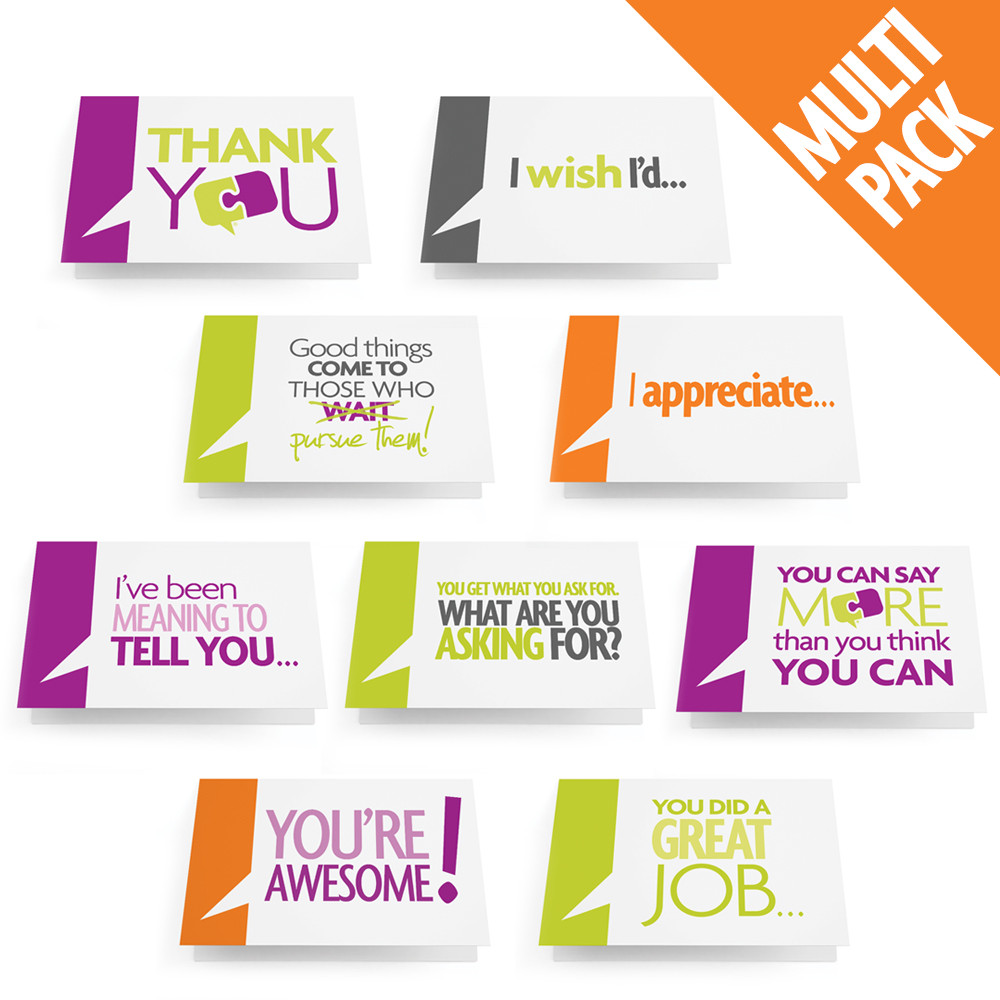
Write the people you work with, who matter most to you, a handwritten note that they’ll keep for a long, long time. You can see our assortment of greeting cards for the workplace HERE. I’ll admit that I collect stationery and love giving and receiving handwritten notes. I suspect the people you work with will appreciate receiving a handwritten note too.
Many people worry about giving feedback because they’re concerned, they don’t have the ‘right’ words. They’re concerned they’ll say ‘it’ wrong and damage their relationships.
Feedback is hard enough to give without worrying about saying everything perfectly. Worry less about having all the right words and more about whether or not people trust your motives.
When people trust your motives – why you’re giving feedback – you can say almost anything. When they don’t trust your motives, you can say almost nothing.
Getting negative feedback is hard. It’s easier to listen to feedback when we trust the person who’s giving us the feedback – we know their intentions are to help versus to judge or hurt us.
Speak from the heart, be authentic, and worry less. Be yourself. If you’re nervous to say what you want to say, tell the other person you’re nervous. If you’re struggling to find the right words, say so. If you’re worried you’ll damage the relationship or that it isn’t your role to give the feedback, say that. Authenticity goes a long way.
Hear are some examples of how to start a feedback conversation:
How to give feedback phrase one: Consider saying, “There’s something I need to talk with you about, but I’m concerned that I won’t use the right words and will damage our relationship.”
How to give feedback phrase two: “There’s something I want to talk with you about, but I’m concerned how it will come across. Is it ok if I say what I need to say?”
How to give feedback phrase three: “I want to give you my thoughts on something, but I’m concerned that it’s not my place to do so. Is it ok if I share my ideas about _________?”
Other people aren’t expecting you to be perfect. But they do want to know they’re working with a human being. And human beings are fallible. We have fears. We make mistakes. And sometimes we don’t say things perfectly.
You don’t have to be perfect; you just have to be real.
You open an email (or a few hundred) telling yourself you’ll reply later, but never do. Feeling ambitious, you agree to a deadline you can’t meet. Needing a break, you take a few days off but don’t put an out-of-office message on your email.
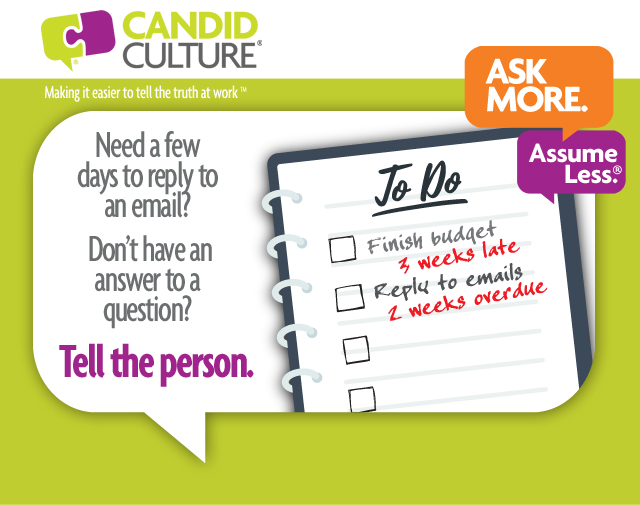
We’ve all taken too long to reply to an email, missed a deadline, or simply taken too long to provide someone with information. It’s ok to take time to respond, not to have all the answers, and take time off. We simply need to provide timely and accurate status updates.
When people don’t hear back from us in what they consider a timely way, they start to wonder (at best), and judge us (worse), or tell others we’re non-responsive and unreliable (worst). Don’t make people wonder if you received their message, send a timely status update and tell the truth.
If you’re behind and need more time than usual to respond to emails, tell people that. Respond to emails within 24-hours and tell senders you received their message and it will be (fill in the blank) before they hear back from you. When you get an email that requires research, respond within 24-hours and tell the person how long it will take to find the information. If you’re out of the office and don’t plan to read or respond to emails, tell people the dates you’re out.
In the absence of knowledge people make stuff up, and it’s never good. Filling in the blanks isn’t malicious. People simply have a need to know what’s happening. And when they don’t know, they invent stuff. It’s how the brain works. When we don’t hear back from people in what we consider a timely way, we start to wonder. “Did they get my message? Why aren’t they responding? What’s wrong?”
It’s ok to need time to respond. It’s ok to be running behind. It’s ok to take time off. Simply let people know the true status. Manage your reputation and business relationships. Don’t make people guess.
Last week one of my friends was concerned about something happening at her son’s school. She wrote out what she planned to say to the school principal and sent it to me to read. Her letter was long, with lots of unnecessary details. I read five paragraphs before understanding what the situation was even about. I revised her letter. My version was three sentences and easy to write. Why? Because it’s not my child and not my situation.
One of the things that makes giving feedback and making requests particularly difficult, is our emotional involvement. We’re invested in the outcome. The stakes feel high. And that emotion makes everything harder.
If you’re struggling with a message you need to deliver, get some help. The person who helps you craft a succinct, specific, and unemotional message doesn’t have to be a feedback expert or a manager. The person just can’t be involved. As long as the person isn’t emotionally involved, they’ll be helpful.
When you ask for help, don’t ask for advice. Instead of asking a friend or colleague, “What would you do in this situation,” ask, “What would you say?” These are very different questions. You want the specific words to resolve whatever you’re struggling with.
Asking someone for help planning a challenging conversation or message begs the question, isn’t asking for that type of help a form of gossip? It could be. So be careful who you ask.
When asking for help planning a message or conversation, ask someone in your organization who is at your same level or above (title-wise) or ask someone outside of the organization. Change the names of the people involved; protect people’s anonymity. And be clear if you are asking for help to plan a conversation or if you are venting. They are not the same.
The most effective feedback and requests are unemotional, factual, and succinct. Sometimes we need other people who are not involved to help us get there.
A professional athlete would never get on the court or field without knowing exactly what will score them points and penalties. But many of us go to work every day without knowing how we’re being evaluated.
If you’ve ever had a performance review or received feedback that caught you off guard or have completed a project and were told your work wasn’t quite what was expected, you didn’t have enough information upfront. Don’t wait for people to tell you what they need and expect (which often happens after breakdowns occur), set clear expectations at the beginning of anything new and ask for feedback as you make progress.
The people you work for and with should tell you what they expect. They should give you feedback along the way. And many won’t. Your career management is in your hands, and that’s a very good thing.
When you start a new job, project, or any responsibility ask the person delegating the work some of these questions:
Career Management Question one: What does a good job look like?
Career Management Question two: What’s the criteria for success?
Career Management Question three: How will you know you picked the right person for the job?
Career Management Question four: Why is this project a priority right now? How will it impact the organization?
Career Management Question five: What kind of updates would you like? In what format, how frequently, and with what level of detail?
Career Management Question six: How often do you want to review my work?
Career Management Question seven: Who in the organization should I work with on this project?
Career Management Question eight: What history, pitfalls, or landmines do I need to be aware of? Has anyone tried to do this before, and if yes, with what outcomes? Who in the organization supports this project? Who doesn’t?
If you’ve been in your job for a long time or have been working on a project for a while, it’s not too late to ask these questions. Simply approach the person with whom you’re working and say, “I want to be sure I’m doing great work on _____________ project. Can I ask you a couple of questions about the desired end results and how we should be communicating as I make progress?”
Lots of people aren’t the best delegators. They give us a project, ask if we have any questions, and provide a due date. Don’t fall into the trap of completing an entire project and then asking for feedback. Even if the person delegating the work doesn’t want to see your progress, ask for that feedback. Schedule weekly or monthly review meetings, present the work you’ve done, and ask for feedback. If you get to the end of a project or responsibility and are surprised by the reaction, you didn’t ask enough questions at the beginning and middle of the project.
People will tell you everything you need to do a good job, if you ask. Take control of your career. Ask more. Assume less.
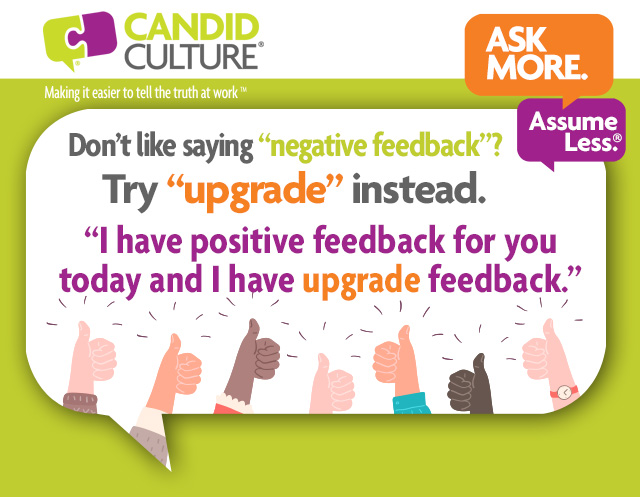
People don’t like the phrase “negative feedback” because it is, well, negative. So, someone came up with “constructive feedback”, i.e., “I have some constructive feedback for you.” I don’t particularly like that either. The definition of constructive is useful, and I think all feedback should be useful. I like the word “upgrade” instead. Upgrade implies the need for improvement, but it isn’t negative. The question is, which comes first, positive or upgrade feedback?
I always give positive feedback first. Not to make people feel better, but to ensure they hear the positive feedback. Most people want to be perfect. We want others to think well of us. Negative feedback calls our perfection into question and thus is hard to hear. When people get negative feedback, they naturally become defensive. It’s hard to listen when you’re defending yourself. If positive feedback comes after negative feedback, the positive feedback isn’t even heard. The negative feedback is all consuming.
When giving feedback, I tell people, “I have positive and upgrade feedback for you today. I’m going to give you the positive feedback first.” I give positive feedback, then I give upgrade feedback, and then I remind the person about the positive feedback, because I know the person is now consumed thinking about the negative feedback.
Think about yourself. If you receive seven pieces of positive feedback and one piece of upgrade feedback, what do you think about for the rest of the day? If you’re like most people, the rest of your day is about the upgrade feedback. We want to do good work and be thought well of, and negative feedback calls all of that into question and is thus, hard to hear.
Give positive feedback first, then give upgrade feedback, then remind the person about the positive feedback. People can handle feedback when it’s delivered by a trusted person in an objective way.
Most of us wait too long to give feedback. We worry, the conversation will take too long. The recipient will get upset and not want to work with us. Or we’ll get in trouble for giving feedback. So, we wait for the right moment, or performance appraisals, when the conversation becomes unavoidable.
Those of you who have had feedback training with me know you can deliver effective feedback in two minutes. Some of you have practiced giving feedback in 40 seconds.
We all know that exercising for 30-minutes a day is better than exercising once a week for two hours. Recency and frequency works with exercise and feedback. Shorter is better. Rather than waiting for the right time to give feedback, which will never come, create a structure to make feedback quicker, more timely, and as a result, easier.
Feedback is like your car’s GPS; it’s designed to help people achieve goals efficiently. If your GPS waited six weeks or six months to give you feedback, where would you and your car be? Peru?
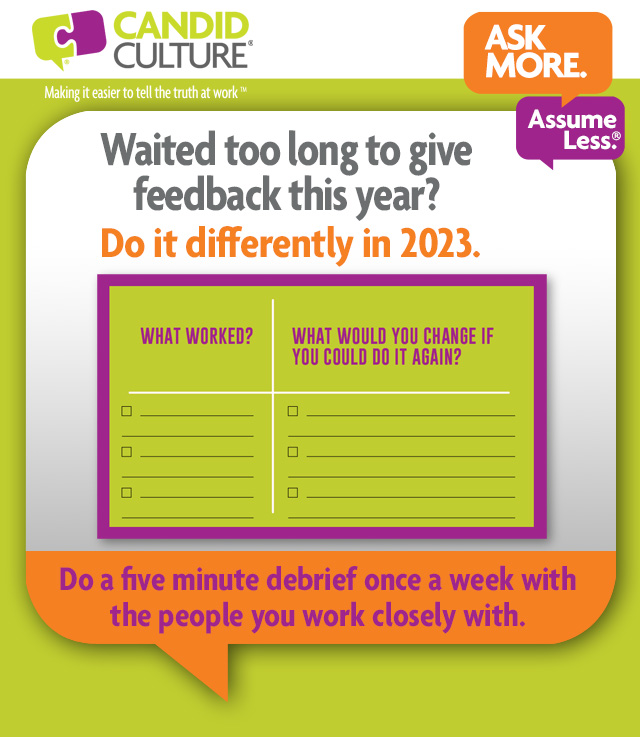
Next year, do it differently. Create a structure now for 2023. Agree to give feedback weekly for five or ten minutes. Talk about what worked and what didn’t work in the past week. If you can discipline yourself to spend five minutes giving feedback as work is completed, feedback conversation will be more useful, less painful, and easier.
Posted under Managing People on November 28, 2022 by Shari Harley. 1 Comments
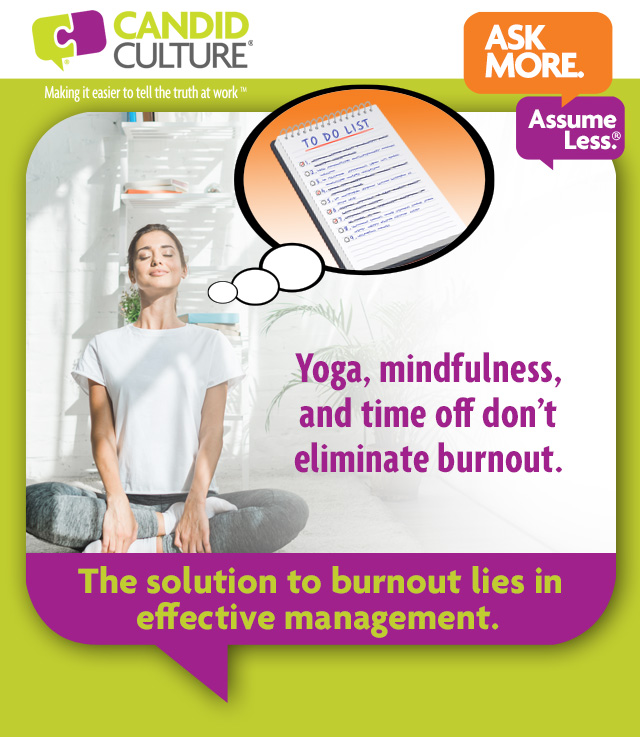
Yoga, wellness programs, and mindfulness will not prevent or eliminate burnout. Burnout is an organizational issue. If you want to prevent and eliminate burnout, focus on your organization, not individuals.
Burnout comes from a lack of role clarity and employees feeling like they can’t be successful at work, either because they consistently have more work than can be done in a regular work week or because they work for a manager who is a perfectionist, and nothing is ever good enough. Employees who constantly feel pressured at work or feel like they’re failing, regardless of the amount or level of work they produce, are susceptible to burnout.
Have you ever gone on vacation, had a relaxing time, and two days after you returned to your regular life, forgot all about that vacation? That’s like burnout. When the yoga class or vacation is over, you go back to your job with unrealistic expectations. Nothing has been solved.
Companies try to make employees’ experience more manageable with programs and perks, but what employees really need is a manager who clarifies roles so everyone knows who does what, helps employees manage their workload, and creates open relationships so employees feel comfortable saying when they’re overwhelmed.
Train your managers to do these three things to prevent and reduce burnout:
Clarify roles so people know what they’re accountable for and to eliminate redundancy. It’s very frustrating to feel overwhelmed, only to find that someone else on your team or in another department is working on the same project as you.
Manage workload and set realistic deadlines. If an employee regularly has more to do than can be done in a 40-hour work week, eliminate something – change deadlines, reallocate work, and evaluate if everything being done is necessary. If you can’t eliminate a project, evaluate if it can be scaled back. Is every bell or whistle necessary?
Create an atmosphere of psychological safety so employees are comfortable asking for help prioritizing work. Most employees suffer in silence until they’re so overwhelmed and exhausted, they quit. Finding employees’ resumes circulating on LinkedIn is predictable and thus preventable.
You can get employees talking by scheduling a short, weekly debrief – 10 minutes – of what’s working and not working.
Help employees prioritize responsibilities by assigning each priority a letter – A, B, or C – in order of urgency.
Ensure there are no consequences for sounding the alarm of needing help. Word gets around. If an employee is penalized for asking for help, other employees will learn not to do the same.
Allocate work to allow employees to be successful, focus on the projects that really matter and eliminate the rest, and create an organization in which it’s safe to tell the truth. That will solve burnout.
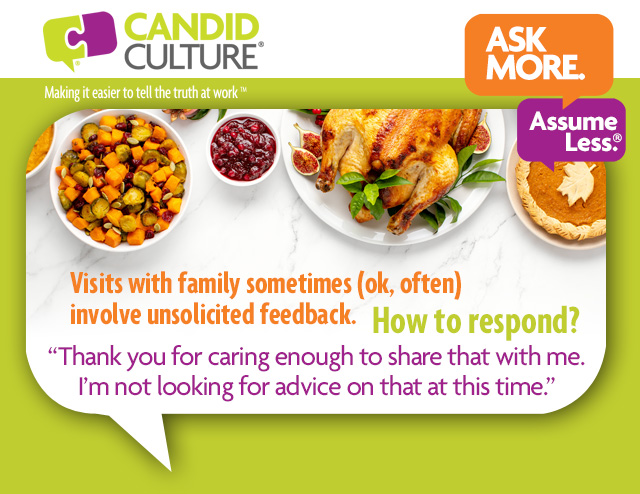
If you visit family and friends this holiday season. you may receive unsolicited feedback and advice. Sometimes people who care and want what’s best for us, provide input we didn’t ask for.
Unsolicited feedback at best feels like someone is trying to help, at worst it feels like criticism. Underneath the feedback might be the message, “If you were doing this right, I wouldn’t need to give you this advice.” I put unsolicited feedback and advice in the same bucket.
If you find yourself receiving unsolicited advice, you don’t have to smile politely and take it. It’s ok to put an end to feedback and advice.
Simply smile, tell the person you appreciate them caring enough to give you that advice, and say that you’re not looking for advice on that topic at this time. And then smile again. Smiling softens most messages. Say nothing more. Most people will stop talking. What else is there to say?
This method of acknowledging the person talking is respectful and firm. To pull it off, watch your tone. If you can safely add the words, “you dummy” to anything you say, you have a tone issue. Be genuinely appreciative and enforce boundaries. You’re not the 7/11. You don’t have to be open to feedback and others’ input all the time.
If the person continues giving you advice, simply say the same thing again. “Thank you for caring enough about me to share that with me. I really appreciate your concern. And I’m not looking for advice on that at this time.” If the person keeps talking, just say, “I’m going to get a drink.” Then get up and go get a drink.
If stopping unsolicited feedback feels uncomfortable, prevent it. Tell people before you see them, “I don’t want to talk about _____________ (fill in the blank). Please don’t bring it up over Thanksgiving.” You can soften that request any way you like.
Most difficult conversation are preventable. And preventing a difficult conversation is always easier than having one.
Setting boundaries might be feel uncomfortable. But it’s likely not as uncomfortable as having a conversation you don’t want to have and then feeling like you need to avoid someone for the rest of the evening and possibly year. It’s ok to say, “No, thank you. Please pass the pie.”
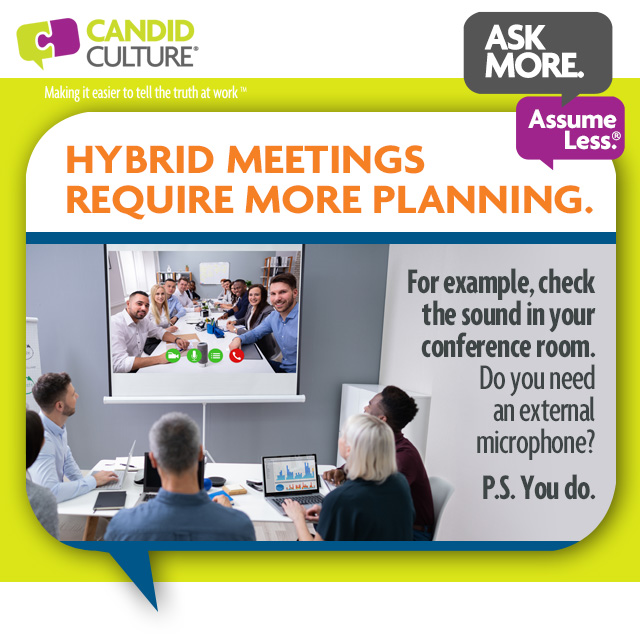
Hybrid meetings are more complicated and more difficult to run. There are lots of pitfalls. But with advanced planning and preparation, hybrid meetings can be well run and efficient.
Hybrid meetings defined: Some participants are together in-person, other participants attend from different locations.
Some pitfalls of hybrid meetings:
Can the people attending virtually hear people who are attending in-person, from a conference room?
Are the people in the conference room ‘talking’ to each other with their eyes while the virtual attendees assume they’re ‘talking’ about them?
Are people participating equally, regardless of their location (not unique to hybrid meetings)?
Are people texting each other about their real thoughts versus saying them out loud (also not unique to hybrid meetings)?
Did the facilitator provide hard copies of documents to in-person attendees and forget to send documents to virtual attendees?
The keys to running effective hybrid meetings – anticipate and practice before the meetings.
Do a dry run of a hybrid meeting before you run one. I run a practice session for all hybrid trainings I facilitate, even with repeat clients and multiple sessions with the same client. It’s not worth leaving anything to chance. Have two people in a conference room and another person attend virtually. Test the sound. Move around the conference room; sit in different locations. Can the virtual attendee see and hear, regardless of where in-person attendees are sitting?
Assess if you need an external camera and microphone. Getting these items set up may feel intimidating at first, but you only need to do it once. Once the technology is set up, it’s ready to use for future meetings.
Most conference rooms – even small ones – will need an external microphone so in-person participants can be heard by virtual participants. Trust me. I’ve learned this the hard way. The microphone in your laptop won’t pick up sufficient sound for virtual attendees to hear in-person attendees. You can buy a microphone for $30 at Best Buy or Amazon.
Plan how you will elicit balanced participation from attendees in all locations. Will you call on people? Consider sharing facilitation of different topics, so people in multiple locations lead different parts of the meeting.
Set expectations for participation when meetings start – using the chat and raise-of-hands feature, microphones on or muted, no distractions, and no messaging fellow participants offline. Don’t assume people know or will follow the guidelines from past meetings. Set expectations at the beginning of every meeting, even recurrent meetings.
When breaking people into groups during hybrid meetings, it’s tempting to put people in groups based on location, putting the in-person people together and the virtual people together. This practice exacerbates proximity bias (a topic for a future blog). While it’s harder to group in-person and virtual attendees together, it is more equitable.
Cameras on or cameras off? Discuss, decide, and tell participants in advance so virtual attendees are prepared.
Talk about the pitfalls of hybrid meetings with all attendees. Tell people to avoid ‘talking’ with their eyes to fellow in-person participants. Avoid having a camera capture the side of your face while you watch a different screen. Use the blur-your-background feature in Zoom if your background is distracting.
The key to leading effective hybrid meetings? Anticipate potential breakdowns. Prepare in advance. Communicate expectations with participants. Debrief meetings after they end. Make necessary changes. Repeat.