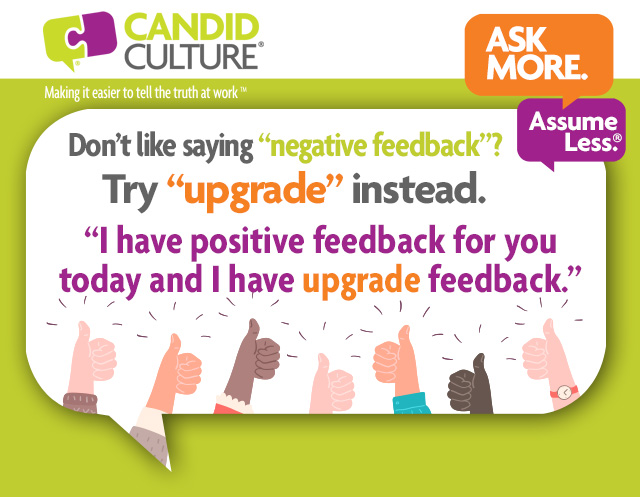
People don’t like the phrase “negative feedback” because it is, well, negative. So, someone came up with “constructive feedback”, i.e., “I have some constructive feedback for you.” I don’t particularly like that either. The definition of constructive is useful, and I think all feedback should be useful. I like the word “upgrade” instead. Upgrade implies the need for improvement, but it isn’t negative. The question is, which comes first, positive or upgrade feedback?
I always give positive feedback first. Not to make people feel better, but to ensure they hear the positive feedback. Most people want to be perfect. We want others to think well of us. Negative feedback calls our perfection into question and thus is hard to hear. When people get negative feedback, they naturally become defensive. It’s hard to listen when you’re defending yourself. If positive feedback comes after negative feedback, the positive feedback isn’t even heard. The negative feedback is all consuming.
When giving feedback, I tell people, “I have positive and upgrade feedback for you today. I’m going to give you the positive feedback first.” I give positive feedback, then I give upgrade feedback, and then I remind the person about the positive feedback, because I know the person is now consumed thinking about the negative feedback.
Think about yourself. If you receive seven pieces of positive feedback and one piece of upgrade feedback, what do you think about for the rest of the day? If you’re like most people, the rest of your day is about the upgrade feedback. We want to do good work and be thought well of, and negative feedback calls all of that into question and is thus, hard to hear.
Give positive feedback first, then give upgrade feedback, then remind the person about the positive feedback. People can handle feedback when it’s delivered by a trusted person in an objective way.
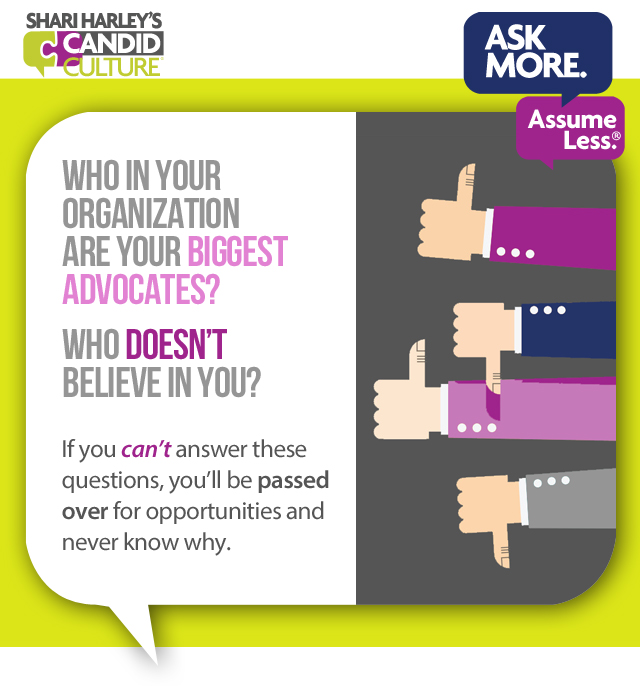
You will be passed over for jobs, projects, and opportunities, and never know why. Being passed over isn’t necessarily a bad thing, not knowing why you were passed over is problematic. If you don’t know why you’re being passed over, how can you be prepared next time?
Organizations are political. People talk. You’ve undoubtedly already experienced this.
If you want to manage your professional reputation, one thing you must know is who talks about you and what they say. How decisions get made in organizations isn’t always obvious. There are the obvious channels of decision making, like your boss and your boss’s boss. But there are also the people who talk to your boss and boss’s boss and have an opinion about you, who you may not be aware of.
Everyone in an organization has people they trust, who they listen to and confide in. Who those trusted people are isn’t always obvious. When you’re being considered for a new position or project, the decision makers will invariably ask others for their opinion. Knowing who does and doesn’t support you in a future role is essential to managing your professional reputation and career.
I don’t want you to be nervous, paranoid, or suspicious at work. I do want you to be savvy, smart, and aware.
It’s not difficult to find out who can impact your professional reputation at work, you just need to ask the people who know. Start with your manager. Your manager likely knows and will tell you, if you ask.
To ensure you know who can impact your professional reputation, tell your manager:
“I really enjoy working here. I enjoy the people, the work and our industry. I’m committed to growing my career with this organization.”
Who in the organization should I have a good relationship with?
Who/what departments should I be working closely with?
Who impacts my professional reputation and the opportunities I have?
What skills do I have that the organization values most?
What contributions have I made that the organization values most?
What mistakes have I made from which I need to recover?
Your manager doesn’t walk around thinking about the answers to these questions. If you want thoughtful answers, set a time to meet with your manager. Tell your manager the purpose of the meeting – to get feedback on your professional reputation so you can adeptly manage your career – and send the questions in advance, giving your manager time to prepare for the meeting. You will get more thoughtful and complete answers if your manager has two weeks to think about the questions and ask others for input.
Don’t be caught off guard by a less-than-stellar professional reputation. Take control of your reputation and career. Ask more. Assume less.
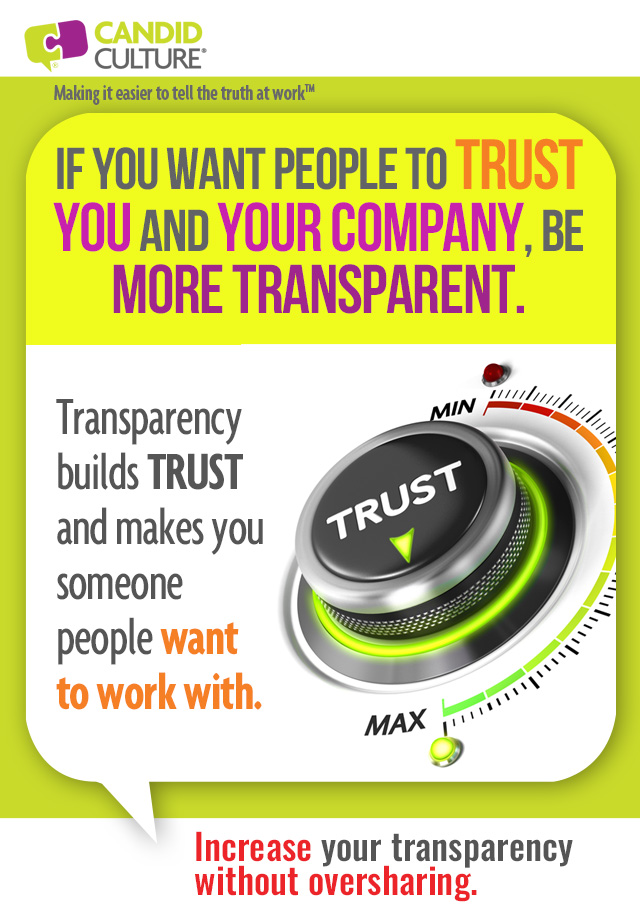
Hire people using whatever legal criteria you like. Compensate employees however you like. Charge for your products and services however you like. Run your business however you like. But be transparent about your practices. People want to work with those they trust. Transparency builds leadership trust.
A few weeks ago, one of our vendors gave me a bill that was higher than what I expected, so I asked for an itemized invoice. I never heard from the company again. Poof: they disappeared. Not a great way to build leadership trust nor a reputation.
Another vendor was very delayed in filling our product orders. When I asked questions about how such a thing could happen, I got a vague answer. “I guess we have communication issues, and you got lost in the shuffle.” It was an insufficient and thus bad answer that didn’t instill confidence in the company. Instead, it created doubt that they could reliably meet our needs, and we’re going to replace them.
One of my friends recently got turned down for an internal job. She was told, “You’re just not the right fit – an unhelpful and yet typical way to decline an internal candidate.
You don’t owe your employees or customers answers, but if you want people to want to work with you, have confidence in you, and trust you, you’ll provide more information than you think you need to.
Employees and customers can handle the truth. And while you may not think you need to provide it, people want to work with those they trust. We trust people who give us the whole truth, or at least more of it than, “I guess you got lost in the shuffle.”
Increase business trust: Be clear and transparent about your pricing.
Increase corporate trust: Tell employees how and why you make the hiring decisions you do. They’ll refer friends to work for you, even when you decline them.
Increase leadership trust: Tell employees how the organization makes money, the feedback you’re getting from prospects and customers, and why you’re making the business decisions you’re making. Employees will feel more connected and thus committed to the organization.
Knowledge makes people feel comfortable. The people who work for and with you want to understand how and why decisions are made. If you want your customers and employees to trust you, give them a little more truth than you might think necessary.
I’ve wanted to be an introvert my whole life. It’s going poorly. Introverts think, then speak. What an amazing quality. Extroverts, like me, wake up talking and then spend much of the day apologizing for what we’ve said.
While I covet introverts’ thoughtful communication style, they are at a disadvantage at work. The people we work with are busy and have limited exposure to coworkers. As a result, others judge us very quickly. If we don’t speak up in meetings or find another way to express our thoughts, people are likely to think we have little to offer. Regardless of your communication style, if you want people to know the value you provide, find a way to share it.
You can’t, won’t, and shouldn’t become a different person to get ahead at work. You have to be yourself. Trying to be someone you’re not, will be painful, frustrating, and short lived. Rather than trying to become someone or something else, find ways to express yourself within your natural style.
Here are four tips to communicate powerfully as an introvert:
Being introverted communication tip one: If you know you’re hesitant to speak up in a meeting, perhaps share your views with the meeting attendees individually – verbally or in writing – before the meeting happens.
Being introverted communication tip two: Make sure the people who can impact your career know your accomplishments. You don’t need to wear a billboard advertising what you’re doing, sending a monthly list of accomplishments and priorities to your boss and boss’s boss (clear this with your boss first) will do the trick.
Being introverted communication tip three: Find your own way of talking about what you think is important. Maybe your conversations will be over lunch with one or two people. Perhaps you’ll periodically email key people with ideas. The point is to find a way to express yourself that resonates with your personal style. Don’t keep all your ideas to yourself.
Being introverted communication tip four: Push yourself to speak up in meetings more than you might naturally be inclined to do so. Being prepared will help you speak up.
Know what’s on meeting agendas. When you feel strongly about a topic, prepare what you want to say. Take notes and consider practicing out loud. Do whatever you need to feel comfortable expressing yourself in front of a group. And if speaking up in a meeting feels too uncomfortable, remember, people who don’t get a lot of exposure to you are evaluating you based on your contributions during meetings. Find a way to make your views known.
People sometimes leave giving and receiving feedback training confused. Armed with the skills to be candid, they think they have the right to say anything they want. Not the case. Feedback isn’t a weapon or a license to dump your opinion on people. Unsolicited and unwelcome feedback is like fish you left on your countertop for too long. It stinks.
You have the right to ask for and accept the feedback you want from peers and customers and reject the feedback you don’t. Help people know the feedback you want by providing clear parameters on what type of input you do and don’t want. You are not a dumping ground.
Follow these steps to manage the feedback you get from others:
Giving and receiving feedback tip one: Don’t ask for feedback because you think you’re supposed to. There are lots of leadership books and training programs that tell leaders to be open to and ask for others’ input. Only ask for input you want. If you’ve made a decision or don’t want others’ input, don’t ask for it. While you might get more buy in by asking people for their input on decisions that impact them, you’re allowed to decide without forming a committee.
Giving and receiving feedback tip two: When you ask for input, be very specific about the type of input you want. Guide people. Tell them, “I’m specifically looking for input on ____________. I’m not looking for input on ____________.” And if you still receive unwanted feedback, remind people about the input you are and aren’t looking for. In the spirit of being helpful, people can overstep their bounds.
Giving and receiving feedback tip three: Don’t be afraid to shut people down who provide unsolicited feedback. The words, “Thank you for your concern. I’m not looking for input on that at this time” will do the trick. Yes, you really can say that.
Giving and receiving feedback tip four: Don’t take feedback personally. While most people don’t think about it in this way, giving feedback subtly tells you that you’re doing something wrong, or at least not how the other person would do it. There are lots of ways to achieve a result. Their way may or may not be better than yours.
Giving and receiving feedback tip five: Trust yourself. You likely know what you want to do a lot of the time. If you find yourself asking for input when you know what you want to do, stop asking. Listen to your gut and decide.
Feedback has a time and a place. I ask for and listen to a lot of feedback, but not all the time and not about everything. Sometimes, you know best.
If you’ve gotten courageous and given someone negative feedback or questioned a decision or action, you probably didn’t get a shiny, happy reply in return. The normal and natural reaction to negative feedback is to defend ourselves. It’s human. Defending yourself when receiving negative feedback is an act of self-preservation, not unlike hitting your brakes when the person driving in front of you unexpectedly slams on their brakes.
The problem with reacting defensively to negative feedback is that it’s scary and off-putting to others. As normal as a defensive reaction is to negative feedback, it makes others so uncomfortable that they’ll be hesitant to give you negative feedback again. And this lack of knowledge of what others really think is dangerous. Silence inhibits career growth and leads to bad business decisions. You want people to tell you the truth, as they see it, so you need to make it easy to speak freely.
If you want more of what others see as the truth, do the opposite of what people expect. Rather than defending or going silent, say “thank you.” “Thank you for telling me that. I’ll think about what you said and will likely come back to you to discuss further,” buys you time and puts the other person at ease.
Here are five ways to make it easier to say thank you for the feedback:
Only accept feedback when you’re ready to listen. You’re allowed to request a conversation at a time that works for you. Bad days, when you have five minutes between meetings, or are about to leave for a vacation, are not the times to accept negative information. Set up a time to talk, as soon as you have the bandwidth to listen.
Take breaks during hard conversations. You’re allowed to say, “I need a few minutes.” Go get coffee. Take a walk. Go outside. Regain your composure. Then continue the conversation.
Have feedback conversations when you’re rested and have eaten. Everything seems bigger and more difficult when we’re tired or hungry.
Accept that “thank you” isn’t the same as telling the other person they are right or that you agree. “Thank you” is a mere acknowledgment that you heard. It buys you time and gives you a chance to gather your thoughts and respond when you’re not emotional.
Don’t have conversations when you’re upset, and we often don’t know when we’re upset. Your emotions will run the show. Give yourself time to get through your emotional response, and then talk.
People are more hesitant than you think to tell you when they disagree. Make it easy to speak up. Do the opposite of what others expect. Say “thank you” rather than reacting, and you’ll get more data than you do now.
There was way too much guessing at work before most people began working from home. Without visual cues, figuring out how to work with people is even harder. You may find yourself thinking, “I’m going to miss this deadline. I wonder what the consequences will be?” Or perhaps, “They said they wanted input on this project. I wonder if they really meant that, and how much feedback is ok to provide?” Or maybe, “They asked for a proposal. Are they expecting something elaborate, or will a one-pager do?”
We often don’t know what others are expecting from us, so we guess. The problem with guessing is that we may do more work than we actually need to, and not in the way the other person wants it. Even worse, when we don’t work according to others’ expectations, they aren’t likely to tell us. Instead, they tell others and make decisions about us that aren’t positive.
I’m a fan of asking lots and lots of questions, preferably at the beginning of anything new. Anticipate all that can happen, get in front of breakdowns, and set clear expectations by asking questions. The people who participate in virtual and in-person training with me get an entire box of questions to ask. And the homework is to go ask more questions of the people they work most closely with. Asking questions will always be easier than recovering from violated and often unstated expectations.
If you want fewer breakdowns and frustrations at work, ask the following questions of the people you work with:
What do you want to do, on this project, and what do you want me to do?
What does a good job look like?
What will be different in the organization when this project is finished?
How would I frustrate you and not even know it?
How often do you want to receive updates from me?
Do you want to receive all the details or just big picture information?
Do you want to receive the information in bullet form or paragraphs?
It’s never too late to ask questions like these. It’s ideal to ask the question at the beginning of a piece of work. But asking in the middle or even towards the end is fine too. People will appreciate that you asked, whenever you ask.
Posted under Uncategorized on August 12, 2024 by Shari Harley. 0 Comments
Employees leave managers not jobs. We’ve all heard this 100 times.
One of the most prevalent reasons for employee turnover is boredom and lack of growth. We’ve also heard this many times.
We know why employees leave jobs. The question is what must managers do to engage and retain their best people. The answer is actually quite simple, although not necessarily easy to execute.
Employees want to know that their manager:
Knows them
Cares about and is invested in their careers
Gives feedback so they can improve
Provides opportunities so they can develop
In other words, employees need attention, and attention requires time – time many managers may not feel they have.
Here is a five-step formula for employee retention and employee engagement:
Get to know employees better and differently.
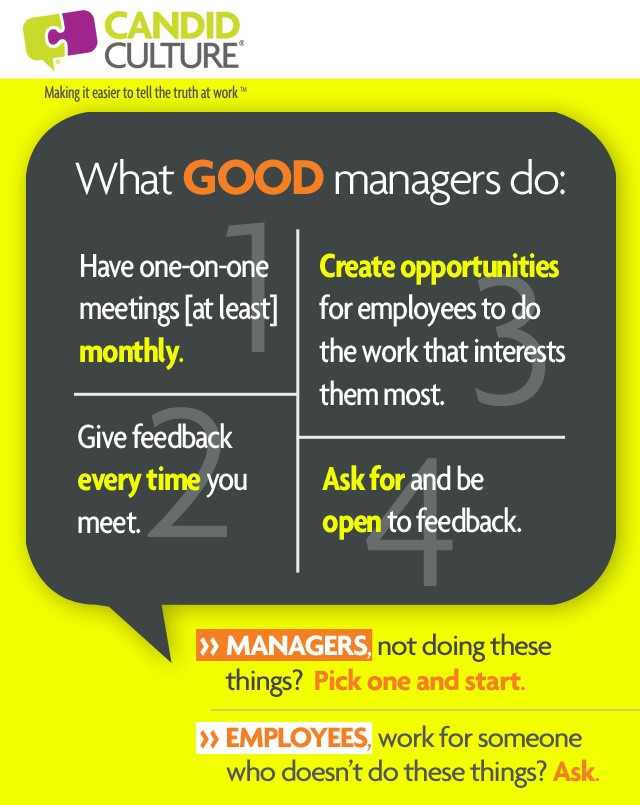
Have meaningful, one-on-one meetings [at least] monthly.
Give balanced feedback as work is done.
Ask for and be open to feedback.
Create opportunities for employees to do the work that interests them most.
Managers, how do you make time for these meetings when you are busy and have several direct reports?
Meet for 15-30 minutes.
Ask direct reports to create an agenda and run the meetings.
Ask direct reports to send follow-up notes of decisions and plans made during meetings. Give some of the accountability away.
If meetings get cancelled, reschedule as soon as possible. Direct reports take cancelled meetings personally. Cancelled meetings that are not rescheduled send the message that managers don’t care about employees and their careers.
Employees, if your manager doesn’t schedule meetings with you:
Ask permission to put a monthly meeting on your manager’s calendar.
Provide rationale for why you want to meet – to get your manager’s feedback and ensure you’re focused on the right work.
Ask permission to reschedule meetings when they get cancelled.
Don’t take cancelled meetings personally.
Offer to meet with your manager via the phone when it’s convenient for them. Leverage commute and travel time, if applicable.
Employees need time with their managers. Meaningful discussions and work, result in employee engagement and employee retention. So managers, make the time, even when you don’t feel you have it. Ask questions you don’t ask now. Give feedback, even when it’s uncomfortable. Give your employees an opportunity to do the work that interests them most. And watch your employee engagement and employee retention improve. And if your manager doesn’t do these things, politely and persistently ask. You won’t get what you don’t ask for. We are all 100% accountable for our careers.
When the people we work with don’t do their jobs, we might find ourselves saying, “They should be more on top of things.” “They shouldn’t make commitments they can’t keep.” “They don’t know what they’re doing, and that’s not my problem.” The challenge is, when your coworkers don’t perform, it is your problem.
When your coworkers don’t get you the information you need in a timely way, you miss deadlines. When you work from incorrect information, your reports are wrong. When others don’t work with you, you look bad. So, you can be right all day about how others perform, and your reputation will still be negatively impacted.
I don’t suggest you enable your coworkers by doing the work others don’t. I do suggest you help your coworkers be successful by holding them accountable.
Here are a few things you can do to manage your career and get what you need from your business relationships:
Don’t assume others will meet deadlines. Check in periodically and ask, “What’s been done so far with the XYZ project?” Notice, I didn’t suggest asking, “How are things going with the XYZ project.” “How are things going” is a greeting, not a question.
Set iterative deadlines. If August 25th is your drop-dead deadline, ask to see pieces of work incrementally. “Can I see the results of the survey on August 10th, the write-up on August 15th, and the draft report on August 20th?” One of the biggest mistakes managers and project managers make is not practicing good delegation by setting iterative deadlines and reviewing work as it’s completed.
Don’t just email and ask for updates. The people you work with are overwhelmed with email, and email is too passive. Visit people’s offices or pick up the phone.
You might be thinking, “Holding my coworkers accountable is awkward. I don’t have the formal authority, and I don’t want my coworkers to think I’m bossy or damage my business relationships.”
It’s all in the how you make requests.
If you’ve seen me speak or have read the business book How to Say Anything to Anyone, you know I believe in setting clear expectations at the beginning of anything new. That could sound something like, “I’m looking forward to working with you on the XYZ project. How would you feel if we set iterative deadlines, so we can discuss work as it is completed? You’ll get just-in-time input, making any necessary adjustments as we go, and we’ll stay ahead of schedule. How does that sound? How are the 10th, 15th, and 20th as mini deadlines for you?”
Many people put large projects off until the last minute. People procrastinate less when large projects are broken into smaller chunks with correlating deadlines. You strengthen your business relationships and support people in meeting deadlines and not procrastinating when you agree on completion dates when projects begin. Also, most of us unfortunately know what it’s like to put a lot of work into a project, have someone review our completed work, and then be told we went down the wrong path and need to start over.
Ask more. Assume less. Don’t assume your coworkers will do what they’re supposed to do. Ask upfront to see pieces of work on agreed-upon dates. Pick up the phone versus rely on email to communicate and know that the people you work closely with are a reflection of you. Get people working with you, and everyone will look good.
Last week I had lunch with a friend. When I returned from lunch, I noticed I had something stuck in my teeth. I was embarrassed and wondered why my friend hadn’t told me.
It’s quite possible she hadn’t noticed. But we all know people who notice and say nothing. We could walk around all day with toilet paper on our shoe, lipstick on our teeth, or our fly down, and the people around us won’t tell us.
If you read my blog weekly, you already know that people have been trained not to tell you the truth.
But I think there is more preventing people from telling us the truth. Complete this sentence: “If you have nothing nice to say, _________________________________. Who told you that? Your mother!!!
I do think there’s something to this. We’re raised to believe that it’s not nice to say something to another person that isn’t positive. And in the past, when we did speak up, it’s likely the other person got defensive, so it’s no wonder that we don’t readily give people bad news.
Here are five tips for getting feedback from the people around you:
Establish a core team of people who will always tell you the truth. These can be friends, coworkers, clients, vendors, your boss, etc.
Give people permission, to be honest with you. “Let’s make a deal. I always want you to tell me the truth. If I have something stuck in my teeth, or I’m inappropriately dressed for a meeting, or I’m doing something that damages my reputation, I want you to tell me.”
Make it easy to tell you the truth. “I promise no matter what you tell me and how hard it is to hear, I will say thank you. I won’t get defensive. And if I do, I’ll apologize and try to do better next time.”
Offer to do the same for them. “And if you want me to do the same thing for you, I’m happy to do it.”
Periodically check in with people and ask for feedback. “A few months ago I asked you to tell me anything I said, did, or wore that got in the way of my success. Is there anything you’ve seen that you want to tell me?”
Every time you ask for feedback and take it graciously, you train the person to give you more feedback. On the contrary, every time you get defensive, you make it hard for people to give you feedback, making it likely they won’t do it again.
If you don’t want to walk around looking silly all day, create a safe environment where friends and co-workers can tell the truth.