Author Archive
 Our company got a shipment of products this week that were partially defective. When I called our vendor to tell him about the defective products, he sighed knowingly. He knew part of our order was imperfect and waited for me to find the problems versus telling me himself.
What?!?!
I love surprise gifts, trips, and discounts. But I don’t like surprise errors and your internal and external customers don’t either.
Everyone makes mistakes at work. Making a mistake is not necessarily a problem. It’s how you deal with the error that matters more. Letting those who are impacted by a mistake be surprised damages your reputation and working relationships much more than coming clean as soon as you realize the error. Rather than waiting to get caught, tell your customers about mistakes and work together to make things right.
Here are a few ways to tell people you made a mistake, while saving face:
Fessing up to making mistakes at work tip #1: When you realize you’ve made a mistake, pick up the phone and tell the person live, as soon as you know. Don’t wait.
Fessing up to making mistakes at work tip #2: Apologize and work with your customer to develop a solution. Be part of the process. Don’t leave your internal or external customer holding the bag.
Fessing up to making mistakes at work tip #3: Don’t give a bunch of reasons or justifications for what happened. It sounds like excuse management and no one cares. Your customers just want to know how you’re going to solve the problem.
Fessing up to making mistakes at work tip #4: Say something like, “I realized we sent you a report with incorrect information. I’m so sorry. I’d like to work with you to make this right. Here are a couple of ideas of what we can do… Would any of these suggestions work for you?”
Or you could say, “I realized parts of your order are imperfect. I’m so sorry. Here’s how we’d like to make things right. Are these solutions satisfactory to you?”
Or consider saying something like, “I’ve realized we can’t fulfill your order by the date we promised. I’m so sorry. Here’s what I suggest we do to get you what you need in a timely way. Does this work for you?”
We all make mistakes. How you handle mistakes determines how your internal and external customers view you and how much they trust you. Come clean quickly. Take responsibility. Don’t provide a bunch of reasons for a mistake. Help make things right. And you’ll likely preserve your reputation and business relationships.

 Summer is on the way, and it’s tempting to dress down at work. Here are a seven summer casual dress code do’s and don’ts that will help you be comfortable at work and preserve your reputation.
Summer casual dress code tip number one:
If you put on an item of clothing and wonder, “Can I get away with this?” you probably can’t.
Summer casual dress code tip number two:
Make friends with your iron. Capri’s may be fine in your organization, if they’re not fresh out of the dryer.
Summer casual dress code tip number three:
Never wear flip flops to work, unless it’s specifically stated in your company’s dress code that flip flops are ok, or if a senior leader wears them too. And what are considered flip flops isn’t always clear. I wore what I considered sandals to work, before I started Candid Culture, but they looked like flip flops to my boss, and he told them me not to wear them again. I assured him that there are no flip flops made of satin that cost what I paid for these shoes. He didn’t care, and I didn’t wear them again.
Summer casual dress code tip number four:
No one wants to see your belly button or bra straps at work. Well they might, but neither is appropriate.
Summer casual dress code tip number five:
Avoid wearing anything sheer, unless you have something that’s not sheer underneath it.
Summer casual dress code tip number six:
As always, during winter, spring, or summer, cover up the girls. Visible cleavage is a no-no at work during any season.
Summer casual dress code tip number seven:
Don’t wear shorts, unless your company’s dress code specifically states that shorts are ok. And if you’re going to wear shorts, keep them long, just a few inches above the knee. No daisy dukes at work. This applies to your company picnic too. Work events are work events. Dress knowing that whatever inappropriate choice you make for the company picnic will be discussed in the hallways the next day.
Company leaders and HR professionals, help employees make appropriate summer casual dress code choices. It’s not enough to tell employees to keep it appropriate during the summer months. Be specific. If shorts are allowed, tell employees how long they need to be. If tank tops are not allowed, circulate photos of acceptable and not acceptable clothing. If you allow sandals, but not Birkenstocks, don’t make employees guess.
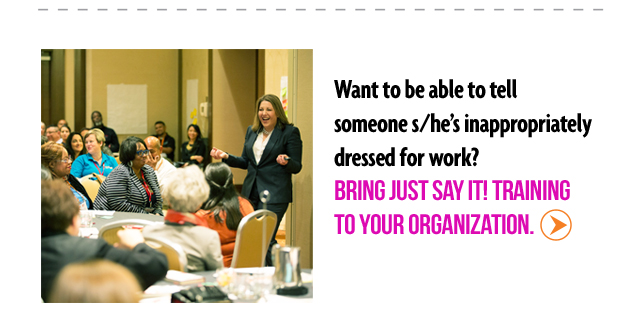
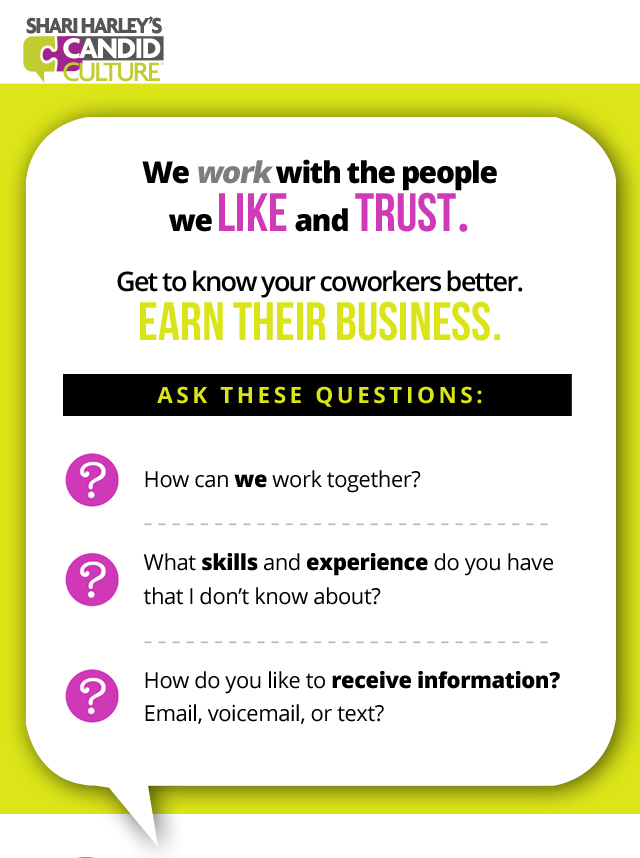
Regardless of who your company’s org chart says you should work with, people work with the people they want to work with and around those they don’t. One way to get people working with you (by choice) is to get to know your coworkers better, and I don’t mean personally.
Most people don’t know the people they work with very well. Coworkers often don’t know what fellow team members are tasked with doing for the company, their past work experience, education, or working style preferences. They often don’t know how fellow team members like to receive information, but get annoyed when they don’t return unopened emails.
If you’ve had any team building training with me, you know I advocate getting to know people better by asking more questions.
Organizations spend a lot of money on team building. Teams go bowling, out to happy hour, and have pot luck lunches, etc. All of those activities are fun and build comradery, and that’s important. But comradery and enjoying spending time together outside of work won’t help a team learn to communicate or overcome challenges.
If you’re really committed to team building and working well with people, ask more questions at the onset and throughout working relationships.
Here are five team building questions coworkers should be asking each other:
- What are your pet peeves? How would I frustrate you and not even know it?
- Are you a big picture or detail oriented person? Should I send you information in bullets or paragraphs?
- What are you best at doing? What type of work could you be doing that you’re not doing now?
- What are you working on now? What are your priorities for the next six months?
- What’s something I could do differently that would make your job easier? (You will survive the answer. I promise)
Your manager may coordinate an activity that gives your team the ability to ask questions like this, and s/he might not. Either way, ask the questions and be forthcoming if others ask you for this information. It’s not just your manager’s job to get your team working well together.
Your daily experience at work – how much you get done, how easily you get that work done, and how much fun you have along the way – is largely dependent on the people you work with. Don’t leave your working relationships to chance. Be assertive. Get to know people better. Ask more questions and offer information about yourself.

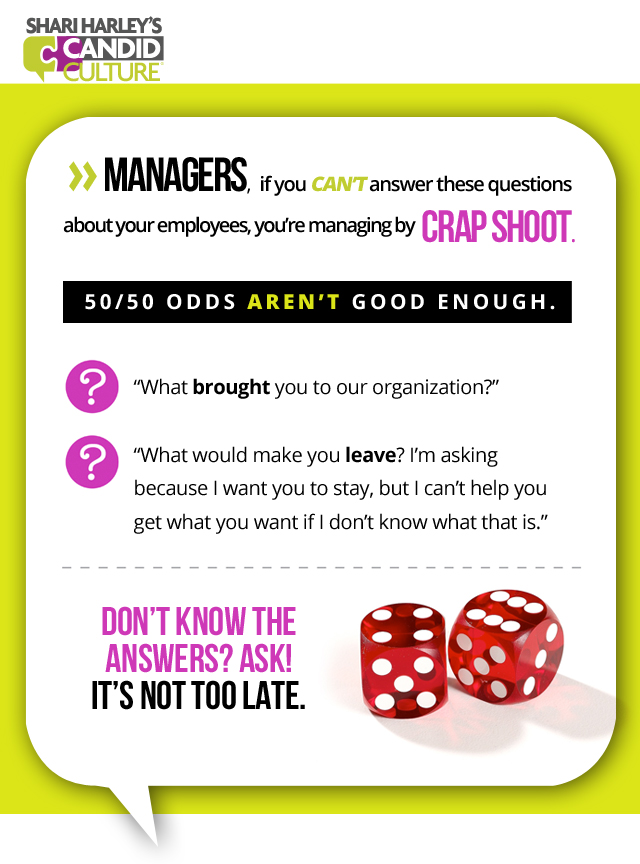 If an employee quits and the manager is surprised, shame on the manager. Employee turnover – literal turnover (he quits and leaves the building) or figurative turnover (he quits but continues to come in everyday and do his minimal best) – are extremely predictable.
Most employees need only a handful of things to be satisfied and productive at work. The key is getting employees to tell you what those things are. And they might just tell you, if you ask.
An employee’s first few weeks at a new job often involve a lot of training. Managers tell employees what they need to do and hopefully why they need to do those things. I recommend balancing telling with asking.
Effective management involves asking the seven questions below during the interview process, after an employee starts, and again 90-days to six months into the job.
Effective management question number one: “What brought you to this company? Why did you accept this job? What are you hoping the job will provide?” Ask one of these three questions. Pick the one you like best.
Effective management question number two: “What would make you leave this job? What are your career deal breakers, things you just can’t tolerate at work?” Ask either of these questions.
Effective management question number three: “What type of work, skills, and/or areas of our business do you want to learn more about?”
Effective management question number four: “Tell me about the best manager you ever had. What made him/her the best manager?” This will tell you what the employee needs from you as a manager and is a much better question than, “What do you need from me as your manager?” That is a hard question to answer. Telling you the best manager s/he ever had is easy.
Effective management question number five: “Tell me about the worst manager you ever had? What made him/her the worst manager?”
Effective management question number six: “What are your pet peeves at work? What will frustrate you?” Why find out the hard way what frustrates employees when it’s so easy to ask. This question demonstrates that you want your employees to be happy and that you will flex your own preferences, when possible, to meet employees’ needs.
Effective management question number seven: “How do you feel about being contacted via cell phone or text outside of business hours? How do you feel about receiving emails during the evenings and weekends?”
If you’ve participated in one of our effective management trainings and received a box of Candor Questions for Managers, you know I could go on. But these seven questions are a good start.
Regardless of age, gender, or work and educational background, all employees have a few things in common. Employees want to:
• Work for someone who takes an interest in and knows them
• Feel valued and appreciated for their contributions
• Be part of and contribute to something greater than themselves
• Feel respected as a person. Managers respect their time, expertise, and needs
Taking the time to get to know employees throughout your working relationship accomplishes many employee needs.
If you have long time employees, it’s never too late to ask these questions. Regardless of for how long employees have worked for you, they’ll appreciate you asking. There is no need to feel that employees will raise an eyebrow and wonder why you’re asking now. They’ll just be happy you’re asking. You can simply say, “I realized that I’ve never overtly asked these questions. I just assume I know. But I don’t want to do that. You’re too valuable to me and to the organization. During our next one-on-one meeting I’d like to ask you these questions and you can ask me anything you’d like.”
If you have a manager who will never ask you these questions, provide him/her the information. Don’t wait to be asked. You’re 100% accountable for your career. Tell your manager, “There are a few things about myself I want to share with you. I think this information will make me easier to manage and will help ensure I do great work for the organization for a long time.”
Managers, the better your relationship with your employees and the more you know about what your employees need from you, the organization, and the job, the easier employees are to engage, retain, and manage. Stop guessing and start asking.

Posted under
Uncategorized on May 10, 2015 by Shari Harley. Comments
I’m going to admit that I’m terrible at what I’m recommending today – taking time for yourself. Often my weekly blog is something I too am working on, and this week is no exception.

Many of you know that I’m often in three to five states a week doing what I love most–working with all of you. When I get home, I often spend my evenings and weekends catching up.
While I feel I need to maintain this schedule to keep up, I’m aware that I can’t and don’t want to work all the time. So today’s blog is for all of us who don’t know how to turn it off and walk away from the laptop.
The value of downtime and taking time for yourself is well documented. There is a lot written on the need to take breaks to recharge, rejuvenate, and avoid burn out. The question is how to do so without feeling like something else is getting short shrift.
Here are seven tips for taking time for yourself:
Taking time for yourself tip one: Give yourself permission after a really busy few days or week(s) to take a day and do nothing. If you’ve been on the road for four days or worked really long hours, plan to sleep in on the fifth day. Don’t schedule early morning meetings and a full day. Know that you won’t be productive on day five anyway, so you might as well plan to do very little, which is what you’re likely to do anyway.
Taking time for yourself tip two: Plan a day doing non-work-related things you really want to do. When is the last time you did something you really love to do, just because? You’re more likely to dedicate time off to doing something you love than just lying around. But, if a day of planned recreational activities feels like another ‘to do,’ you’re better off doing nothing and not feeling badly about it.
Taking time for yourself tip three: Plan time to see one or two friends a week. I’ll admit that I have to schedule phone calls to catch up with friends and schedule time to see people I care about. Yes, I admit, this seems wrong. But do whatever it takes. If you have to put lunch or a phone call with a friend in Outlook for it to happen, do it.
Taking time for yourself tip four: Don’t feel badly about taking time off. I always feel guilty when I sleep until 11 am or do nothing until 3 pm on a Saturday. I still do it, but my enjoyment is diminished by my self-imposed judgment. Just do what you need to feel rested and refreshed. Stop judging yourself.
Taking time for yourself tip five: If you take a day off or sleep late, don’t work until two in the morning the next day to compensate. Doing so defeats the purpose and will put you in a hole the next day.
Taking time for yourself tip six: Watch where your time goes when you’re ‘working.’ I know that I squander lots of time while I’m ‘working.’ I allow myself to get distracted reading emails as they come in, texting, and chatting in our office. You could work fewer hours if you reduced these distractions.
Taking time for yourself tip seven: Decide what you really want your life to be about and what’s really important to you. Do you want work to be your focus or do you want an equal balance of friendships, family, and community activities? You likely have what it is that you really want.
If what you really want is a career-centric life, then just admit that and don’t judge yourself for it. But do take enough time off that you are rested, productive, and don’t resent your work.

Posted under
Uncategorized on May 4, 2015 by Shari Harley. Comments
Consider the things other people do that frustrate you. Now consider what you’re asking for.
You aren’t likely to get what you don’t ask for, but most people don’t ask for very much. We assume that the people in our lives will do the right thing without prompting. We’ll get the recognition and compensation we deserve at work because it’s the right thing to do. Our friends will remember our birthday because how couldn’t they know that’s important to us? And no one will come to our home empty handed for dinner because we would never do that.
If you read this blog regularly, you already know that I’m a proponent of setting clear expectations and asking more questions before problems occur. Consider what you want and need, anticipate what can go wrong, and plan accordingly before problems happen. Doing that sounds great in theory, but how does it work in practice?
 Here are five ways to increase your job satisfaction:
Increasing your job satisfaction tip one: Be honest with yourself about what you need to be happy at work. Rather than tell yourself you won’t get what you need or try to convince yourself that you shouldn’t need something, just admit your needs to yourself.
Increasing your job satisfaction tip two: Share your needs with people who can help you get those needs met. Don’t make people guess. Chances are they won’t guess at all or will guess wrong.
Increasing your job satisfaction tip three: Don’t assume things will go well and just wait and see what happens. Instead, set clear expectations at the beginning of new projects and working relationships.
Here’s how that could sound: “We’re going to be working together for the next six months. Let’s talk about how everyone likes to communicate, what people’s pet peeves are, and the kind of information each person wants to receive.”
Here’s another example of how that could sound: “I’m excited to work on this project with you. There are a few things to know about me that will help us work well together and delivery timely results. I ask a lot of questions. Let me know if this frustrates you. I’m not questioning you; I just have a need to understand why we do what we do. And I work best with a deadline. I am happy to be available off hours, but you probably won’t hear from me before 9 am. You will get messages and work from me at night and on the weekends. Just let me know if you’d prefer I schedule messages to go out during regular business hours.”
People might give you what you need if you ask, but they likely won’t if you don’t. Train others how to work with you.
Increasing your job satisfaction tip four: Agree to talk about things as they happen. Don’t wait until you’re about to explode to speak up.
That could sound like, “I want us to work well together, and things will go wrong. Can we agree that we’ll provide feedback as things happen so we can make timely adjustments?”
Increasing your job satisfaction tip five: Renegotiate when you need to. If you realize you need or want something that you didn’t ask for, go back and ask. It’s never too late.
Here’s how that could sound, “We touch base about once a month and I’m realizing that if we could talk for about 20 minutes once a week, I’d be able to get more done. Can we make that happen?”
Job satisfaction and happiness at work (and at home) don’t just happen. The people you live and work with are not you and they don’t know what you need. Make a regular practice of identifying what you need, making those needs known, and then speaking up when things go array. You won’t get what you don’t ask for. But you will get whatever you allow.

Fourteen years ago, during my annual performance review, my manager said, “You had a great year. You rolled out 18 new training programs and got more participation in those programs than we’ve ever seen in the past. But you’re all substance and no sizzle. You’re not good at sharing the work you’re doing, and as a result my boss doesn’t know enough about what you’re doing and to support a large raise for you, so I can’t even suggest one.”
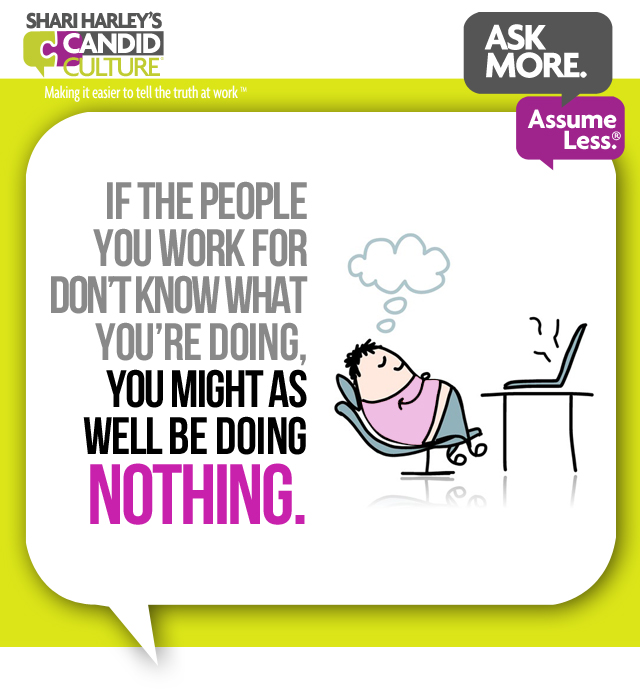
That happened to me ONCE, and I swore it would never happen again.
Too many people believe that if they do good work, the right people will notice and they will be rewarded appropriately. Part of this thinking is accurate. To be rewarded appropriately, you need to be doing good work. But the people in a position to reward you also need to know what you’re doing and the value you’re adding.
You need to find a way to share the value you’re providing without going over your boss’s head, sucking up, or alienating your coworkers.
Here are four ways to manage up while strengthening your business relationships:
Manage up tip number one: Ask your manager’s permission to send him a weekly update of what you accomplished during the week. This should be a one-page, easy-to-read, bulleted list of accomplishments or areas of focus.
Your boss is busy and most likely doesn’t follow you around all day. As a result, you need to let him know about the work you’re doing. Don’t make him guess.
Manage up tip number two: Periodically share what you’re doing with the people your manager works for and with. That can sound like, “I just wanted to share what my department is accomplishing. We’re really excited about it.” Ask your manager’s permission to do this and tell her why you want to do it (to ensure that the senior people in your organization are in-the-know about what your department’s accomplishments).
If you’re not sure who can impact your career and thus who you should inform about your work, ask your manager. She knows and will tell you, if you ask.
Manage up tip number three: Use the word “we” versus “I.” “We accomplished…..” “We’re really excited about….” Using the word “we” is more inclusive and makes you sound like a team player versus a lone ranger.
Manage up tip number four: If you work remotely and don’t see your coworkers and manager often, make sure you’re keeping people informed about what you’re doing. Likewise, if you work flexible hours – leave early, come in late, and work at night – people will assume you’re working fewer hours than them and will talk about it to whoever will listen. So while the hours you work shouldn’t be anyone’s business, people in organizations talk about stuff like this.
Don’t assume that people know what you’re doing or the value you’re adding to your organization. Instead, assume people have no idea and find appropriate ways to tell them. You are 100% accountable for your career.

 There’s when things end and then there’s when we physically leave, and the two rarely coincide. Sometimes it takes six months, a year, or even longer for our body to catch up with our brain.
Knowing when to leave a job, a relationship, and even a party is a skill. If you’re unhappy at work, have asked for what you want, and know you can’t it where you are, develop an exit strategy and act on it quickly.
When you’re checked out, people know. Unhappiness shows up in our performance, attitude, and body language. And quitting and staying is bad for your career, reputation, and business relationships.
If you’re unhappy at work and are ready to make a change, there are a few actions you should take to keep your reputation intact while you make a transition:
- Make sure you’ve fully investigated your options at your current place of work before deciding to move on. Share your desires in a positive way, with people who can help you get what you want. Saying, “I’d really like to do _________, or I’d really like to work in the ______ department” will get you much further than saying, “I’m underutilized, undercompensated, and unappreciated.”
- Do your job and do it well. Don’t go missing in action.
- Only commit to things you know you can and will do, and keep your commitments.
- Confide in people about your unhappiness and future plans who are outside your current place of work. People talk. Assume anything you tell someone at work will be told to someone else.
- Take at least one action every day towards getting what you want. It can be easy to get into a rut when job hunting. Stay in action.
If you’re unhappy at work, it’s probably time for a change – either within or outside your company. Ask for what you want in a positive way. Do a great job on a daily basis, regardless of how you feel. Confide in people outside of your workplace. And take one action every day towards getting what you want.
Know when to go.


People like certainty. We feel more comfortable knowing than not knowing. Not having an answer is uncomfortable. And looking for answers requires work. But sometimes knowledge is the enemy and the death to innovation in the workplace. If we know how something or someone is, there isn’t much of a reason to look for different and possibly better answers. But sometimes we don’t know what we don’t know.
Companies want to be innovative, creative and agile. And that’s good. A lack of innovation is surely the route to long-term failure. For example, a company is at the top of its game. It sells a product that is better than everyone else’s and becomes complacent. Relying on its past success, the successful company creates nothing new for five years, while up-and-comers are creating better solutions. Before they know it, the successful company is obsolete.
On a smaller scale, but equally damaging to innovation in the workplace, is hiring and retaining employees who don’t regularly ask the questions:
- Why do we do this this way?
- Is there a better way to do this?
- What don’t we know that we don’t know?
If you want innovation in the workplace, you need to hire people who are curious and think critically.
People who are curious and think critically have a few key qualities. Curious and critical thinkers are:
- Secure
- Self-confident
- Coachable
- Not afraid to ask questions
- Not afraid to be wrong
Identifying these qualities in candidates is challenging. I’ve interviewed and hired many people who seemed quite self-confident and coachable during the interview process, but once they began working, it quickly became apparent that they were neither. If you want people who will execute an existing process that works, non-critical thinkers are effective employees. If you want people who will consistently challenge the status quo, you should let insecure and people lacking curiosity go, as soon as you see the signs.
If you want innovation in the workplace and want your organization to stay current and competitive you need to have employees who aren’t afraid to consistently ask the question “why. Incorporate status-quo busting questions into your meetings. Create rewards and recognize people who risk trying to fix a problem or create something new.
Train employees to ask these questions:
- Why do we do things this way?
- Why did this happen?
- What questions have we not asked?
- What would happen if we did _______?
As always, you get what you ask for. What are you asking for?

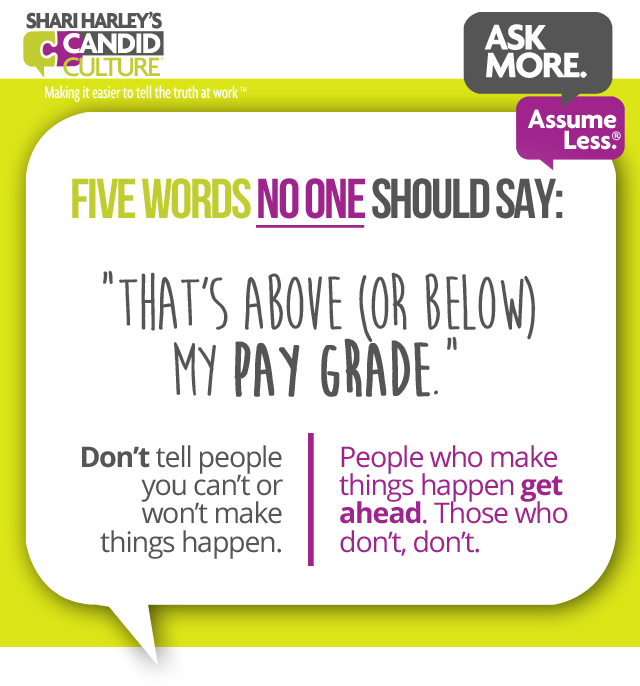 There are three reasons people say “that’s above or below my paygrade” or “that’s not my job” –they don’t feel empowered to make decisions, they think they’re being unfairly compensated for the challenges at hand, or they aren’t particularly motivated (read lazy).
“That’s not my job” (aka, I don’t do things that are outside of my job description) is a mindset, and if someone has it, I’d suggest not hiring that person. People who think they should only have to do what’s on their job description aren’t utility players, and your organization is likely too lean to afford employees who only want to perform in a narrow box.
“That’s not my job” can also be an outcome of leaders and managers who can’t let go and let employees take risks and make decisions. If that’s your management style, hire people who will follow directions and don’t want to create new things and solve problems. Problem solvers will be frustrated if they only get to follow instructions.
Here are six steps to steer clear of “that’s not my job” syndrome and advance your career, regardless of your current role in your organization:
- Never say the words “that’s above or below my paygrade” or “that’s not my job.” Even if it’s true.
- If you don’t have the latitude to solve certain problems, ask the people you work for how they want you to handle those types of issues when you see or hear about them. That’s a subtle way to provide feedback that you don’t have the latitude you need to solve certain problems.
- When you see an impending train wreck, say something. I see lots of very capable employees see the train wreck coming, comment to themselves or others who can’t do anything about the problem (aka gossip), and then nod knowingly when the *&#@ hits the fan. Don’t be that person. Look out for your organization and the people you work with.
- If you see a broken or lacking process, raise the issue with someone who can do something about it, and offer to take a stab at fixing the problem. One of managers’ biggest complaints is employees who dump and run – “I’ve identified a problem. I’m leaving it for you to fix.”
- Go out of your way to do the right thing, even if you are uncomfortable or don’t want to. If it’s easier to email someone, but you know the right thing to do is to pick up the phone, pick up the phone. If an internal or external customer expresses concern and you can’t solve the problem, find someone who can. There are lots of ways to make an impact.
- Ask more questions. Find a non-judgmental way to ask, “Why do we do this this way?” “Have we considered…?” “Would you be open to trying…?” Status quo can be the right thing and what’s necessary. It can also be the death of organizations.
Make stuff happen. Don’t pass the buck. And if you are going to pass the buck, don’t announce it. It only makes you look disempowered and uncommitted.