

Improving Customer Service – More Talking Isn’t Always Better
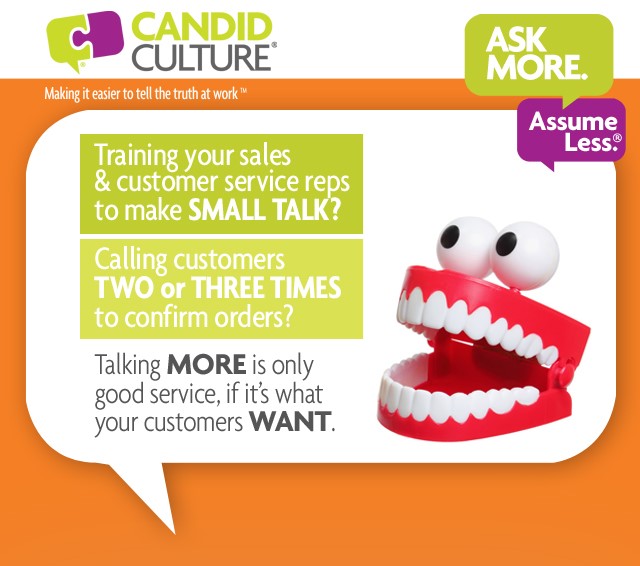
Many organizations think they’re improving customer service by training sales and customer representatives to make small talk — asking how a customer’s day or week is going. Asking questions and chatting with customers about personal matters is only good customer service if clients WANT to make small talk.
Are you asking customers what good customer service means to them and what type of service they’re hoping you’ll provide?
Here are a few questions you can ask to improve customer service:
If we need to contact you, what method is best? Phone, email, or text message?
What kind of information would you like to receive, how often, in what format, and with how much detail?
What’s your definition of good customer service? Check all that apply.
- Get it done fast and right the first time.
- Get to know me. I’m happy to chat.
- Get it done right and ask all the questions you’d like.
- I’ll sacrifice pleasantries for speed.
Ride-share drivers, massage therapists, dental hygienists, etc. ask, “Would you like a silent ride/visit?”
If you ask for customers’ preferences, be sure to accommodate those requests. When I ordered an Uber from the airport last night, I selected a “comfort ride.” I’d never selected “comfort” before. When I made my selection, I was asked what kind of ride I wanted, “quiet or conversational”. I picked quiet. As soon as the Uber driver found out I was from Denver, he told me he owned a home in Colorado, and how his aunt who he called “mom” because she was like a second mother to him, bought him the home, and about the shopping complex his aunt owned, and how her husband gambled and lost all their savings, and how she died her nephew’s arms. I learned all of this in a four-mile trip, during what was supposed to be a quiet ride.
It’s worse to ask for customers’ preferences and then ignore those preferences, than not to ask at all.
Our customers don’t necessarily share our definition of good customer service. Small talk may suit some customers, while it alienates others. Read your customers’ body language and listen to their tone of voice. Do they look and sound like they want to chat with you? Do they happily provide you with detailed answers to small-talk related questions, or do they provide short answers and appear impatient? Listen, watch, and adjust your behavior accordingly. Or preferably, ask what customers are expecting from you when they buy. Ask more. Assume less.
Tags: candor questions, customer service questions, customer service training, get your customers talking, improve customer service, improving customer service, sales and customer service, sales training