Posts Tagged ‘improving customer service’
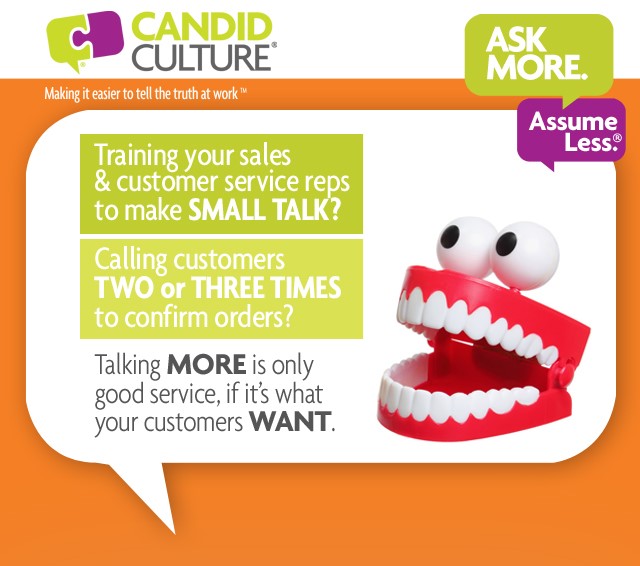
Many organizations think they’re improving customer service by training sales and customer representatives to make small talk — asking how a customer’s day or week is going. Asking questions and chatting with customers about personal matters is only good customer service if clients WANT to make small talk.
Are you asking customers what good customer service means to them and what type of service they’re hoping you’ll provide?
Here are a few questions you can ask to improve customer service:
If we need to contact you, what method is best? Phone, email, or text message?
What kind of information would you like to receive, how often, in what format, and with how much detail?
What’s your definition of good customer service? Check all that apply.
- Get it done fast and right the first time.
- Get to know me. I’m happy to chat.
- Get it done right and ask all the questions you’d like.
- I’ll sacrifice pleasantries for speed.
Ride-share drivers, massage therapists, dental hygienists, etc. ask, “Would you like a silent ride/visit?”
If you ask for customers’ preferences, be sure to accommodate those requests. When I ordered an Uber from the airport last night, I selected a “comfort ride.” I’d never selected “comfort” before. When I made my selection, I was asked what kind of ride I wanted, “quiet or conversational”. I picked quiet. As soon as the Uber driver found out I was from Denver, he told me he owned a home in Colorado, and how his aunt who he called “mom” because she was like a second mother to him, bought him the home, and about the shopping complex his aunt owned, and how her husband gambled and lost all their savings, and how she died her nephew’s arms. I learned all of this in a four-mile trip, during what was supposed to be a quiet ride.
It’s worse to ask for customers’ preferences and then ignore those preferences, than not to ask at all.
Our customers don’t necessarily share our definition of good customer service. Small talk may suit some customers, while it alienates others. Read your customers’ body language and listen to their tone of voice. Do they look and sound like they want to chat with you? Do they happily provide you with detailed answers to small-talk related questions, or do they provide short answers and appear impatient? Listen, watch, and adjust your behavior accordingly. Or preferably, ask what customers are expecting from you when they buy. Ask more. Assume less.

Many organizations think they’re improving customer service by training sales and customer representatives to make small talk — asking how a customer’s day, week, or trip is going. Asking questions and chatting with customers about personal matters is only good customer service if clients WANT to make small talk.
When room service delivers breakfast and the hotel guest is standing in a towel, he’s probably not interested in talking about whether his trip is for business or pleasure and whether or not he’ll have time for fun while he’s in town. Improving customer service will likely require the wait person to get in and out of his room quickly. When a ride-share driver talks with you when you want to work, his desire to chat probably isn’t improving customer service.
Sales and customer service representatives can also over communicate about business-related issues. Last weekend I ordered some equipment online. Shortly after placing the order, a customer service representative called me because I’d provided different billing and shipping addresses, and he wanted to be sure that someone wasn’t fraudulently using my card. Focused on improving customer service, he asked me to call back before they’d ship my item, which I needed Monday and paid $32 to have sent via overnight mail.
When I called back, I got voicemail and left a message. Then I spent the day wondering if the guy got my message and if my order would arrive on Monday. Then he left another voicemail saying that one of the items I ordered was out of stock but he thought they might have it in another color. He then called again to tell me that they did indeed have the item in a different color and asked me to call back. When I called back, I was told that my order had already shipped. Three unnecessary phone calls on a Saturday is not improving customer service.
You may be thinking this situation is an anomaly, but it happened to me again a few days later. I returned a pair of pants I bought online. I wrote a letter explaining for what item I wanted to exchange the pants. A customer service representative called to ask if I was sure about what I wanted and asked me to call back. When I returned the call, I was told that my order had already shipped.
I suspect companies think they’re improving customer service by asking how a customer’s day is going and by calling customers personally when questions arise. Perhaps I’m too busy, but having to call a vendor to tell them that I meant to order what I ordered and I really do have a separate billing and mailing address is not improving customer service. It’s time consuming and annoying.
I’m aware my preferences are not consistent with all buyers, and many customers appreciate calls from vendors and making small talk with wait staff, taxi drivers, and other service providers. But you won’t know what your customers want if you don’t ask them. Consider asking customers about their preferences when they buy something.
Here are a couple of questions you could ask, with the goal of improving customer service:
If we need to contact you, what method is best? Phone, email, or text message?
Ride-sharing drivers, massage therapists, dentists, etc. ask, “Would you like a silent ride/visit?”
What’s your definition of good customer service? Check all that apply.
- Get it done fast and right the first time.
- Get to know me. I’m happy to chat.
- Get it done right and ask all the questions you’d like.
- I’ll sacrifice pleasantries for speed.
Our customers don’t necessarily share our definition of good customer service. Small talk may suit some customers, while it alienates others. Read your customers’ body language and listen to their tone of voice. Do they look and sound like they want to chat with you? Do they happily provide you with detailed answers to small-talk related questions, or do they provide short answers and appear impatient? Listen, watch, and adjust your behavior accordingly. Or preferably, ask what customers are expecting from you when they buy. Ask more. Assume less.
Many organizations think they’re improving customer service by training sales and customer representatives to make small talk — asking how a customer’s day, week, or trip is going. Asking questions and chatting with customers about personal matters is only good customer service if clients WANT to make small talk.
When room service delivers breakfast and the hotel guest is standing in a towel, he’s probably not interested in talking about whether his trip is for business or pleasure and whether or not he’ll have time for fun while he’s in town. Improving customer service will likely require the wait person to get in and out of his room quickly. When a taxi driver talks with you when you want to work, his desire to chat probably isn’t improving customer service.
Sales and customer service representatives can also over communicate about business-related issues. Last weekend I ordered some equipment online. Shortly after placing the order, a customer service representative called me because I’d provided different billing and shipping addresses, and he wanted to be sure that someone wasn’t fraudulently using my card. Focused on improving customer service, he asked me to call back before they’d ship my item, which I needed Monday and paid $32 to have sent via overnight mail.
When I called back, I got voicemail and left a message. Then I spent the day wondering if the guy got my message and if my order would arrive on Monday. Then he left another voicemail saying that one of the items I ordered was out of stock but he thought they might have it in another color. He then called again to tell me that they did indeed have the item in a different color and asked me to call back. When I called back, I was told that my order had already shipped. Three unnecessary phone calls on a Saturday is not improving customer service.
You may be thinking this situation is an anomaly, but it happened to me again a few days later. I returned a pair of pants I bought online. I wrote a letter explaining for what item I wanted to exchange the pants. A customer service representative called to ask if I was sure about what I wanted and asked me to call back. When I returned the call, I was told that my order had already shipped.
I suspect companies think they’re improving customer service by asking how a customer’s day is going and by calling customers personally when questions arise. Perhaps I’m too busy, but having to call a vendor to tell them that I meant to order what I ordered and I really do have a separate billing and mailing address is not improving customer service. It’s time consuming and annoying.
I’m aware my preferences are not consistent with all buyers, and many customers appreciate calls from vendors and making small talk with wait staff, taxi drivers, and other service providers. But you won’t know what your customers want if you don’t ask them. Consider asking customers about their preferences when they buy something.
Here are a couple of questions you could ask, with the goal of improving customer service:
If we need to contact you, what method is best? Phone, email, or text message?
Taxi and Uber drivers, massage therapists, dentists, etc. ask, “Would you like a silent ride/visit?”
What’s your definition of good customer service? Check all that apply.
- Get it done fast and right the first time.
- Get to know me. I’m happy to chat.
- Get it done right and ask all the questions you’d like.
- I’ll sacrifice pleasantries for speed.
Our customers don’t necessarily share our definition of good customer service. Small talk may suit some customers, while it alienates others. Read your customers’ body language and listen to their tone of voice. Do they look and sound like they want to chat with you? Do they happily provide you with detailed answers to small-talk related questions, or do they provide short answers and appear impatient? Listen, watch, and adjust your behavior accordingly. Or preferably, ask what customers are expecting from you when they buy. Ask more. Assume less.
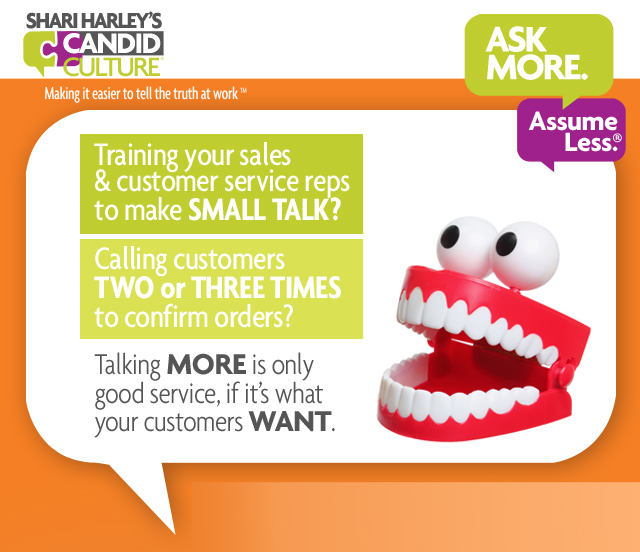 Many organizations think they’re improving customer service by training sales and customer representatives to make small talk, asking how customers’ day, week, or trip is going. Asking questions and chatting with customers about personal matters is only good customer service if clients WANT to make small talk.
When room service delivers breakfast and the guest is standing in a towel, he’s probably not interested in talking about whether his trip is for business or pleasure and whether or not he’ll have time for fun while he’s in town. Improving customer service will likely require the wait person to get in and out of his room quickly. When a taxi driver talks with you, when you want return phone calls, his desire to chat probably isn’t improving customer service.
Sales and customer service representatives can also over communicate about business related issues. Last weekend I ordered some equipment online. Shortly after placing the order, a customer service representative called me because I’d provided different billing and shipping addresses, and he wanted to be sure that someone wasn’t fraudulently using my card. Focused on improving customer service, he asked me to call back before they’d ship my item, which I needed Monday and paid $32 to have sent via overnight mail.
When I called back, I got voicemail and left a message. Then I spent the day wondering if the guy got my message and if my order would arrive on Monday. Then he left another voicemail saying that one of the items I ordered was out of stock but he thought they might have it in another color. He then called again to tell me that they did indeed have the item in a different color and asked me to call back. When I called back, I was told that my order had already shipped. Three phone calls on a Saturday is not improving customer service.
You may be thinking this situation is an anomaly, but it happened to me again a few days later. I returned a pair of pants I bought online. I wrote a letter explaining for what item I wanted to exchange the pants. A customer service representative called to ask if I was sure about what I wanted, and asked me to call back. When I returned the call, I was told that my order had already shipped.
I suspect companies think they’re improving customer service by asking how a customer’s day is going and by calling customers personally when questions arise. Perhaps I’m too busy, but having to call a vendor to tell them that I meant to order what I ordered and I really do have a separate billing and mailing address, is not improving customer service. It’s time consuming and annoying.
I’m aware my preferences are not consistent with all buyers, and many customers appreciate calls from vendors and making small talk with wait staff, taxi drivers, and other service providers. But you won’t know what your customers want if you don’t ask them. Consider asking customers about their preferences when they buy something.
Here are a couple of questions you could ask, with the goal of improving customer service:
If we need to contact you, what method is best? Phone, email, or text message?
Taxi drivers, massage therapists, dentists, etc. ask, “Would you like a silent ride/visit?”
What’s your definition of good customer service? Check all that apply.
- Get it done fast and right the first time.
- Get to know me. I’m happy to chat.
- Get it done right and ask all the questions you’d like.
- I’ll sacrifice pleasantries for speed.
Our customers don’t necessarily share our definition of good customer service. Small talk may suit some customers, while it alienates others. Read your customers’ body language and listen to their tone of voice. Do they look and sound like they want to chat with you? Do they happily provide you with detailed answers to small-talk related questions, or do they provide short answers and appear impatient? Listen, watch and adjust your behavior accordingly. Or preferably, ask what customers are expecting from you when they buy. Ask more. Assume less.


