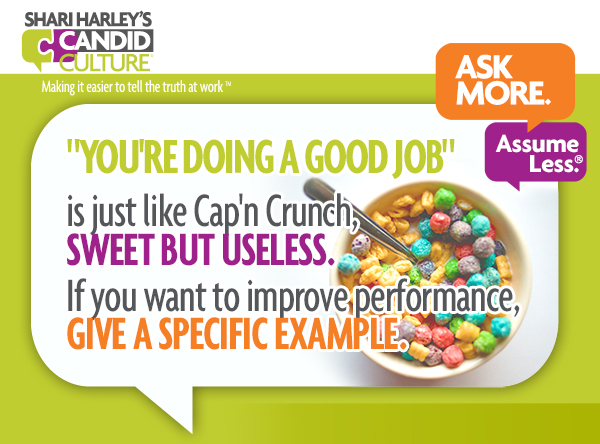
Most of the feedback people receive in the workplace isn’t feedback at all, it’s what I fondly refer to as Cap’n Crunch – vague and unhelpful words that put people on the defensive but don’t change behavior. If you want people to do something differently, give specific feedback.
Most of the fake Cap’n Crunchfeedback people get sounds like this:
“You did a great job on that.”
“You’re doing really good work.”
“You’re dressing inappropriately.”
“You’re difficult to work with.”
None of this is feedback. It’s all Cap’n Crunch. Vague, vague, and more vague.
The first words out of your mouth will invariably be Cap’n Crunch. Follow those words with, “for example” and you’ll be headed in the right direction.
“You did a great job on that. For example, I never had to ask about the status of the project. You gave me an update every Friday, and that made me feel comfortable that we were on track.”
“You dressed inappropriately for that meeting. For example, the client was dressed in business casual; you wore jeans and a t-shirt. Next time, please dress as the client dresses or a step above in khaki pants or slacks and a jacket.”
Most people are afraid to give feedback because they don’t want to deal with the defensive reaction they anticipate. The more vague you are, the more defensive people will be, because they don’t know what you’re talking about and they feel judged. Vague feedback is subjective. Subjective is judgmental. Feeling judged puts people on the defensive.
If employees shop your feedback around, asking what others think of the feedback you provided, it’s because you were vague, they disagree with you, or they’re being defensive. Feedback will be received better and resisted less if you’re specific.
Specific feedback can be captured on video. Meaning, you can video someone calling into a meeting late, rolling their eyes, and texting on their phone. I dare you to video “you were disrespectful in the meeting, you dressed inappropriately, or you’re difficult to work with.” If you can’t capture the feedback on video, you don’t yet have specific feedback. You have Cap’n Crunch.
When I teach managers to give feedback I ask the managers to, “Describe the situation to me. What did the person do?” Managers often reply with, “They were negative.” This is Cap’n Crunch. So, I keep asking questions. “What did they do that was negative? What did it look like?” After two or three questions the manager tells me, “I overheard them complaining to other employees about the decisions the company is making. I’d rather they ask me questions about the direction we’re going versus gossip to peers.” Now we have specific feedback.
Wait to give feedback until you have a specific example. If you don’t have a specific example, go get one. Without an example, employees will look at you in a confused way, question the validity of what you’re saying, and become defensive. And they’ll be justified in doing all of these things.
Most of us dread giving feedback because we don’t want to deal with people’s defensive responses. If you want more help, chapters nine through twelve of How to Say Anything to Anyone provide a clear and easy-to-follow formula for giving specific feedback.
Remember, if you’re not using the words “for example” you’re not giving specific feedback.
Wearing too much perfume, cologne, or other scented products will make people scatter or wish they could. Unfortunately, rather than tell you that you’re wearing too much, people will just avoid sitting near you. Scent is such a personal thing, like clothing choices, that people are hesitant to comment on it.
I suggest not wearing anything scented at work, on airplanes, or when you’ll be in close proximity with other people you don’t know well. But if I can’t persuade you to skip the scent, here are a few guidelines when putting on cologne and perfume:
• Spray the air ten inches in front of you, and walk through the mist, rather than spraying your skin.
• If you can smell the scent on yourself or people who are more than a few inches from you can smell it, you’re wearing too much.
• You should never be able to smell a person’s cologne after they’ve left a room.
No, I’m not an expert on how to wear perfume. I googled it. I’m an expert at how to talk about how scents impact you and your work environment.
The next step is to ask a few people you trust to tell you when you wear too much perfume or cologne. Give people permission to give you this feedback and promise you won’t bite their head off when they do. This could sound something like, “I want to be sure I’m not wearing too much perfume/cologne. Would you be willing to tell me when I do? I promise I won’t freak out or jump down your throat. I really want to know.”
Let’s say you work with someone who wears too much perfume, cologne or other scented products. They haven’t asked if they’re wearing too much, and you want to say something. You could say something like, “This is a bit awkward, but the perfume/cologne you wear is a bit overwhelming. Would you be willing to wear less or none when you’re in the office?” This is an awkward conversation that most people don’t want to have. Consider that you’re doing the person a favor. Would you rather know the amount of scent you wear keeps other people away, or would you rather alienate the people around you?
If the relationship is a personal one, you could say, “You wear the most lovely cologne/perfume. I’m very sensitive to scents. Would you be willing not to wear perfume/cologne when we’re together?” Again, this is an awkward conversation. But you won’t die from having it and the other person won’t either. When they get over being embarrassed and defensive, your relationship will be fine. And if it’s not, you didn’t have much of a relationship to begin with.
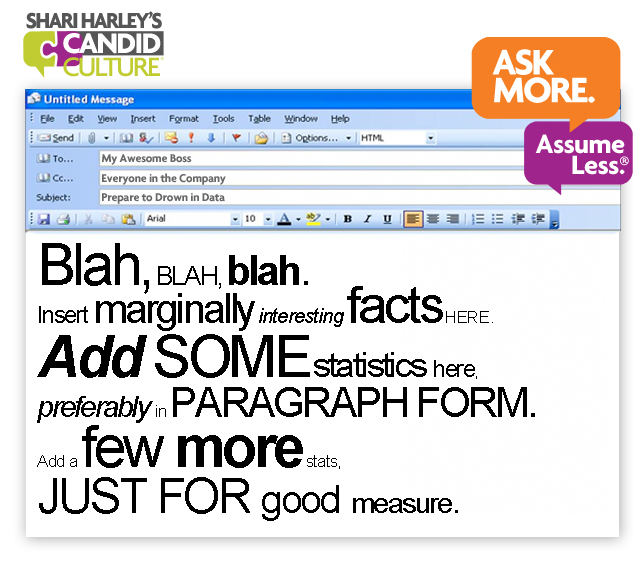
When I get an email that has multiple paragraphs I look at it, decide I don’t have time to read it, and close it out, promising to go back to it later when I have more time, which never happens. If you want your emails read, shorter is better.
Here are a few tips for writing effective emails that are more likely to be read:
Put a specific subject in the subject line that says what the email is about.
This does not include your name. We already know your name.
Example: “Meeting” (that’s not specific). Instead try: “Meeting to agree upon Q3 goals.”
Highlight and bold important parts of the email.
Limit this practice so what’s bolded and highlighted stands out.
If everything is bold, nothing stands out.
Use bullets.
Use the fewest number of words possible.
Use links that send readers to relevant information.
Offer to provide additional information, if desired.
The shorter your emails are, the more likely they are to get read. You can always offer additional information, but readers won’t get to the detail if they never read the email. When it comes to writing effective emails, shorter is better.
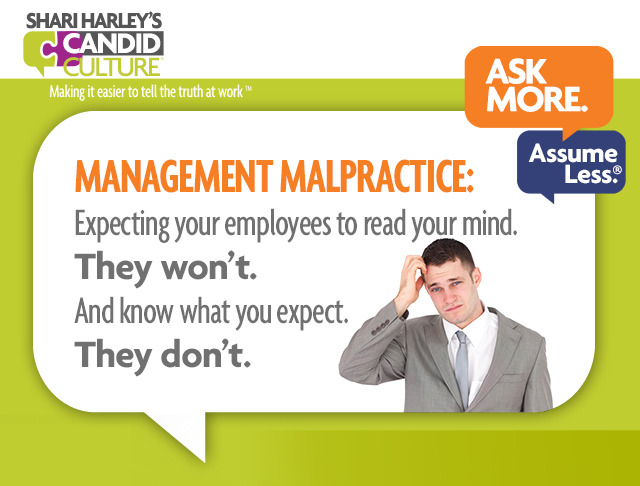
We have all worked hard on a project, only to find out that what we created was not what our manager was expecting. When this happens, everyone is frustrated. Managers question whether or not employees listen. Employees wonder why managers weren’t clearer about what they wanted at the beginning.
Giving negative feedback is hard. Asking for what you want will always be easier. Managers would be well served by setting clear expectations at the beginning of working relationships and projects. Tell your employees what a good job looks like. Don’t make them guess.
If you want a weekly status update, tell employees that rather than being frustrated when you don’t know where projects stand. If you want a bulleted summary, tell people that rather than being annoyed when five paragraphs land in your inbox. If you envision a report with tables and charts, tell employees that versus being disappointed when they create a bulleted list. Setting clear expectations applies to all internal and external working relationships – up, down, and lateral.
Most of us assume people will do things the way we do. They won’t. Save time and reduce frustration by being crystal clear when you set expectations at the beginning of anything new.
When people see the title of my book How to Say Anything to Anyone, they think it’s a book about giving feedback and having difficult conversations. It’s not. How to Say Anything to Anyone is about asking more questions, so you know what your direct supervisor, coworkers, and customers need and don’t have to guess. How to Say Anything to Anyone is not about giving people bad news. It is about asking for what you want before challenges occur and then talking about how you’ll deal with challenges when they arise.
If you work for or with someone who does not set expectations that are clear, then you, the employee, needs to set those expectations.
Set expectations by asking your manager and coworkers:
• When do you want to see this, in what format, with how much detail?
• What does a good job look like?
• What’s your expectation of how this should look when it’s complete?
• Where does this fit, as a priority, in relation to other projects?
• How does this project fit into the department’s or organization’s goals?
Asking questions and telling people what you want is always easier than giving negative feedback. Everyone – employees and managers alike – are accountable for ensuring that expectations are clear and that work is done right the first time Ask more. Assume less.
Download the five questions managers must ask their employees to set expectations that are clear:
Sign Up
Career tips you won't get elsewhere. Sign up to get a free tip card.