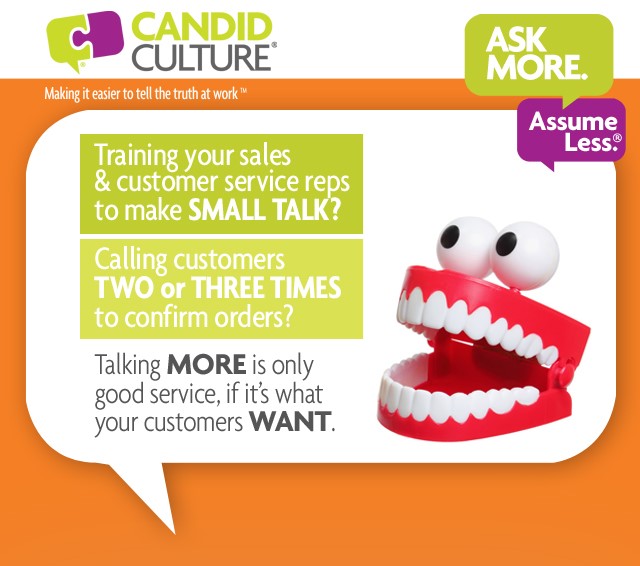
Many organizations think they’re improving customer service by training sales and customer representatives to make small talk — asking how a customer’s day, week, or trip is going. Asking questions and chatting with customers about personal matters is only good customer service if clients WANT to make small talk.
When room service delivers breakfast and the hotel guest is standing in a towel, he’s probably not interested in talking about whether his trip is for business or pleasure and whether or not he’ll have time for fun while he’s in town. Improving customer service will likely require the wait person to get in and out of his room quickly. When a ride-share driver talks with you when you want to work, his desire to chat probably isn’t improving customer service.
Sales and customer service representatives can also over communicate about business-related issues. Last weekend I ordered some equipment online. Shortly after placing the order, a customer service representative called me because I’d provided different billing and shipping addresses, and he wanted to be sure that someone wasn’t fraudulently using my card. Focused on improving customer service, he asked me to call back before they’d ship my item, which I needed Monday and paid $32 to have sent via overnight mail.
When I called back, I got voicemail and left a message. Then I spent the day wondering if the guy got my message and if my order would arrive on Monday. Then he left another voicemail saying that one of the items I ordered was out of stock but he thought they might have it in another color. He then called again to tell me that they did indeed have the item in a different color and asked me to call back. When I called back, I was told that my order had already shipped. Three unnecessary phone calls on a Saturday is not improving customer service.
You may be thinking this situation is an anomaly, but it happened to me again a few days later. I returned a pair of pants I bought online. I wrote a letter explaining for what item I wanted to exchange the pants. A customer service representative called to ask if I was sure about what I wanted and asked me to call back. When I returned the call, I was told that my order had already shipped.
I suspect companies think they’re improving customer service by asking how a customer’s day is going and by calling customers personally when questions arise. Perhaps I’m too busy, but having to call a vendor to tell them that I meant to order what I ordered and I really do have a separate billing and mailing address is not improving customer service. It’s time consuming and annoying.
I’m aware my preferences are not consistent with all buyers, and many customers appreciate calls from vendors and making small talk with wait staff, taxi drivers, and other service providers. But you won’t know what your customers want if you don’t ask them. Consider asking customers about their preferences when they buy something.
Here are a couple of questions you could ask, with the goal of improving customer service:
If we need to contact you, what method is best? Phone, email, or text message?
Ride-sharing drivers, massage therapists, dentists, etc. ask, “Would you like a silent ride/visit?”
What’s your definition of good customer service? Check all that apply.
Get it done fast and right the first time.
Get to know me. I’m happy to chat.
Get it done right and ask all the questions you’d like.
I’ll sacrifice pleasantries for speed.
Our customers don’t necessarily share our definition of good customer service. Small talk may suit some customers, while it alienates others. Read your customers’ body language and listen to their tone of voice. Do they look and sound like they want to chat with you? Do they happily provide you with detailed answers to small-talk related questions, or do they provide short answers and appear impatient? Listen, watch, and adjust your behavior accordingly. Or preferably, ask what customers are expecting from you when they buy. Ask more. Assume less.
Who have you fired lately? The person who cuts your hair or lawn? A doctor, accountant, or restaurant where you had a bad experience? Did you call any of those providers and tell them why you were replacing them? My hunch is no. There’s little incentive to do so. Why risk their defensiveness? It’s easier to just replace them. And the same is true for you.
There’s little incentive for the people you work with to tell you when you frustrate them. The perceived cost seems too high. The people you work (and live) with have experienced others’ defensive responses to negative feedback (which is no fun) and they don’t want to experience your reaction. As a result, when you disappoint or frustrate others, it’s easier to say nothing than tell you the truth.
The tendency for others to tell you things are fine when they’re not, will prevent you from managing your career and relationships. People will go missing and you’ll be passed over for professional opportunities and never know why.
To make it more likely that people will tell you when you disappoint or frustrate them, make it easy to tell you the truth.
Here are seven practices for receiving feedback:
Receiving Feedback Practice #1: When you begin new relationships, tell people you want their feedback.
Receiving Feedback Practice #2: Promise that no matter what people say, you’ll respond with “thank you.” This is very hard to do.
Receiving Feedback Practice #3: Tell people you already have relationships with, that if you haven’t said it in the past, you really want their feedback and promise to respond graciously with “thank you.”
Receiving Feedback Practice #4: Ask people who matter to you for feedback regularly.
Receiving Feedback Practice #5: Resist the urge to get defensive.
Receiving Feedback Practice #6: Catch yourself when you start to become defensive and apologize. Say something like, “I’m getting defensive. I’m sorry. Tell me again. I’ll do a better job of listening.”
Receiving Feedback Practice #7: Take a break from conversations during which you find yourself responding defensively. Say something like, “I’m not responding as well as I’d like. How about we take a break? Give me a few minutes (hours or days) and I’ll come back to you to talk more. I really want to hear what you have to say.”
The aforementioned list provides recommendations for asking for and receiving feedback you want, not feedback you don’t. You are not a dumping ground. Don’t ask for feedback you don’t want. And when you do ask for feedback, qualify what type of feedback you’re looking for. Telling people “I want your feedback” doesn’t mean they’re welcome to say whatever they want.
The purpose of asking for feedback and making it safe to tell the truth is to give you more control over your career and relationships. It’s ok to be passed over for opportunities and relationships, but it’s unhelpful not to know why.
Much of what comes through our phones is not important – emails we don’t really want to read, advertisements for things we won’t buy, and social media updates we don’t care about. And yet those little devices are so seductive. It’s hard not to check your email, texts, and social media updates constantly. Being so connected electronically and thus so continuously distracted has its benefits but it also has real costs.
Most of you know I have a small child and I’m committed to being a present and involved mom. I spend a lot of time with my son. But the best times are when I leave my phone behind. Without my phone I’m fully present with him, in the moment, enjoying him. When I have my phone, I’m distracted, often stressed, and typically torn. Can’t I read this email and reply quickly? What’s the harm? It will only take a second.
And each time I take a minute to read my email, I’m gone. I’m focused on my phone. And then I feel guilty and sad for not being as engaged as I want to be. Then I recommit to being fully present. And then read my email again. It’s a vicious cycle.
There is a huge cost to being distracted most of the time. Our relationships suffer. Car fatalities have increased tenfold. People are consistently tired.
Every productivity expert will tell you to check your messages three times a day, respond, and to not be constantly reading email. It’s fantastic advice. And I suspect no one, including productivity experts, follows it. It’s just too hard. We’re lured by our phones, tablets and laptops. Not checking them regularly makes us antsy, uncomfortable, and nervous.
What would happen if we set defined periods of time for each thing we did? I.e., Spend from 2:00 pm – 4:00 pm working on a project. At 4:00 p.m., check your phone. Take the weekend off and check your messages at 7:00 p.m. on Sunday. I suspect we’d get way more done and feel less stressed. But we have to give ourselves permission to put the phone away.
Here are three ways to be more focused and productive, and hopefully, happy:
1. Schedule work and personal activities for realistic, defined periods of time, and stick to them.
2. Agree on no cell phones or other electronics during personal meals and outings. I like the game people are playing in restaurants by putting cell phones face down in a pile on the table. The first person who touches their cell phone pays the entire bill.
3. Agree on no cell phones during group or one-on-one meetings. Your meetings will be shorter, easier to manage, and more productive. Meeting attendees want to tell their peers to put away their phones but feel like they can’t. Strong meeting facilitators who set and hold to this expectation earn others’ respect and run productive meetings.
In a nutshell, give yourself permission to focus. Do one thing at a time for a short period of time. Allow similar chunks of time to read and reply to messages and read Facebook updates you don’t care about. Then put the phone down and walk away. Your family and friends miss you.
Chances are, at some point in your career, you’ve worked with someone you wished would go away. Maybe the person repeatedly threw you under the bus, took credit for your work, or didn’t keep their commitments. And at some point, you wrote the person off, and have been merely tolerating them ever since.
Damaged relationships can be repaired, if you’re willing to do some work.
The first step in repairing a damaged relationship is to decide that you really want to do so. Managing conflict in the workplace isn’t easy. It will take effort and will likely be uncomfortable, so before you take action, decide if you really want to work on the relationship.
How to know if you should try resolving conflict in the workplace: Ask yourself how much you need the relationship. This probably sounds political, and it is. If you work on projects together, need to give or receive information, or have to work together regularly, then it’s likely worth working on the relationship. If you don’t need to work together regularly, then perhaps don’t work on the relationship.
If you decide to attempt to strengthen a relationship, plan what you’re going to say. Never trust the first thing that comes out of your mouth during a difficult conversation.
Step one for resolving conflict in the workplace: Like any feedback conversation, start with the end in mind. Consider what you want to have happen as a result of the conversation.
Step two for resolving conflict in the workplace: Plan what you’re going to say by taking notes and practicing out loud. What you say in your head is usually not what comes out of your mouth.
Step three for resolving conflict in the workplace: Ask the person for time on their calendar. People don’t like surprises. You’ll have a better outcome if the person has blocked time to talk with you. Have the conversation in-person whenever possible. If you can’t speak in-person, talk on the phone. Do not attempt to fix your relationship via email. 1. Email is wimpy. 2. It will not work.
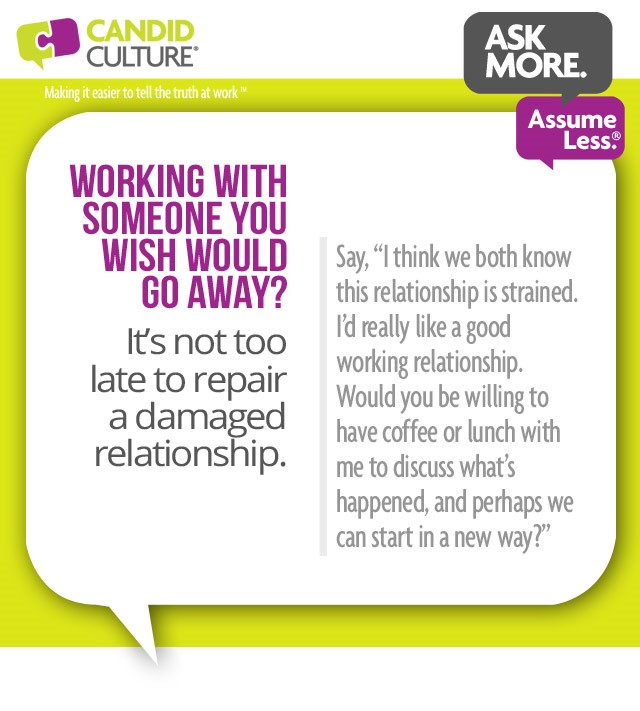
Tell the person, “Our relationship is strained. I don’t think I’m saying anything we’re not both aware of. I’d really like a good working relationship. Would you be willing to have coffee or lunch with me, and we can talk about what has happened and perhaps start in a new way?”
Step four for resolving conflict in the workplace: Ask for a meeting to work on the relationship up to three times. If, after the third time, the person hasn’t made time, stop asking. You can’t work with someone who won’t work with you. If the person doesn’t make time to meet, be polite, professional, and inclusive, but stop trying to nurture the relationship. Inclusive means: cc’ing them on necessary emails, inviting them to appropriate meetings, and providing necessary data.
Step five for resolving conflict in the workplace: If the person makes time to meet, speak candidly, be yourself, and be vulnerable. I don’t mean be a doormat. I do mean be authentic.
Ask for feedback about how you’ve damaged the relationship.
Listen to what you hear, and resist the urge to defend yourself.
Ask for permission to tell him how he’s damaged the relationship.
Give small amounts of feedback, with a few specific examples.
Make agreements of what each of you will do differently in the future.
Thank the person for the conversation and schedule another meeting.
Step six for resolving conflict in the workplace: Build in follow-up. Most people have one conversation and expect things to be fixed forever. Relationships don’t work that way. Agree to meet monthly, for the first few months, until you’ve rebuilt trust and learned how to communicate and work together. During the monthly meetings, give each other permission to give candid feedback about how you’re working together. I call these Relationship Inventory Meetings.
During monthly Relationship Inventory Meetingsask:
What’s working about how we work together?
What’s not working?
What working agreements did we keep?
What working agreements did we break?
Which working agreements are helpful?
What working agreements need to change?
You might be thinking, “I don’t like this person. I don’t want to work with them. And I definitely don’t want to have these uncomfortable conversations.”
If the nature of your relationship is impacting your ability to do your job, your professional reputation, or your happiness, all of those consequences are far worse and more long-lasting than any conversation will be.
The conversations won’t be as bad as you think. No one will tell you anything you can’t handle, because for the most part, they’re afraid of your reaction and they know they’ll be next.
Conflict in the workplace and damaged relationships keep people up at night, reduce job satisfaction, and often motivate people to leave jobs. If you’re experiencing any of these things, all of them are worse than any conversation will be. The anticipation of the conversation is far worse than the conversation itself.
Decide if you want to strengthen the relationship.
Plan the conversation.
Ask for time to meet.
Have the conversation. Speak honestly, but responsibly.
Plan to have another conversation before ending this conversation.
Congratulate yourself for being courageous and picking happiness over anxiety and frustration.
Sign Up
Career tips you won't get elsewhere. Sign up to get a free tip card.