How many times have you been sitting at your desk wondering, “Why won’t they ___________ ?” Perplexed, you talk with your buddy at work. The conversation goes something like, “I’ve got this person, and I can’t figure out why they won’t ______________.” Or perhaps you talked directly to the person, but after several conversations, they still haven’t done what you asked them to do.
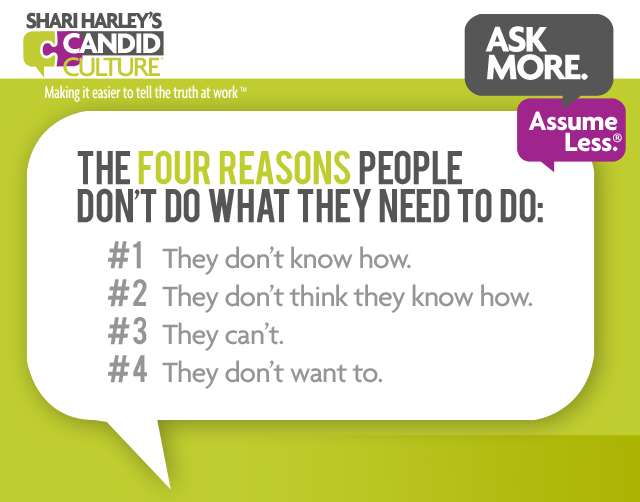
There are four reasons why people don’t do what you ask them to do:
They don’t know how.
They don’t think they know how.
They can’t.
They don’t want to.
Reason number one for a lack of employee performance, they don’t know-how, is the easiest to solve. People who don’t know how to do something need training, coaching, a mentor, a job aid or some other form of instruction. The hope is that with the right training and exposure, they will be able to do what you’re asking.
Reason number two for a lack of employee performance, they don’t think they know how, can be improved over time with patience and consistent coaching. You aren’t working with clean slates. Most people are recovering from or reacting to a past relationship or situation. If a person worked for a controlling manager who never let them make a decision or worked for someone who invoked punitive consequences for making mistakes, the person will likely be hesitant to make decisions. Hence why they continue to ask questions and repeatedly check in, but never make a decision independently.
If you work with someone who doesn’t think they know what to do, but you know they have the answer, encourage them to trust themself. When they come to you for validation or approval, ask questions, don’t give answers. Tell the person you trust their judgment and encourage risk-taking. Tell them you’ll support their decision, even if it proves to be the wrong one. And encourage them to make a decision next time without consulting you. Then keep your word. If they make a wrong call, you have to have their back and can’t invoke negative consequences.
Reason number three for a lack of employee performance, they can’t, is challenging but clear-cut. People who can’t do a task their brains aren’t wired for, will never do that responsibility well, regardless of how much coaching, training, and assistance you provide. If you have repeatedly and effectively, coached, trained, and provided support and the person still can’t do what is being asked, remove that responsibility and give the person something they can do well. If that responsibility is a large part of the job, you have someone in the wrong job. It’s time to make a change.
Reason number four for a lack of employee performance, they don’t want to, is annoying but manageable. There are lots of reasons people don’t do things they don’t want to do. Those reasons include, but aren’t limited to, boredom, lack of buy-in as to why something is important, insufficient time, feeling like a task is beneath them, etc. If you’ve got someone who can but doesn’t want to do something, you can either take the responsibility away, incent them to do it, or give feedback EVERY TIME the task doesn’t get done.
Giving negative feedback isn’t fun for the giver or the receiver. No one wants to hear that they aren’t meeting expectations and most people don’t want to tell you. But the discomfort of receiving negative feedback EVERY TIME the person doesn’t do what they need to do will create behavior change. They will either begin doing what you ask, quit, or ask for a transfer. Either way, your problem is solved.
The first step in getting people to do what you want them to do is to discover why they’re not doing what you ask. It’s impossible to appropriately manage employee performance if you don’t know why someone isn’t doing what needs to do be done. And the person to ask why a responsibility isn’t getting done isn’t you or your buddy, it’s the person not doing the work. So, get out of your head, leave your office or laptop, and go talk to the person not doing the work.
Here’s how to start an employee performance conversation:
“I’ve noticed you’re not doing ___________. Help me understand what’s happening.” Watch your tone, inquire from a place of genuine curiosity, and identify the reason they aren’t doing what they need to do. Then you can intervene appropriately and hopefully get what you want.
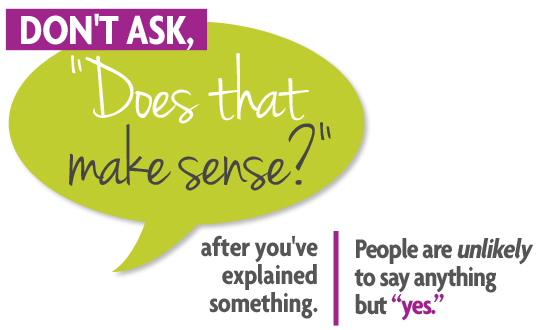
I’m taking golf lessons, which should frighten anyone within 100 feet. Every time the instructor explains something new, he asks me, “Does that make sense?” “Does that make sense” is a common clarifying question that many people ask, but it’s not a good question for two reasons.
Reason number one: If an explanation doesn’t make sense to me, I’m the idiot for not “getting it.” It’s not that the instructor hasn’t been clear, I just “didn’t get it.”
Reason number two: The question doesn’t force me to speak, thus the person asking the question doesn’t get any information. “Does that make sense” is like asking a shopper in a store, “Can I help you?” We all know the right answer to that question is, “No, I’m just looking.” This is a similar to when someone asks, “Are there any questions?” The right answer is “no.” And when people say “no,” the person who asked the question often says, “good,” affirming people for not asking questions and making it less likely that questions will be asked in the future.
The golf instructor should be asking me:
What did you learn today?
What are you planning to do as a result of what we’ve covered?
What techniques did I demonstrate?
Let me see how that form looks.
What questions do you have for me?
If he asks me the clarifying questions above, he will know what I am likely to do on the golf course.
Here are some clarifying questions that will force people to talk and won’t make them feel stupid for asking questions. Instead of asking, “Does that make sense,” consider asking:
“I want to make sure I gave clear instructions. Will you tell me what I’m asking you to do?” You could also phrase the questions like this, “Just so I know how I landed, what do you think I’m asking/expecting you to do?”
** This may sound condescending and like micromanaging in writing, but the question can be asked in a supportive and non-judgmental manner.
I was talking with one of my clients a few months ago. She was very upset because she told one of her employees what to do and he didn’t do it. Frustrated, she said, “He knew what to do, and he didn’t do it.” I asked her, “How do you know that he knew what to do?” She replied, “I told him what to do and when I asked if he had any questions, he said no.”
Her situation is a common one. The right answer to “Do you have any questions” is “no.” And we’re surprised when we swing by the person’s desk two weeks later to get a status update on the project, and he hasn’t started working on it yet.
Here are some additional examples of clarifying and delegation questions. These questions will force people to speak, providing a clearer sense of what people know and are likely to do.
What questions do you have?
What are you planning to do first? If the person answers this question appropriately, ask what they are planning to do next. If they don’t answer the question appropriately, step in and give more direction.
Provided you trust that the person knows what to do, give a tight deadline and ask to review the person’s work in a few days. Give people some freedom, but not enough to waste a lot of time and go down a fruitless path. Delegation is something at which most managers can improve. More effective delegation will lead to fewer missed deadlines and frustrations in the workplace.
You’ve either seen the video or heard about the group think that happened before NASA’s Challenger exploded in 1986. One engineer felt strongly that there was a defect in the Challenger’s design. He spoke up, others disagreed. He continued to speak up, until it became very uncomfortable to do so.
Most employees don’t even get that far. Many employees are afraid to speak up at all, feeling that it’s not ok to have a counter point of view, and that those who disagree with ‘management’ are eventually fired. I honestly am not sure where this comes from. It hasn’t been my experience, and yet the fear of speaking up is pervasive. I hear it in almost every organization with which I work.
If it’s not ok to express different opinions, your organization will deliver the same-old products and services you always have. If staying the same works in your industry, great. But stagnation is detrimental to most organizations.
If you want more innovation in the workplace, you have to make it safe to speak up and offer a different point of view. Saying new, different, and even controversial things must be encourage and rewarded.
Five Ways to Encourage Innovation In the Workplace:
Wait until you get both. Don’t allow a meeting or discussion to move on until you get new, opposing, and different points of view.
Positively acknowledge people who risk and say something new or different from the norm.
Ensure people with new ideas and different points of view are allowed to finish speaking before they’re interrupted or before someone else tries to negate their ideas.
Create a few new awards in your organization and announce winners publicly and with great fanfare. You get what you reward.
Create Awards to Encourage Innovation In the Workplace:
Acknowledge the person who fails massively trying something new.
Award the person who brings new ideas to the table, regardless of what happens to those ideas.
Celebrate the person who willingly gives you the worst news.
The fear of speaking up and saying something new or different will destroy your innovation efforts. It will also squelch your employees’ ambition and ability to be creative. Make it safe to tell the truth, even when the truth is hard to understand or unpopular, and see what happens to innovation, creativity, and employee productivity and morale.
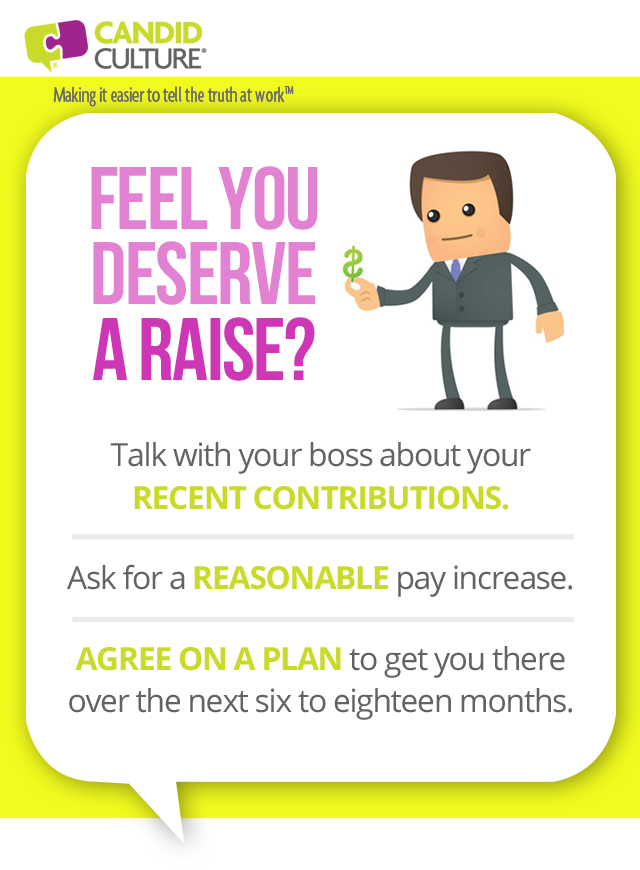
The best way to get your next job is to be great at your current job and ask for more. And the same goes for asking for a raise. Do a great job, make your contributions known, and work with your boss to create a plan to help you get to the salary you want.
Saying or acting as if you’ve been treated unfairly and that your talents aren’t being recognized may be true, but it may also get you the reputation as a negative whiner. People want to work with positive and appreciative people. Demonstrate both when asking for more.
Below are eight steps for asking for a raise:
How to ask for a raise step one: Write down the accomplishments you’re proud of since your last significant pay increase.
How to ask for a raise step two: Find out what your job pays on the open market. Jobs are assigned a value and a pay zone that is often transferable across industries. For example, if an entry level accountant at a big four accounting firm is earning $60,000, the pay zone is likely $50,000 – $70,000. If said employee asks for $64,000, that’s realistic. If they ask for $85,000, they’ll be seen as out to lunch. If an employee wants to earn $85,000, with their current level of education and experience, they’ll have to switch careers.
How to ask for a raise step three: Learn your company’s philosophy on compensation. Companies often deliberately decide to pay in the top, middle, or lower part of pay zones. For example, if an industry like sports or entertainment is glamorous and lots of people want to work in that industry, jobs are likely to pay less. Perhaps a company has great perks and benefits, and in exchange, pays less. Alternatively, some companies want to be known as providing the highest compensation and will pay for it. Knowing where your company falls on the compensation spectrum will help you determine a realistic number to ask for. Your Human Resources representative can answer these questions.
How to ask for a raise step four: Be prepared to present and talk about the impact you’ve made on your organization. Focus on accomplishments and how you’ve changed the business, not on how hard you’ve worked. Results get rewarded.
How to ask for a raise step five: Don’t give an ultimatum, unless you’ve already discussed a pay increase a few times, nothing has changed, and you’re ready to leave. Instead, work with your manager to create a realistic plan to get you to an agreed-upon pay rate. Put the plan, with specific milestones you need to hit, in writing and agree to discuss results quarterly. Managers may be hesitant to promise a future pay increase, but will support written work-related goals, which will help you make the case for a pay increase.
How to ask for a raise step six: Don’t be afraid to ask for a raise. You may not get the raise you want, but nothing bad will happen for asking, providing you do so appropriately. The initial conversation could sound something like, “I love working here and am really enjoying my job. Because of my contributions to our organization, I feel I’m worthy of a pay increase. Can we schedule a time to talk about what might make sense? And with your permission, I’d like to send a list of my most recent accomplishments. Would that be ok?”
How to ask for a raise step seven: Discover who needs to support your pay increase. Your boss may not have the ability or authority to give you an increase. Subtly ask what they can do. That could sound something like, “Who needs to participate in the decision to grant me a pay increase? Is there anything I can do to assist with sharing my accomplishments or making the case for an increase?”
How to ask for a raise step eight: Once you know what your job pays across industries and your company’s philosophy on compensation, ask for a realistic number that will make you happy. If you’re asking for large increase, consider incremental raises over a period of months. Ask for something that’s easy to say yes to.
If you think you deserve a pay increase, don’t be afraid to ask. Ask in a positive way, focusing on the value you’re adding to the business. Be patient and work with your boss to create a plan to get where you want to be. The worse you’ll hear is “no.” And if the answer is no, you’ve planted a seed and opened the door to the next conversation.
Sign Up
Career tips you won't get elsewhere. Sign up to get a free tip card.