Archive for September, 2021
People are not us; they do things their way, not ours. This is so obvious. Yet violated expectations are consistently a source of lots of frustration and upset, both personally and professionally. “How could you not check your work before submitting information to a client?” “What do you mean you didn’t call that person back?” “You said what?!”
The most frequent request we get at Candid Culture is for feedback training. The call usually goes something like this, “The communication isn’t great at our company. Managers don’t give a lot of feedback. People don’t talk directly to each other when there are problems, they talk about each other. Can you help?”
Sure, we can help. But once we’re having this conversation people are already frustrated. Trust has been violated and relationships and reputations have been damaged. Instead of waiting for problems to occur, expect the unexpected. Set clear expectations before people don’t proofread reports, miss deadlines, and do other things you wouldn’t dream of doing.
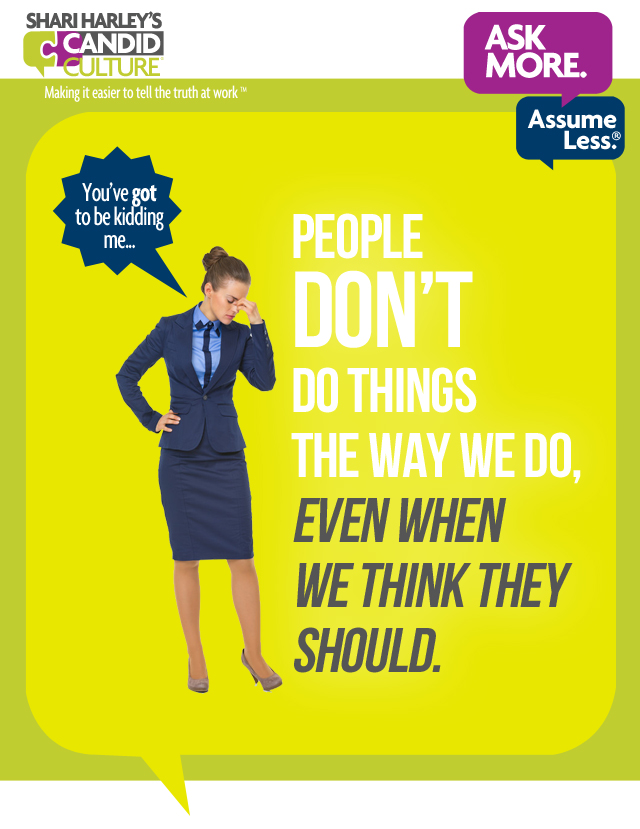
How to avoid violated (often unstated) expectations? Ask more questions.
Here are seven questions you should ask every person you work with to set expectations. And if you do, your workplace will have fewer frustrations and violated expectations:
- What’s most important that you’re working on right now? What are your goals this quarter?
- What are we both working on that we can work on together? Or what should one of us stop working on?
- How do you like to communicate? Phone, video, in-person, by appointment, or impromptu calls?
- How do you like to receive information – email, voicemail, text message or instant messenger?
- If I need information from you and I haven’t heard back from you, what should I do?
- What are your pet peeves at work? How could I annoy you and not even know it?
- How do you like to be interrupted? (You’re going to be interrupted. You might as well have a preference.)
Here’s the philosophy and practice: People aren’t you. Anticipate challenges, breakdowns, and violated expectations, and talk about them before they happen. Make requests. Ask questions.
It’s always easier to ask for what you want than to give feedback.
If you want to freak out the people you work with, tell them, “We need to talk.” If you really want to freak them out, say those four magic words on a Friday, or even better, the day before someone goes on vacation. “We need to talk” is rarely followed by, “and you’re awesome.” People know bad news is likely coming, and they’ll inevitably be on edge.
The antidote to asking for time to talk is to create opportunities to give feedback regularly.

There are many reasons giving feedback is hard. One of them is we wait too long. Something happens. We know we should address it, but we don’t want to. So, we wait to see if the behavior is really ‘a thing.’ Then it happens again. And now we know it’s ‘a thing.’ But we still don’t want to address it. Then the situation gets really bad, and now we have to say something. The conversation then takes 90 minutes, is painful, and everyone goes home unhappy.
Here are two keys to make giving feedback easier:
Giving feedback strategy one: Debrief everything. Do a quick plus/delta on a regular basis to assess how things are going. Plus – what went well? Delta – what would we change if we could/what did we learn?
I recommend doing a quick debrief at the end of important meetings, hiring processes, projects, and when anything changes. Conduct a short debrief when you have staffing changes, gain or lose a client, launch or eliminate a product or service, etc. Change is an opportunity to evaluate how you work and to make appropriate adjustments.
When you debrief important events, you tell people that feedback is important and that it’s ok to be candid. Conducting regular debriefs also gives employees a chance to practice giving feedback, which is a hard skill. And like anything, the more we give feedback, the easier it becomes.
Conducting short, regular debriefs is one of the easiest ways to learn from the past and become a more candid culture.
Giving feedback strategy two: Schedule five to fifteen minutes each week to talk as a team or with direct reports. When you know you have time each week to talk with your manager, direct reports, and/or team members, you never have to ask for time to talk. Issues don’t build up or linger. Breakdowns and frustrations are discussed within of few days of their occurrence, and no one is on edge that bad news is coming at their end of their vacation.
The key to being effective at giving feedback is to give feedback regularly. Short, frequent feedback conversations are much more effective than infrequent, long conversations that everyone dreads and leaves feeling exhausted and demoralized.
Debrief everything meaningful. Meet with people weekly. Ask for and give feedback as things happen, and watch your culture change.
People often hoard feedback until a situation becomes so frustrating that they can’t help but speak up. And because they waited too long to say what they think, many more words come tumbling out than is either necessary or helpful.
When it comes to giving feedback, less is more. Be specific, give an example or two, and stop talking.
If you want people to be receptive to your feedback, make it easier to hear by saying less. By saying less, I don’t mean don’t tell the truth or provide enough information that the person knows precisely what to do differently. I do mean, don’t provide more information than is necessary.
You are likely familiar with the phrase “let someone save face.” Allowing someone to save face requires saying just enough that the person knows what to do differently, but not so much that the person feels attacked.
Here are two examples of giving feedback do’s and don’ts:
Too much feedback: Last week you turned in a report that had five typos and had important pieces of information missing. I’m surprised you’d be so careless. It made our entire department look bad. I’m perplexed that you’d submit work without checking it first. What is leading you not to check your work and submit incomplete reports?
Don’t repeat feedback. Say it once and move on. And remove unnecessary judgments (careless) and share just the facts.
Just the right amount of feedback: The report you gave me last week had a few typos and was missing some important information. The report went to the client with those errors which didn’t reflect well on our department. What happened?
Too much feedback: I noticed you didn’t speak up during last week’s department meeting. People won’t know the value you provide if you don’t share what you’re working on. You need to be more vocal. People’s only exposure to you is often during our team meetings. If you don’t speak up, you won’t establish yourself as a leader in your department. People really need to know what you’re working on and the impact you’re making.
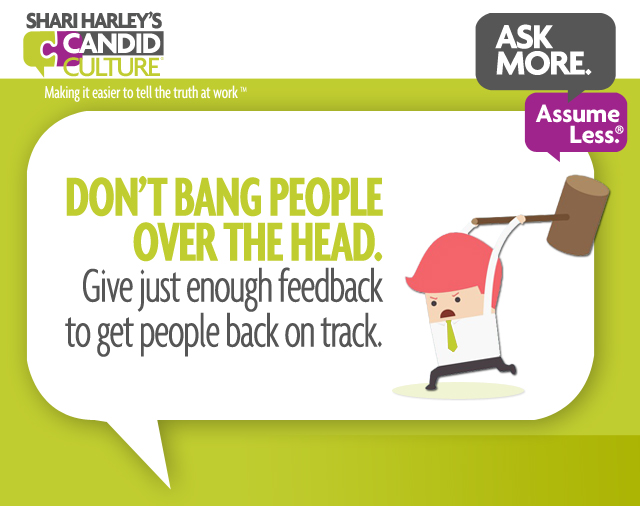
Redundant feedback feels critical and leaves the person feeling like they have been hit over the head with a mallet.
Just the right amount of feedback: I noticed you didn’t speak during last week’s department meeting. Often, team members’ only exposure to you is during our weekly meetings. How can I help you feel comfortable speaking up so you can establish yourself as a leader in the department?
It’s easy to get carried away when giving feedback. We’re likely frustrated. And when our emotions run the show, it’s easy to say too much.
Here are three practices for giving feedback:
- Practice the 24-hour guideline and the one-week-rule. If you’re upset, wait 24-hours to give feedback, but not longer than a week after an event.
- Plan what you’re going to say both in writing and out loud. Practicing a conversation in your head is not the same as speaking it.
- Let someone you trust hear what you’re planning to say and ask that person how you can improve the feedback. Ask what you can remove without losing any of the message.
Planning a conversation is like packing for a trip. When packing for a trip, many people put their clothes on the bed, then put the clothing in a suitcase. Realizing they have way more than they need, they start taking things out of the suitcase. Eventually they arrive at their destination with much less than they initially packed, but still more than they need.
Use the same principles when planning a feedback conversation. Put every thought you have on paper, and then remove what you don’t need, leaving only the necessary points that tell the person just what they need to do differently.
When giving feedback, less is more. Tell the person what happened, why it’s a problem, and what they need to do differently. Then stop talking and let the person save face.
Most of us avoid giving negative feedback because we don’t want to deal with the recipient’s defensive behavior. We’re waiting for what I call, The Freak Out. The Freak Out is the predictable response to negative feedback.
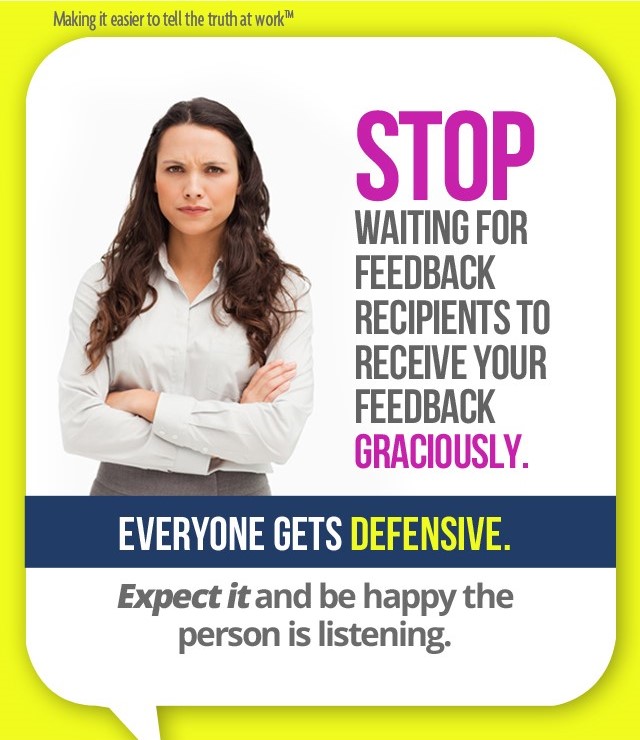
Everyone wants to be seen as competent and adding value. When we give people negative feedback, we call those two things into question and the brain instinctively reacts. It’s as if you were driving down the road and the person in front of you slammed on their brakes. As an act of survival, you’d hit your brakes too. Becoming defensive when receiving negative feedback is the same instinctual response. We (almost) can’t help ourselves. So rather than dread and avoid others’ defensive behavior, expect it and have a plan.
Here are five ways to deal with defensive behavior:
- Plan your conversation by writing notes and bringing them to your conversation. I’m a fan of typed, double-spaced bullets that are easy to follow.
- Practice what you want to say out loud. What you say in your head is often different than what comes out of your mouth.
- Ask others for help. Change names and details to protect the feedback recipient and ask how someone else might deliver the feedback. Someone who is not emotionally involved will likely handle the conversation better.
- When the feedback recipient exhibits defensive behavior, take a breath and pause. Remember that you expected this. Don’t retract what you’ve said. Just let the person speak.
- Stay on track. Defensive behavior is designed to derail conversations. Keep the conversation focused on the feedback. Don’t become distracted.
What to say when people respond to feedback defensively:
Defensive behavior: “Why are you talking to me? I’m not the only one doing this.”
Appropriate response: “If others are doing this, I promise you that I’m managing it. Right now we’re talking about you. I know this is difficult. Let’s stay here.”
Defensive behavior: “You’re wrong. Everyone else has given me positive feedback.”
Appropriate response: “I know this is difficult. I’m asking you to __________. Please do that.”
Defensive behavior: “You don’t like me and you’re picking on me.”
Appropriate response: “I’m sorry you feel that way. The reason I’m asking you to ________ is _______.”
Defensive behavior: “I disagree.”
Appropriate response: “I know that we disagree. And I’m asking you to __________.”
The key is not to get baited by defensive behavior. This is why I suggest preparing and bringing notes. When I’m having a particularly difficult conversation and the other person becomes defensive, I often become flustered and either forget what I want to say or back pedal. Do neither. Expect defensive behavior. Don’t get distracted. Stay on track. You can handle anything someone says.