In all of my years of working in and with organizations, I have
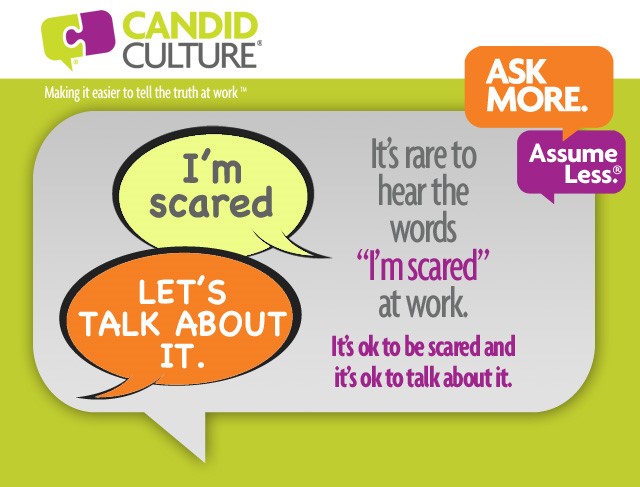
never heard anyone say the words, “I’m scared” at work. I’ve heard: “I’m
concerned” and “I’m uncomfortable,” but never the words, “I’m scared.”
These are scary times. It’s scary to go to the grocery
store, to know who it’s ‘safe’ to stand next to, and to travel.
Make it safe for employees to talk about their fears.
One of the first things I teach when I talk about change management
is letting people express how they feel – their worries, hopes, and concerns.
The people you work with are likely scared. They may be wondering if their job
is secure, what happens if they get sick, and are they doing enough work from
home with their kids present.
It’s hard to talk about fear because we think doing so makes us appear weak. Leaders and managers need to normalize the conversation. Make it ok to talk about how people feel at work.
Here are four steps to make it easier to talk about fear
at work:
Leaders and managers – admit what you’re afraid
of. People will take your lead. Admitting how you feel demonstrates strength
not weakness.
Tell people it’s ok to be afraid and it’s ok to
talk about fear at work. Sanction the conversation.
Give more information about contingency planning,
budgets and work from home and time off policies than you think you need to. Communicate, communicate, communicate. Then do it again.
Create a forum for people to talk about how they
feel about recent events and changes. Managers are not therapists or dumping grounds,
but you are coaches. You can help people work through their work-related fears
when you know what those fears are.
I’ve always believed that demonstrating our humanity at work
is a strength. Being authentic makes people want to work for and with you. Admitting
concerns makes you approachable and real.
Your employees and coworkers don’t need to know the details of
your whole life, but they do need to see your humanity and be able to relate to
you. Talk about how you feel and open the door for others to do the same.
I have a nanny who works in my home. She isn’t afraid of getting sick with the Coronavirus. She was going to the gym, before gyms were closed. I couldn’t tell her not to, however badly I wanted to. I could tell her not to come to work, but that doesn’t help me. How does a nanny work from home?
You are likely in a similar situation. You canceled your spring break trip, your direct report didn’t. You are practicing social distancing, your coworker who sits in the desk next to you isn’t. You’re keeping your kids at home; your next-door neighbors are not. Your kids want to play together.
You can’t
legally tell an employee or coworker what to do when they’re not working, but
you can tell your coworkers, friends, and family members that you’re uncomfortable.
You can make requests and express concern.
My son is on
the cusp of the cutoff to go to kindergarten in September. He just makes the
deadline. I’ve been asking his preschool teacher how I decide if I should send
him to kindergarten in September. His teacher’s criteria for determining if
children are ready for kindergarten is self-advocacy. Can children ask for what
they need and get their needs met. This is an interesting criterion that I see
adults struggle with all the time.
Do we (the adults)
regularly ask for what we need and want? Are we willing to be uncomfortable on
our own behalf, on our employees’ behalf?
The coronavirus
is testing all of us. It’s testing our patience, resilience, and self-discipline.
It’s also testing our personal courage in the area of speaking up.
Here are
a few ways to talk about the coronavirus at work:
Share
your concerns. Tell the
people you work with, “We work closely together. I’ve heard you talking about
attending parties and other events with groups of people outside of work. I am
very nervous about contracting the coronavirus virus. This is making me uncomfortable.
I can’t tell you what to do outside of work. Can we talk about what types of social
distancing we’re both willing to practice so we’re both comfortable?”
This will take
courage. If you can’t advocate for yourself, who will?
Make
requests. Tell your
boss, “I’m really committed to the project I’m working on with _______. I’m
working very hard to stay healthy and practice social distancing. I’ve heard _________
talking about going to parties and gatherings with other people outside of work.
We’re working closely together and it’s making me uncomfortable. I want to be a
good coworker and employee and protect myself. Can you help me?”
Self-advocacy
takes courage.
Caveat – Vet
any conversation you plan to have with your HR person or in-house counsel. Make
sure what you ask for is legal in your home state.
Share your
positive intentions:
“I want to be a good coworker.” “I want
to do good work on this project.” “I want to be easy to work with.”
Share your
concerns: “I’m concerned about getting sick. I’m trying
to limit my exposure to the coronavirus.”
Share your
observation: “I’ve
heard you talk about spending time with groups of people outside of work.” “I’ve
noticed you spending time with groups of people.”
Share how
you feel: “This is
making me uncomfortable.”
Make a
request: “Can we
talk about how we can keep each other safe?”
Creating a safe workspace and working environment requires the courage to speak up. Plan, practice, and prepare your conversations. Don’t speak off the cuff. Vet what you plan to say with your HR person or in-house counsel. Speak from your positive intention. Be courageous. Be safe.
At some point, you’ll get passed over for a promotion, project, or piece of work, and no one will tell you why. Why should they? There is little incentive to deal with your likely (human and normal) defensive response. It’s easier to say nothing.
The problem is that this lack of information gives you no ability to manage your career.
Most people get almost no feedback at work. “Good job” isn’t feedback. Neither is, “You seem distracted.” And being told, “You just weren’t the right fit,” is utterly unhelpful.
If you want to manage your career, you need more information. Getting this information might seem scary. You might be thinking, “What if I don’t want to hear what people have to say? What happens if I hear something really bad?” People are so hesitant to give feedback, they’ll likely be ‘nice’ to you. You won’t hear anything you can’t handle.
There are people in your life who will tell you the impression you create, what you’re like to work with, and why you might not have gotten a job you really want. They’ll tell you, if you ask and make it safe to tell you the truth. Making it safe means you can’t defend yourself. No matter what the person says and how hard it may be to hear, you must respond with, “Thank you for telling me that,” even if you’re convinced they’re wrong.
The easier it is to give you feedback, the more feedback you’ll get. The harder it is to give you feedback, the less you’ll get. Remember, no one wants to deal with your defensive response. It’s easier to say nothing.
Identify five people in your life who care about you, who you trust. They might work with you now, but perhaps not. Don’t overlook your friends, family, spouse and past co-workers. Tell each person, individually, that you want to know more about the impression you make and what you’re like to work/interact with. Do this over the phone or in-person. Emailing the request doesn’t demonstrate seriousness. Ask the person to schedule a conversation with you. Send your questions in advance, so the person is prepared. Have the scheduled meeting; don’t cancel it, even if something important comes up. Consider asking: The first impression you make; what you’re like to work/interact with; the best thing about you; and one change you could make. Say, “thank you,” for the information and not more. Don’t underestimate the power of your emotions. Everyone gets defensive when receiving feedback. Defensiveness can be off-putting and scary to others. Don’t do anything to limit future feedback.
Ask these questions a few times a year. You don’t necessarily need to make any changes, based on what you learned. The point isn’t to act on the information, it’s merely to have it. Information is power, and power is control.
You know when someone gives you ‘the tone’, similar to when people roll their eyes at you? When you get ‘the tone’ you’re being told that the other person is exasperated.
Tone of voice is one of the hardest things to coach because we don’t hear ourselves. People who give people ‘the tone’ rarely know they’re doing it. One of the best ways I know to effectively coach tone of voice is to ask tone givers to tape themselves during phone calls. Then listen to the recording together and ask the tone giver, “If your grandmother called and someone spoke to her that way, would you be happy?” You can also read written correspondence out loud, adding the tone you ‘heard’, and ask the sender how she would have interpreted the message.
When given the tone, most people feel judged. And when people feel judged, conversations are constrained.
The way to avoid giving ‘the tone’ is to come from a place of curiosity. When you ask the question, “What were you thinking when you approached the customer that way,” you can sound curious or judgmental. Being judgmental evokes defensiveness, which shuts conversations down. Being curious creates discussion.
Consider asking questions like these to invite discussion:
• Tell me more about… • Help me understand what happened here… • What are your thoughts about… • What’s the history behind….
Any of these questions will lead to a good discussion, if you manage your tone.
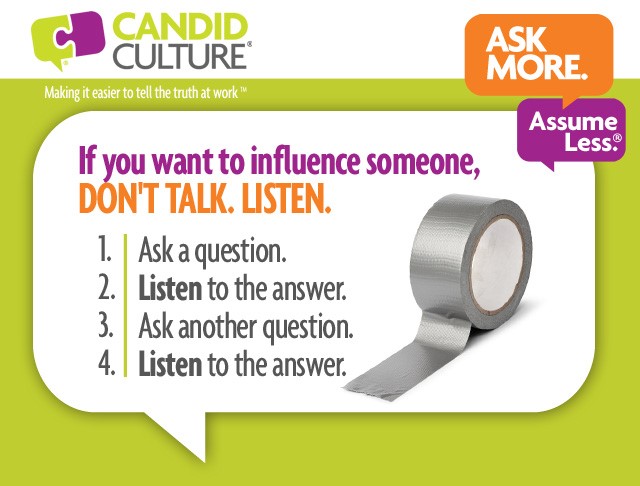
If you want to get information or influence someone, ask questions and engage the person in a dialogue. We often try to persuade people by giving them information. This rarely works. Instead of overloading people with data, ask questions that evoke discussion. Through discussion, you might get to a different place. And if not, you’ll at least have learned why the other person thinks as he does and you will have shared your point of view in a way that is inviting versus off-putting.
It’s easy to give people ‘the tone’ when we’re tired and frustrated. Try to avoid difficult conversations when you’re tired or stressed. Wait to have important conversations until you know you can manage yourself and your tone.
Some people say that you show employees appreciation by giving them a paycheck and that any more thanks is over the top. We call that old school management. And it doesn’t work.
The human brain thrives on recognition. People are more likely to replicate positive behaviors when those behaviors are recognized. If your employees are doing a good job and you appreciate them, don’t make them guess. “Well, my badge still works. So I guess things are going ok,” is not sufficient recognition.
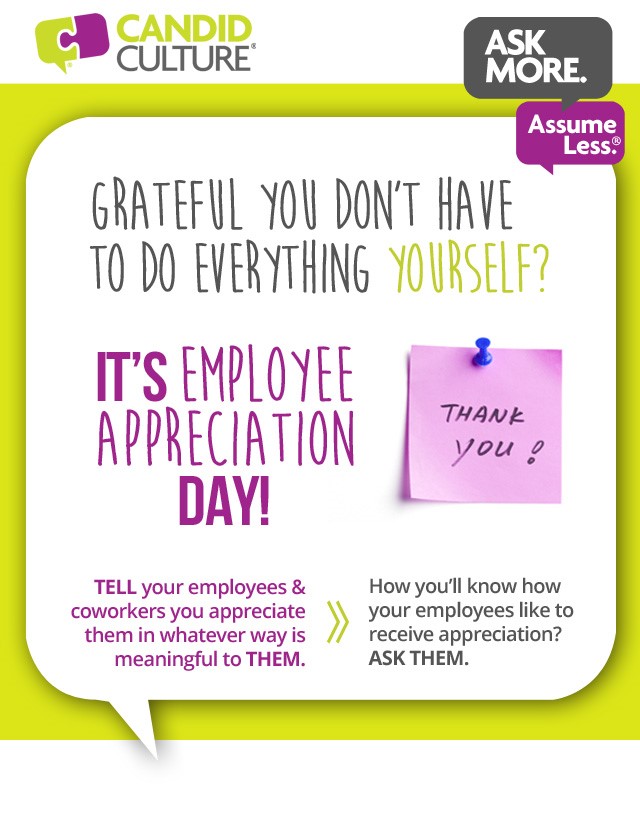
Today is Employee Appreciation Day – a made-up holiday to remind us to say “thank you” to the people we work with, who contribute every day.
Don’t take your employees for granted, or you’ll be finding new ones.
Here are six ways to mark Employee Appreciation Day today and every day:
Employee appreciation ideas 1) Ask employees what’s important to them – why they accepted the job, why they stay, and how they would like to receive recognition.
Most employees will work their entire career without a manager ever asking these questions. Getting to know your employees better and differently costs nothing but a little time.
Employee appreciation ideas 2) Ask employees about the kind of work they want to do in the future and what they want to learn and gain exposure to. Write down what they say (so you don’t have to remember) and give employees exposure to this type of work when it’s appropriate (when there’s a business need and when they’ve earned it by doing good work.)
Employee appreciation ideas 3) Give very specific, positive feedback regularly. Giving specific feedback demonstrates you’re paying attention to employees’ work and noticing the impact they’re making. Employees want to know how they’re doing. As odd as it may sound, feedback is a form of recognition. Taking the time to observe performance and give specific, timely feedback tells employees they matter.
Employee appreciation ideas 4) Tell the senior people in your organization what a great job your employees are doing. Employees have limited exposure to senior leaders. Don’t make the people who can influence your employees’ careers guess who’s doing great work.
Employee appreciation ideas 5) Take the time to write a handwritten note. In my 15 years of working in a corporate environment, I received one handwritten note from one of my managers. I kept it for 10 years.
Employee appreciation ideas 6) Spend time with your employees. Every employee needs face time with his/her boss. Don’t underestimate the value employees place on the time you give them. If you’re not meeting with your employees on a one-on-one basis regularly, start. Meet for 30-minutes once a quarter. Then meet once a month. Employees create the meeting agenda and come prepared to give you an update on their work. You should be prepared to give both positive and upgrade feedback.
Notice not one of the employee appreciation ideas or ways to recognize Employee Appreciation Day above is monetary in nature. Employees want your time and attention. They want to learn and grow. Provided employees feel fairly compensated, money is secondary.
Today, and every day, find a way to say “thank you” that’s meaningful to your employees. And the only way to know what employees will find meaningful is to ask.
When selling a product, service, or idea, people often think that providing more information is better. The more data points, the more likely the other person is to be persuaded. This is not necessarily the case. Excluding data hounds, most people don’t like to be overloaded with information. But people do appreciate the opportunity to talk about what they want and need. So if you want to sell something, give people a chance to talk.
I’ll never forget one of my first sales calls, early in my career. I was selling Dale Carnegie Training. After calling a prospect for six months, he agreed to spend ten minutes with me. Feeling rushed, I laid out all of our training brochures and quickly told him about every program we offered. Then I asked if he wanted to buy anything. He didn’t.
If I had asked a few questions and listened to his answers, I could have provided information on just the training programs he needed, instead of giving him a list of likely irrelevant options.
Selling a product or service is no different from selling an idea. You are trying to persuade someone to your way of thinking. Resist the temptation to persuade solely by educating. Instead, ask questions, listen to the answers, and then tell the person what you heard her say. If you’ve taken a listening class, you learned the practice of paraphrasing what someone said. Paraphrasing is a very old, very effective practice.
People need to feel heard and understood. From my experience, asking relevant questions, demonstrating that you listened to the answers by paraphrasing what the person said, and providing pertinent and succinct information is what people need to make a decision.
Sign Up
Career tips you won't get elsewhere. Sign up to get a free tip card.