If you haven’t had a bad boss yet, just be more patient. He or she is coming. Why do I say that? Because not all managers are great bosses. Many managers don’t provide employees with challenging opportunities, regular feedback, and exposure to different areas of the business.
Too many professionals are waiting for their boss to make their career happen. You might be lucky enough to have a boss who cares about you and helps you advance your career, but you might not. Either way, you deserve to have the career you want and ultimately, it’s your job to advance your career.
How to Advance Your Career Step One: Learn about different areas of your organization and become clear on what you want to learn and to what areas of the business you want exposure.
You won’t know what to ask for from your manager if you don’t know what your organization does and the opportunities that are available. Get to know the leaders and employees in other departments. Find out what they do on a daily basis, the initiatives they’re working on, and their short and long term goals.
How to Advance Your Career Step Two: Ask your manager, your peers and other organizational leaders who you need a good working relationship with and who can influence your next career opportunity.
You never know who talks to whom and who can influence your future opportunities. Department heads you don’t know well talk to other department heads. Don’t assume that because you don’t know someone well that s/he can’t influence your next opportunity or lack thereof.
How to Advance Your Career Step Three: Build and strengthen necessary working relationships and improve your reputation in areas it has been damaged.
You might need to tell a coworker (in person or over the phone, not via email!), “Our relationship is strained. I don’t think I’m saying anything we both don’t know. I would really like a good working relationship with you. If you’d be willing to have lunch or coffee with me and talk about what has gone on, and perhaps we can start anew, I’d really appreciate that.”
Ask for feedback and make necessary changes. Assume others are not aware of the changes you’ve made, so make those changes overt. Tell people who can impact your career, “I’ve received _________ feedback. As a result, I’ve made ___________ changes. I’d really appreciate your continued feedback on the changes I’ve made and other changes I need to make.”
How to Advance Your Career Step Four: Tell people who can influence your career what you want to do.
Don’t assume people know what you want to do in the future. In fact, assume others have no idea about the work you want to do and the things you want to learn. Tell people, “I’m really interested in learning more about ___________. I’d like exposure to __________ part of our organization.”
How to Advance Your Career Step Five: Make it clear that you’re capable of either doing or learning what you aspire to do.
I’ll never forget my first college internship. I was interning for a company that did ropes courses and backpacking trips with at-risk teenagers. During orientation, my boss pointed to a large storeroom and told me that interns were responsible for sweeping the floor and washing sleeping bags and cooking utensils after camping trips. I thought, “I did not take a semester off from school to sweep floors and wash sleeping bags.” I never said that out loud. I simply did other things (that I wanted to do) well, that offered great value to the organization. At the end of the internship, my boss said, “You’re the only intern who has never cleaned the storeroom because you demonstrated you were capable of doing more.”
Your career is your responsibility. Don’t wait for the right boss to make your career happen. Take matters into your own hands. Follow the steps above and get more of what you want at work.
Most people would rather get a root canal than participate in an annual employee performance appraisal.
The reasons employee performance appraisals are so difficult is simple:
Many managers don’t deliver timely and balanced feedback throughout the year.
Many employees don’t ask for regular feedback.
Too much information is delivered during the annual employee performance appraisal.
And as crazy as it sounds, managers and employees haven’t agreed to give and receive regular and candid feedback.
Employee performance appraisals don’t have to be the worst day of the year.
Here are four steps to ensure employee performance appraisals are useful and positive:
Managers and employees must agree to give and receive balanced, candid feedback. Don’t assume the agreement to speak honestly is implicit, make it explicit.
Managers, be honest and courageous. Don’t rate an employee a five who is really a three. You don’t do anyone any favors. Employees want to know how they’re really doing, no matter how much the feedback may sting.
Managers, focus on three things the employee did well and three things to do more of next year. Any more input is overwhelming.
Managers, schedule a second conversation a week after the employee performance appraisal, so employees can think about and process what you’ve said and discuss further, if necessary.
The key to being able to speak candidly during an employee performance appraisal is as simple as agreeing that you will do so and then being receptive to whatever is said. And don’t make feedback conversations a one-time event. If you do a rigorous workout after not exercising for a long time, you often can’t move the next day. Feedback conversations aren’t any different. They require practice for both the manager and employee to be comfortable.
“If you have nothing nice to say, don’t say anything at
all.” Most of us grew up hearing these words. Last week I used them with my
four-year-old son, and instantly regretted it. He said something hurtful to me
and I told him to keep those thoughts to himself.
I want him to keep his thoughts to himself if he doesn’t
like a kid at school or doesn’t want to play with someone. Walk away, find
another place to play, is often my guidance. But with me? With me I want him to
be honest, always, even if it hurts.
Every time we talk with people, we train them how to
interact with us. If I tell my son not to tell me the truth, I teach him to
protect my emotions and stifle his. I teach him I’m not strong enough to handle
the truth and that I’m someone who needs protecting. I teach him that he can’t
be honest with me.
Do I want him to be a kind, empathetic person? Yes. Do I
want him to measure himself with others, watching what he says and how he says
it? Yes. Do I want him to do those things with me? No. I’m the mom. He’s the
kid. And that will always be the case, even when he’s 45. I can take whatever
he has to say. And if I want to have a real relationship with him, he needs to
know that.
Every time we react to what others say, we train them how to
interact with us. If you want your coworkers, boss, family and friends to be
honest with you, make it easy to tell you the truth. Take in what others say
without visibly reacting. Say “thank you” for whatever feedback and input you
get, even when you want to say everything but. Take the time to ‘get over’ hard
messages and then discuss further, when you’re not angry.
People learn quickly. If we react to suggestions, input, and
feedback negatively, people learn that we can’t take challenging data and they
stop giving it to us. I don’t want to be the person the people I care about are
afraid to talk with because my reaction is just too hard to deal with.
Should you care about everyone’s feedback? No. Should you
ask everyone for feedback? No. Should you be open to everyone’s feedback? No.
Be open to feedback from the people who matter most to you. Open your heart and
your mind. Close your mouth. Even when you want to do everything but.
Strengthen your relationships and train people that you can handle the truth.
Note: I know this blog is not what my weekly tip said it
would be about. I write the weekly tips before the blog and this blog just went
a different direction. Everything I write is inspiration driven. I’ll write
about the courage to speak up in a future week.
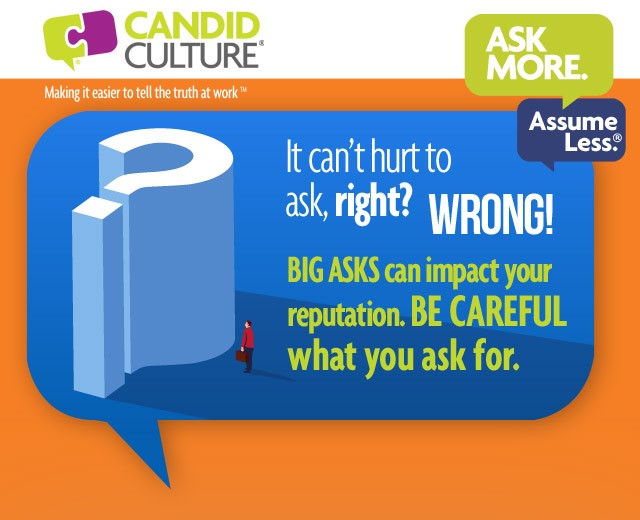
We’ve all heard the expression, “it doesn’t hurt to ask.” But
what if it can and does?
While it’s true that you won’t get what you don’t ask for,
it’s also true that requests help form others’ impressions of us. Some asks may
seem high maintenance and create the impression that we’re difficult to work
with. Other requests may create the impression that we’re out of touch or entitled.
Be brave in what you ask for but also be judicious and aware of how requests
may impact others.
So, what shouldn’t you ask for at work? That’s a hard question
to answer. What’s appropriate in one environment may not be ok in another. I’ll
provide some guidance for most work environments below.
Don’t ask for anything that requires your boss to break the
rules or treat you differently from other employees. This may seem obvious, but
I’ve been asked for things that I couldn’t legally provide. A candidate asked
me to write her a monthly check towards her personal health insurance plan versus
her participating in our company-sponsored health insurance plan. It’s an
innocent request but put me in a very awkward position and I said no.
Here are a few do’s and don’ts to follow when making requests:
Don’t ask for or take time off during the busiest times of
the year. Ask your boss what those busy times are and then plan accordingly.
Don’t ask for exceptions unless you’re desperate – being paid
in advance to cover unforeseen personal expenses, time off you haven’t earned, unless
It’s regularly permitted in your company, using company resources for personal
use. All of these may seem acceptable in the moment, but if they make your boss
bend or break the rules, they’ll likely make you look bad too.
Be brave. Be bold. And be careful what you ask for. Your reputation is more important than a request that feels important right now but will be insignificant by next year.
Sign Up
Career tips you won't get elsewhere. Sign up to get a free tip card.