Archive for August, 2019
No one likes to make mistakes. We want to do good work and have people think well of us.
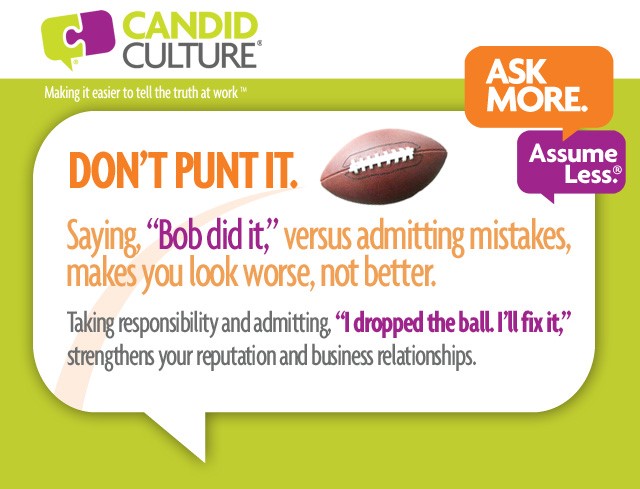
The key to maintaining your relationships and reputation, when you make a mistake, is to take responsibility and make things right as soon as possible. Saying something wasn’t your fault or becoming defensive will only damage your reputation and relationships. As counterintuitive as it sounds, you will gain respect and credibility by admitting fault and correcting problems.
I often get asked if people lose credibility by being humble – asking for feedback and admitting to making mistakes. It takes strength to ask for and be open to feedback and to admit when you drop the ball. So while it may seem counterintuitive, the more you ask for and respond to feedback, and admit when you make mistakes, the stronger you will appear.
I made a mistake at work. Now what?
When you make a mistake say something like:
“I dropped the ball on that. I apologize. I’ll fix it and let you know when it’s been handled.”
Or, “Thank you for the feedback. This clearly didn’t go as planned. I’ll make those changes and let you know when they’re done.”
Also, let people know the steps you’ll take to avoid similar challenges in the future.
You could say something like:
“Thanks for letting me know that our process is causing your department challenges. We certainly want the process to be smooth. My team will fix this month’s report, so your team doesn’t have to invest more time. We’ll update the process for next month and walk you through the changes before the report is due.”
Don’t provide a bunch of reasons for breakdowns. No one cares. Telling people why something occurred can sound like excuse management. People just want to know things will be made right.
Asking for feedback, taking responsibility, and telling people how you will correct errors may not be your natural or first reaction. The more you can train yourself to do these things, the easier you will be to work with and the better your reputation and business relationships will be.
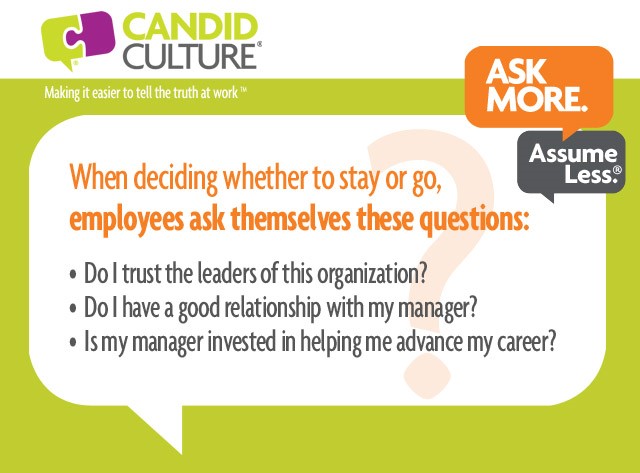
“My boss is a jerk and my career is going nowhere in this organization, but there’s yoga and a pool table, so I think I’ll stay,” said no employee ever.
Employees enjoy concierge service, free lunch, ping pong, and social events at work, but these perks don’t improve retention or performance. The only perks known to improve employee loyalty and commitment is time off and a flexible schedule. Everything else is nice to have, but does not impact career decisions.
Organizational leaders and managers have been led down a path of expensive distractions disguised as employee retention strategies. Eliminate the noise and focus on the four things that really matter to employees, and your best people will stay.
This is what’s important to your employees:
- I trust the leaders who run this organization.
- My opinion means something. I am listened to.
- I feel respected (by my manager) and have good relationships in the organization.
- My work is challenging and interesting.
So what should you do if you want to be a best place to work?
Here are Four Employee Retention Strategies Managers Can Take:
1. Meet one-on-one with employees and have meaningful discussions about his/her performance and career goals.
2. Ask employees for their opinion and demonstrate that you’ve heard them.
3. Provide opportunities for employees to do work they enjoy.
4. Ensure employees who want to advance in your organization are learning and growing.
Read about our Be a Great Place to Work leadership training program that eliminates the noise and teaches the things leaders and managers really need to do to retain the best employees.


The people you work with want to do a good job. They want you to think well of them. Yes, even the people you think do little work. Give people the benefit of the doubt. Assume people are doing the best they know how to do. And when you don’t get what you want, make requests.
There are two ways to give feedback. One way is very direct.
Version one: “You did this thing and here’s why it’s a problem.”
The other way is less direct. Rather than telling the person what went wrong, simply make a request.
Version two: “Will you…” Or, “It would be helpful to get this report on Mondays instead of Wednesday. Are you able to do that?”
It’s very difficult to give feedback directly without the other person feeling judged. Making a request is much more neutral than giving direct feedback, doesn’t evoke as much defensiveness, and achieves the same result. You still get what you want.
When I teach giving feedback, I often give the example of asking a waitstaff in a restaurant for ketchup. Let’s say your waiter comes to your table to ask how your food is and your table doesn’t have any ketchup.
Option one: Give direct feedback. “Our table doesn’t have any ketchup.”
Option two: Make a request. “Can we get some ketchup?”
Both methods achieve the desired result. Option one overtly tells the waiter, “You’re not doing your job.” Option two still tells the waiter he isn’t doing his job, but the method is more subtle and thus is less likely to put him on the defensive.
You are always dealing with people’s egos. And when egos get bruised, defenses rise. When defenses rise, it’s hard to have a productive conversation. People stop listening and start defending themselves. Defending oneself is a normal and natural reaction to negative feedback. It’s a survival instinct.
You’re more likely to get what you want from others when they don’t feel attacked and don’t feel the need to defend themselves. Consider simply asking for what you want rather than telling people what they’re doing wrong, and see what happens.
I will admit, asking for what you want in a neutral and non-judgmental way when you’re frustrated is very hard to do. The antidote is to anticipate your needs and ask for what you want at the onset of anything new. And when things go awry, wait until you’re not upset to make a request. If you are critical, apologize and promise to do better next time. It’s all trial and error.

 Being in the wrong job feels terrible. It’s not unlike being in the wrong romantic relationship, group of friends, or neighborhood. We feel misplaced. Everything is a struggle. Feeling like we don’t fit and can’t be successful is one of the worst feelings in the world.
The ideal situation is for an underperforming employee to decide to move on. But when this doesn’t happen, managers need to help employees make a change.
The first step in helping an underperforming employee move on to something where s/he can be more successful is to accept that giving negative feedback and managing employee performance is not unkind. When managers have an underperforming employee, they often think it isn’t nice to say something. Managers don’t want to hurt employees’ feelings or deal with their defensive reactions. In fact, when we help someone move on to a job that she will enjoy and where she can excel, we do the employee a favor. We set her free from a difficult situation that she was not able to leave out of her own volition.
I get asked the question “How do I know when it’s time to let an employee go?” a lot.
Here’s what I teach managers in our managing employee performance training programs: There are four reasons employees don’t do what they need to do:
- They don’t know how.
- They don’t think they know how.
- They don’t want to.
- They can’t. Even with coaching and training, they don’t have the ability to do what you’re asking.
Numbers one and two are coachable. With the right training and coaching, employees will likely be able to do what you’re asking them to do.
Numbers three and four are less coachable and are likely not trainable.
When you’re confronted with someone who simply can’t do what you need them to do, it’s time to help the person make a change.
The way you discover whether or not someone can do something is to:
- Set clear expectations
- Observe performance
- Train, coach, and give feedback
- Observe performance
- Train, coach and give feedback
- Observe performance
- Train, coach and give feedback
Welcome to management.
After you’ve trained, coached, and given feedback for a period of time, and the person still can’t do what you’re asking her to do, it’s time to make a change.
Making a change does not mean firing someone. You have options:
- Take away responsibilities the person can’t do well and give him other things that he can do well.
- Rotate the person to a different job.
Firing someone is always a last resort.
Sometimes we get too attached to job descriptions. The job description outlines a specific responsibility that the person can’t do. So we fire the person versus considering, who else in the organization can do that task? Be open-minded. If you have a person who is engaged, committed, and able to do most of her job, be flexible and creative. Give away parts of the job to someone who can do them well. I’ve also seen employees who were failing thrive in a different job. Organizations that are flexible survive; organizations that are rigid do not.
Let’s say you’ve stripped away the parts of the job that an underperforming employee can do well, and she still can’t perform effectively. Now it’s time to make a change.
Here are some words to use when having the difficult “it’s time to move on” conversation:
“I really want you on my team and to be successful in our organization. Over the past six months, we’ve had several conversations about the parts of your job that are a struggle. We’ve taken away responsibilities that aren’t a fit for you and have replaced those responsibilities with things that seemed like a better fit. And yet I can see that you are still struggling. I’m very sorry to say that it’s not appropriate for you to continue working here. Today is your last day.” Depending on your organizational culture, can also say, “How do you want to handle this? You can resign or we can let you go. I’ll do whatever feels more comfortable for you.”
This is a difficult conversation that no manager wants to have. Yet I promise you, this conversation feels better to your employee than suffering in a job in which s/he can’t be successful. After you’ve set expectations, observed performance, and coached and given feedback repeatedly, letting someone go is kinder than letting the employee flounder in a job in which he cannot be successful.