You will be passed over for jobs, projects, and opportunities – personally and professionally. People will choose not to buy from you and they’ll choose not to be your friend and romantic partner. And that’s ok. Not everyone is our right “customer.” The key isn’t to win every opportunity. Rather, it’s what we do when we don’t get what we want.
When you’re done feeling disappointed, mad, and frustrated, get curious. Find out why you were passed over. I’ll never suggest you make changes. I simply want you to know what’s standing in your way, so you have power – the power to choose. Eliminate your business blind spots.
All of us have blind spots – things we do that are off-putting to others, that we’re not aware of. For the most part, people won’t tell us our business blind spots, instead, they simply pass us over. Being rejected is feedback, it’s just not specific enough to help us make different choices. If you want to be able to change your behavior, you need to know what behaviors are standing in your way. Then you can choose what, if anything, to do about those behaviors.
When you get turned down for an opportunity, practice these strategies to eliminate your business blind spots:
Allow yourself to have an emotional reaction, to feel disappointed, and to grieve the loss.
When your emotions dissipate, call people who can tell you why you were turned down, and ask for feedback. The goal of the conversation: Eliminate your business blind spots.
Be humble and open.
Consider saying something like, “Thank you so much for considering me/us to support your needs. We were disappointed not to win your business. Would you be willing to share what had you choose a different provider and what we could have done differently to be a stronger candidate? I’ll be grateful for anything you’re willing to tell me.”
Depending on the circumstances, you could also say something like, “I wasn’t put on the _______ project. I wonder if you have any information as to why? I appreciate anything you’re able to tell me. Your input will help me grow and eliminate my business blind spots.”
Regardless of what you hear, thank the person for the feedback. You can ask for additional information and ask who else you can talk with, but don’t become defensive. The less defensive you get, the more feedback you’ll get. Make it easy to tell you the truth (as the other person sees it).
Remember, information is power, and power is control. Many people don’t give direct feedback because they’re afraid of the other person’s reaction. Surprise people by being open to feedback, and eliminate your business blind spots.
Validate feedback that doesn’t feel right to you. If you’re not sure what someone told you is accurate, vet the feedback with other people you trust. Simply ask other people who are aware of your performance, “I received this feedback. Does that resonate with you?”
Sit with the feedback for a few days before taking any action.
When your emotions have passed, decide what – if anything – you want to do with the input you’ve received. Perhaps you want to make changes. Perhaps you don’t. Either way, you have more power than you did before you received any input.
You won’t win them all. The key isn’t avoiding rejection, it’s what you do when you don’t get what you want. Be brave. Be open. Ask for feedback. And you’ll have the power to make different choices next time, if you want to.
Need to give negative feedback? Practice out loud. The words you say in your head while driving to work will not be what comes out of your mouth when you give the actual feedback. Ask a friend, family member, or even your pet (aka someone you don’t work with) to listen to you deliver the feedback. If people outside of your industry and organization understand the feedback, the feedback recipient will be clear, too.
Giving feedback is stressful for both the person giving the feedback and the feedback recipient. The best way to manage the stress of giving feedback is to be prepared.
Here are three ways to prepare for difficult feedback conversations:
Write out the feedback, save your notes, and walk away. Read your notes later and ask yourself, “Have I been clear?” Then see if you can cut the notes in half. Shorter feedback is better.
Practice out loud. Use our 8- step Feedback Formula as a guide. The Formula will ensure you give clear, specific, and succinct feedback without emotion.
Bring type-written notes to your feedback conversations. When the feedback recipient becomes defensive (and they will) or you become flustered (and you might), your notes will help you keep the conversation on track.
During every feedback training I teach, I am asked how to reduce feedback recipient’s defensiveness. Defensiveness is a normal, healthy response to feedback. When you give someone negative feedback, you (subtly) tell the person they did something wrong. No one wants to hear that, so the brain goes on the defensive. It’s a normal survival mechanism. Instead of avoiding and dreading defensiveness during feedback conversations, prepare for it. And the best way to prepare is to practice what you want to say out loud. Speaking a message is not the same as practicing the conversation silently in your head. Speaking out loud is more stressful and takes more time. So, if a conversation is particularly difficult or awkward, practice out loud!
I’d like to give a huge shout out to Angela Fusaro of Physician 360 for sharing this video with us. Angela practiced my eight-step Feedback Formula on her dog, Thor. I thought it was so funny and thought you would, too.
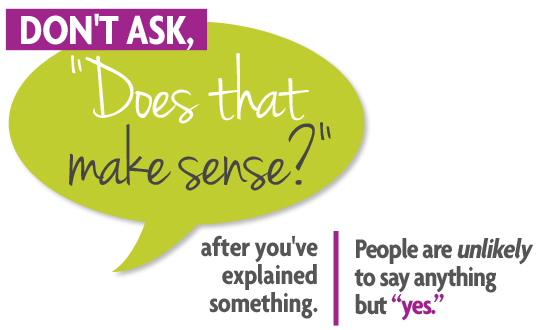
I’m taking golf lessons, which should frighten anyone within 100 feet. Every time the instructor explains something new, he asks me, “Does that make sense?” “Does that make sense” is a common clarifying question that many managers, trainers, and instructors ask, but it’s not a good question for two reasons.
Reason number one: If an explanation doesn’t make sense to me, I’m the idiot for not “getting it.” It’s not that the instructor hasn’t been clear, I just “didn’t get it.”
Reason number two: The question doesn’t force me to speak. “Does that make sense” is like asking a shopper in a store, “Can I help you?” We all know the right answer to that question is, “No, I’m just looking.” This is a similar to when someone asks, “Are there any questions?” The right answer is “no.” And when people say “no,” the person who asked the question often says, “good,” affirming people for not asking questions and making it less likely that questions will be asked in the future.
Here are some clarifying questions that will force people to talk and won’t make them feel stupid for asking questions. Instead of asking, “Does that make sense,” consider asking:
So I know I’ve been clear, tell me what you heard me say.
** This may sound harsh and like micromanaging in writing, but the questions can be asked in a supportive and non-judgmental manner.
Just so I know how I landed, what do you think I’m asking/expecting you to do?
What do you think you need to do?
What are you planning to do?
I was talking with one of my clients a few months ago. She was very upset because she told one of her employees what to do and he didn’t do it. Frustrated, she said, “He knew what to do, and he didn’t do it.” I asked her, “How do you know that he knew what to do?” She replied, “I told him what to do and when I asked if he had any questions, he said no.”
Her situation is a common one. The right answer to “Do you have any questions” is “no.” And we’re surprised when we swing by the person’s desk two weeks later to get a status update on the project, and he hasn’t started working on it yet.
Here are some additional examples of clarifying questions and delegation questions. These questions will force people to speak, providing a clearer sense of what people know and are likely to do.
What questions do you have?
What are you planning to do first? If the person answers this question appropriately, ask what he is planning to do next. If he doesn’t answer the question appropriately, step in and give more direction.
Provided you trust that the person knows what to do, give a tight deadline and ask to review the person’s work in a few days. Give people some freedom, but not enough to waste a lot of time and go down a fruitless path. Delegation is something few managers do well and the root of many missed deadlines and frustrations in the workplace.
The golf instructor should be asking me:
What did you learn today?
What are you planning to do as a result of what we’ve covered?
What techniques did I ask you to follow?
Let me see how that form looks?
What questions do you have for me?
If he asks me these clarifying questions and forces me to do the things he is asking me to do, he will know what I know and am likely to do on the golf course. All he knows right now is that I’m poking fun of him in a blog post.
Sign Up
Career tips you won't get elsewhere. Sign up to get a free tip card.