When I led leadership development training for a large mutual fund company we offered a lot of training focused on helping people have hard conversations. Over time I realized that despite that I’d bought and offered the best training programs I could find, the training wasn’t helping. Managers didn’t give enough feedback, and when they did give feedback, employees were often left confused, wondering what they needed to do differently.
I decided that what was missing was the conversation before the crucial conversation. It wasn’t that managers didn’t know what they wanted to say, but many managers felt they couldn’t say what they wanted to say. There wasn’t sufficient safety or permission for giving feedback, so managers said little or delivered messages that were so vague, employees were left wondering if there was a problem. This is when the idea for Candid Culture was born.
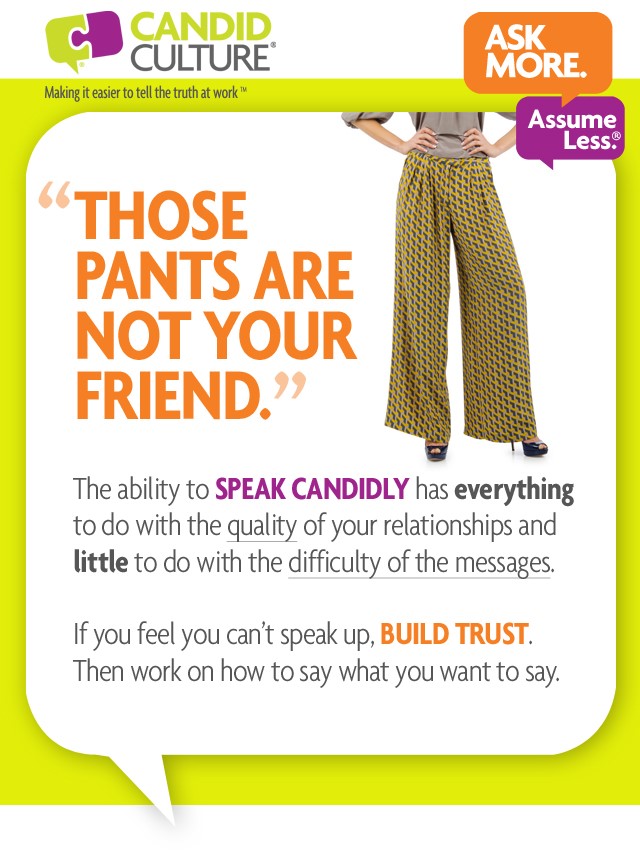
If you’re struggling with giving feedback, I doubt it’s the message that’s the challenge. The distinction between being able to tell the truth (as you see it) and saying nothing, is the quality of your relationship.
Think about the people – personal and professional – who can say anything to you. These are the people who can tell you that the person you’re dating is wrong for you, that a piece of clothing is not flattering, that you disappointed them, or that you dropped the ball. You may not enjoy getting the feedback, but you’re able to hear what they have to say and take it in because you know they care about you and have your best interests at heart. You trust their motives. When you trust people’s motives, they can say anything to you. When you don’t trust people’s motives, there is little they can say.
If you’re struggling to give feedback, evaluate your relationship by asking these three questions:
Does this person know that I have her back under any circumstances?
Does this person trust me?
Does this person know that I accept her just as she is?
If the answer to any of the questions above is no, it’s not giving feedback you’re struggling with, it’s the quality of your relationship. Work on building trust with this person and you’ll be able to say whatever you feel you need to say.
Here are five steps to building trusting relationships:
Get to know people better than you know them now. Get five free conversation-starting Candor Questions to have these conversations.
Tell people you want them to succeed and demonstrate that by being supportive of their efforts.
Don’t be judgy. No one likes to be told that she is wrong.
Set the expectation that you will give both positive and negative feedback when appropriate, because you want the person to win. And if you remain silent, you are of no help to the other person.
When you deliver feedback, be extremely specific. Feedback that is specific will be received much better than vague feedback, which is typically judgmental.
When people know that you respect and want good things for them, you have a great deal of freedom to speak up. When people don’t trust your motives, giving feedback is almost impossible. The recipient will become defensive and dismiss whatever you say, rationalizing that you don’t like her and never have.
Worry less about giving feedback – for now. Instead, build trust. Get to know people better, then work on giving feedback.
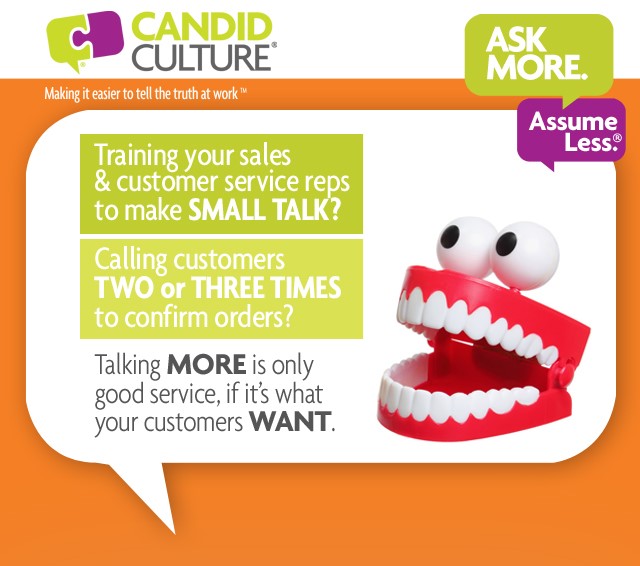
Many organizations think they’re improving customer service by training sales and customer representatives to make small talk — asking how a customer’s day, week, or trip is going. Asking questions and chatting with customers about personal matters is only good customer service if clients WANT to make small talk.
When room service delivers breakfast and the hotel guest is standing in a towel, he’s probably not interested in talking about whether his trip is for business or pleasure and whether or not he’ll have time for fun while he’s in town. Improving customer service will likely require the wait person to get in and out of his room quickly. When a taxi driver talks with you when you want to work, his desire to chat probably isn’t improving customer service.
Sales and customer service representatives can also over communicate about business-related issues. Last weekend I ordered some equipment online. Shortly after placing the order, a customer service representative called me because I’d provided different billing and shipping addresses, and he wanted to be sure that someone wasn’t fraudulently using my card. Focused on improving customer service, he asked me to call back before they’d ship my item, which I needed Monday and paid $32 to have sent via overnight mail.
When I called back, I got voicemail and left a message. Then I spent the day wondering if the guy got my message and if my order would arrive on Monday. Then he left another voicemail saying that one of the items I ordered was out of stock but he thought they might have it in another color. He then called again to tell me that they did indeed have the item in a different color and asked me to call back. When I called back, I was told that my order had already shipped. Three unnecessary phone calls on a Saturday is not improving customer service.
You may be thinking this situation is an anomaly, but it happened to me again a few days later. I returned a pair of pants I bought online. I wrote a letter explaining for what item I wanted to exchange the pants. A customer service representative called to ask if I was sure about what I wanted and asked me to call back. When I returned the call, I was told that my order had already shipped.
I suspect companies think they’re improving customer service by asking how a customer’s day is going and by calling customers personally when questions arise. Perhaps I’m too busy, but having to call a vendor to tell them that I meant to order what I ordered and I really do have a separate billing and mailing address is not improving customer service. It’s time consuming and annoying.
I’m aware my preferences are not consistent with all buyers, and many customers appreciate calls from vendors and making small talk with wait staff, taxi drivers, and other service providers. But you won’t know what your customers want if you don’t ask them. Consider asking customers about their preferences when they buy something.
Here are a couple of questions you could ask, with the goal of improving customer service:
If we need to contact you, what method is best? Phone, email, or text message?
Taxi and Uber drivers, massage therapists, dentists, etc. ask, “Would you like a silent ride/visit?”
What’s your definition of good customer service? Check all that apply.
Get it done fast and right the first time.
Get to know me. I’m happy to chat.
Get it done right and ask all the questions you’d like.
I’ll sacrifice pleasantries for speed.
Our customers don’t necessarily share our definition of good customer service. Small talk may suit some customers, while it alienates others. Read your customers’ body language and listen to their tone of voice. Do they look and sound like they want to chat with you? Do they happily provide you with detailed answers to small-talk related questions, or do they provide short answers and appear impatient? Listen, watch, and adjust your behavior accordingly. Or preferably, ask what customers are expecting from you when they buy. Ask more. Assume less.
Early in my career, I worked with a woman with whom I didn’t get along. We were on the same team and had the same job, but didn’t see eye to eye on how to approach work or solve problems. And when we didn’t agree, things got ugly. I have to admit to being afraid of her. She was nasty when things didn’t go her way.
The odd thing is that socially, we did fine. When our team socialized outside of work, we had fun and got along well. That’s when I realized that there was no correlation between getting along outside of work and working well together.
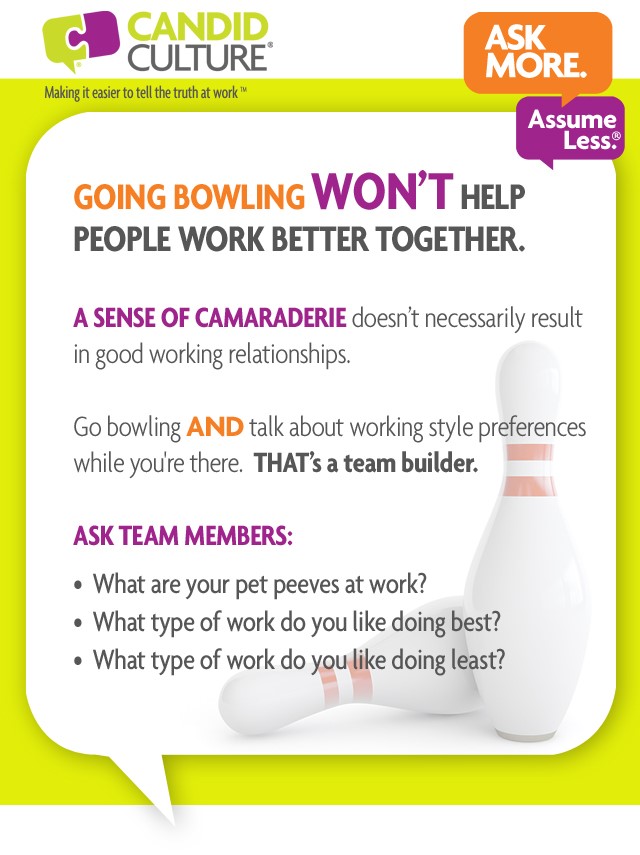
Lots of teams go bowling, to baseball games, and out for happy hour as team building activities. And while team members may enjoy being together at these events and getting to know each other personally, they don’t learn team members’ working style preferences, the work others are really good at, and the things at which team members are not as good.
Go bowling or out for happy hour, just don’t expect people to work better together after doing those activities. If you want to do impactful team building activities, give team members a chance to learn about each other and themselves, and make agreements of how team members will work together in the future. Create occasions for candid conversations.
When I lead corporate team building activities, I put people in small groups, give the group a box of Candor Questions for Team Building and time to answer the questions. One person in the group asks one question from the box. Everyone in the group answers that person’s question. The person who asked the question then answers his own question. Then another person on the team asks a question and so on. A great conversation always ensues.
People talk about things they should have and wished they were talked about when they started working together. Team members learn about each other’s work style preferences and what each person needs from both the job and each other. But most importantly, team members have permission to talk about things they normally don’t, and begin to create a climate of candor, which is essential for any group of people working together. For a team to work well together, it must be safe to tell the truth. Teams need to talk about the things that impact them most – each other.
So go bowling and out for happy hour. But also create opportunities for team members to talk about the things that matter most — how they impact each other at work.
You’re more likely to get an email or text message with emojis at work than a phone call or an in-person visit. Email, text messages, and instant messenger have become the primary modes of communication in most workplaces. And as we know, it’s difficult to manage tone of voice in written communication. Not wanting to sound angry or demanding, we add emoticons at work so the reader doesn’t misinterpret our message.
I believe email and text messages are overused. But I know most people won’t pick up the phone as often as they could or should. So instead of recommending that you pick up the phone more frequently, I’ll suggest you give people the benefit of the doubt, and make it a general rule not to take things personally.
If you’ve seen me teach how to give feedback or have read How to Say Anything to Anyone, you know I believe that one of the keys to being able to tell the truth is to ask for and gain permission to do so. What would happen if everyone in your workplace assumed that every email had a positive tone and that if something is a problem or a big deal, people will talk to you live? What if you made a deal that people won’t take emails or text messages personally?
When I teach feedback, I tell people not to give feedback via email and to instead talk with people. And we can’t always do that. Sometimes we need email to ensure feedback is timely. But email recipients are often hurt by the implied tone of an email or the brevity of a text message. Intended meanings are often misconstrued, feelings are hurt, and relationships are damaged, hence why we add emoticons at work.
There is a lot written on the value of emoticons at work and how we need to embrace the change in the way we communicate. I just wish we didn’t need emoticons at work. I wish, instead, we thought, “I trust you and assume good. I know that if you’re annoyed with me, you’ll tell me, because we’ve built a relationship in which we deal with challenges overtly, as they happen.” And perhaps I’m living on another planet – the planet of utopic candor. But the aforementioned are my goals. It’s why I do the work I do at Candid Culture. I envision workplaces in which we assume good and ask questions if we don’t. Do you?
Who have you fired lately? The person who cuts your hair or lawn? A doctor, accountant, or restaurant where you had a bad experience? Did you call any of those providers and tell them why you were replacing them? My hunch is no. There’s little incentive to do so. Why risk their defensiveness? It’s easier to just replace them. And the same is true for you.
There’s little incentive for the people you work with to tell you when you frustrate them. The perceived cost seems too high. The people you work (and live) with have experienced others’ defensive responses to negative feedback (which is no fun) and they don’t want to experience your reaction. As a result, when you disappoint or frustrate others, it’s easier to say nothing than tell you the truth.
The tendency for others to tell you things are fine when they’re not will prevent you from managing your career and relationships. People will go missing and/or you’ll be passed over for professional opportunities and never know why.
To make it more likely that people will tell you when you disappoint or frustrate them, make it easy to tell you the truth.
Here are seven practices for receiving feedback:
Receiving Feedback Practice #1: When you begin new relationships, tell people you want their feedback.
Receiving Feedback Practice #2: Promise that no matter what people say, you’ll respond with “thank you.” This is very hard to do.
Receiving Feedback Practice #3: Tell people you already have relationships with that if you haven’t said it in the past, you really want their feedback and promise to respond graciously with “thank you.”
Receiving Feedback Practice #4: Ask people who matter to you for feedback regularly.
Receiving Feedback Practice #5: Resist the urge to get defensive.
Receiving Feedback Practice #6: Catch yourself when you start to become defensive and apologize. Say something like, “I’m getting defensive. I’m sorry. Tell me again. I’ll do a better job of listening.”
Receiving Feedback Practice #7: Take a break from conversations during which you find yourself responding defensively. Say something like, “I’m not responding as well as I’d like. How about we take a break? Give me a few minutes (hours or days) and I’ll come back to you to talk more. I really want to hear what you have to say.”
The aforementioned list provides recommendations for asking for and receiving feedback you want, not feedback you don’t. You are not a dumping ground. Don’t ask for feedback you don’t want. And when you do ask for feedback, qualify what type of feedback you’re looking for. Telling people “I want your feedback” doesn’t mean they’re welcome to say whatever they want.
The purpose of asking for feedback and making it safe to tell the truth is to give you more control over your career and relationships. It’s ok to be passed over for opportunities and relationships, but it’s unhelpful not to know why.
Sign Up
Career tips you won't get elsewhere. Sign up to get a free tip card.


 If you’re struggling with giving feedback, I doubt it’s the message that’s the challenge. The distinction between being able to tell the truth (as you see it) and saying nothing, is the quality of your relationship.
 Many organizations think they’re improving customer service by training sales and customer representatives to make small talk — asking how a customer’s day, week, or trip is going. Asking questions and chatting with customers about personal matters is only good customer service if clients WANT to make small talk.
 Early in my career, I worked with a woman with whom I didn’t get along. We were on the same team and had the same job, but didn’t see eye to eye on how to approach work or solve problems. And when we didn’t agree, things got ugly. I have to admit to being afraid of her. She was nasty when things didn’t go her way.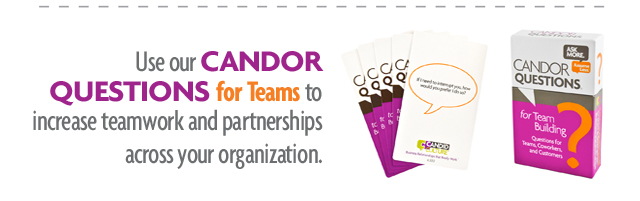
 You’re more likely to get an email or text message with emojis at work than a phone call or an in-person visit. Email, text messages, and instant messenger have become the primary modes of communication in most workplaces. And as we know, it’s difficult to manage tone of voice in written communication. Not wanting to sound angry or demanding, we add emoticons at work so the reader doesn’t misinterpret our message.
 . And the same is true for you.