Archive for July, 2018
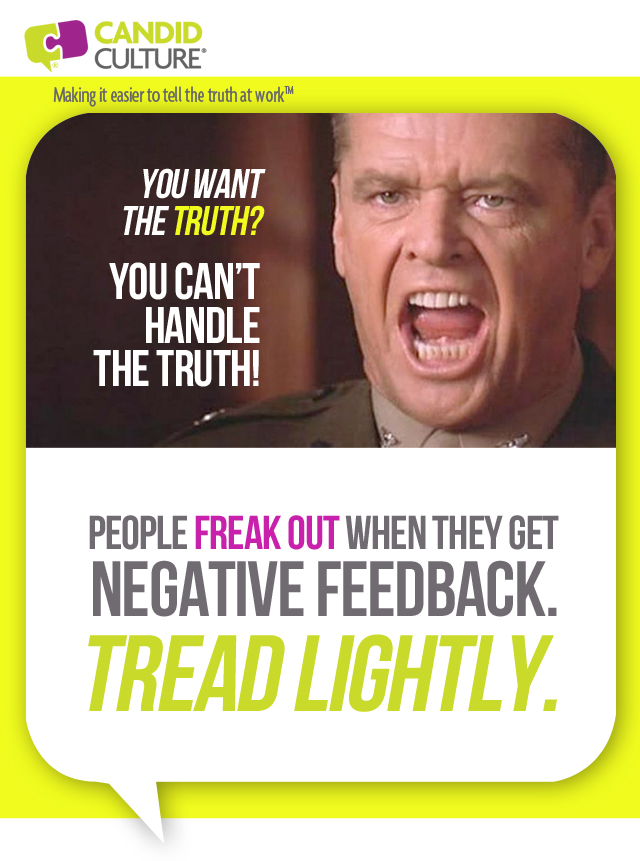 Last week I was talking with a friend who works for a large investment bank. He said, “I don’t believe in the premise of your book. There is no place for negative feedback in the workplace. It’s just not possible.” And I’m seeing firsthand how hard it is for people to receive negative feedback. All kinds of people – sensitive people and less sensitive people, Type A and laid back types. No one wants to hear she made a mistake, could have done something better, or any other type of negative feedback. It’s just too hard.
This is a massive conflict for me. At Candid Culture, we teach people how to give and receive feedback and yet, here I am wondering if it’s even possible.
We need to be able to tell people what they can do better. And the truth, is, while people may not want to hear negative feedback, most people do want to know what they can do to improve their performance and get ahead, hence the quandary. Give negative feedback and evoke others’ defensiveness or say nothing and put up with whatever isn’t working? I, of course, would prefer that you give the feedback, believing that it empowers people to make better personal and professional choices. The question is how?
Here are six steps to make giving negative feedback possible:
- Set the expectation at the onset of working relationships that you will give and receive balanced (positive and negative) feedback regularly. If you’ve worked with people for years and have not set this expectation, it’s not too late. Simply say, “I realized we don’t give each other a lot of feedback. In the spirit of continuous improvement, I’d like to implement a weekly debrief during which we talk about what’s working and not working. We’ll give each other feedback during the meetings.”
- Assess candidate’s openness to feedback when you interview, and don’t hire people who don’t accept negative feedback. We do practical interviews at Candid Culture. We give candidates a chance to do some of the work they’ll be doing on the job and tell candidates what they can do to improve, during the interview. Then we see how they accept our feedback. We also ask interview questions that help elucidate whether or not candidates are open to feedback and we ask candidates’ references how well the person accepts negative feedback.
- Observe performance regularly and provide balanced feedback from the start. Don’t wait until a problem occurs or until you have time to give feedback. Begin the practice of meeting weekly to review and discuss work, setting the precedent that this is the way you do business.
- Provide positive feedback regularly so people know the good stuff and aren’t solely focused on the negative feedback they receive.
- Ask for and be open to feedback. When you demonstrate being open to feedback, you earn the right to give feedback.
- Lastly, don’t underestimate how hard it is to hear negative feedback. When some people receive negative feedback, they begin to question themselves, their skills, and their value. So tread lightly. Pick your battles. Address only what you really need to and say things gingerly, remembering that you’re talking to a sensitive person, no matter how tough he may seem.

 Most people avoid giving feedback because they’re concerned about (don’t want to deal with) the other person’s defensive response. It’s easier to say nothing than deal with someone’s defensiveness. So we say things are fine when they’re not.
If you want people to tell you the truth, do the opposite of what they expect when responding to feedback. Rather than become defensive, say, “thank you.”
Saying “thank you for the feedback” is not intended to be a pollyanna response, nor does it mean you agree and that the person is right. Saying “thank you” catches the other person off guard (in a good way) and buys you time to think and respond calmly, making it more likely that you’ll get feedback in the future.
Each of us wants to be thought well of and be seen as competent. Negative feedback calls both into question and the brain responds defensively. The challenge is that defensive responses scare other people into silence. And you only need to get defensive once for people to believe that you don’t deal well with feedback.
Don’t underestimate the power of your emotions and ego. You are likely to respond to feedback defensively, even if you don’t see yourself do it. A seemingly benign ‘explanation’ of why you did something as you did it, is seen as defensive and is thus off putting to others.
Here are six strategies for responding to feedback well:
- Responding to feedback strategy one: Have feedback conversations when you have the time to listen and are rested. If you’re tired, on a deadline, or rushing to your next meeting, the conversation will not go well.
- Responding to feedback strategy two: If someone catches you off guard with feedback and you know you won’t respond well, interrupt the person. Tell him that you appreciate him bringing this to your attention and you want to give the conversation the attention it deserves, but now isn’t a good time. Schedule a time to finish the conversation within a few days.
- Responding to feedback strategy three: Have a plan for how you’re going to respond to scheduled/planned feedback conversations before the conversations start. Tell yourself, “I will say thank you, end the conversation, and ask for another time to talk.”
- Responding to feedback strategy four: If you receive feedback that doesn’t feel accurate, ask others, who you trust, what they think. Just be prepared to hear what they have to say, and, of course, respond with “thank you.”
- Responding to feedback strategy five: Don’t respond to negative feedback in the moment, even if the other person wants you to and you think you can do so without being defensive. Don’t underestimate the power of your emotions. You will be upset, even if you don’t feel upset, and your response will be better after you’ve had time to process. Tell the person who gave you feedback that you take their feedback seriously and want to respond thoughtfully, and thus you’re going to think about what s/he said before responding. People may be frustrated with this response at first, but they’ll be appreciative later.
- Responding to feedback strategy six: Be sure to get back to the person, who has feedback for you, within a few days. Tell him you thought about what he said and then tell him how you feel. You can speak candidly. Your words will be calmer and more thoughtful then when you received the initial feedback.
We know people are hesitant to give feedback. Make giving you feedback easier by responding calmly. No one expects to hear “thank you for the feedback.” Your unemotional response will strengthen your reputation and relationships, and make it more likely that you get more feedback in the future.
 Many of us are hesitant to give peer feedback. We worry that giving peer feedback will damage our relationships. We wonder if we have the right and if it’s our place to give peer feedback. And we are concerned about what the consequences of giving peer feedback will be.
Giving peer feedback isn’t so different from giving feedback to a friend or even a direct report. While you have an implicit ‘right’ to give a direct report feedback, doing so without building trust will ensure your feedback falls flat.
People respond to feedback in predictable ways. Most people get upset and defend themselves. This is normal and natural. Negative feedback conflicts with our desire to be thought well of, which all people (despite what they might say) want. People are more open and less defensive when they trust the source of the feedback and trust the sources’ motives. Follow these practices when giving peer feedback and your feedback will hopefully be well received.
Four practices for giving peer feedback:
- Think about why you want to give feedback. Really think about this. Is your desire to help the person change a behavior, or are you just being judgmental? If your intention isn’t to help someone replicate or change a behavior, say nothing. It’s not feedback you’re planning to give, it’s only your opinion you want to disseminate. One of my friends recently told me she felt my son’s name was waspy. Her comment wasn’t feedback as there was nothing I could do with the information. She simply gave me her judgmental opinion, which annoyed me.
Also consider why you want to give feedback. Do you simply want something done your way, or do you feel strongly that what the person is doing is having a negative impact on him/her or the organization? I worked with a business leader who red lined every document his staff created. He didn’t only change language that was wrong, he edited documents so they were written more akin to his writing style. This made his staff feel that they couldn’t do anything right and it wouldn’t matter what they produced, he’d revise even the most ‘perfect’ work. So they stopped trying. Evaluate your true motive. Just because something wasn’t done your way, doesn’t mean it wasn’t done well.
- Provided your motives are pure – you’re trying to make a difference for someone and his/her behavior is causing real challenges, it’s ok to speak up. Be sure you have the relationship to give peer feedback. Does the person know you have his/her back? If you speak up, will s/he trust it’s because you care about her or the organization, versus you just want to express your opinion and be right.
- Provided you are giving feedback to alter a behavior and you have the relationship to give feedback, it’s important that you ask for permission. A peer relationship is a lateral one. You each have the same ‘power’ (at least by title) in the organization, thus you don’t intrinsically have the ‘right’ to give feedback. You earn the right to give feedback by asking for permission and being willing to hear, “No, thank you.”
Asking for permission to give feedback might sound something like, “I’ve noticed a few things that I think are making ________ project harder than it has to be. Would you be willing to talk with me about it?”
Or, “Our weekly team meetings are tough. It’s a challenging group. I have a couple of ideas that might make the meetings easier to run. Would you be interested in talking about them?”
Or, “I have something I want to share with you. I feel awkward bringing this up because we’re peers and I’m not sure it’s my place to do so. But I care about you and want you to be successful. Would it be ok if I shared? Feel free, of course, to say no.”
- Lastly, don’t worry about giving peer feedback perfectly. You might follow our feedback formula to a tee. You might not. There is no one right way to give feedback. Speak from the heart. If you’re nervous to have a conversation, say so. If you’re not sure it’s your place to give a piece of feedback, say so. If you’re worried you won’t deliver the feedback well, say that. Saying how you really feel, being human and vulnerable builds trust, relationships, and credibility. People want to work with other real people, and real people have concerns. It’s ok to share them.
Giving peer feedback doesn’t have to be hard. Evaluate your motives. Ensure that what you plan to share is really feedback versus merely your opinion. Build trust, ask for permission, and speak from the heart. If you make a mess, you can always clean it up. Simply repeat the steps by saying something like, “I’m sorry if I hurt your feelings. I hope it’s ok I said something. I really want this project to go well for both you and the team. How could I have done that better for next time?”
Since having a child, the words “I’m sorry” have taken over my life. “I’m sorry I missed your birthday.” “I’m sorry I’m delayed in replying.” “I’m sorry I missed your call.” “I’m sorry it took me four months to send you a thank you card.” These two words come out of my mouth so often that they’ve taken over my vocabulary.
I’m a big fan of taking responsibility and personal accountability. I think being accountable is easier than passing the buck. When I’m accountable, I have more power and control. When someone else is accountable, I have neither. But there’s a difference between being accountable and apologizing for yourself.
Last week I vowed to stop saying, “I’m sorry.” And yet, the next words out of my mouth were apologetic. Apologizing for oneself is so natural, it’s pervasive, aka, a hard habit to break.
Below are a few strategies for being accountable but not apologetic:
- Be accountable: Establish clear priorities and boundaries. When I had a child, I set very clear guidelines for myself on work hours and travel practices. And I stick to those 99% of the time. Having clearly established boundaries makes decision making easy.
- Be accountable: Only commit to things you know you will do. For personal situations, only commit to things you genuinely want to do.
- Be accountable: Tell the truth. If you don’t plan to do something, say so, without apology. “Thank you but no” has a lot of power.
- Be accountable: Know your limits and what you need to be healthy and functioning at an optimum level. If you need eight hours of sleep, structure your life to get it. If you need weekends focused on your family, do that. If a trip home this summer feels like too much, don’t go. Taking care of yourself enables you to take care of others.
- Be accountable: Renegotiate when you need to. If you realize something you agreed to isn’t feasible or in your best interest, renegotiate versus suffer through it. Or, keep your commitment, but don’t recommit the next time a similar opportunity or request comes around.
- Be accountable: Be careful where you invest your energy. I love my family and friends, and they will never get a printed party invitation or holiday card from me. Ever. I want to do both. I really do. But just thinking about collecting addresses puts me over the edge.
- Be accountable: Give yourself a break. You’re doing the best you can. You’re a human like everyone else. We’re all doing the best we can.
Being accountable isn’t being perfect. It’s being human with points for effort. Be yourself. Take care of yourself. And do your best, unapologetically.

 If you want to freak out the people you work with, tell them, “We need to talk.” If you really want to freak them out, say those four magic words on a Friday, or even better, the day before someone goes on vacation. “We need to talk” is rarely followed by, “and you’re awesome.” People know bad news is likely coming, and they’ll inevitably be on edge.
The antidote to asking for time to talk is to create opportunities to give feedback regularly.
There are many reasons giving feedback is hard. One of them is we wait too long. Something happens. We know we should address it, but we don’t want to. So we wait to see if the behavior is really ‘a thing.’ Then it happens again. And now we know it’s ‘a thing.’ But we still don’t want to address it. Then the situation gets really bad, and now we have to say something. The conversation then takes 90 minutes, is painful, and everyone goes home unhappy.
Here are two key to make giving feedback easier:
Giving feedback strategy one: Debrief everything. Do a quick plus/delta on a regular basis to assess how things are going. Plus – what went well? Delta – what would we change if we could/what did we learn?
I recommend doing a quick debrief at the end of important meetings, hiring processes, projects, and when anything changes. Conduct a short debrief when you have staffing changes, gain or lose a client, launch or eliminate a product or service, etc. Change is an opportunity to evaluate how you work and to make appropriate adjustments.
When you debrief important events, you tell people that feedback is important and that it’s ok to be candid. Conducting regular debriefs also gives employees a chance to practice giving feedback, which is a hard skill. And like anything, the more we give feedback, the easier it becomes.
Conducting short, regular debriefs is one of the easiest ways to learn from the past and become a more candid culture.
Giving feedback strategy two: Schedule five to fifteen minutes each week to talk as a team or with direct reports. When you know you have time each week to talk with your manager, direct reports, and/or team members, you never have to ask for time to talk. Issues don’t build up or linger. Breakdowns and frustrations are discussed within of few days of their occurrence, and no one is on edge that bad news is coming at their end of their vacation.
The key to being effective at giving feedback is to give feedback regularly. Short, frequent feedback conversations are much more effective than infrequent, long conversations that everyone dreads and leaves feeling exhausted and demoralized.
Debrief everything meaningful. Meet with people weekly. Ask for and give feedback as things happen, and watch your culture change.