Archive for February, 2017
Most of us wait to give negative feedback until it’s the right time, aka the recipient won’t get upset. Or we wait, hoping the situation will resolve itself. If something is really an issue, the likelihood of either happening is pretty slim. The right time to give feedback is shortly after something happens. I’ll offer up the 24-guideline and the one-week rule. Wait 24-hours to give feedback, if you’re upset. But don’t wait longer than a week.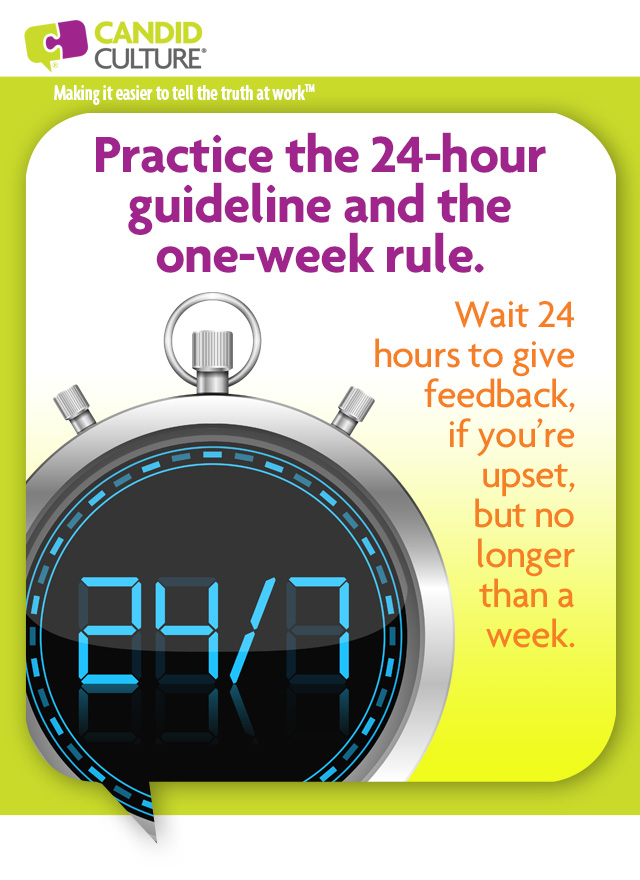
The purpose of giving positive or negative feedback (I like the words upgrade feedback) is to motivate someone to replicate or change a behavior. That’s it. Feedback is supposed to be helpful. If you wait longer than a week to give either positive or upgrade feedback, the person isn’t likely to remember the situation you’re referencing and the purpose of giving feedback – to change or replicate a behavior – will be lost.
Here are four practices to make negative (upgrade) feedback conversations shorter, less painful, and more useful:
Giving feedback practice one: Agree to give and receive feedback at the onset of relationships. Do this with everyone you work with – direct supervisors, direct reports, peers, internal and external customers, and vendors. If we’ve done How to Say Anything to Anyone training for your organization or you’ve read the book, you got the specific language to have this conversation.
Giving feedback practice two: Prepare for feedback conversations by writing down what you plan to say and then delivering the feedback to a neutral person. Ask that person to tell you what she heard and what her expectations would be, based on what you said. Confide in someone either at your level or above at work or someone outside of work, to keep the gossip to a minimum. Ask for confidentiality.
Giving feedback practice three: Tell a neutral person about your situation, and ask what she would say to address the situation. Everyone but you will do a better job at giving feedback. Feedback conversations become hard when we’re emotionally involved. The guy working at the 7-11 will do a better job than you. Seriously. It’s our emotions and concern about the other person’s reaction that makes feedback conversations challenging.
Giving feedback practice four: Agree to do a weekly debrief with the people you work closely with, and follow through. Answer the questions – what went well this week from a work perspective and what would we do differently if we could. Answer the same questions about your working relationship. Giving feedback about your relationship will be hard at first. It will be easier the more you do it. Be sure to say “thank you” for the feedback, regardless of what you really want to say. One of the reasons giving negative feedback is so hard, is we wait too long. Shorter, more frequent conversations are better than long, infrequent discussions.
Giving negative feedback doesn’t have to be so hard. Follow the suggestions above and remind yourself that the purpose of giving feedback is to be helpful. If you were doing the wrong work, you’d want to know. And others do too.

There is way too much guessing at work. You may find yourself thinking, “I’m going to miss this deadline. I wonder what the consequences will be?” Or perhaps, “She said she wanted input on this project. I wonder if she really meant that, and how much feedback is ok to provide?” Or maybe, “He asked for a proposal. Is he expecting something elaborate, or will a one-pager do?”
We often don’t know what others are expecting from us, so we guess. The problem with guessing is that we may do more work than we actually need to, and not in the way the other person wants it. Even worse, when we don’t work according to others’ expectations, they aren’t likely to tell us. Instead, they tell others and make decisions about us that aren’t positive.
I’m a fan of asking lots and lots of questions, preferably at the beginning of anything new. Anticipate all that can happen, get in front of breakdowns, and set clear expectations by asking questions. The people who participate in training with me get an entire box of questions to ask. And the homework is to go ask more questions of the people they work most closely with. Asking questions will always be easier than recovering from violated and often unstated expectations.
If you want fewer breakdowns and frustrations at work, ask the following questions of the people you work with:
Managing up question one: What do you want to do, on this project, and what do you want me to do?
Managing up question two: What does a good job look like?
Managing up question three: What will be different in the organization when this project is finished?
Managing up question four: How would I frustrate you and not even know it?
Managing up question five: How often do you want to receive updates from me?
Managing up question six: Do you want to receive all the details or just big picture information?
Managing up question seven: Do you want to receive the information in bullet form or paragraphs?
It’s never too late to ask questions like these. It’s ideal to ask the question at the beginning of a piece of work. But asking in the middle or even towards the end is fine too. People will appreciate that you asked, whenever you ask.
Ask more. Assume less. Suffering is optional at work.

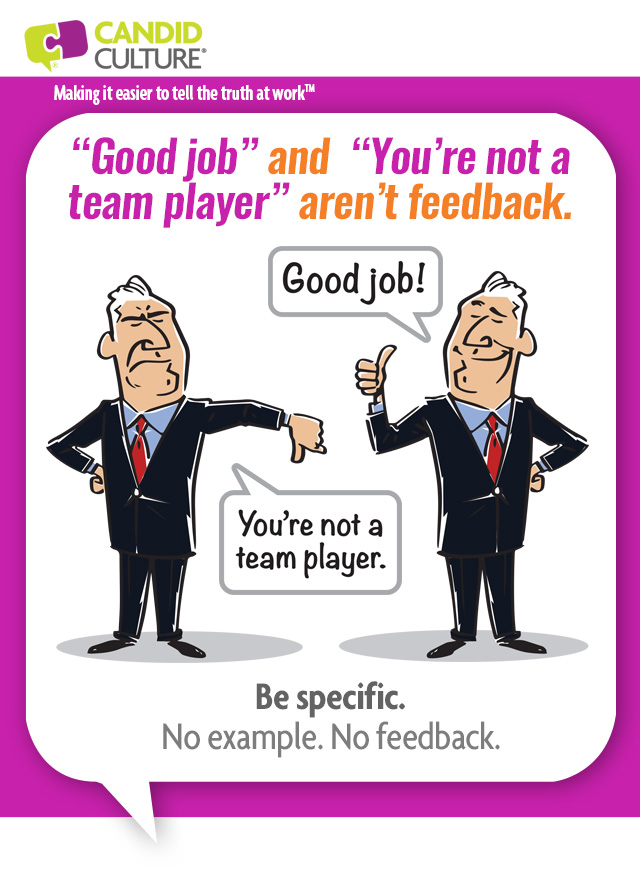
Want to know why people get defensive when you give feedback and why they often don’t change their behavior? Because what you’re giving them isn’t actually feedback.
“You’re awesome to work with” isn’t feedback. Neither is “You did a great job.” “Your work isn’t thorough” isn’t either. Neither is, “You were inappropriate.”
Most of what we consider feedback isn’t feedback at all. It’s vague, unhelpful language that leaves people wondering what they need to do more, better, or differently.
There are only two reasons to give feedback – to encourage someone to either change or replicate a behavior. Unfortunately, most of the ‘information’ we give is too vague to help people do either.
When you give coach or give feedback, you serve as someone’s GPS. Like the GPS on your phone, you need to be so specific the person knows precisely what to change or replicate. If you were driving and your GPS said, “Good job” or “I think you’re off track,” you’d throw the GPS out the window and get a map.
If you give someone what you consider feedback and he says, “I don’t know what you mean, can I have an example?” you’ll know you weren’t helpful.
Here are six tips for giving helpful feedback:
Giving feedback tip one: Write down what you plan to say, then strip out half the words. Shorter feedback with fewer words is better.
Giving feedback tip two: Practice what you plan to say out loud. Have you noticed that what you ‘practice’ in your head is typically not what comes out of your mouth?
Giving feedback tip three: Before having the ‘real’ conversations, give the feedback to an independent, third party and ask her to tell you what she heard. Ensure who you talk with will maintain confidentiality. Your organization doesn’t need more gossip.
Giving feedback tip four: Tell someone else about the conversation you need to have, and ask him what he would say. Anyone not emotionally involved in the situation will do a better job than you will. Again, ensure confidentiality.
Giving feedback tip five: Ask the feedback recipient what he heard you say. Asking, “Does that make sense?” is an ineffective question. “Do you have any questions?” isn’t any better.
Giving feedback tip six: Give one to three examples of what the person did or didn’t do, during the conversation. If you don’t have an example, you’re not ready to provide feedback, and anything you say will evoke defensiveness rather than behavior change.
Giving feedback doesn’t have to be so hard. Be so specific that your feedback could be used as driving directions. The purpose of feedback is to be helpful.


Last week had some really, really terrible moments. Our office WIFI went out during a webinar. Not even the phone worked. I took on a commitment I knew I shouldn’t have, and it required too many long nights, flights, and time away from my family. And I self-medicated with chocolate, and possibly coffee cake, and maybe pizza. There’s more, but I don’t want to bore you.
Some days are going to be terrible. It’s so easy to feel like we’re screwing things up and that we are indeed a screw up. Give yourself a break. The thing to know and remember, in the moment, is that you’re not terrible. You’re a human being, doing the best you can.
Here is a list of ways to give yourself a break and as a result, do your best work. I’ll admit, I’m working on doing these things too. Every day, I’m annoyed that I’m not perfect. I want to be a combination of Sheryl Sandberg, Mary Poppins, and Kate Middleton. I’m not. I’m a business owner, working mom, who hasn’t seen the inside of a gym in over a year, and dreams of nights at the Ritz Carlton, by myself.
Nine Way to Give Yourself a Break:
- Set realistic deadlines. Set yourself up to win and look good.
- Ask yourself, “Do I really want to do this,” before agreeing to any new commitment.
- Turn off the alerts on your phone and laptop. You’ll be more focused and get more work done.
- Ask for help. If there is someone who can help with a project (and it won’t make you look bad), let them.
- Go to bed earlier than you think you need to.
- Take a day off. Your company offers vacation time for a reason. People do better work when they take time to relax and rejuvenate.
- Take time for yourself, even if it’s 30 minutes.
- Drink more water and make sure you eat breakfast and lunch. I’m starting to sound like your mom.
- Say “thank you” more and “I’m sorry” less.
Some of these things are business focused, some are personal. You bring yourself – your whole self – to work. It’s why you’re good at what you do. People want to work with real people. And real people over commit, make mistakes, and spend too much time on Facebook. Give yourself a break.