Archive for November, 2014
 It’s the time of year when people start to evaluate the last year and plan for the next. As I do my own planning, I watch myself repeatedly doing things that will never allow me to reach my personal and professional goals.
I want to get more sleep, but I lie in bed playing with my iphone long after I should be asleep. I want to be in better shape, but I find every reason not to work out. I want to do more local work, but I don’t pursue work in Denver. Who in Colorado wants to hire me to speak or do some training? Ok, back on track.
To have something different, we need to do something different, and that often means giving something up. Letting go of a habit or pattern is challenging. There’s a reason we do what we do. Our habits provide something – comfort, distraction, fun, etc. If you’ve ever done a ropes course or graduated to a more challenging ski run, you know you need to let go of what feels secure to get to the next level. And letting go can be scary and difficult. But if we don’t let go, we get stuck where we are.
Make a list of things you want that you don’t have now. Perhaps you want to:
- Learn a new skill or take on a new responsibility at work
- Buy a house
- Save more money
- Be in better shape
- Pursue a hobby
Then I’d ask, what do you need to give up (aka stop doing) to have what you want?
You need to do something differently, or you would already have what you want. Doing something differently could be as simple as telling someone who can help you get what you want. We often tell our coworkers and friends what we need to be happy in our job, but we don’t always tell the people who can help us get what we want.
If you want a different job, tell someone in your organization who can help you get what you want. Then create a plan with actions you’ll take, milestones, dates, and measurable outcomes, and follow up until you attain your goal.
Lastly, accept when you can’t get what you want from a person or organization, grieve, and then make a big change. If you have consistently pursued a role in your organization and in two or three years haven’t moved toward that goal, chances are you won’t get that job at that company. It’s likely you need to leave.
Choosing to leave is often the most difficult decision to make. We work and work on a relationship or situation, and eventually realize, we will never get what we want. That’s a very hard pill to swallow. But if you’re certain you won’t get what you want, despite your efforts, move on.
Five Steps to Reaching Your Goals – Ask Yourself:
Reaching your goals #1: What do I want that I don’t have now?
Reaching your goals #2: What do I need to give up in order to have what I want?
Reaching your goals #3: Have I made a request of the person/people who can help me get what I want?
Reaching your goals #4: Can the person/people I’ve asked for help assist me, and do they want to do so?
Reaching your goals #5: With persistence and consistency, can I get what I want from this situation, or is it time to move on?
Keys to reaching your goals: Determine what you want; tell someone who can help you get what you want; be consistent and persistent, and be ready to make changes. To have something different, we have to do something different.
Add a comment to the blog about what you’re giving up or doing differently to create the life you want, and we’ll enter you to win a free copy of my book, How to Say Anything to Anyone. And if you already have the book, you can pick a box of Candor Questions of your choosing.

Employees appreciate perks – good coffee, an onsite gym, concierge service, and workout classes. But none of those things motivate employees to stay with an organization. And no one will quit because a company doesn’t offer those perks.
I won’t tell you not to offer yoga classes or to get rid of your video games. Just know neither perk is resulting in employee retention.
There are really just a few things employees need to stay with your company and do good work. And if you do those things consistently, you’ll see your best employees stay and excel.
Here are a few employee retention ideas: 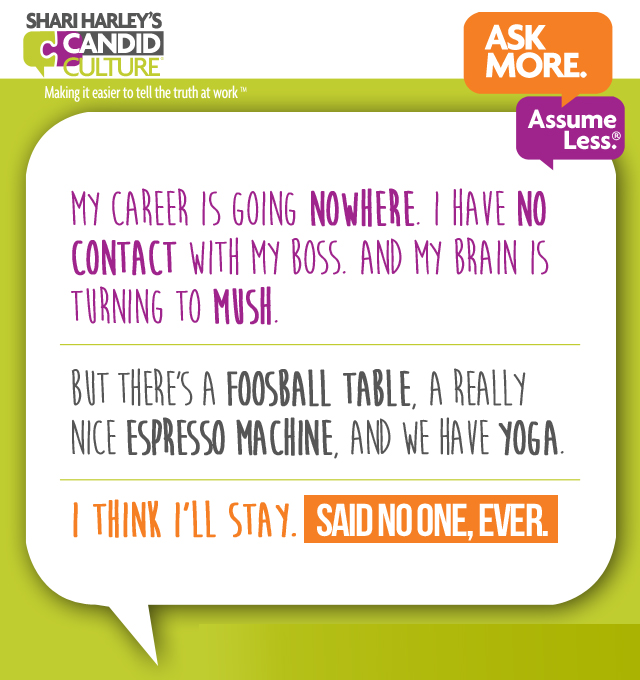
Employee retention idea #1: Managers, get to know employees better. Ask what brought employees to your company, what would make them leave, what employees want to learn, and what type of work they really don’t want to do. And when it’s possible, remove responsibilities employees don’t want to do, and replace those tasks with things employees enjoy more. You can’t eliminate all aspects of a job that employees don’t like. But people won’t stay in a job for long that doesn’t let them do work they enjoy about 75% of the time.
Employee retention idea #2: Managers, meet individually with employees, twice a month, for at least 30 minutes, to discuss current and future projects. Give specific and balanced (positive and negative) feedback during each meeting. Even the most independent employees need regular feedback and one-one-one time with their manager.
Employee retention idea #3: Teach and coach employees, so they expand their skill set and approach challenges in new and different ways. Most employees want to learn and grow. Managers don’t have to do the training themselves, just ensure it happens.
Employee retention idea #4: Give employees exposure to the senior leaders in your organization. This includes: attending meetings where senior leaders are present; pitching ideas to senior leaders; and learning from people above the employees’ manager.
Employee retention idea #5: Give employees stretch assignments and the chance to learn new things. One of the greatest reasons for employee turnover is boredom and a lack of growth and development. You don’t need to rotate or promote someone to help them grow. Giving employees exposure to different departments and types of work will allow employees to expand their skill set.
Most employees want to work for a manager who cares about them, takes time to get to know them, and helps advance their career. These activities will take some time. They won’t take a lot of money. Perhaps have your next one-on-one at the foosball table or over espresso. But know that the time managers take with employees, trumps every perk, every time.

Just because you can say something, doesn’t mean you should.
There can be too much candor and feedback.
A few guidelines to consider before giving feedback:
- Ask yourself, was the feedback solicited? Unsolicited feedback rarely goes over well.
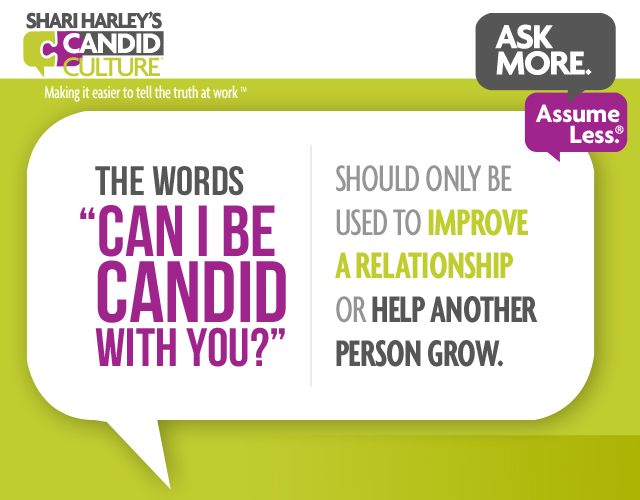
- Assess if you have the relationship to give feedback. I’m offered all sorts of feedback from people I don’t even know. People I don’t know haven’t earned the right to give me feedback.
- Determine if you’re trying to strengthen the person or the relationship. If you aren’t trying to help someone improve, AND the feedback isn’t requested, AND you don’t have the rapport to give feedback, say nothing.
Feedback recipients don’t have to accept unsolicited input or advice. It’s perfectly acceptable to put limits and boundaries on the input you’re open to from peers, friends and family.
Here are two tips for how to handle negative feedback:
How to handle negative feedback tip one:
When you ask for feedback, be very specific about what type of feedback you want.
For example, you could say something like, “We’re picking a new software application to track leads. I’ve already narrowed the choice down to three vendors and vetted what each software application can and can’t do. I want to know about things I may not be aware of, like software that’s being phased out and won’t be supported and potential bankruptcies.”
There’s nothing wrong with asking for targeted feedback. Simply tell people what kind of feedback you want and why. And avoid asking open ended questions like, “What do you think?” If you ask a broad question, you’ll likely get a broad answer.
How to handle negative feedback tip two:
Tell people if you aren’t looking for feedback.
For example, you could say something like, “Thank you so much for your concern. I really appreciate it. I’m actually not looking for feedback at this time. But I really appreciate your concern.”
There’s NOTHING wrong with setting limits and boundaries about what kind of input you’re seeking. And when you do set those limits, intrusive people will think twice before offering unsolicited advice in the future.

Most people would rather get a root canal than participate in an annual employee performance appraisal.
The reasons employee performance appraisals are so difficult is simple:
- Many managers don’t deliver timely and balanced feedback throughout the year.
- Many employees don’t ask for regular feedback.
- Too much information is delivered during the annual employee performance appraisal.
- And as crazy as it sounds, managers and employees haven’t agreed to give and receive regular and candid feedback.
Employee performance appraisals don’t have to be the worst day of the year.
Here are four steps to ensure employee performance appraisals are useful and positive:
- Managers and employees must agree to give and receive balanced, candid feedback. Don’t assume the agreement to speak honestly is implicit, make it explicit.
- Managers, be honest and courageous. Don’t rate an employee a five who is really a three. You don’t do anyone any favors. Employees want to know how they’re really doing, no matter how much the feedback may sting.
- Managers, focus on three things the employee did well and three things to do more of next year. Any more input is overwhelming.
- Managers, schedule a second conversation a week after the employee performance appraisal, so employees can think about and process what you’ve said and discuss further, if necessary.
The key to being able to speak candidly during an employee performance appraisal is as simple as agreeing that you will do so and then being receptive to whatever is said. And don’t make feedback conversations a one-time event. If you do a rigorous workout after not exercising for a long time, you often can’t move the next day. Feedback conversations aren’t any different. They require practice for both the manager and employee to be comfortable.

When leaving a job, the late nights and all-consuming projects quickly become history. What we take with us, are the people we worked with and the friendships we formed.
Much of what contributes to job satisfaction or dissatisfaction are our workplace relationships. “I just can’t work with this person. We don’t see eye to eye. We can’t get along,” are the types of challenges that often motivate people to job hunt.
I’m a believer that suffering at work is optional. You deserve and can have a job doing work you love, with people you enjoy. If your workplace relationships are strained, there are several things you can do to improve them.
Four steps to improve workplace relationships:
1. Make a list of the people you need a good working relationship with.
2. If you’re not sure who you need to work well with, ask your boss, peers, and internal customers. They know.
3. Ensure you know what your internal customers are expecting from you. Ask what a good job looks like, how they’re evaluating your results, and how they like to communicate.
4. Tell people you’re struggling with, “I think we both know this relationship is strained. I’d really like a good working relationship with you. Would you be willing to have coffee or lunch with me, and we can talk about what has gone on, and perhaps start in a different way?”
Fixing a broken relationship needs to be a phone or in-person conversation. Sending someone an email, telling him you want a good working relationship, won’t do the job.
Damaged workplace relationships can be fixed. We often don’t know what the other person is really upset about. We may think we know or assume, but may be surprised when we have the conversation.
You spend way too much time at work not to enjoy the people you work with. Don’t assume strained relationships will remain strained. Identify who is most important to your success, tell those people you want a good working relationship, and then ask questions to learn what they are expecting from you. Good relationships don’t just happen.
You have more influence over your relationships than you may think. Don’t accept the status quo. Suffering is optional.
Click here to take advantage of our holiday special. Get everyone in your organization a copy of How to Say Anything to Anyone, and get more peace at work. Buy five books. Get one free. No limit on quantities.