Archive for June, 2014
This funny communication skills training video provides the words to tell someone they smell, that there is too much cleavage at work, and that there is no texting in the workplace. Giving feedback doesn’t have to be hard.
About fifteen years ago, I worked with a woman with whom I didn’t get along. We were on the same team and had the same job, but didn’t see eye to eye on how to approach work or solve problems. And when we didn’t agree, things got ugly. I have to admit to being afraid of her. She was nasty when things didn’t go her way.
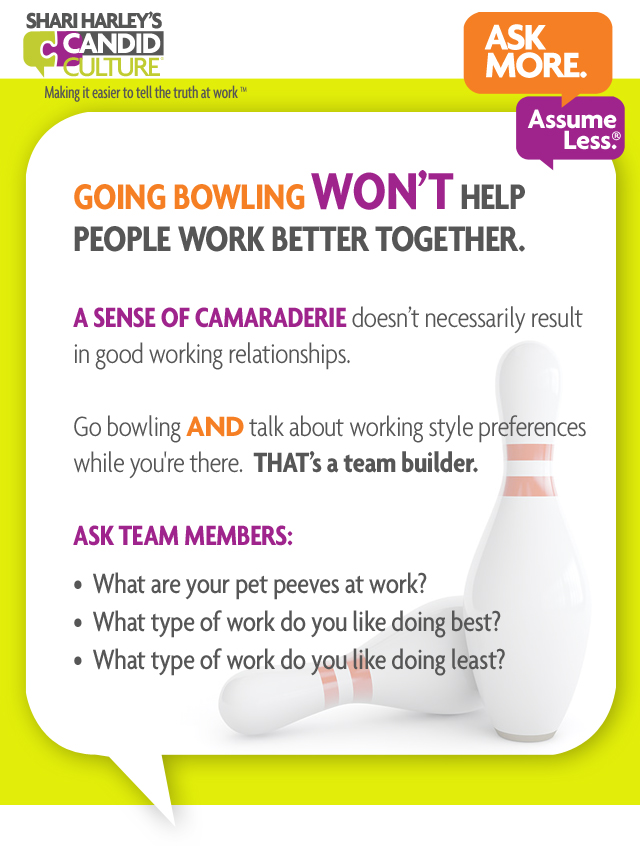 The odd thing is that socially, we did fine. When our team socialized outside of work, we had fun and got along well. That’s when I realized that there was no correlation between getting along outside of work and working well together.
Lots of teams go bowling, to baseball games, and out for happy hour as corporate team building activities. And while team members may enjoy being together at these events and get to know each other better personally, they don’t learn team members’ working style preferences, the work others are really good at, and the things at which team members are not as good.
Go bowling or out for happy hour, just don’t expect people to work better together after doing those activities. If you want to do corporate team building activities, give team members a chance to learn about each other and themselves, and make agreements of how team members will work together in the future. Create occasions for candor.
When I lead corporate team building activities, I put people in small groups, give the group a box of Candor Questions to Say Anything to Anyone, and time to answer the questions. One person in the group asks one question from the box. Everyone in the group answers that person’s question. The person who asked the question then answers his own question. Then another person on the team asks a question and so on. A great conversation always ensues.
People talk about things they should have and wished they’re talked about when they started working together. Team members learn about each others’ work style preferences and what each person needs from both the job and each other. But most importantly, team members have permission to talk about things they normally don’t, and begin to create a climate of candor, which is essential for any group of people working together. For a team to work well together, it must be safe to tell the truth. Teams need to talk about the things that impact them most –each other.
So go bowling and out for happy hour. But also create opportunities for team members to talk about the things that matter most –how they impact each other at work.
 You’ve either seen the video or heard about the group think that happened before NASA’s Challenger exploded in 1986. One engineer felt strongly that there was a defect in the Challenger’s design. He spoke up, others disagreed. He continued to speak up, until it became very uncomfortable to do so.
Most employees don’t even get that far. Many employees are afraid to speak up at all, feeling that it’s not ok to have a counter point of view, and that those who disagree with ‘management’ are eventually fired. I honestly am not sure where this comes from. It hasn’t been my experience, and yet the fear of speaking up is pervasive. I hear it in almost every organization with which I work.
If it’s not ok to express different opinions, your organization will deliver the same-old products and services you always have. If staying the same works in your industry, great. But stagnation is a killer to most organizations.
If you want more innovation in the workplace, you have to make it safe to speak up and offer a different point of view. Saying new, different, and even controversial things must be encourage and rewarded.
Five Ways to Encourage Innovation In the Workplace:
- Ask for new ideas and different points of view.
- Wait until you get both. Don’t allow a meeting or discussion to move on until you get new, opposing, and different points of view.
- Positively acknowledge people who risk and say something new or different from the norm.
- Ensure people with new ideas and different points of view are allowed to finish speaking before they’re interrupted or before someone else tries to negate their ideas.
- Create a few new awards in your organization and announce winners publicly and with great fanfare. You get what you reward.
Create Awards to Encourage Innovation In the Workplace:
- Acknowledge the person who fails massively trying something new.
- Award the person who brings new ideas to the table, regardless of what happens to those ideas.
- Celebrate the person who willingly gives you the worst news.
The fear of speaking up and saying something new or different will kill your innovation efforts. It will also kill your employees’ ambition and ability to be creative. Make it safe to tell the truth, even when the truth is hard to understand or unpopular, and see what happens to innovation, creativity, and employee productivity and morale.
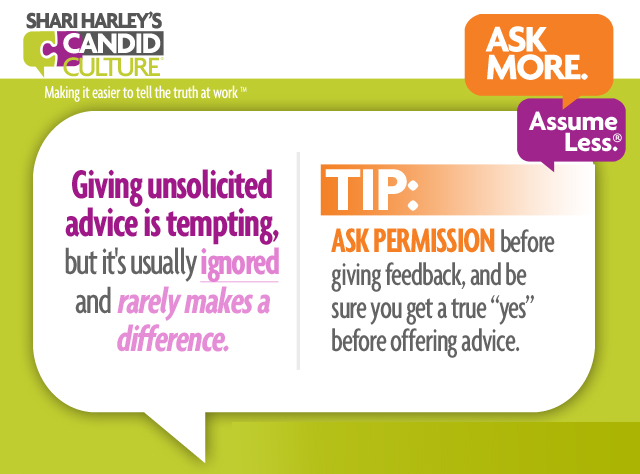 It’s hard to watch people do things that damage them – personally or professionally. And yet, if they haven’t asked for feedback, people likely won’t listen to unsolicited advice, so don’t bother giving it.
If you really want to give unsolicited advice, ask for permission and make sure you get a true “yes” before speaking up.
The conversation could go something like this:
“I noticed we’re getting behind on the XYZ project. I have a couple of ideas about what we can do. Would you be interested in talking about them?” Or, “That Monday meeting is rough. I feel for you. I used to run meetings like that. Would you be interested in talking about some meeting management strategies? I’d be happy to share what I’ve learned.”
After you offer to talk (aka, give your opinion), listen and watch the response you get. Does the person’s words and body language portray a true “yes, I’d like your opinion” or what seems like an “I’m supposed to say yes” reply? If you get the latter, you’re likely just giving unwanted advice that won’t be heard. If that’s the case, let it go. But if the person appears generally interested and open, proceed.
You could also say something like:
“Last week we were talking about your frustrations about not being promoted. I have a couple of ideas about that. Do you want to talk about them? Either way is fine, but I thought I’d offer.”
Or, “That was a tough conversation during today’s staff meeting. It’s hard to present ideas and not have them be embraced. I have a couple of thoughts about ways you can approach the conversation during the next meeting. Want to talk about them?”
If you make the invitation to talk, the other person has to be able to say no. An invitation is only an invitation if no is an acceptable answer. You can’t ask if the person wants your input and then keep talking even if he verbally or physically said no.
Be brave. If you care about someone personally or professionally and you see him doing something that gets in the way of his success, ask permission to say something. If you get the go ahead, proceed. If you get a “no thank you,” accept that and move on. You’ve done your part.
Read How to Say Anything to Anyone, and get the words to have even the toughest conversations.

Employees leave managers not jobs. We’ve all heard this 100 times.
One of the most prevalent reasons for employee turnover is boredom and lack of growth. We’ve also heard this many times.
We know why employees leave jobs. The question is what must managers do to engage and retain their best people. The answer is actually quite simple, although possibly not easy to execute.
 Employees want to know that their manager:
- Knows them
- Cares about and is invested in their careers
- Gives feedback so they can improve
- Provides opportunities so they can develop
In other words, employees need attention, and attention requires time, time many managers may not feel they have.
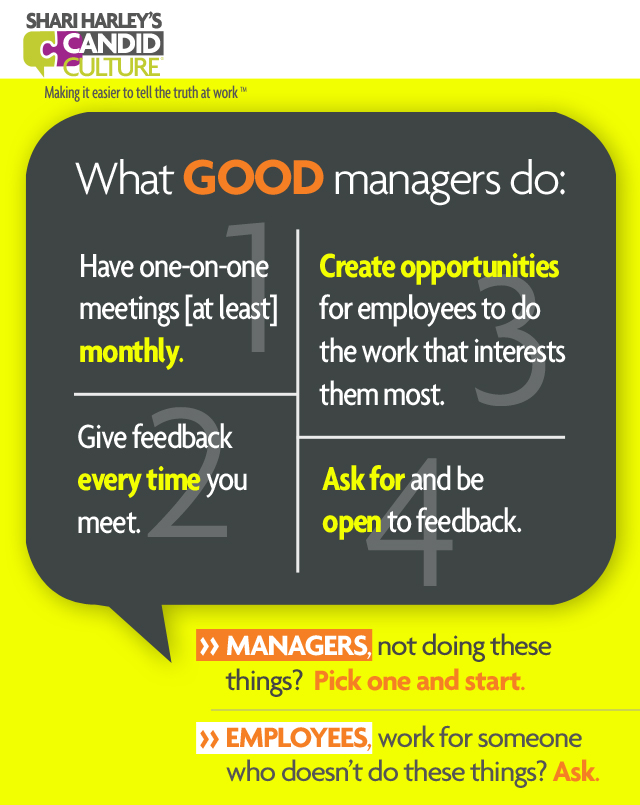
Here is a five-step formula for employee retention and employee engagement:
- Get to know employees better and differently
- Have meaningful, one-on-one meetings [at least] monthly
- Give feedback every time you meet
- Ask for and be open to feedback
- Create opportunities for employees to do the work that interests them most
Managers, how do you make time for these meetings when are busy and have several direct reports?
- Meet for 15-30 minutes
- Meet over the phone while commuting or waiting for flights
- Ask direct reports to create an agenda and run the meetings
- Ask direct reports to send follow-up notes of decisions and plans made during meetings. Give some of the accountability away.
- If meetings get cancelled, reschedule as soon as possible. Direct reports take cancelled meeting personally. Cancelled meetings, that are not rescheduled, send the message that managers don’t care about employees and their careers.
Employees, if your manager doesn’t schedule meetings with you:
- Ask permission to put a monthly meeting on your manager’s calendar
- Provide rationale for why you want to meet–to get your manager’s feedback and ensure you’re focused on the right work
- Ask permission to reschedule meetings when they get cancelled
- Don’t take cancelled meetings personally
- Offer to meet with your manager via the phone when it’s convenient for him/her. Leverage commute and travel time.
Employees need time with their managers. Meaningful discussions and work result in employee engagement and employee retention, so managers, make the time, even when you don’t feel you have it. Ask questions you don’t ask now. Give feedback, even if it’s uncomfortable. Give your employees an opportunity to do the work that interests them most. And watch your employee engagement and employee retention improve. And if your manager doesn’t do these things, politely and persistently ask. You won’t get what you don’t ask for. We are all 100% accountable for our careers.