Archive for November, 2013
When I was 27 my boss gave me a yellow sticky note that said “thanks” for something I had done well at work. When I was 29 he gave me a card when I broke up with a long term boyfriend. I still have both. And I’m way past 27 and 29.
He is the only manager in my entire career who wrote me a personal note. And it meant everything to me. He took the time to do something others didn’t. The notes were personal and thus they meant something to me – they still do. And the notes took him only seconds to write and cost almost nothing.
When is the last time you received a handwritten note? Not a note from Send Out Cards, that is made to look handwritten, or a note written by someone’s assistant, or a note that was typed and then hand signed? Rather, a real handwritten note, with a message, just for you? My guess is not in a long time.
Your employees like perks – paid time off, gift cards, bonuses, onsite yoga classes, concierge service, etc. But perks are not what result in engaged and retained employees. There is a lot of research on what results in employees doing their best work and being loyal to both their manager and to the organization.
Here’s a snap shot of some of the research on engaging and retaining employees.
Employees:
- Need to trust senior management
- Want to work for someone who cares about them, is invested in their success, and with whom they have a good relationship
I won’t tell you not to give bonuses or gift cards, but I will tell you to give each bonus and gift card with a handwritten note. The handwritten note will mean more and last longer. I promise you.
I admit I love stationery. In fact, I collect it. I always have a stash of cards, ready to go for any occasion. And if you know me long and well enough, you will receive a handwritten note from me.
Because I love stationery so much, I’ve always wanted to create a line of greeting cards, and now we have. Today we’re launching Candor Cards. Thank you notes for employees designed to help you say what you want to say.
Use the cards at work and at home to:
- Say thank you
- Provide encouragement
- Give positive feedback
- Say you’re sorry
- Reinforce training
I hope you like and use our thank you notes for employees! Enjoy!
Spend less. Say more.

During the holidays we often see people we haven’t seen in a long time. Your family and friends care about you and want to hear what’s happening in your life. Caring and curiosity can lead people to ask questions that you don’t want to answer.
Over Thanksgiving last year I was holding my sister-in-law’s adorable baby. That prompted another family member to ask when I was going to have a baby. I was completely taken aback by the question and simply replied, “I don’t know.”
Friends and family don’t need to know everything that’s happening in your life. None of your business – said a bit differently – is a perfectly acceptable reply. You decide what to share.
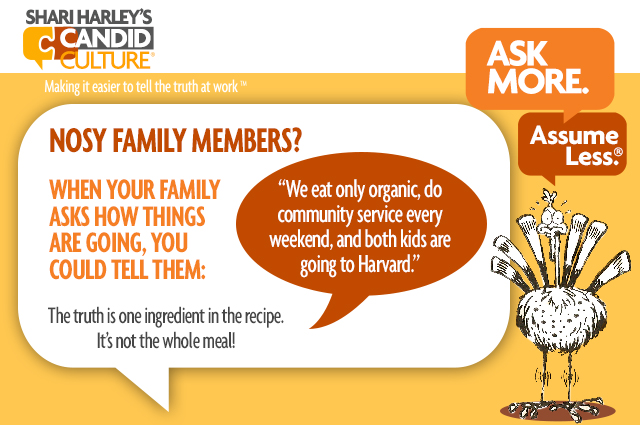
Here are a few possible replies to questions you don’t want to answer:
Question: “What’s happening with that nice young man/woman you’ve been dating?”
Answer: “Things are going great. Thanks for asking.”
Question: “Are you guys serious?”
Answer: “We like each other a lot. If it goes further, I’ll let you know.” Aka, this conversation is over.
Here’s another scenario:
Question: “Are you dating anyone?”
Answer: “No, not right now.”
Question: “You know, I met my husband on Match.com. Have you tried online dating?”
Answer: “That’s great that you met online. I don’t really want to talk about my dating life. What else is happening?”
The next thing she says, “You really should try it. You need to be open. You just never know.”
Answer: “I really appreciate your interest. I’m not looking for dating advice right now, but I really appreciate your concern.” Aka, shut up.
The examples above are about romantic relationships but they could have been about careers, kids, or finances. Your response can be the same. You don’t need to tell anyone anything you don’t want to. It’s ok to tell people to back off and that something is none of their business. You can say it nicely. Just don’t let yourself get cornered into giving information you don’t want to share.
An appropriate answer to almost any personal question is, “I don’t have anything to report on this front, but I’ll let you know when I do.”
An appropriate response to any type of unsolicited advice is, “Thanks so much for your concern. I’m not looking for advice on _____, but I really appreciate you caring.”
Telling someone to back off is perfectly appropriate. S/he’ll get the point and your personal life will remain personal. Boundaries are your friend.
Read How to Say Anything to Anyone, and be ready to manage intrusive questions and unsolicited advice this holiday season. We’re offering a special holiday deal. It’s the best price you’ll find anywhere.
By Shari Harley, Keynote Speaker and Founder and President of www.candidculture.com.
A few weeks ago, a college student introduced me before I spoke at a conference. I heard him practicing out loud shortly before he was to read my introduction on stage. As he practiced, I heard him struggle with the word candor. Initially he pronounced it as can-door vs. can-dor. He’d never seen the word and didn’t know what it meant.
The word candor is not being used on a regular basis. Younger people may not know what it means. And, in my experience, people who are familiar with the word often misinterpret candor to mean bad news. Most people expect bad news to come after the question, “Can I be candid with you?”
The definition of candor is to be honest, truthful and forthright. We at Candid Culture define candor differently. The Candid Culture definition of candor: Telling people what you need before challenges occur. Anticipating everything that can take a project or relationship off track and talking about potential pitfalls before they happen.
Think about the projects and processes in your office – hiring someone new, sourcing a vendor, training people on new software. The potential breakdowns are predictable. You know the pitfalls that can happen when starting anything new because you’ve experienced them.
What if candor sounded like, “We want this project to be smooth. There are a couple of things that will make our work together go well and a few things that may delay the project and have it cost more than we budgeted. Let’s talk about what needs to happen for things to go smoothly, ways to prevent missed deadlines, and how we’re going to handle breakdowns when they happen.”
Some call a conversation like this setting expectations, others call it planning. In my world, these conversations are called candor –talking about what you need when projects begin, rather than letting the anticipatable train wreck happen.
Candor isn’t bad news. It’s telling people how to win with you vs. making them guess.
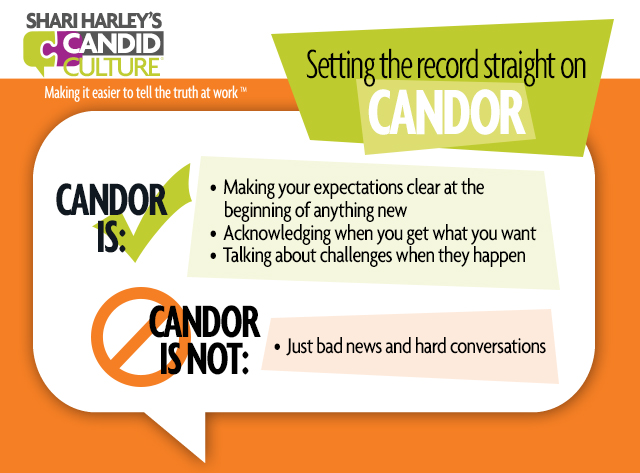
Examples of candor at work and at home:
“Here a few of my pet peeves… It would be great if you could avoid them.”
“What will frustrate you?”
“I turn off my cell phone alerts at night, so feel free to text or call me anytime. I’ll respond to all messages in the morning.”
“I respond to text messages mostly quickly, then voicemail, then emails. If you don’t get a reply to an email within two or three days, don’t take it personally. Chances are I haven’t read the message. Feel free to follow up with a text or voicemail.”
“I work best by appointment. Drop by’s are hard because they interrupt my flow. Email or text me if you need something, and I’ll tell you when I can swing by. Does that work for you?”
For the most part, we treat people as we want to be treated. Other people aren’t us. They don’t do things as we do and don’t know what we want. Don’t make people guess how to work with you, what you need, and what you expect. Be candid and tell them! Then ask what the people you work and live with expect from you.
You won’t get what you don’t ask for.
Most of the feedback we give and receive puts people on the defensive. We don’t do this intentionally. It just happens. We say how we feel, usually when we’re upset, and the other person responds.
Most of the feedback we give and receive is judgy, like the examples below.
|
Judgy – Not Real Feedback
|
Just the Facts – Actual Feedback
|
| “You ignore me in meetings.” |
“When I raise my hand to participate in meetings, you don’t call on me.” |
| “You’re rude to me.” |
“When you pass me in the hallway, you don’t say hello.” |
| “You won’t work with me. You go around me.” |
“We were supposed to screen potential vendors together. You scheduled and held the appointments without me.” |
| “You’re not responsive.” |
“You usually reply to emails a week after they were sent.” |
| “It’s hard to get time on your calendar.” |
“It takes three weeks to schedule time to meet with you.” |
Becoming defensive when receiving feedback is a hard-wired response, like slamming on your brakes when the car in front of your does the same. The more people feel judged, the more defensive they become. If you want to be sure people become defensive when you give feedback, be vague. If you want people to be able to hear you and take action on your feedback, strip out the opinion (judgment) and give people just the facts.
Referring to the chart above, the sentences on the left are opinions. And opinions can be debated. The sentences on the right are facts. Facts are harder to debate. When giving feedback give just the facts, not your opinion. This will take practice.
The first thing out of our mouths will invariably be judgment/opinion. People who have participated in feedback training with me or who have read How to Say Anything to Anyone know I call the tendency to be vague Cap’n Crunch. Cap’n Crunch: “You’re doing a good job.” That’s sweet but useless.
When someone upsets you and you want to tell the person, prepare for the conversation by asking yourself these questions:
- What did the person do that frustrated me?
- What behaviors did s/he exhibit?
- What actions did s/he take?
- What was the impact on me?
Then practice giving feedback to someone outside of your workplace or group of friends (to reduce gossip and drama) and ask the person with whom you’re practicing what s/he heard. If your feedback is specific and clear, any lay person will interpret the feedback as you intended it.
Giving feedback, that others can hear, isn’t easy to do. It requires you to put your emotions aside, strip out judgments and opinions, and tell the other person the facts of what happened. The more you focus on the facts and less on how you feel about what happened, the better your conversations and relationships will go.