We’ve all received work via email from another person that wasn’t what we were expecting, hit reply, and told the other person what we thought. Then we dealt with the consequences.
A few tips for giving feedback to get more of what you want and less of what you don’t:
Don’t give feedback via email. Ever. You can’t manage your tone or see the person’s reaction.
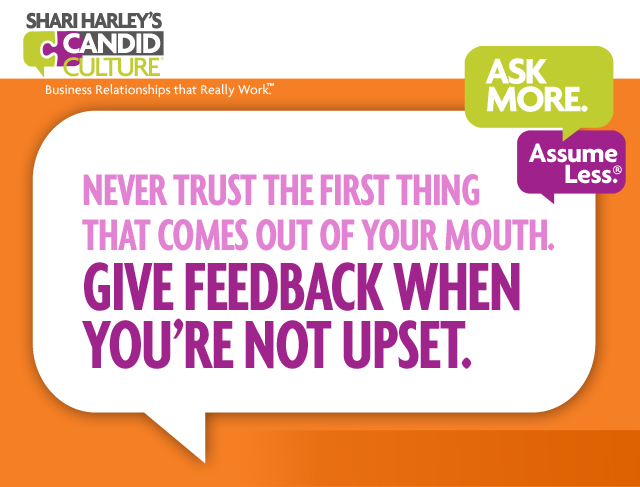
Practice the 24-hour rule and the one-week guideline. Wait until you’re not upset to give feedback, but don’t wait longer than a week.
It’s almost impossible to give negative feedback without putting the other person on the defensive. Becoming defensive when receiving feedback is normal and natural. It’s a way to protect ourselves when we feel judged.
When people are defensive, it’s hard to listen and respond. The less defensive the other person becomes, the easier it is to communicate with that person. People will be less defensive if you give feedback when you’re calm and choose your words carefully.
Communicate in a way that the relationship needs versus what you need in the moment.
When we give feedback when we’re upset, we’re really communicating for ourselves, not for the other person. I didn’t get what I want, I’m upset, and I’m going to tell you about it. Then the other person gets upset and now, in addition to you not getting what you wanted in the first place, you have to do damage control.
Communicating in a way the relationship needs means choosing the timing, words, and method of communication that is likely to produce the result you want – the other person being able to hear you, while becoming minimally defensive, and taking action. Giving feedback when you’re upset, especially via email, will not produce the result you want. You’ll only damage your relationship.
Being an effective communicator and maintaining good business relationships requires patience and self-discipline. Wait to give feedback until you’re not upset. Don’t send an email. Pick up the phone, meet via video, or walk to the person’s desk. Deliver the feedback in a way the other person can hear you. Be ready for the person to become defensive. It’s human to become defensive. You can’t eliminate defensiveness, but how you deliver feedback can greatly reduce defensiveness, and you’ll get more of what you want and less of what you don’t.
The normal, natural reaction to negative feedback is to become defensive, a response I’ve labeled as The Freak Out.
Everyone, even the people you think do little work, wants to be seen as good – competent, hardworking, and adding value. When anyone calls our competence into question, we get defensive. Becoming defensive is an automatic response that we have to train out of ourselves.
Until the people you work with train themselves not to become visibly defensive when receiving feedback, just expect it. And be happy when you get a defensive response. It means the person is breathing and cares enough about what you’re saying to get upset.
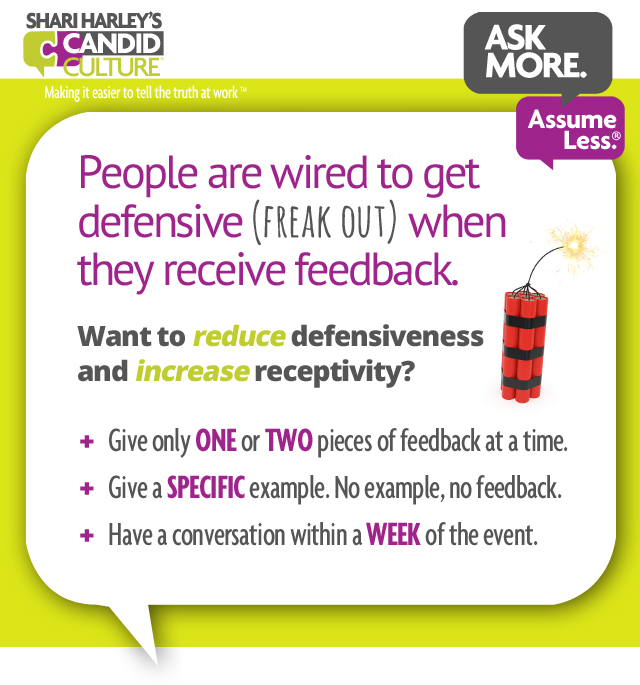
While you can’t get rid of a defensive response to feedback, you can reduce it by following a few feedback practices. Practice these methods of giving feedback and your input will be heard and acted on, more often than not.
Employee feedback practice one: Don’t wait. Give feedback shortly after something happens. But do wait until you’re not upset. Practice the 24-hour guideline and the one week rule. If you’re upset, wait at least 24-hours to give feedback, but not longer than a week. If the feedback recipient can’t remember the situation you’re talking about, you waited too long to give feedback, and you will appear to be someone who holds a grudge.
Employee feedback practice two: Be specific. Provide examples. If you don’t have an example, you’re not ready to give feedback.
Employee feedback practice three: Praise in public. Criticize in private. Have all negative feedback discussions privately.
Employee feedback practice four: Effective feedback discussions are a dialogue; both people talk. When the feedback recipient responds defensively, don’t be thwarted by their reaction. Listen to what they have to say and keep talking. Don’t get distracted.
Employee feedback practice five: Give small amounts of feedback at a time – one or two strengths and areas for improvement during a conversation. People cannot focus on more than one or two things at a time.
Employee feedback practice six: Give feedback on the recipient’s schedule and in their workspace, if you are working in person and the recipient has a door. It will give the other person a sense of control and they will be more receptive.
Employee feedback practice seven: Talk with people – either in person or via phone. Don’t send an email or voicemail. Email is for wimps and will only damage your relationships.
Employee feedback practice eight: Prepare. Make notes of what you plan to say and practice out loud. Articulating a message and thinking about it in your head are not the same thing.
Employee feedback practice nine: Avoid The Empathy Sandwich – positive feedback before and after negative feedback. Separate the delivery of positive and negative feedback, so your message is clear.
Employee feedback practice ten: Offer an alternative. Suggest other ways to approach challenges. If people knew another way to do something, they would do it that way.
You can deal with whatever reaction to negative feedback you get. The other person’s response might make you uncomfortable, but that’s ok. You’ll survive. Try to practice the guidelines above, and if you don’t, and you ‘do it all wrong,’ at least you said something. Just opening your mouth is half the battle. When you come from a good place of truly wanting to make a difference for the other person, and you have both the trust and permission to give feedback, you really can’t go wrong.