Posts Tagged ‘managing business relationships’
At the end of presentations, attendees often approach me and say something like, “People tell me my communication style is really direct and that it can be off putting. I don’t know what to do about this.” Or they say, “People say I’m really quiet and hard to read. They have a difficult time getting to know me.”
If you’ve been given the same feedback repeatedly or know you create a first impression that may be challenging to others, set expectations and tell people about your communication style when you begin working with them. Don’t wait until they feel offended, confused, or frustrated. Simply tell people when you meet them, “I’ve been told that I’m too direct and how I provide feedback can be off putting. Anything I say is to be helpful. If I ever offend you or provide too much information, I hope you’ll tell me.” Or you could say something like, “I’m told that I’m quiet and it’s hard to know my thoughts on projects and initiatives. Please feel free to ask anything you want to know about me or my thoughts on company initiatives.”

People will make decisions about and judge you. There is nothing you can do about this. But you can practice what I call, ‘get there first.’ Set people’s expectations about your communication style and what you’re like to work with, and then ask people to speak freely when they aren’t getting something they need.
The root of frustration and upset is violated expectations. People may not be aware of their expectations of you or be able to articulate those expectations. But if they didn’t have certain expectations, they wouldn’t be upset when you acted differently than how they (possibly unconsciously) expected.
I’m a proponent of anticipating challenges and talking about them before problems arise. If you know something about your behavior is off putting or confusing to others, why not be upfront about it?
When people interview to work for me, I set clear expectations about my communication style and what I’m like to work with. I tell them all the things I think they’ll like about working for me and all the things I suspect they won’t. People often nod their heads and say, “no problem,” which, of course, may not be true. They won’t know how my style will impact them until they begin working with me. But when I do things I gave them a heads up would likely be off putting, we can more easily talk about those behaviors, than if I had said nothing.
Talk about your communication style when projects and relationships begin. Replace judgment and damaged relationships with dialogue.

When something ‘bad’ happens, my nine-year-old is quick to ask who is at fault, hoping, of course, it’s not him. I’m trying to get him to use the word accountability instead, and to understand that if he has some accountability, he has some control over what happens. If he has no accountability, he has no control. A tough concept for a nine-year-old.
Stuff happens. People won’t give you what you need to complete projects. Things will break. When breakdowns happen, I always ask myself, “What could I have done to prevent this situation?” or “What did I do to help create this situation?”
It may sound odd that I always look at myself when breakdowns occur, even when it’s someone else who didn’t do their job. It’s just easier. When I can identify something I could have done to make a situation go differently, I feel more in control – aka better.
I’m the person who gets off a highway jammed with traffic. The alternative route may end up taking longer, but at least I’m moving. I feel like I’m doing something and thus have more control. Taking responsibility for what happens to you is similar. When you’re accountable for what happens, you can do something to improve your situation. When someone else is accountable, you’re at the mercy of other people and have very little control.
There are, of course, exceptions to the practice that “we’re accountable.” Terrible and unfair acts of violence, crime, and illness happen to people, about which they have no control. But in general, in our day-to-day lives, there is typically something we did to contribute to a bad situation or something we can do to improve it.

Here are four practices for improving difficult situations even when you didn’t create the mess alone.
- Ask more questions. If you’re not clear as to what someone is expecting from you, ask. Even if their instructions aren’t clear, it is you who will likely be held accountable later.
- Tell people what you think they’re expecting and what you’re planning to do, to ensure everyone’s expectations are aligned. This beats doing weeks’ worth of work, only to discover what you created isn’t what someone else had it mind.
- Ask for specific feedback as projects progress. Don’t wait until the end of a project to find out how you performed.
- Admit when you make a mistake or when you wish you had done something differently. Don’t wait for someone to tell you. Saying, “I’m sorry. How can I make this right with you?” goes a long way.
These are really delegation practices — reverse delegation. Help people express their expectations of you clearly, so you can be successful.
I am always asking the questions, “What could I have done differently? What did I do to contribute to this situation, what can I do now to make this situation better?” I encourage you to do the same, even when someone else drops the ball. You can’t control others, but you can control you. And your happiness and success is your responsibility.

When the people we work with don’t do their jobs, we might find ourselves saying, “They should be more on top of things.” “They shouldn’t make commitments they can’t keep.” “They don’t know what they’re doing, and that’s not my problem.” The challenge is, when your coworkers don’t perform, it is your problem.
When your coworkers don’t get you the information you need in a timely way, you miss deadlines. When you work from incorrect information, your reports are wrong. When others don’t work with you, you look bad. So, you can be right all day about how others perform, and your reputation will still be negatively impacted.
I don’t suggest you enable your coworkers by doing the work others don’t. I do suggest you help your coworkers be successful by holding them accountable.

Here are a few things you can do to manage your career and get what you need from your business relationships:
- Don’t assume others will meet deadlines. Check in periodically and ask, “What’s been done so far with the XYZ project?” Notice, I didn’t suggest asking, “How are things going with the XYZ project.” “How are things going” is a greeting, not a question.
- Set iterative deadlines. If August 25th is your drop-dead deadline, ask to see pieces of work incrementally. “Can I see the results of the survey on August 10th, the write-up on August 15th, and the draft report on August 20th?” One of the biggest mistakes managers and project managers make is not practicing good delegation by setting iterative deadlines and reviewing work as it’s completed.
- Don’t just email and ask for updates. The people you work with are overwhelmed with email, and email is too passive. Visit people’s offices or pick up the phone.
You might be thinking, “Holding my coworkers accountable is awkward. I don’t have the formal authority, and I don’t want my coworkers to think I’m bossy or damage my business relationships.”
It’s all in the how you make requests.
If you’ve seen me speak or have read the business book How to Say Anything to Anyone, you know I believe in setting clear expectations at the beginning of anything new. That could sound something like, “I’m looking forward to working with you on the XYZ project. How would you feel if we set iterative deadlines, so we can discuss work as it is completed? You’ll get just-in-time input, making any necessary adjustments as we go, and we’ll stay ahead of schedule. How does that sound? How are the 10th, 15th, and 20th as mini deadlines for you?”
Many people put large projects off until the last minute. People procrastinate less when large projects are broken into smaller chunks with correlating deadlines. You strengthen your business relationships and support people in meeting deadlines and not procrastinating when you agree on completion dates when projects begin. Also, most of us unfortunately know what it’s like to put a lot of work into a project, have someone review our completed work, and then be told we went down the wrong path and need to start over.
Ask more. Assume less. Don’t assume your coworkers will do what they’re supposed to do. Ask upfront to see pieces of work on agreed-upon dates. Pick up the phone versus rely on email to communicate and know that the people you work closely with are a reflection of you. Get people working with you, and everyone will look good.

You interviewed for a job four weeks ago but haven’t heard back from the recruiter. You asked a coworker to have lunch, no reply. You asked a team member for a document, but after three emails, two texts messages, and a voicemail, still no reply.
It’s normal and natural to go to a dark place when we don’t get the response we’re expecting. We wonder, “Maybe they don’t like me? Perhaps they don’t want me involved in the project? Did I step on their toes? Maybe I asked in the wrong way?”
Wondering why we haven’t heard from people and inventing reasons for the lack of communication is normal and natural. It’s also exhausting and draining.
I’ll admit, I am on pins and needles after I deliver a training program, until I connect with my client to hear how they felt about the program. Even when I know I did a great job, I need to get the feedback and I’m on edge until I get it.
I’ve had enough training on communication and interpersonal relationships to know that others’ responses are usually not personal. People are busy taking care of themselves, as they should. They’re thinking about their own deadlines, deliverables, and the demands on their own time. Ninety-nine percent of the time they’re not thinking about us.
People are wired for self-preservation, and this very good and important. If you don’t take care of yourself, who will? The question, is how do we get our own needs met when we don’t get the response we’re expecting or the communication we need?
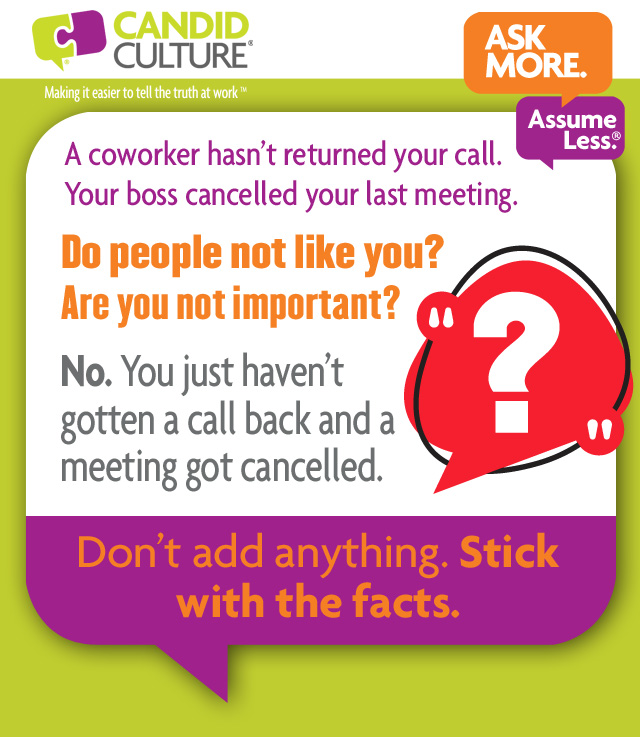
The most powerful approach is to remember that people’s response or lack thereof has nothing to do with us, and to let it go. Don’t be consumed with the lack of communication. Move on. You’ll hear back from the person when you hear back. This would be a powerful position to take, and it’s very difficult, at least for me.
The next approach could be to make up an interpretation that empowers you. If you’re inventing a reason you haven’t heard from the person; you might as well invent a reason that makes you feel good. For example, “The person participated in an escape room this past week and hasn’t made it out yet. They don’t have an Apple watch and have no way to communicate.”
Another approach is to set expectations when you begin working with people. Ask the recruiter, “If I haven’t heard back from you and a few weeks have passed, is it ok if I call to check in?” Ask your boss, “Is it ok if I reschedule meetings that get cancelled?” Ask your coworkers, “If I need information but haven’t heard back after three attempts, what should I do? Who else can I ask rather than wait?” Having a plan in place when you don’t get the communication you need will give you a clear course of action, rather than guessing.
But ultimately the most powerful – even if it’s the most difficult – response is to know deep down that the lack of communication is not about us.