My last boss, before I started Candid Culture 18 years ago, was the best boss I ever had. He always had my back. He was knowledgeable about the business and happy to share his knowledge. He trusted me and gave me a lot of latitude. And I confused that positive relationship with that of a confidante.
I felt comfortable with my boss, so I complained about my internal customers to him. I thought he was a safe person to do that with. I was wrong. He eventually told me he had no way to determine that I didn’t vent with everyone. My naïve decision to vent to my boss was a point of reference about my professionalism and not a good one.
A manager’s job is to help employees eliminate obstacles, ensure employees have the resources they need to be successful, and to be a coach. A manager’s job is also to evaluate their employees.
Managers only have so many points of reference to evaluate their employees’ performance. If employees tend to vent with their boss how internal customers are difficult to work with, the manager doesn’t know that that employees don’t do this with everyone. It’s a point of reference that makes an impression.
It would have been fine to tell my boss I was struggling to work with an internal customer and ask for suggestions for how to work better with the person. It would have been fine to say I was frustrated or discouraged and was in need of support. It’s ok to share problems and breakdowns and leverage your boss to find solutions and to get help. Asking your boss to help you solve a problem you haven’t been able to solve yourself is expected. Using your boss as a therapist is not.
I don’t want you to be paranoid, to feel that you have to watch every word that comes out of your mouth, and that you always have to be on your guard. Just know the role people in organizations play. Leaders and managers have to determine who is successful in their current role and who is a good fit for future roles, so be mindful of how you show up and to whom.
We all know impressions are formed quickly and are hard to change. If someone sees you once a week, one a month, once a quarter, what are they seeing? People only know what we show them and what others tell them. Let your boss see the poised professional you are. Let your friends and family see the rest.
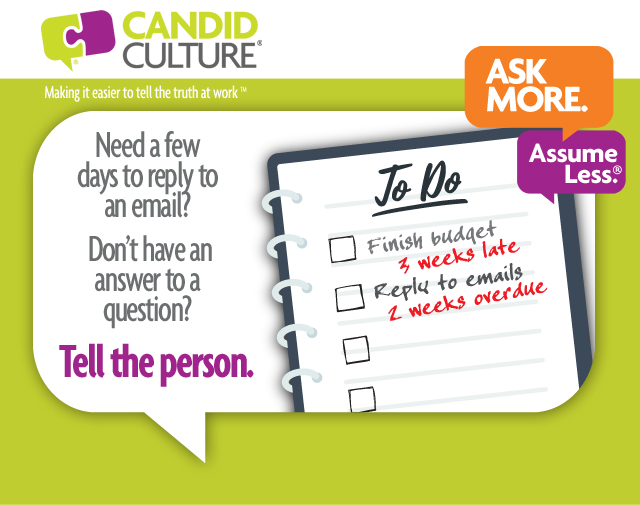
You open an email (or a few hundred) telling yourself you’ll reply later, but never do. Feeling ambitious, you agree to a deadline you can’t meet. Needing a break, you take a few days off but don’t put an out-of-office message on your email.
We’ve all taken too long to reply to an email, missed a deadline, or simply taken too long to provide someone with information. It’s ok to take time to respond, not to have all the answers, and take time off. We simply need to provide timely and accurate status updates.
When people don’t hear back from us in what they consider a timely way, they start to wonder (at best), and judge us (worse), or tell others we’re non-responsive and unreliable (worst). Don’t make people wonder if you received their message, send a timely status update and tell the truth.
If you’re behind and need more time than usual to respond to emails, tell people that. Respond to emails within 24-hours and tell senders you received their message and it will be (fill in the blank) before they hear back from you. When you get an email that requires research, respond within 24-hours and tell the person how long it will take to find the information. If you’re out of the office and don’t plan to read or respond to emails, tell people the dates you’re out.
In the absence of knowledge people make stuff up, and it’s never good. Filling in the blanks isn’t malicious. People simply have a need to know what’s happening. And when they don’t know, they invent stuff. It’s how the brain works. When we don’t hear back from people in what we consider a timely way, we start to wonder. “Did they get my message? Why aren’t they responding? What’s wrong?”
It’s ok to need time to respond. It’s ok to be running behind. It’s ok to take time off. Simply let people know the true status. Manage your reputation and business relationships. Don’t make people guess.
You’ve heard countless times that you never get a second chance to make a first impression. So when something not-so-positive happens – a customer is upset, you missed a deadline, or made an error – don’t let your boss find out about it from someone else. Manage your professional reputation and get there first to create the first impression of what happened.
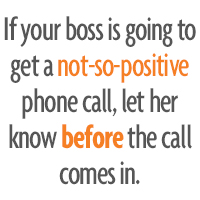
Managers don’t like surprises. If your manager is going to get a call about something that isn’t positive, let them know before the call comes in. You will create your manager’s perception of the situation, and perceptions are hard to change. Don’t wait for the s*** to hit the fan. Get ahead of the problem by coming forward and giving your manager and other stakeholders a heads up.
It could sound something like this, “I just had a tough conversation with John in IT. You may get a call. Here’s what happened… I didn’t want you to be surprised.”
Or “I told Jessica at Intellitec we’re raising our prices this quarter. She wasn’t happy. You may get a call.”
Or let’s say you’re going to work on a strained relationship. Tell your manager before you take action. It could sound something like this, “I want to work on my relationship with Julie. Our relationship has been strained since we worked together on the software project last year. I’d like to approach her, tell her that I know our relationship is strained, and that I’d like a good working relationship with her. Then I’d like to ask if she’s willing to have lunch with me, talk about what’s happened, and see if we can start again in a more positive way. What do you think of me doing that? Would you approach the conversation differently? I don’t know how it’s going to go, so I wanted you to know what I’m planning to do, just in case it backfires and you get a call.”
Manage your professional reputation assertively by taking responsibility for mistakes, working on damaged relationships, and telling your manager before someone else does!
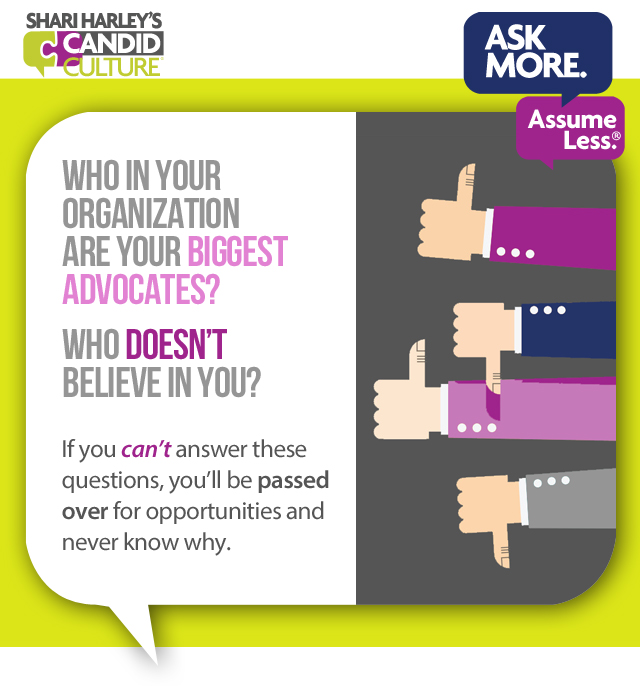
You will be passed over for jobs, projects, and opportunities, and never know why. Being passed over isn’t necessarily a bad thing, not knowing why you were passed over is problematic. If you don’t know why you’re being passed over, how can you be prepared next time?
Organizations are political. People talk. You’ve undoubtedly already experienced this.
If you want to manage your professional reputation, one thing you must know is who talks about you and what they say. How decisions get made in organizations isn’t always obvious. There are the obvious channels of decision making, like your boss and your boss’s boss. But there are also the people who talk to your boss and boss’s boss and have an opinion about you, who you may not be aware of.
Everyone in an organization has people they trust, who they listen to and confide in. Who those trusted people are isn’t always obvious. When you’re being considered for a new position or project, the decision makers will invariably ask others for their opinion. Knowing who does and doesn’t support you in a future role is essential to managing your professional reputation and career.
I don’t want you to be nervous, paranoid, or suspicious at work. I do want you to be savvy, smart, and aware.
It’s not difficult to find out who can impact your professional reputation at work, you just need to ask the people who know. Start with your manager. Your manager likely knows and will tell you, if you ask.
To ensure you know who can impact your professional reputation, tell your manager:
“I really enjoy working here. I enjoy the people, the work and our industry. I’m committed to growing my career with this organization.”
Who in the organization should I have a good relationship with?
Who/what departments should I be working closely with?
Who impacts my professional reputation and the opportunities I have?
What skills do I have that the organization values most?
What contributions have I made that the organization values most?
What mistakes have I made from which I need to recover?
Your manager doesn’t walk around thinking about the answers to these questions. If you want thoughtful answers, set a time to meet with your manager. Tell your manager the purpose of the meeting – to get feedback on your professional reputation so you can adeptly manage your career – and send the questions in advance, giving your manager time to prepare for the meeting. You will get more thoughtful and complete answers if your manager has two weeks to think about the questions and ask others for input.
Don’t be caught off guard by a less-than-stellar professional reputation. Take control of your reputation and career. Ask more. Assume less.
You open an email (or a few hundred) telling yourself you’ll reply later, but never do. Feeling ambitious, you agree to a deadline you can’t meet. Needing a break, you take a few days off but don’t put an out-of-office message on your email.
We’ve all taken too long to reply to an email, missed a deadline, or simply taken too long to provide someone with information. It’s ok to take time to respond, not to have all the answers, and take time off. We simply need to provide timely and accurate status updates.
When people don’t hear back from us in what they consider a timely way, they start to wonder (at best), and judge us (worse), or tell others we’re non-responsive and unreliable (worst). Don’t make people wonder if you received their message, send a timely status update and tell the truth.
If you’re behind and need more time than usual to respond to emails, tell people that. Respond to emails within 24-hours and tell senders you received their message and it will be (fill in the blank) before they hear back from you. When you get an email that requires research, respond within 24-hours and tell the person how long it will take to find the information. If you’re out of the office and don’t plan to read or respond to emails, tell people the dates you’re out.
In the absence of knowledge people make stuff up, and it’s never good. Filling in the blanks isn’t malicious. People simply have a need to know what’s happening. And when they don’t know, they invent stuff. It’s how the brain works. When we don’t hear back from people in what we consider a timely way, we start to wonder. “Did they get my message? Why aren’t they responding? What’s wrong?”
It’s ok to need time to respond. It’s ok to be running behind. It’s ok to take time off. Simply let people know the true status. Manage your reputation and business relationships. Don’t make people guess.
Every day I’m annoyed that I’m not perfect. I want to be a combination of Mary Poppins, Super Woman, and Kate Middleton, but I’m not. I’m a business owner, working mom, who hasn’t seen the inside of a gym since my son was born, who recommits to better self-care every day, only to break that commitment in eleven different ways by 10:00 am.
Some days are going to be bad. On those bad days, it’s easy to feel like we’re messing things up and that we are indeed a mess. Instead, give yourself a break. The thing to know and remember, in the moment, is that you’re a human being, doing the best you can.
Here is a list of five ways to give yourself a break and as a result, do your best work.
Set realistic deadlines so you’re not constantly running against time, and overestimate how long everything will take to do.
Before agreeing to a new commitment, ask yourself, “Do I really want to do this?” Try not to commit yourself to things you know, at your core, you don’t want to do. You’ll just resent that commitment when it rolls around and aren’t likely to do your best work.
Turn off the alerts on your phone and laptop when you’re working. You’ll be more focused and get more work done.
Take a day off. Your company offers vacation time for a reason. People do better work when they take time to relax and rejuvenate.
Say “thank you” more and “I’m sorry” less. “Thank you for letting me know” is more empowering than “I’m sorry I missed that.” I’m guilty of apologizing for everything, so much so that one of my employees and I play a game that whoever says she’s sorry first has to throw a dollar in a communal collection pot. Whatever you put attention on will improve.
Some of these things are business focused, some are personal. You bring yourself – your whole self – to work. It’s why you’re good at what you do. People want to work with real people. And real people over commit, make mistakes, and spend too much time on social media at 11:30 pm. Give yourself a break.
You’ve heard countless times that you never get a second chance to make a first impression. So when something not-so-positive happens – a customer is upset, you missed a deadline, or made an error – don’t let your boss find out about it from someone else. Manage your professional reputation and get there first to create the first impression of what happened.
Managers don’t like surprises. If your manager is going to get a call about something that isn’t positive, let them know before the call comes in. You will create your manager’s perception of the situation, and perceptions are hard to change. Don’t wait for the s*** to hit the fan. Get ahead of the problem by coming forward and giving your manager and other stakeholders a heads up.
It could sound something like this, “I just had a tough conversation with John in IT. You may get a call. Here’s what happened… I didn’t want you to be surprised.”
Or “I told Brian at Intellitec that we’re raising our prices in the second quarter. He wasn’t happy. You may get a call.”
Or let’s say you’re going to work on a strained relationship. Tell your manager before you take action. It could sound something like this, “I want to work on my relationship with Julie. Our relationship has been strained since we worked together on the software project last year. I’d like to approach her, tell her that I know our relationship is strained, and that I’d like a good working relationship with her. Then I’d like to ask if she’s willing to have lunch with me, talk about what’s happened, and see if we can start again in a more positive way. What do you think of me doing that? Would you approach the conversation differently? I don’t know how it’s going to go, so I wanted you to know what I’m planning to do, just in case it backfires, and you get a call.”
Manage your professional reputation assertively by taking responsibility for mistakes, working on damaged relationships, and telling your manager before someone else does!
You will be passed over for jobs, projects, and second dates, and never know why. Being passed over isn’t necessarily a bad thing, not knowing why you were passed over is problematic. If you don’t know why you’re being passed over, how can you be prepared next time?
Organizations are political. People talk. You’ve undoubtedly already experienced this.
If you want to manage your professional reputation, one thing you must know is who talks about you and what they say. How decisions get made in organizations isn’t always obvious. There are the obvious channels of decision making, like your boss and your boss’s boss. But there are also the people who talk to your boss and boss’s boss and have an opinion about you, who you may not be aware of.
Everyone in an organization has people they trust, who they listen to and confide in. Who those trusted people are isn’t always obvious. When you’re being considered for a new position or project, the decision makers will invariably ask others for their opinion. Knowing who does and doesn’t support you in a future role is essential to managing your professional reputation and career.
I don’t want you to be nervous, paranoid, or suspicious at work. I do want you to be savvy, smart, and aware.
It’s not difficult to find out who can impact your professional reputation at work, you just need to ask the people who know. Start with your manager. Your manager likely knows and will tell you, if you ask.
To ensure you know who can impact your professional reputation, tell your manager:
“I really enjoy working here. I enjoy the people, the work and our industry. I’m committed to growing my career with this organization.”
Who in the organization should I have a good relationship with?
Who/what departments should I be working closely with?
Who impacts my professional reputation and the opportunities I have?
What skills do I have that the organization values most?
What contributions have I made that the organization values most?
What mistakes have I made from which I need to recover?
Your manager doesn’t walk around thinking about the answers to these questions. If you want thoughtful answers, set a time to meet with your manager. Tell your manager the purpose of the meeting – to get feedback on your professional reputation so you can adeptly manage your career – and send the questions in advance, giving your manager time to prepare for the meeting. You will get more thoughtful and complete answers if your manager has two weeks to think about the questions and ask others for input.
Don’t be caught off guard by a less-than-stellar professional reputation. Take control of your reputation and career. Ask more. Assume less.
I recently realized that when I recommend someone for a job, first I mention the person’s competence, second I mention how easy they are to work with.
I want smart, competent, and committed people on my team. I also want people who are easy to work with. People who take everything personally, get defensive when receiving even the slightest amount of feedback, and accuse first and ask questions later, are difficult to work with. These behaviors are exhausting. Working in our current environment is hard enough, working with people who make work harder because they’re difficult to work with is unnecessary and avoidable.
There are a few behaviors that make people difficult to work with. Avoid these blunders and accelerate your career.
Five tips to be easy to work with:
How to be easy to work with tip 1: Don’t take things personally. Human beings are wired for survival. Most people are so worried about themselves – looking good and doing well – they’re not all that worried about you. When you get overlooked for a project or a meeting, rather than feeling slighted, ask what happened that you weren’t included. Or just be grateful you have one fewer meeting to attend.
How to be easy to work with tip 2: Give other people the benefit of the doubt. Most people are genuinely trying to do the right thing. If you question someone’s motives or actions, ask a question before making a decision about that person.
I like the question, “Help me understand…?” It’s neutral and invites the other person to speak. If you choose to ask this question, watch your tone of voice. If you can safely add the words “you dummy” to a question, you have a tone issue.
How to be easy to work with tip 3: Don’t hold a grudge. When an event is over, it’s over. Set expectations for how you want people to interact next time and then let your upset go. Let people recover from mistakes and miscommunication.
How to be easy to work with tip 4: Temper your emotions at work. You’re human and human beings have feelings. But sometimes our feelings can be off putting to others. Most people are uncomfortable when managers and coworkers yell, cry, or give the silent treatment. Wait to have conversations until you’re not upset. And if you can’t manage your emotions during a conversation, excuse yourself until you can.
How to be easy to work with tip 5: Be introspective and self-aware. The better you know yourself and how you impact others, the more you can work with others how they like to work. Periodically ask people you trust for feedback on the impression you make and what you’re like to work with. Listen to their feedback and adjust your communication habits to be easier to work with.
The bottom line – positive work performance isn’t just about producing results, it’s also how we get those results. Are we easy to work with or do we make work harder than it has to be? I want to be someone and want to work with people who make work easier, not harder.
You open an email (or a few hundred) telling yourself you’ll reply later, but never do. Feeling ambitious, you agree to a deadline you can’t meet. Needing a break, you take time off over the holidays but don’t put an out-of-office message on your email.
We’ve all taken too long to reply to an email, missed a deadline, or simply taken too long to provide someone with information. It’s ok to take time to respond, to not have all the answers, and to take time off. We simply need to provide a timely and accurate status update.
When people don’t hear back from us in what they consider a timely way, they start to wonder (at best), and judge us (worse), or tell others we’re non-responsive and unreliable (worst). Don’t make people wonder if you received their message, send a timely status update and tell the truth.
If you’re behind and need more time than usual to respond to emails, tell people that. Respond to each email within 24-hours and tell the person you received their message and it will be (fill in the blank) a week or two before they hear back from you. When you get an email that requires research, respond within 24-hours and tell the person it will take however long it will really take to find the information. If you’re out of the office and don’t plan to read or respond to emails, tell people the dates you’re out.
In the absence of knowledge people make stuff up. And it’s never good. Filling in the blanks isn’t malicious. People simply have a need to know what’s happening. And when we don’t know, we invent stuff. It’s how the brain works. When we don’t hear back from people in what we consider a timely way, we start to wonder. “Did she get my message? I haven’t heard back. She must not like me. Maybe she’s out of the office? Maybe she doesn’t work here anymore?”
It’s ok to need time to respond. It’s ok to be running behind. It’s ok to take time off. Simply let people know the true status. Manage your reputation and business relationships. Don’t make people guess.




 It could sound something like this, “I just had a tough conversation with John in IT. You may get a call. Here’s what happened… I didn’t want you to be surprised.”
 she’s willing to have lunch with me, talk about what’s happened, and see if we can start again in a more positive way. What do you think of me doing that? Would you approach the conversation differently? I don’t know how it’s going to go, so I wanted you to know what I’m planning to do, just in case it backfires and you get a call.”