Posted under Uncategorized on January 31, 2016 by Shari Harley. 1 Comments
Most of us avoid giving negative feedback because we don’t want to deal with the recipient’s defensive behavior. We’re waiting for what I call, The Freak Out. The Freak Out is the predictable response to negative feedback.
Everyone wants to be seen as competent and adding value. When we give people negative feedback, we call those two things into question and the brain instinctively reacts. It’s as if you were driving down the road and the person in front of you slammed on their brakes. As an act of survival, you’d hit your brakes too. Becoming defensive when receiving negative feedback is the same instinctual response. We (almost) can’t help ourselves. So rather than dread and avoid others’ defensive behavior, expect it and have a plan.
Here are five ways to deal with defensive behavior:
Plan your conversation by writing notes and bringing them to your conversation. I’m a fan of typed, double-spaced bullets that are easy to follow.
Practice what you want to say out loud. What you say in your head is often different than what comes out of your mouth.
Ask others for help. Change names and details to protect the feedback recipient and ask how someone else might deliver the feedback. Someone who is not emotionally involved will likely handle the conversation better.
When the feedback recipient exhibits defensive behavior, take a breath and pause. Remember that you expected this. Don’t retract what you’ve said. Just let the person speak.
Stay on track. Defensive behavior is designed to derail conversations. Keep the conversation focused on the feedback. Don’t become distracted.
What to say when people respond to feedback defensively:
Defensive behavior: “Why are you talking to me? I’m not the only one doing this.”
Appropriate response: “If others are doing this, be assured that I’m managing it. Right now we’re talking about you. I know this is difficult. Let’s stay focused.”
Appropriate response: “I know this is difficult. I’m asking you to __________. Please do that.”
Defensive behavior: “You don’t like me and you’re picking on me.”
Appropriate response: “I’m sorry you feel that way. The reason I’m asking you to ________ is _______.”
Defensive behavior: “I disagree.”
Appropriate response: “I know that we disagree. And I’m asking you to __________.”
The key is not to get baited by defensive behavior. This is why I suggest preparing and bringing notes. When I’m having a particularly difficult conversation and the other person becomes defensive, I often become flustered and either forget what I want to say or back pedal. Do neither. Expect defensive behavior. Don’t get distracted. Stay on track. You can handle anything someone says.
Posted under Uncategorized on January 25, 2016 by Shari Harley. 3 Comments
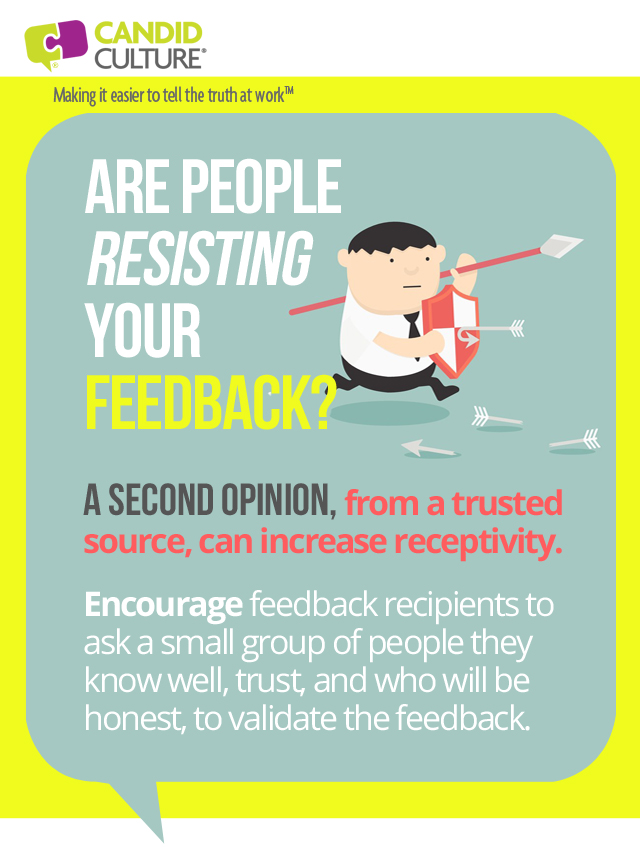
People get defensive when they receive negative feedback. It’s hard not to. Everyone wants to be seen as competent, and when we receive negative feedback, our competence is called into question. So we react.
There are several things you can do to reduce others’ defensiveness – ensure you have trusting relationship and thus have earned the right to give feedback, watch your words, deliver feedback in a private setting, etc. But for today, I’m going to focus on getting a second opinion.
If you want people to be more receptive to your feedback, consider encouraging them to get a second, third, or fourth opinion. I’m a fan of casual 360 degree feedback – when we ask for feedback from people we work with both inside and possibly outside the organization. Think of 360 degree feedback like an orange, it’s all the way around, like a sphere. When you get 360 degree feedback, you gather input from all the different types of people you interact with, thus getting a more comprehensive and accurate picture of performance. There are different types of 360 degree feedback. 360 degree feedback ranges from the formal – an online, anonymous survey (I’m not a fan) – to casual conversations (which I recommend). In this instance I’m suggesting something I call The Core Team.
I suggest everyone has a Core Team of about five people who love you, know you well, and have your back. Most important is that you trust these people. You Core Team may be personal or professional relationships, or a mixture of both. You may have worked with Core Team members or not. What all Core Team members have in common is that they know you well, want what’s best for you, and will tell you the truth when asked.
My core team consists of a friend from high school, two people I used to work with, and my parents. When I get feedback that I’m having a hard time reconciling, I ask people on my Core Team to validate the feedback. It doesn’t matter if they’ve worked with me or not. I am who I am. I do the same annoying stuff in my personal and professional relationships. So a personal Core Team member can provide valid, professional feedback and vice versa. Sometimes they agree with the feedback I’ve been given and sometimes they don’t. But I always get compelling information to think about. And because I trust the people on my Core Team, I listen to what they have to say.
Don’t be disheartened if people don’t trust your feedback and aren’t receptive. Instead, see their resistance as human and encourage them to get a second opinion. And then talk again. Listening to and incorporating feedback is a process. It takes time, courage, and patience.
Several years ago I hired a vendor that wasn’t a good fit. Try as we might to work together, we didn’t communicate well. Everything was a struggle. After a frustrating few weeks, the owner of the business offered to refund my money and amicably part ways. His company had already done work on our behalf and I didn’t want to lose momentum. I turned him down. That was a mistake. When a small business owner, who needs your business (money), tells you to go elsewhere, listen. We parted ways a few months later in a much more costly and less amicable way.
You don’t want to work with people who don’t want to work with you. The same is true for friends and romantic relationships. Don’t chase people. If they don’t want you, move on. There are lots of other people who will see your value.
There are differing schools of thought on whether or not you should try to retain unhappy employees who quit. I’d be interested in seeing statistics on how long employees who quit but are then retained, stay with an organization and how well they perform. I’d let them go. Again, you don’t want people who don’t want you.
The challenge is that most people are afraid to speak up in organizations and relationships (of all kinds) when they’re unhappy. Unhappy employees typically quit versus make requests and give feedback.
The antidote is to create a culture in which employees, vendors, and customers openly make requests and talk about what is and isn’t working. Create a climate of candor in which feedback is exchanged regularly versus just during exit interviews, which is too late.
How to know when to cut bait with unhappy employees and vendors:
You’ve had several open discussions and can’t meet each others’ needs. If you don’t have a job the employee wants, that’s a good reason to part ways.
It’s not a good culture fit. You talk and talk but don’t communicate. Issues don’t get resolved. Frustration is the norm. This is also a good reason to end a working (or personal) relationship.
Five steps to create a more candid culture:
Discuss employees’, customers’, and vendors’ needs and requests at the beginning of working relationships. Agree upon what success and a good job looks like. Ask lots and lots of questions, and listen closely to the answers.
Ask for feedback regularly. Conduct a weekly plus/delta (a discussion of what is and isn’t working) during which all parties are invited and expected to speak freely. The more you have these discussions, the easier they will be and the more candid people will become.
Address challenges as they come up.
Discuss challenges that can’t be fixed.
If a relationship isn’t working, end it sooner rather than later. Be slow to hire and quick to fire.
There are lots of talented vendors and employees. Find employees and suppliers who are easy to work with (for you) and who can meet your needs, and vice versa. If you can’t meet each others’ needs or the relationship is a constant struggle, those are good reasons to move on. Don’t chase.
Think about all the people and situations that frustrate you. Now consider what you’re asking for. My hunch is, you’re getting what you ask for.
While most of us aren’t great at telling people when they violate our expectations, we’re not any better at asking for what we want. You might be afraid of appearing demanding or may not feel you have the right to make requests. When you tell people what you expect, you make their lives easier. Think about when someone invites you to their house for dinner. If you have any manners (and I’m sure you do), you ask what you can bring. When the other person says nothing, it makes your job (to be a good guest) harder. Now you have to guess what the other person wants. It would be so much easier if he would just tell you. This also applies to birthday gifts and where to meet for lunch. When people tell you what they want as a gift and where they want to eat, you don’t have to guess and they are easier to please.
It’s much easier to live and work with people when we know what they expect from us. And setting expectations is always easier than giving negative feedback. Negative feedback implies someone did something wrong. And no one likes to be told he is wrong. Setting expectations provides a road map to success, making it easier to win with you.
Here are a few phrases to make setting expectations easier:
Setting expectations example one: Consider saying, “I need time to get settled when I come in in the morning. Will you hold all questions and requests until 10:00 am?” You’re not telling someone she barrages you with questions before you’ve even gotten to your desk in the morning; you’re simply asking for what you need.
Setting expectations example two: You could say, “I like to have things done well before they are due. Will you send me all input for the weekly status report by Wednesday of each week so I have a few days to review your input before I have to submit it?” You’re not telling the person that working with him requires a weekly fire drill; you’re simply making a non-judgmental request.
Setting expectations example three: You could ask, “Would it be possible to touch base once a week via phone during your morning commute so I can get your input on projects?” You’re not telling the person she is impossible to get time with; you’re simply proposing an idea.
One of the keys to getting what you want is make requests in a neutral, non-judgmental way. The more you ask for and the more specific your requests, the easier you are to work with. What you need and want will be clear; there will be no guessing. People may choose to ignore your requests and violate your expectations, and then you’ll provide feedback. But start with making clear and specific requests, and see how many fewer feedback conversations you need to have.
Many people worry about giving feedback because they fear they don’t have the ‘right’ words. They’re concerned they’ll say ‘it’ wrong and damage their relationships.
Feedback is hard enough to give without worrying about saying everything perfectly. Worry less about having all the right words and more about whether or not people trust your motives.
When people trust your motives – why you’re giving feedback – you can say almost anything. When they don’t trust your motives you can say almost nothing.
Getting negative feedback is hard. It’s easier to listen to feedback when we trust the person who’s giving us the feedback – we know their intentions are to help versus to judge or hurt us.
Speak from the heart, be authentic, and worry less. Be yourself. If you’re nervous to say what you want to say, tell the other person you’re nervous. If you’re struggling to find the right words, say so. If you’re worried you’ll damage the relationship or that it isn’t your role to give the feedback, say that. Authenticity goes a long way.
How’s how to give feedback you’re apprehensive about:
How to give feedback phrase one: Consider saying, “There’s something I need to talk with you about but I’m concerned that I won’t use the right words and will damage our relationship.”
How to give feedback phrase two: “There’s something I want to talk with you about, but I’m concerned how it will come across. Is it ok if I say what I need to say?”
How to give feedback phrase three: “I want to give you my thoughts on something but I’m concerned that it’s not my place to do so. Is it ok if I share my ideas about _________?”
Other people aren’t expecting you to be perfect. But they do want to know they’re working with a human being. And human beings are fallible. We have fears. We make mistakes. And sometimes we don’t say things perfectly.
You don’t have to be perfect, you just have to be real.
Who have you fired lately? The person who cuts your hair or lawn? A doctor, accountant, or restaurant where you had a bad experience? Did you call any of those providers and tell them why you were replacing them? My hunch is no. There’s little incentive to do so. Why risk their defensiveness? It’s easier to just replace them. And the same is true for you.
There’s little incentive for the people you work with to tell you when you frustrate them. The perceived cost seems too high. The people you work (and live) with have experienced others’ defensive responses to negative feedback (which is no fun) and they don’t want to experience your reaction. As a result, when you disappoint or frustrate others, it’s easier to say nothing than tell you the truth.
The tendency for others to tell you things are fine when they’re not will prevent you from managing your career and relationships. People will go missing and/or you’ll be passed over for professional opportunities and never know why.
To make it more likely that people will tell you when you disappoint or frustrate them, make it easy to tell you the truth.
Here are a seven practices for receiving feedback:
Receiving Feedback Practice #1: When you begin new relationships, tell people you want their feedback.
Receiving Feedback Practice #2: Promise that no matter what people say, you’ll respond with “thank you.” This is very hard to do.
Receiving Feedback Practice #3: Tell people you already have relationships with that if you haven’t said it in the past, you really want their feedback and promise to respond graciously with “thank you.”
Receiving Feedback Practice #4: Ask people who matter to you for feedback regularly.
Receiving Feedback Practice #5: Resist the urge to get defensive.
Receiving Feedback Practice #6: Catch yourself when you start to become defensive and apologize. Say something like, “I’m getting defensive. I’m sorry. Tell me again. I’ll do a better job of listening.”
Receiving Feedback Practice #7: Take a break from conversations during which you find yourself responding defensively. Say something like, “I’m not responding as well as I’d like. How about we take a break? Give me a few minutes (hours or days) and I’ll come back to you to talk more. I really want to hear what you have to say.”
The aforementioned list provides recommendations for asking for and receiving feedback you want, not feedback you don’t. You are not a dumping ground. Don’t ask for feedback you don’t want. And when you do ask for feedback, qualify what type of feedback you’re looking for. Telling people “I want your feedback” doesn’t mean they’re welcome to say whatever they want.
The purpose of asking for feedback and making it safe to tell the truth is to give you more control over your career and relationships. It’s ok to be passed over for opportunities and relationships, but it’s unhelpful not to know why.
Unless you never interact with other people, there’s probably someone in your life who repeatedly engages in a behavior that annoys you. You’ve probably made requests about what you’d like to the person to do differently, and hopefully you’ve given feedback. But the behavior hasn’t changed.
At some point, we have to accept that people are who and how they are. People can and will change certain behaviors, if their motivation is high enough. But other behaviors won’t change. They are what they are. And if you want to have the person in your personal or professional life, you have to accept the behavior and the person as they are. And doing this can be very difficult, at least it is for me. I admit, I often have this conversation myself, “Why won’t he…? I don’t get it. It’s not that hard. How many times do I have to ask?”
Here are five strategies for working with difficult people:
Working with difficult people strategy one: Become very clear on the behavior(s) you expect.
Working with difficult people strategy two: Make a request and ask the person to do what you want. Be sure you are being explicitly clear in your request. For example, “Please include me in meetings” is too vague. Instead, try, “Please invite me to all client meetings so I can stay connected to the clients and projects.”
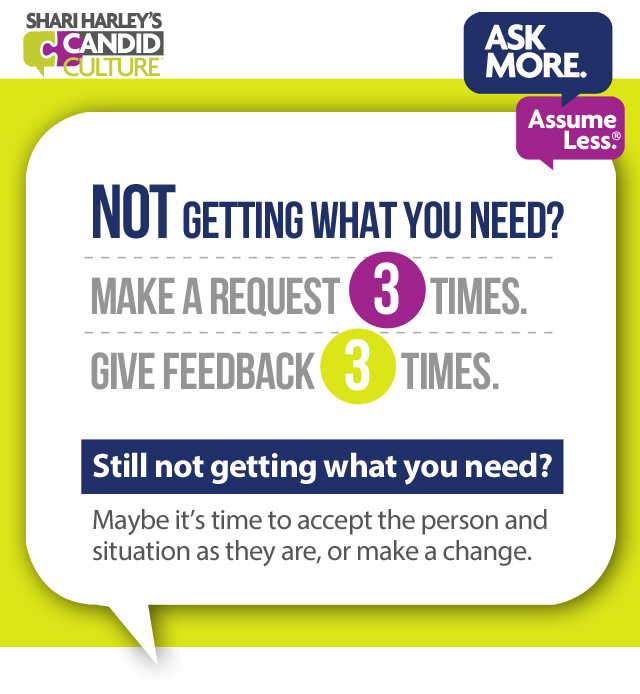
Working with difficult people strategy three: Make requests at least three times. With each successive request (nicely) remind the person that you’ve made this request in the past and it still isn’t happening. For example, “We’ve talked about this in the past and it isn’t happening. Help me understand what’s happening?”
Working with difficult people strategy four: If you’ve made a request at least three times, give feedback as to what isn’t happening and why that causes challenges. For example, “We’ve talked about inviting me to client meetings a few times. It’s still not happening. I’m getting calls from clients with questions I can’t answer because I’m not included in the meetings. Can you help me understand why I’m not being invited to meetings?” Read chapters nine through eleven and chapter thirteen of How to Say Anything to Anyone to get more examples of how to give clear and specific feedback.
Working with difficult people strategy five: Know when to give up and accept the person and behavior as they are. If you’ve made a request and have given feedback three times, you likely aren’t going to get what you want. The person either can’t do what you’re asking or doesn’t want to. Now you have a decision to make.
Decide how important this behavior is. Is it a deal breaker? If it’s a deal breaker, you can’t work or live with the person. If it’s not a deal breaker stop expecting the behavior to happen and accept that it won’t. When you accept that you won’t get what you want from someone you’ll suffer less.
Strategy five is really the crux of this blog. Knowing when to stop expecting something and coming to peace with that decision will give you great freedom. In order to let go of the expectation you have to decide that it’s really ok for you not to get what you want. Ask yourself, “Can I live with this behavior as it is?” If you can’t, you have a hard decision to make. If you can, then stop expecting and asking for the behavior. Truly let it go. You’ll feel better.
Most training programs about giving feedback focus on negative feedback, because giving negative feedback is hard and makes us uncomfortable. But most people aren’t any better at giving positive feedback.
Most of the positive feedback people get at work really isn’t feedback at all. It’s vague, fluffy, and unhelpful. Aka, Cap’n Crunch – sweet but useless.
“Great job.” “You’re awesome.” “You’re great to work with.” None of this qualifies as real feedback.
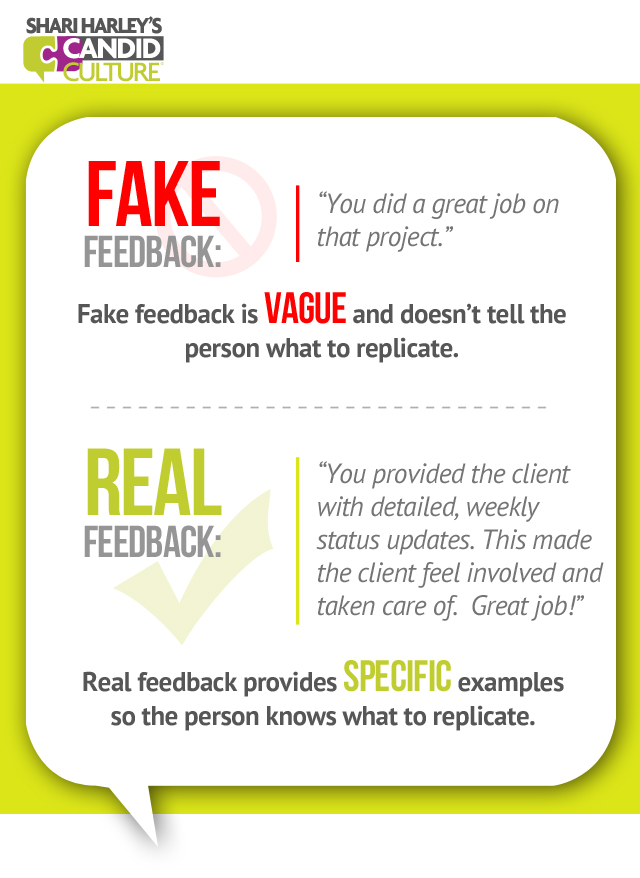
The purpose of positive feedback is to make people feel valued and appreciated and to get them to replicate a behavior. Telling someone, “great job” or “you’re doing great work” will make the person feel good (momentarily), but won’t tell her what to replicate. These phrases are vague, and vague positive comments come across as inauthentic at best and unhelpful at worst.
Here are a few examples of what I refer to as real vs. fake feedback:
Examples of positive feedback:
Fake feedback: “Great job.”
Real feedback: “You researched three vendors when making a proposal of who we should choose to manage our payroll operations. You included all the necessary information for us to make a decision and presented the information in a one-page table that was easy to read. Your work made it really easy to make a decision. Great job!”
Examples of positive feedback:
Fake feedback: “You’re really reliable.”
Real feedback: “I know that whatever I give you to do will get done the first time I ask and will be accurate. I don’t have to ask again or check your work. You check your work for typos and mistakes before submitting it.”
Examples of positive feedback:
Fake feedback: “You make my job easy.”
Real feedback: “Last week you noticed an invoice that didn’t seem accurate. You researched the invoice and got the mistake corrected before I even knew there was a problem. You make my job easy.”
Examples of positive feedback:
Fake feedback: “You’re awesome.”
Real feedback: “You always do what’s right for the company. Last week you called a vendor whose service has been spotty. You provided them with feedback and asked for their plan to improve their service levels. This added a lot of value to our organization.”
The guidelines for giving positive feedback are the same as giving negative feedback:
Be specific.
Give an example.
Give feedback close to the time an event happens.
To give specific and meaningful positive comments, you will have to observe performance, and that takes time. But if you want someone to replicate a behavior, tell the person specifically what she did well.
People are not us; they do things their way, not ours. This is so obvious. Yet violated expectations are consistently a source of lots of frustration and upset, both personally and professionally. “How could you not check your work before submitting information to a client?” “What do you mean you didn’t call that person back?” “You said what?!”
The most frequent request we get at Candid Culture is for feedback training. The call usually goes something like this, “The communication isn’t great at our company. Managers don’t give a lot of feedback. People don’t talk directly to each other when there are problems, they talk about each other. Can you help?”
Sure, we can help. But once we’re having this conversation people are already frustrated. Trust has been violated and relationships and reputations have been damaged. Instead of waiting for problems to occur, expect the unexpected. Set clear expectations before people don’t proofread reports, miss deadlines, and do other things you wouldn’t dream of doing.
How to avoid violated (often unstated) expectations? Ask more questions.
Here are five questions you should ask every person you work with. And if you do, your workplace will have fewer frustrations and violated expectations:
What’s most important that you’re working on right now? What are your goals this quarter?
What are we both working on that we can work on together? Or what should one of us stop working on?
How do you like to communicate? Phone, in-person, by appointment or drop by’s.
How do you like to receive information – email, voicemail, text message or instant messenger?
If I need information from you and I haven’t heard back from you, what should I do, and is it ok to do that?
What are your pet peeves at work? How will I annoy you and not even know it?
How do you like to be interrupted? (You’re going to be interrupted. You might as well have a preference.)
I know. That was seven questions, not five. I could keep going. But this is a good start.
Here’s the philosophy and practice: People aren’t you. Anticipate challenges, breakdowns, and violated expectations, and talk about them before they happen. Make requests. Ask questions.
It’s always easier to ask for what you want than to give feedback.
Posted under Uncategorized on June 28, 2015 by Shari Harley. 0 Comments
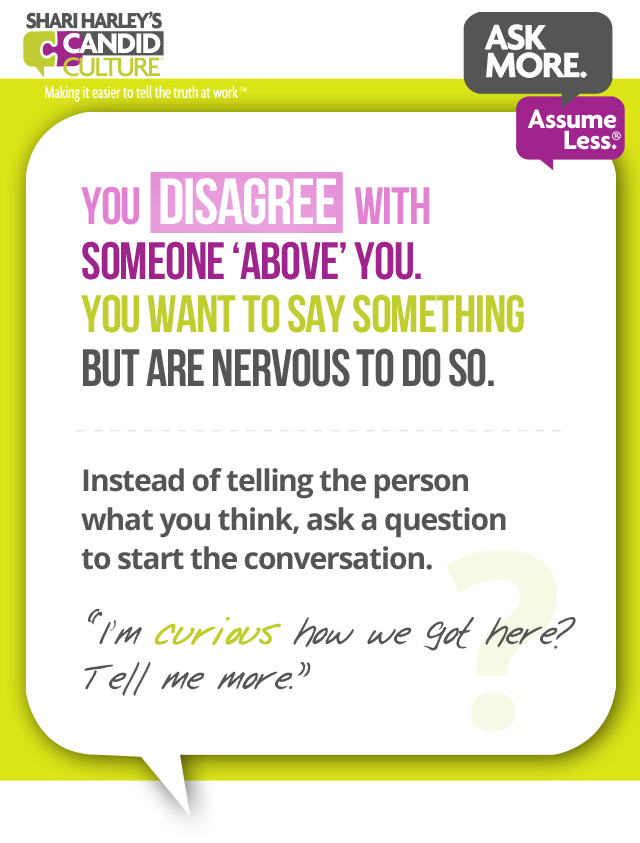
You disagree with something someone above you said or did. How do you tell the person without actually telling him?
Lots of people think they can’t give direct feedback when talking to someone at a higher level. I’m here to tell you that that’s not true. The ability to speak freely has little to do with titles and more to do with the quality of your relationship. When you’re comfortable with people and have mutual trust, you can say (almost) anything, regardless of titles and levels. But that’s not the true purpose of today’s blog. So I’m going to stick to the topic at hand –what to say when you feel like you can’t say very much.
When you don’t have the relationship to say what you really think, manage up by asking a question instead. Engage the person in a conversation. At some point during the conversation, you’ll be able to say what you think.
For example, you question a decision but don’t want to overtly say you question the decision.
Here’s how the conversation could go:
“I wasn’t involved in the conversations to select our new payroll software. Can you give me a little history? What had us choose our current provider?”
“What software features were important when selecting the software?”
“What problem were we trying to solve that drove the need to make a change?”
“What do you like about the software we picked? What don’t you like?”
** Obviously this is meant to be a discussion, not an interrogation. Ask one question at a time and see where the conversation goes. You may ask all of these questions and you may ask only one.
The point is to gather more information. Manage up by seeking to understand before you express an opinion. As the conversation progresses, you might see opportunities to express your point of view.
Here are three suggestions if you’re going to practice the technique of asking questions as a way to manage up and eventually give feedback:
1. When you ask a question, come from a place of genuine curiosity. If you aren’t truly curious and asking questions is just a technique you found in some blog, it will show.
2. Watch your tone of voice. If you can safely add the words “you dummy” to a question, you have a tone issue.
3. Be patient. Asking questions may feel easier than giving direct feedback, but it also takes more patience and time.
As the conversation progresses, you might be asked for your opinion. Before saying what you think, remember, no one likes to be told that s/he is wrong. And the person you’re talking to likely had a hand in making the decision you’re questioning. Be careful not to judge.
Instead of overtly judging, consider saying something like:
“I think the new system has potential and also has some limitations. Do you want feedback as we use the system and get to know it better?”
“What specifically would you like feedback on? What are you not looking for feedback on?”
“What’s the best way to provide input and to whom?”
You can speak more freely when you have the relationship to do so and have permission. Until you have both, earn the right to give feedback by asking questions from a place of genuine curiosity. And only provide your point of view when you’re asked and are certain you have all the information to defend your position.


 Most of us avoid giving negative feedback because we don’t want to deal with the recipient’s defensive behavior. We’re waiting for what I call, The Freak Out. The Freak Out is the predictable response to negative feedback.





 . And the same is true for you.
 Unless you never interact with other people, there’s probably someone in your life who repeatedly engages in a behavior that annoys you. You’ve probably made requests about what you’d like to the person to do differently, and hopefully you’ve given feedback. But the behavior hasn’t changed.
 communication isn’t great at our company. Managers don’t give a lot of feedback. People don’t talk directly to each other when there are problems, they talk about each other. Can you help?”
 You disagree with something someone above you said or did. How do you tell the person without actually telling him?