You get an email that annoys you, hit reply, type your thoughts, hit send, and feel instant regret. We’ve all done this. We’re frustrated and we let the other person know.
Feedback via email is always a bad idea. You don’t know how the recipient will read and interpret your message. You can’t manage the tone of the message or give the person a chance to respond. And more often than not, the recipient will reply equally frustrated. And now the non-conversation begins –back and forth, back and forth.
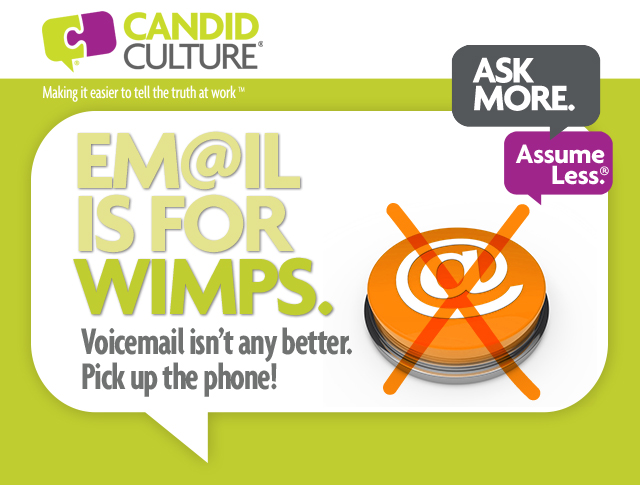
Email is for wimps and voicemail isn’t any better. No texting feedback either. End the madness and pick up the phone or take a shower and meet via video. Things are resolved most quickly and easily by talking about them.
I’m consistently surprised at how much feedback is delivered via email. And it’s only gotten worse with people working virtually. I’ll admit to occasionally being guilty of it too. I’m in a hurry and I want to get something done quickly. Or my emotions get the best of me, and I feel compelled to respond to a situation quickly, so I send an email or a text message that I know I shouldn’t send. Then I regret it and spend the rest of the day apologizing and feeling badly for communicating impulsively.
If we want people to want to work with us and perform at their best, we need to consider how our actions impact them. Yes, it’s easier to send a quick email or text. But doing so invariably annoys the other person and damages your relationship. Slow down. When you need to give feedback, consider what you want the other person to do. Then ask yourself, how do I need to communicate to get the result I want? Then pause, breathe, and pick up the phone.
We’ve all received work via email from another person that wasn’t what we were expecting, hit reply, and told the other person what we thought. Then we dealt with the consequences.
A few tips for giving feedback to get more of what you want and less of what you don’t:
Don’t give feedback via email.Ever. You can’t manage your tone or see the person’s reaction.
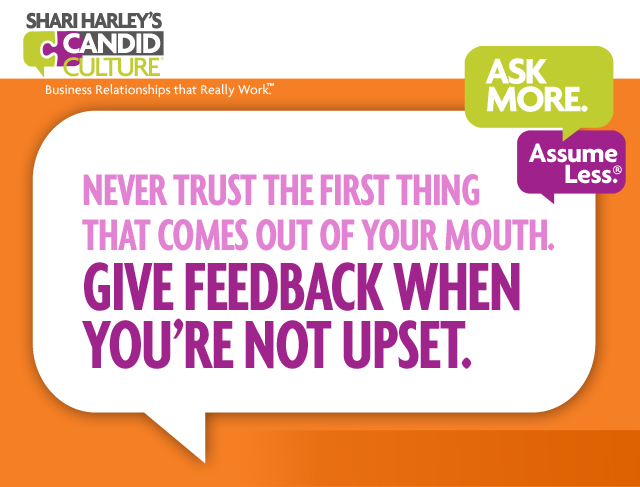
Practice the 24-hour rule and the one-week guideline. Wait until you’re not upset to give feedback, but don’t wait longer than a week.
It’s almost impossible to give negative feedback without putting the other person on the defensive. Becoming defensive when receiving feedback is normal and natural. It’s a way to protect ourselves when we feel judged.
When people are defensive, it’s hard to listen and respond. The less defensive the other person becomes, the easier it is to communicate with that person. People will be less defensive if you give feedback when you’re calm and choose your words carefully.
Communicate in a way that the relationship needs versus what you need in the moment.
When we give feedback when we’re upset, we’re really communicating for ourselves, not for the other person. I didn’t get what I want, I’m upset, and I’m going to tell you about it. Then the other person gets upset and now, in addition to you not getting what you wanted in the first place, you have to do damage control.
Communicating in a way the relationship needs means choosing the timing, words, and method of communication that is likely to produce the result you want – the other person being able to hear you, while becoming minimally defensive, and taking action. Giving feedback when you’re upset, especially via email, will not produce the result you want. You’ll only damage your relationship.
Being an effective communicator and maintaining good business relationships requires patience and self-discipline. Wait to give feedback until you’re not upset. Don’t send an email. Pick up the phone, meet via video, or walk to the person’s desk. Deliver the feedback in a way the other person can hear you. Be ready for the person to become defensive. It’s human to become defensive. You can’t eliminate defensiveness, but how you deliver feedback can greatly reduce defensiveness, and you’ll get more of what you want and less of what you don’t.
You get an email that annoys you, hit reply, type your thoughts, hit send, and feel instant regret. We’ve all done this. We’re frustrated and we let the other person know.
Feedback via email is always a bad idea. You don’t know how the recipient will read and interpret your message. You can’t manage the tone of the message or give the person a chance to respond. And more often than not, the recipient will reply equally frustrated. And now the non-conversation begins –back and forth, back and forth.
Email is for wimps and voicemail isn’t any better! No texting either. End the madness and pick up the phone or take a shower and meet via video. Things are resolved most quickly and easily by talking about them.
I’m consistently surprised at how much feedback is delivered via email. And it’s only gotten worse with people working virtually. I’ll admit to occasionally being guilty of it too. I’m in a hurry and I want to get something done quickly. Or my emotions get the best of me and I feel compelled to respond to a situation quickly. So I send an email or a text message that I know I shouldn’t send. Then I regret it and spend the rest of the day apologizing and feeling badly for communicating impulsively.
If we want people to want to work with us and perform at their best, we need to consider how our actions impact them. Yes, it’s easier to send a quick email or text. But doing so invariably annoys the other person and damages your relationship. People can work with you, around you, and against you. If people want to work with you, they’ll work harder and produce better work.
Slow down. When you need to give feedback, ask yourself what you want the other person to do. Then ask yourself, how do I need to communicate to get the result I want? Then pause, breathe, and pick up the phone.
Sign Up
Career tips you won't get elsewhere. Sign up to get a free tip card.