Posts Tagged ‘brand management’
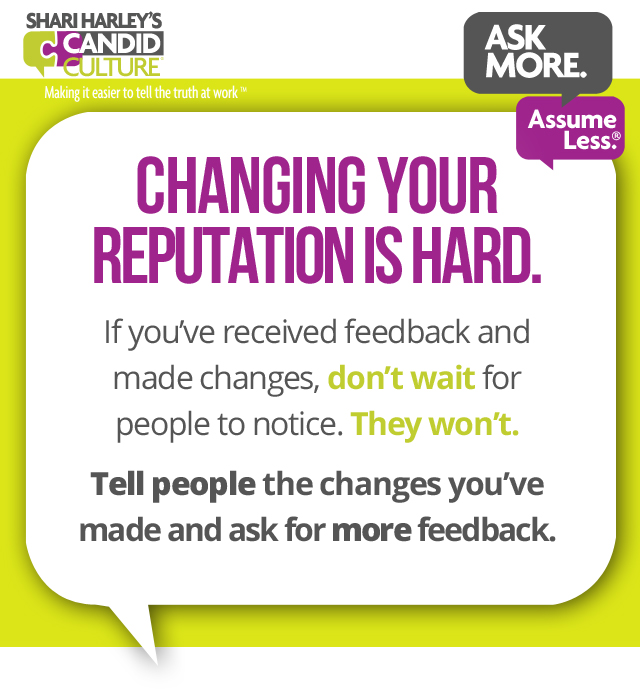
Changing a damaged reputation is challenging. My number one piece of advice: Be very overt about the changes you’re making.
Here are eight steps to discover and repair your professional reputation:
Step one to repair your professional reputation: Make a list of people who observe your performance and who can impact your career. If you’re not sure who these people are, ask your boss and peers. They know.
Step two to repair your professional reputation: Ask for specific, candid feedback at least twice a year, and tell people why you’re asking for the information.
Asking, “How am I doing?” is not specific. Instead, say something like, “I want to learn more about my reputation in the office and want to eliminate my blind spots. I’d be grateful for any input you can provide on my reputation and what people say about me when I’m not there.” Then schedule a specific time in the near future to discuss the feedback, so you don’t catch people off guard. You’ll get better feedback when people have had a chance to observe your behavior and think about what they’d like to say.
Step three to repair your professional reputation: Listen to the feedback and no matter how hard the feedback is to hear, say, “Thank you for telling me that.” Don’t defend yourself. Instead, leave the conversation, think about what the person has said, and then go back to him a few days later with questions, if you need to.
Step four to repair your professional reputation: If the feedback you receive doesn’t feel accurate, tell others who you trust about the feedback and ask them to provide input.
Step five to repair your professional reputation: Sit with the feedback before taking action. Let yourself be emotional. You might feel angry, sad, or betrayed. All of those are normal responses to feedback.
Step six to repair your professional reputation: Take action. Make changes that feedback providers suggested.
Step seven to repair your professional reputation: Tell people who provided input and who are impacted by your behavior about the changes you’ve made. You could say, “I recently received feedback that I’m not careful enough and that my work often has errors. I’m really working on this. Will you pay attention to the accuracy of what you receive from me and let me know if you see changes? I’d really appreciate your input.”
Step seven is very important and something people rarely do. Don’t assume people will notice the changes you’ve made. Instead, assume they won’t. Without being told what to look for, the decisions people have already made about you will supersede changes you’ve made. It takes a lot of effort to see people differently. Validating what we already know and think about someone is much easier and more likely than noticing changes.
Step eight to repair your professional reputation: Continue to ask for feedback. Receiving feedback is not a one-time-event. It’s an ongoing process. Don’t ask for feedback weekly, rather check in once a quarter, tell people the changes you’ve made, and ask for specific input.
You can change your reputation, if you want to. Doing so will require courage, openness, and effort on your part. Work on one or two things at a time, not ten. And then reward yourself for the changes you’ve made with a pint of Ben & Jerry’s, because too often we’re hard on ourselves and forget to celebrate wins.
 You’ve undoubtedly heard that it takes fewer than 30 seconds to form a first impression. The question is how frequently is your first impression wrong?
If the person sitting next to you on a plane doesn’t speak to you during the entire flight, you may initially think he is unfriendly, only to strike up a conversation as the plane is landing and find out that’s not the case. If a job candidate is outgoing, you may decide she has good people skills, only to experience contrary behavior when she starts the job. If someone is late to arrive for an initial meeting, you may decide he has an issue with time management, versus he was just running late that day.
Many things go into forming a first impression. People who are tall and attractive – by societal standards – are typically perceived as likable and credible. It’s assumed that people with degrees from good schools are smart. But we all know people who went to good schools who we wouldn’t hire.
Your first impression may be right and it may be wrong, but it takes more than 30 seconds to be sure.
If you’ve participated in job interview training, you were probably trained to look for contrary evidence when forming an opinion about a candidate. Looking for contrary evidence is an attempt to disprove your first impression. If you quickly dismiss a candidate for lacking knowledge of your industry, you should ask interview questions to disprove your opinion before making a final decision.
Why not follow this practice in all settings? If you initially decide someone is trustworthy and reliable, spend more time with that person to be sure. If you quickly decide someone is unhelpful and uncommitted, give the person additional opportunities to behave differently before making a final judgment.
Snap judgments eliminate lots of great people and experiences from our lives.
Unfortunately just as we prematurely exclude potential employees, friends, and life partners without having enough information, people do this to us as well, which is why it’s important to know the first impression you, your department and your company make. If you don’t know the first impression you create, there’s nothing you can do to shift behaviors that may be costing you friends and customers.
I started asking the first impression I create after I got chucked under the bus by some coworkers. When I was new to one of my jobs, I asked my coworkers to give me feedback if they saw me do anything that got in the way of my being successful on the job. They agreed. But when they had negative feedback, they didn’t give it to me, they told my boss instead.
That’s when I got the hard and painful lesson that people have a tendency to talk about us, not to us. It’s also when I began asking the people closest to me, who I know love me and care enough to tell me the truth, the first impression I create.
Opinions are formed quickly and they’re hard to break. Give people more than one chance, and see how they show up. And know that many people will eliminate you, your department and your company after just one interaction. So find out the impression you create, giving you the power to do something about it.
Download some of the questions I ask to learn my reputation, here.

 It’s hard to come back to work after a long weekend, no matter how much you like your job. As fun and fulfilling as work can be, we all struggle with back to work blues from time to time.
If you’re having a hard time getting back into it today, here are a few things to try:
- Be realistic about how much you’re going to do today. Move a few things on today’s to-do list to tomorrow, or maybe Wednesday. Setting unrealistic goals sets people up for frustration and feelings of failure.
- Pick one or two things you’re going to do today, and finish those two things.
- Do one thing at a time. Not five.
Stress occurs when we’re thinking about the past or the future. When we’re in the moment, there is nothing to stress about. You’re focused on what you’re doing, nothing else. This is easier said than done, which is why I do yoga. If I’m thinking about anything but the teacher’s instructions, I fall over.
- Plan something fun. When is your next vacation? What are you looking forward to? Having something fun and exciting on the horizon is motivating and keeps us going.
- If you’re not having fun at work or you’re feeling stuck, tell someone who can do something about it. Most people are so afraid of being fired, they don’t speak up at work. From my experience it’s not so easy to get fired. Look around. I suspect there are several people you work with who you think deserve to be fired, yet there they are. Worry less. Speak up more. No organization is going to fire you for wanting and being willing and able to do more.
If after all of these BRILLIANT suggestions you still find yourself in the back to work blues, gossip about a few people who haven’t made it in yet today, eat someone else’s lunch from the refrigerator that looks better than what you brought, and re-arrange the most organized person’s desk. And all will be well.
Advance your career and manage people with our top three sellers.