Posts Tagged ‘annual appraisals’

A professional athlete would never get on the court, field, or ice without knowing the rules of the game. Athletes know every action that will result in points, penalties, and other positive and negative consequences. Yet many of us go to work without any idea of how we’re being held accountable and what a good job looks like.
In the next few weeks, way too many people will have a performance review during which they will receive feedback that’s a surprise.
Writing clear, specific, and measurable goals is the key to managing your own work performance and to not being caught off guard by performance appraisals. Writing goals may not be sexy or fun, but doing so is the key to taking control of your year.
Four tips for setting goals at work:
1. Setting goals at work: Don’t wait for your manager to suggest writing goals. Ask permission to draft 5 to 7 goals.
2. Setting goals at work: Discuss and finalize each goal with your manager, and ask that the goals be the criteria for your 2015 evaluation.
3. Setting goals at work: Write such specific goals, that at the end of the year, it’s very clear whether you did or didn’t produce the agreed-upon results. When goals are specific, performance appraisals write themselves.
4. Setting goals at work: As business priorities and objectives change, goals change as well. Review your goals with your manager quarterly and make changes as appropriate.
Here are questions to answer when writing goals:
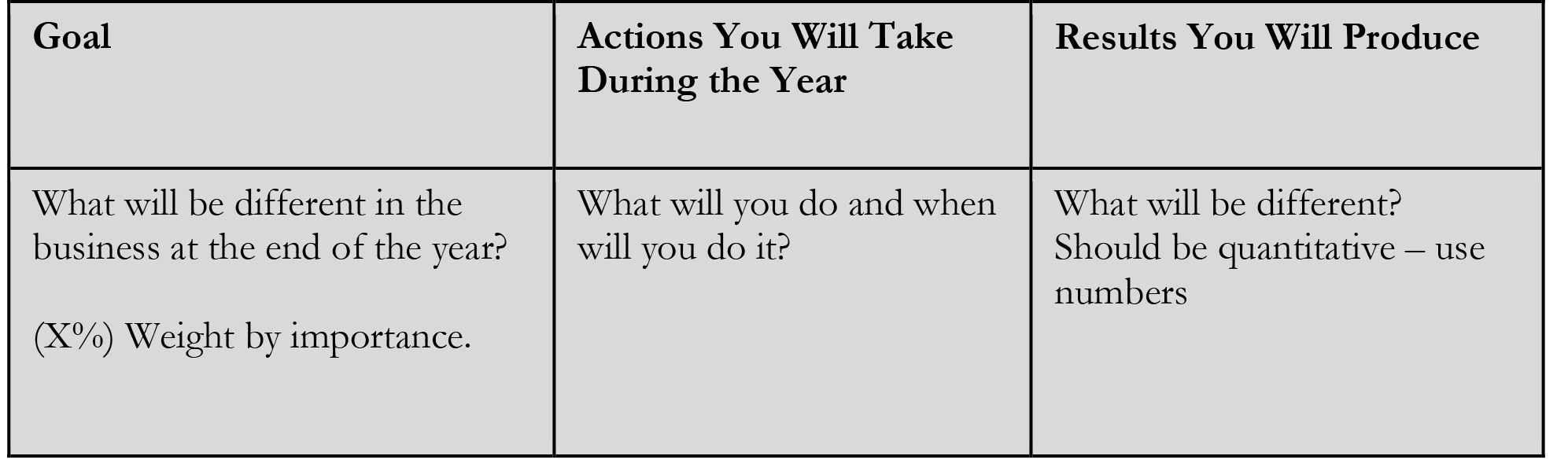
- What results will you produce? What will be different in the organization at the end of the year? (X%) Assign each goal a percentage. Weight each goal by importance.
- What actions will you take? What will you do, and when will you do it?
- How will you know you’ve made progress or achieved your goal? What will be different as a result of your work? (This should be quantitative. Use numbers.)
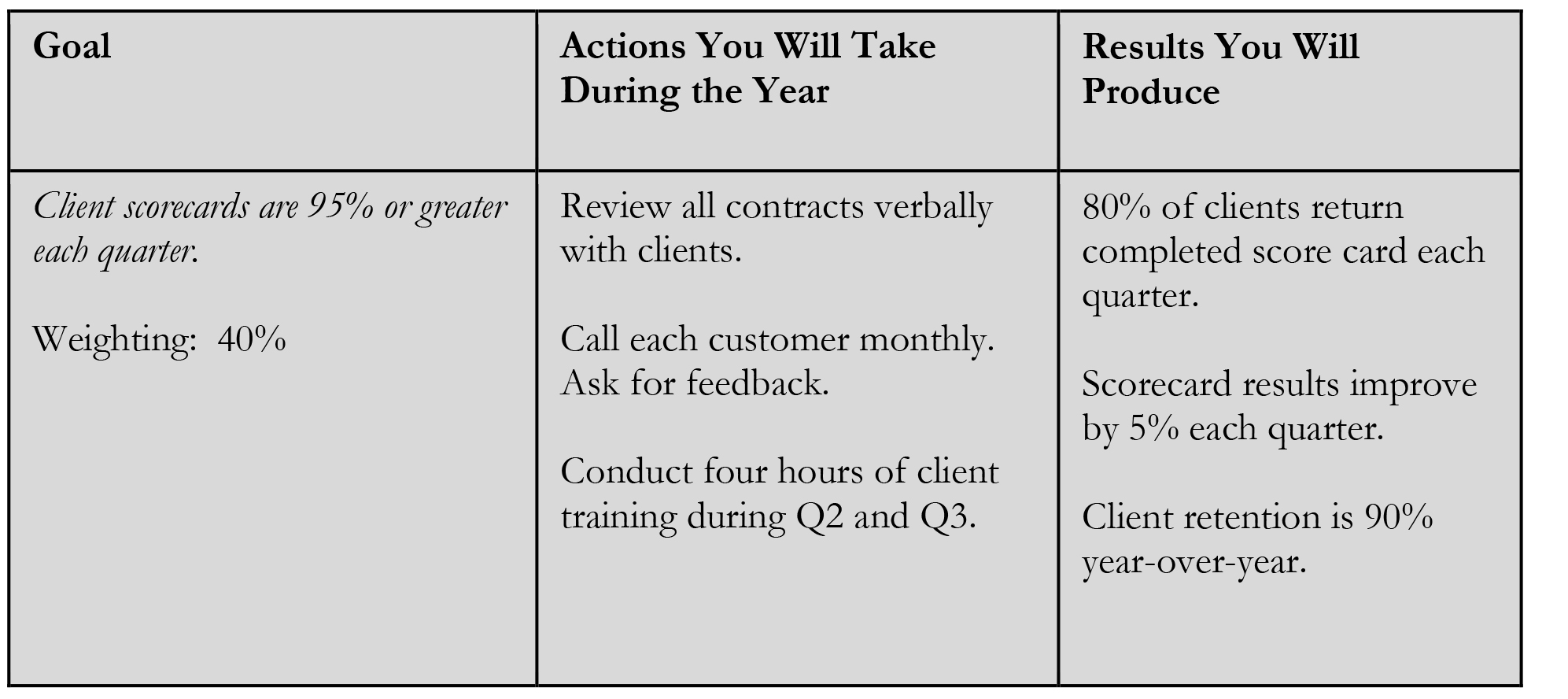
Here is a completed sample goal:
Results to produce: Retain 90% of new customers. Weighting: 40%
Actions to take:
- Have a setting-expectation meeting with each new customer.
- Return all customer calls within 24-hours.
- Call 10% of customers quarterly, and ask for feedback.
Milestones and year-end results:
- Customer complaints will drop by 20%.
- Customer change orders will drop by 10%.
Early in my career, I worked for an organization that did goal setting well. Each employee wrote 5 to 7 goals that were weighted and extraordinarily specific. It was obvious, throughout the year, if employees were meeting performance standards. And at the end of the year, it was so clear whether or not employees had done what they needed to do, employees could write their own performance appraisal. That’s the power of goals. Well–written goals drive performance, empower employees, and remove the debate about results.
When what you need to do during the year is clearly articulated, you’ve set yourself up to win. You know exactly what you need to do to be successful.
Not every goal or objective at work is numerical and clear cut, but many are. Write down what you need to do and what the desired outcome looks like, whenever possible, and you’ll feel more empowered and in control at work than you previously thought possible.

 Many year-end performance reviews include whatever the manager and direct report can remember happening during the last six to twelve weeks of the year. For the most part, managers and direct reports sit in front of blank performance appraisals and self-appraisal forms and try to remember everything that happened during the year. The result: A vague, incomplete performance review that leaves employees feeling disappointed, if not discounted.
If you were disappointed by your performance review this year, don’t let it happen again next year. Take charge of your career by writing your own goals.
One of the first companies I worked for did the goal process so well, I learned early in my career how powerful well written goals could be. Each employee set five to seven goals. Experienced employees wrote their own goals and then discussed those goals with their manager. Less experienced employees wrote their goals with their manager. Managers wrote goals for inexperienced employees. The goals were so specific and clear that there could be no debate at the end of the year whether or not the goal had been achieved. It was obvious. Either employees had done what they said they would, or they hadn’t. This made writing performance appraisals very easy. Very little on the appraisal was subjective. And this gave employees a feeling of control over their year and performance.
It’s great if you work for an organization or manager who works with you to write goals. If you don’t, write your own goals and present them to your manager for discussion and approval. Managers will be impressed you took the initiative to write goals and will be thankful for the work it takes off of them.
Goals should be simple and clear. It must be obvious whether you achieved the goal or not. There should be little if any room for debate.
Sample goals are below.
Desired Outcome (goal):
• Improve client feedback – too vague
• Get better written reviews from clients – better
• 80% of clients respond to surveys and respond with an average rating of 4.5 or above – best
Actions you will take to achieve the goal:
• Ask clients for feedback throughout project — too vague
• Ask clients for feedback weekly – better
• Visit client site weekly. Talk with site manager. Ask for feedback — best
Goal template:
Completed sample goal:
How to approach your manager with written goals:
Try using this language with your manager: “I want to be sure I’m working on the things that are most important to you and the organization. I’ve written some goals for 2014 to ensure I’m focused on the right things. Can we review the goals, and I’ll edit them based on your input? And what do you think of using the agreed-upon goals to measure my performance in 2014?
You have nothing to lose by writing goals and presenting them to your manager. You will gain respect from your manager, clarity of your 2014 priorities, and more control of your year-end performance review. Give it a try, and let me know how it goes.
If you want more feedback from your manager, ask these questions.

If I hear this one more time I might lose it.
Manager: “One of my employees has been making a lot of mistakes. He seems disengaged. I’m not sure what’s happening.”
Me: “Have you talked to him?”
Manager: “No. Performance appraisals are coming up, so I’ll just wait to give the feedback until then.”
Me: “When are performance appraisals?”
Manager: “In six weeks.”
Most people hoard feedback. We wait for the right time, aka when we’re comfortable. That time will never come. The right time to give feedback is when something happens or shortly thereafter. Practice the 24-hour rule and the one-week guideline. Give feedback when you’re not upset, but soon after the event occurs, so people remember what you’re talking about.
Most employees feel as if they’re treated unfairly during some portion of a performance appraisal. Employees receive feedback they’ve not previously heard, or receive feedback that is unbalanced – overly positive or negative, or the feedback is so vague employees aren’t sure what to do more, better or differently.
Good performance appraisals are a quick summary of all the performance conversations you’ve had during the year and planning for next year. To have an appraisal meeting like this one, managers need to meet with their employees regularly and give feedback every time you meet. And that is the management BEST suggestion I can make.
Meet regularly with your employees. If you never meet one-on-one with employees, start meeting monthly. If you meet monthly, meet twice a month. If you meet twice a month, consider meeting weekly for 30 minutes.
The one-on-one meeting agenda, which the employee owns:
- What is the employee working on that’s going well?
- What is the employee working on that is not going great, but she doesn’t want your help?
- What is the employee working on this isn’t going great and she wants your help?
- Give each other feedback: What went well since you last met? What could be improved?
** Give and receive feedback on the work and on your relationship. This will be hard the first few times you do it, but will become easier with each successive conversation.
Ask your employee to create a meeting agenda. Take notes on the agenda and keep your notes. The summary of these meetings becomes your annual performance appraisal.
Regardless of whether or not you’re meeting regularly, throughout the year and have performance notes, you can only give small pieces of feedback during the appraisal meeting. Discuss three SPECIFIC things the employee did well during the year and three things she should do next year. People can’t focus on more.
Think about the New Year’s resolutions you may have made last January. You might have promised yourself you’d save ten percent of your income, lose twenty pounds, take a two-week vacation without your phone, and apply to attend graduate school. How many of those things did you do? Setting too many aggressive goals sets us up to fail. And performance appraisals are not different.
Consider how each of your employees must impact your department and your organization’s annual goals. In that context, determine the most important things each employee did to contribute to those goals this past year and what she should have done more, better or differently? That’s your appraisal. Not more and not less.
During performance appraisals, force yourself to focus on and present ONLY the most important behaviors and outcomes, and your employees will bring the same focus to the ensuing year.